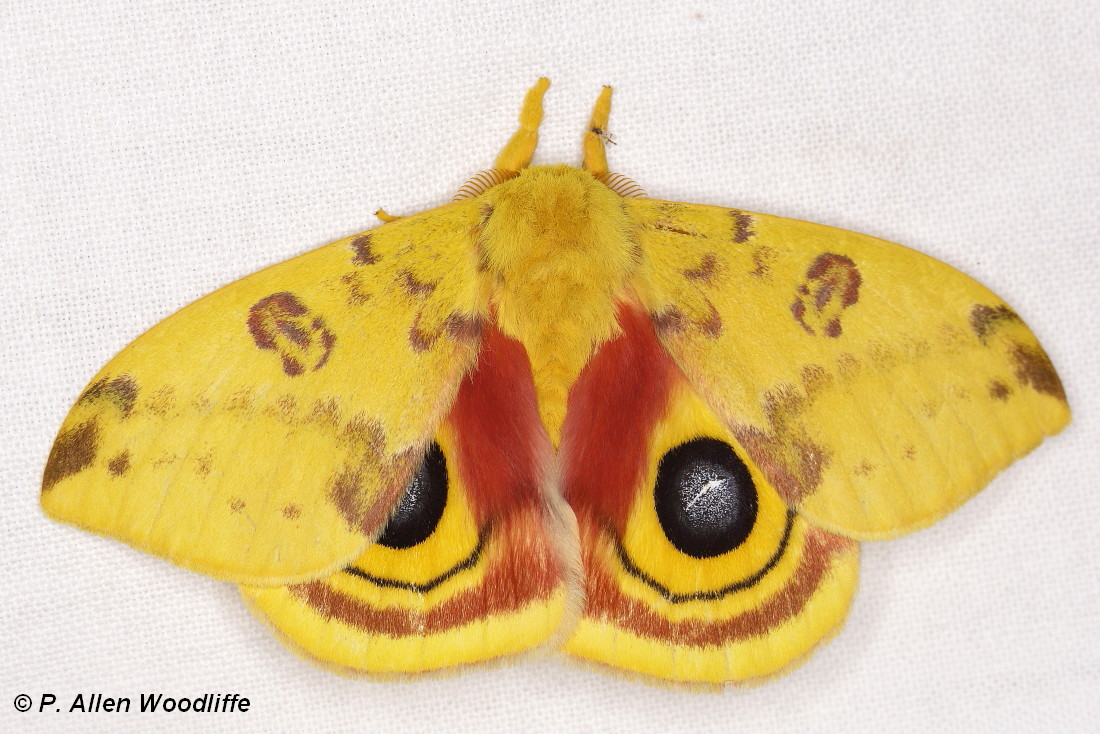
Newport Forest is a wonderful natural treasure, tucked away on the south side of the meandering Thames River in Elgin County. It was a combination of woodland, creek valleys and abandoned farmland when it was acquired more than two decades ago by Kee and Pat Dewdney. The abandoned farmland was planted into various trees, shrubs and native herbaceous plants, and the Dewdney's undertook an ambitious plan to document all living things, plant or animal, to be found on the site. You can read much more about Newport Forest at this link.
A few years ago, the Dewdney's donated it to the Thames Talbot Land Trust, a well-organized and effective organization dedicated to preserving many natural areas within their area of interest.
 |
Virginia Bluebells
|
I have been there several times, usually upon invitation, and especially with the intent of enjoying the wonderful display of Virginia Bluebells in late April or early May, but even more so, to set up my black lights and survey for the night-time creatures that are drawn to the lit up sheets. Moths, of course, are my main target, although there are many other things that arrive.
It was this past weekend, at the end of National Moth Week, that I met Kee and we proceeded to set up the black lighting equipment in preparation for the arrival of some winged denizens of Newport. There were lots of non-moths, to be expected, and there was no shortage of caddisflies of various shapes, colours and sizes. They are difficult to identify to species, but this one apparently is Potamyia flava. I don't know if it has a common name or not.
But the moths were the main focus, and although we only had the lights on for a bit less than two hours, I photographed a little more than 40 species of moths. Most were to be expected, but some were notable for their provincial rarity. What follows are some of the more significant or colourful ones.
The first one, Currant Fruitworm Moth, is fairly small as you can tell in comparing it to the size of the weave of the sheet. There are very few records for Ontario, although it does not have any official status. It is the first record for Elgin, according to iNaturalist.
 |
Delightful Dagger
|
This next one is one of the largest moths we saw that night. It lives up to its name, the Drab Prominent, and what makes it a bit notable is that it is officially Endangered according to Nature Serve, and S2/Imperiled according to the Natural Heritage Information Centre. There are fewer than 20 records for Ontario, all in southern Ontario, and this is the first for Elgin.
 |
Flowing Line Snout
|
Another rarity is Glorious Habrosyne, shown next. It didn't come to the sheet, but hung out on the branch I was using from which to support the light. Fortunately it was not worn and the detailed pattern was nicely visible. There are a few dozen records scattered across Ontario, predominantly in the south, and it is on the list of rare species that the NHIC maintains. I photographed this species a couple of years ago at Newport. It is the third record for Elgin, according to iNat.
On the very smallest scale of the moths was this next one: the Gooseberry Barkminer, a.k.a. White Eye-capped Moth. It is only about 6 mm in length.
 |
Green Leuconycta
|
This next one is not very common anywhere, but widely scattered, and its distinctive pattern is always a delight to see on the sheet.
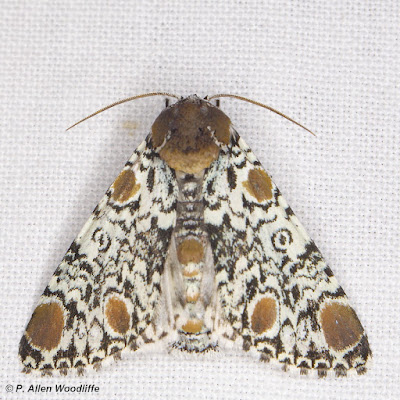 |
Harris's Three-spot
|
These next two are quite similar, and if they are not in fairly unworn condition, can be a challenge to identify. They are both in the
Acrobasis genus.
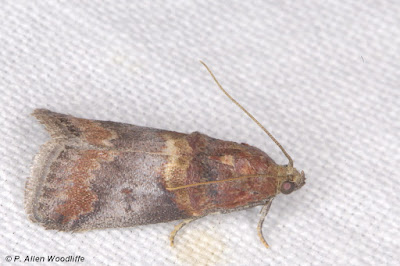 |
Hickory Leafstem Borer
|
 |
Hickory Shoot Borer
|
Next is a fairly large one, known as the Interrupted Dagger Moth.
 |
| Johnson's Euchlaena |
|
|
|
The American Lappet Moth, next, is not only fairly large and colourful, it has the distinct habit of not folding its forewing against the body and hindwing, but laying it somewhat flattened.

 |
Mantled Acrobasis Moth
|
 |
Master's Dart
|
 |
| Painted Lichen Moth |
|
As you can see, not all moths come to the sheet. This one, the Ragweed Borer Moth, decided the light itself was more to its liking.
Some moths habitually have their wings folded in an upright position, at least part of the time.
Fortunately they will usually flatten them out, making this Red-fringed Emerald much easier to photograph and identify.
 |
Sharp-angled Carpet
|
Next is a member of the Slug Moth group, called a Skiff Moth. While it doesn't have an official rarity status, it is on the NHIC's list of Rare Species in Ontario.
The Splendid Palpita is fairly common and widespread.
Unfortunately this next one, which was formerly called Gypsy Moth but now called Spongy Moth, is not native and fairly common. It goes in cycles, and in 2021 it was extremely abundant. The current year is a lot better, and this is just the first one I have photographed this year and the only one we saw on this night. Last year I sometimes would get as many as 20 at a time on the sheet!
The Thin-winged Owlet, next, is quite distinctive in both form and pattern. It is Vulnerable in Canada, and on the NHIC list of rare species. It is widely scattered in mostly southwestern Ontario. This is the first record for Elgin Co., according to iNat.
 |
Variegated Midget
|
Next is the Verbena Bud Moth, the Verbena presumably referring to the genus of plant that it is specifically attracted to and lays eggs on.
Underwing moths are in a class by themselves in terms of diversity and the very attractive pattern one may see on the hind, or under, wing. They are not often attracted to lights, so I was pleasantly surprised to see this one, known as the Wonderful Underwing. I didn't get a photo of its underwing colours and pattern which features black and orange bands.
 |
Woodgrain Leafroller Moth
|
I did show one non-moth at the beginning of this post. I don't often spend a lot of time photographing them, but some are nice to capture just the same.
This first one shows a pair of mating craneflies of the Limoniidae family.
This is the Green Cone-headed Planthopper. It used to be considered rare in Ontario, but likely due to the increased interest in black lighting, it has been determined to be more common and widespread to the point of not being rare now.
Next is what may be a small mayfly known as one of the Blue-winged Olives. I photographed it unintentionally, as it was beside a much larger moth, but was able to crop the photo to get this critter as well.
And last, but not least, is a bug that has its own lighting ability, and may have come by to see what this larger white sheet lighting was all about. It is a Lightning Bug of the
Photuris genus.
Kee and I are already discussing another black lighting event much later in the season, depending on the weather.
If you would like to subscribe, or unsubscribe, to Nature Nuggets, send an email to: prairietramper@gmail.com