Readers of my last post will note that Marsh Tickseed, a species at risk was something I found at St. Clair NWA, and since there were a couple of older records for this species at Rondeau, I tried diligently to find it there. The search got me out to places I hadn't been for awhile, at least not at this time of year, so I was hopeful. The south beach, along the edges of the marsh, was the place to search. Unfortunately the habitat has changed due to variable water levels as well as the onslaught of the non-native Phragmites.
This is the plant that I was looking for. A sort of typical looking sunflower type....
...but with very distinctive finely cut leaves.
I did find a few other things to aim the camera at, however, including this adult Bald Eagle, which did not like me getting any more than about 300 metres away before it left its perch....
...a moth, this Rubbed Dart, feeding on a relative of the Marsh Tickseed (I looked at a lot of tickseed types!)
And this small but colourful plant, the Trailing Fuzzy-Bean, a member of the legume family.
I saw a number of Double-crested Cormorants, as usual but for some reason this one was quite tolerant of my presence.
Elsewhere, while checking out some of the multitude of goldenrods, I came across a Northern Paper Wasp....
....a type of cluster fly...
....and this Bald-faced Hornet.
While some of these critters are capable of giving a painful sting, I have never been stung yet, as they are much too busy feeding on the nectar. I leave them alone as much as possible, but sometimes I use a macro lens and flash, and may only be inches away from them.
On my way to and from the park, I sometimes stop at the Blenheim Sewage Lagoons, as there is always a good variety of birds to view. On occasion they even are close enough to photograph! Bonaparte's Gulls can be fairly plentiful and sometimes quite close to the edge of the cells.
My target species for this visit to the lagoons, however, was to find one of the Red-necked Phalaropes that have been there lately. It is very much an irregular migrant, and one doesn't see them every year. Unfortunately it is often well out in the middle of the lagoon, making a decent photo hard to come by. This was taken at a magnification of about 22X, and then cropped considerably to more like about 80X.

One of the intriguing birds recently reported in southern Ontario, was a Cinnamon Teal, near Grimsby. It is quite the rarity at any time of year. Apparently hundreds of birders flocked to see it, but I wasn't one of them. I have seen it in Ontario before, as a fairly brightly plumaged spring male was at Rondeau for a brief period back in May of 1994. It was well out along the Marsh Trail and I, along with a good number of others, managed to see it. I didn't get a photo of it, but I do have a photo of one that I took out in southern Saskatchewan in July of 2018, where it was hanging out in a prairie pothole area along with numerous shorebirds, especially Wilson's Phalaropes, shown next. Not a brightly plumaged male.
A trip to St. Clair NWA is almost always worthwhile, and not just to see the Marsh Tickseed. Waterfowl are building in numbers, with Canada Geese numbering in the several hundreds by now.
Tucked well out of the way along the shrubby shoreline of the wetland, was this immature Green Heron. It was likely about 300 metres away, and when I first saw it through binoculars, I thought it might be an immature Black-crowned Night-Heron, but when I got a distant photo and highly cropped it, also to about the equivalent of about 80X, I could see the darker crown and the slightly dull green back. An immature BCNH would show a more evenly coloured brownish back. This bird is a little more fluffed up to make its body look a little more BCNH like, adding to the challenge of identification, especially in poor light and at a considerable distance.
Mallard are in the area, also by the hundreds.
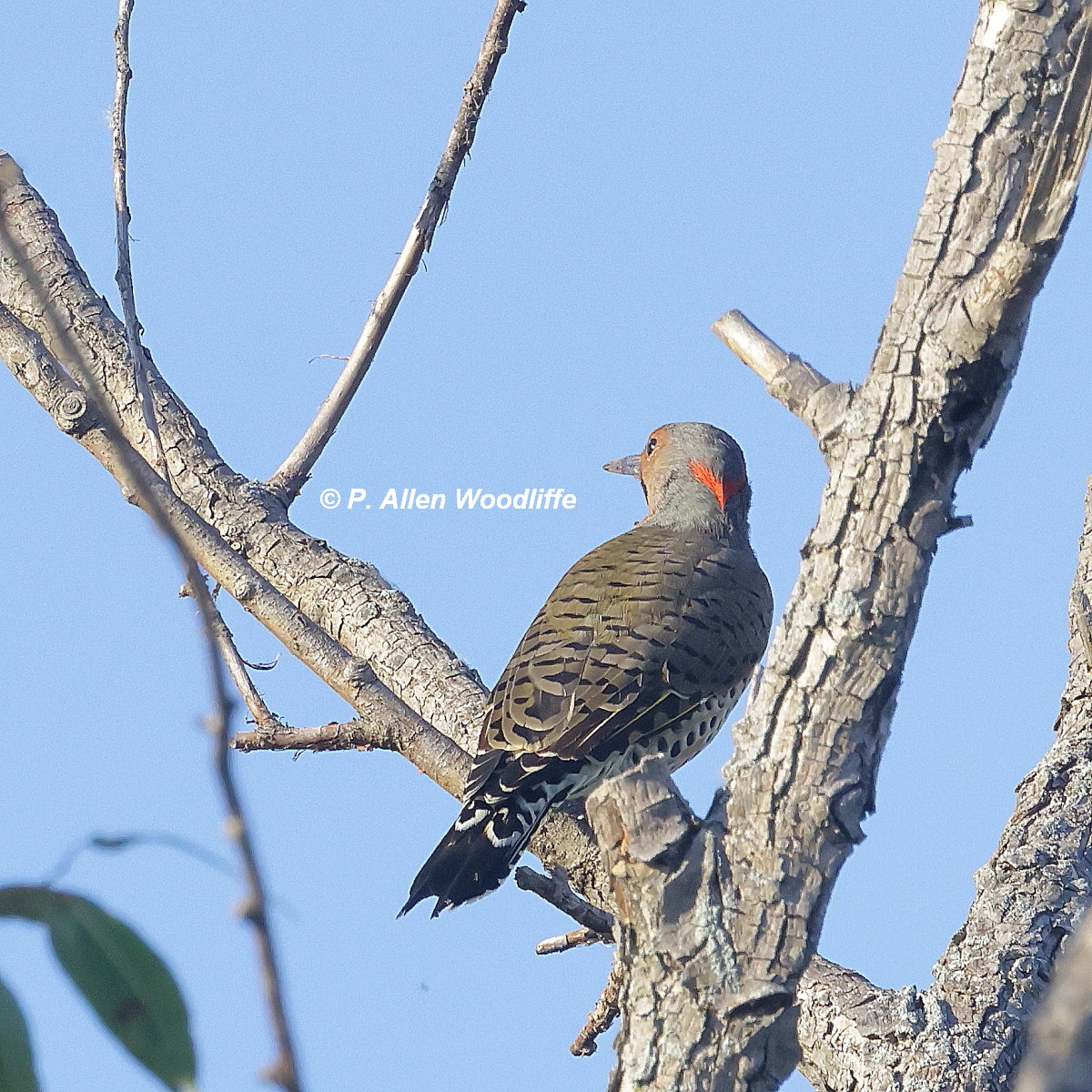
This Northern Flicker was in one of the few trees along the dyke trail.
Sandhill Cranes can often be heard, and occasionally seen and even photographed on their flights to and from the NWA.
Sometimes they will be feeding in a field immediately adjacent to the NWA.
Along the far woodland shore, there often are a few Wood Ducks tucked away, giving only distant views and photos. Sometimes up to 20 can be seen in one or two places....
....and on occasion, a brightly coloured male, shown next, will even linger in the channel adjacent to the trail, and a cautious approach might result in a photo such as this next one.
Northern Harriers are periodically seen, although usually in flight mode, and often heading away, giving a rear view only.
I typically add visiting the Mitchell's Bay North Shore Trail to one of my more northern forays in Chatham-Kent. The openness means there is often a comfortable breeze. As I have mentioned before, it is a great spot to see a few Great Egrets with typically at least half a dozen seen on each visit. On a cloudy day when they are sitting up in a tree, they may be a bit more challenging to get a good photo, but it is always worth a try.
There is enough shallow water or muddy shoreline along the edge to attract a few shorebirds, such as this Lesser Yellowlegs....
...and a Wilson's Snipe.
This adult Red-tailed Hawk was keeping an eye on me from a safe distance.

My next post may finally get me to do the one I had in mind awhile ago, featuring a variety of late summer orchids, including the endangered Nodding Pogonia, a.k.a. Three-bird's Orchid (Triphora trianthophoros). Stay tuned!
If you would like to subscribe, or unsubscribe, to Nature Nuggets, send an email to: prairietramper@gmail.com