Showing posts with label Common Milkweed. Show all posts

Sunday, 25 October 2020

Black-headed Gull, Autumn colours, and Seeds

The title may seem a bit eclectic, but there is so much to see in nature!

The great fluctuations in the weather at this time of year is perfect for putting birds on the move. And that means species not normally seen can show up, however briefly. Certainly in the last day or so, with the brisk north to north east winds, raptors continue to be on the move. Bald Eagles, shown first, continue to be frequently be passing through, while Red-tailed and Red-shouldered hawks are building in numbers. They are often too high for great photography, at least when I have seen them, so this image of a sub-adult Bald Eagle will have to suffice.

The bonus for watching for raptors along the north shoreline of Lake Erie is that waterbirds are seen as well. Common Loons, the occasional Red-throated Loon, grebes and scoters are seen but often well out from shore. On occasion some unusual gull may be found, such as the adult Black-headed Gull that showed up along the shoreline just north of Rondeau this past Friday. Steve C put the word out that both a Sabine's Gull and Black-headed Gull had been seen there within a 30 minute time frame. As I was already on my way out to the park, it was easy to stop by. The Sabine's Gull had gone from view awhile before (it was reported later in the day, but well away from this location), but the Black-headed was still in the vicinity, although it had moved down the shoreline a bit. Garry S and I struck out down the beach, noting two other birders intently looking through their scope. Kevin G joined us and by the time we got to where the birders were scoping some gulls, the Black-headed Gull flew into view and joined a small group of other gulls already resting at the shoreline. Although it was still a distance away, the light was good and the telephoto lens worked well. This first photo shows the Black-headed at the left, showing its characteristic red bill with a dark tip and red legs, and the black dot behind the eye. Several Ring-billed Gulls and a single Herring Gull in the group made for an easy comparison.
Although we wanted to get closer for better photos, we hesitated since there were other birders on their way to see this quite rare vagrant. But there were non-birders walking along the beach, some with dogs, and it was only a matter of time before the gulls flushed. We went a bit closer and then waited. But a dog was getting too close, and the gulls were getting restless. Then all of a sudden the Black-headed took to flight, and fortunately flew in our direction. With the nice light, it made for some good photo ops. This is only the third Black-headed Gull I have seen in the Rondeau vicinity in over 5 decades of birding!

I headed into the park, wanting to photograph some of the golden autumn colours before the forecast wind and rainstorm in a few hours, blew most of the remaining leaves off the trees. Bennett Avenue is one of my favourite places here. The colours aren't as vivid as sometimes, but were still nice to see,

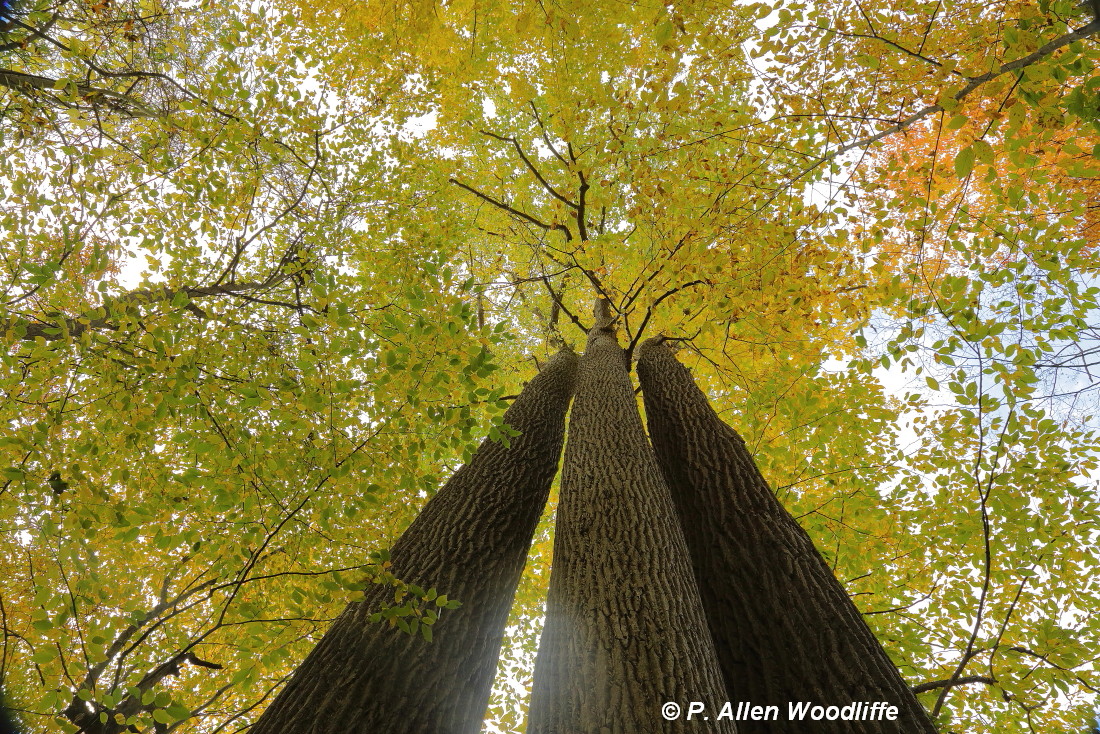
Here are the trio of Tuliptrees along the Tuliptree Trail.

A slug of some sort was crossing the path. At first glance it looked like a species I photographed earlier in the year, which turned out to be an endangered species. I'm not sure about this one, though.

I also like to get to Clear Creek Forest Provincial Park for some autumn colour photography. Here is one of my preferred vantage points, a couple of weeks ago. It was still looking quite green, and the creek itself was totally dry.

  This is from the same vantage point, taken yesterday, two weeks later.
And just to provide a different perspective, this is a lower angle from the stream edge.
A few days ago I got a message from Fred, a retired OMNR colleague, about a white goose associating with the large flock of Canada Geese hanging out at Mud Creek, here in Chatham. Knowing that Snow Geese are arriving in the area these days, Marie and I decided to check it out.
 
This was one that we saw along the creek system.
But it wasn't the one that Fred was referring to. We also saw this one, which turns out to be a hybrid of a Greylag and domestic goose. Who knows where it came from, but hybrid geese involving the Greylag, native to Europe, are widespread.
This is also the time of year when the fruiting bodies of many plants are visible, although maybe not for long as some are highly sought after by wildlife. Big Bluestem is one of the most common grasses in a Tallgrass Prairie. The seeds will be a source of food for songbirds, especially sparrow types.
 
Seed of the Common Milkweed are quite photogenic, and they are often abundant, which bodes well for the species in the future, as well as for the endangered Monarch butterfly which relies heavily on the availability of this plant.


The seeds of the Swamp Milkweed, shown next, are very similar, not surprisingly, and the plant is just as important to the Monarch.
Although this next seed head is not that of a native plant species, it is photogenic just the same. It is that of Green Foxtail.
 The bright red berries of Winterberry will not last long. When they are found, they are consumed quickly by some of the thousands of migrating songbirds.
 
 This next photo shows the fruiting body of another member of the plant kingdom. The part of the fungus we see is just a small part of the extensive living fungus that is growing underground, inside the trunk of a tree, or wherever. I'm not sure what species this is, but thought it was photogenic.


Sunday, 3 July 2016

Milkweeds and Monarchs

Milkweeds are nicely coming into bloom these last couple of weeks. There are nine species of milkweed in Ontario, some of which are quite rare. Some of the more common ones include the bright orange Butterfly Milkweed (Asclepias tuberosa) .

 One that is not uncommon, but many people would not notice it, is the Poke Milkweed (Asclepias exaltata), which grows in small numbers along the edges of lush deciduous forests.
 An uncommon species more or less restricted to prairies and savannas is Purple Milkweed (Asclepias purpurascens).
Of course the most common one is, as its name suggests, Common Milkweed (Asclepias syriaca). It is the most aromatic, in my opinion. Fortunately milkweeds were removed from Ontario's Noxious Weed List a little more than a year ago, and that will greatly benefit the declining Monarch butterfly population.

I tried to count the number of Common Milkweeds in my yard....some of which I planted several years ago, and others that just came up on their own. I counted approximately 105 plants, the majority of which will likely flower this year.
More pollinators are found on Common Milkweed than the others, presumably due to their more aromatic nature. Bees, ants, beetles, butterflies all can be found, sometimes all at the same time. But milkweeds can also be traps, as certain sized insects may get their leg trapped in the flower parts and cannot escape. The bee in this next image is one of several bees I have noticed dangling from the flowers in my yard.


Adult Monarchs have not been plentiful yet this year. In fact I have not seen any in our yard, but clearly at least one has been there.


About a week ago, we spied at least 5 good-sized larvae on various milkweeds in our yard, and the neighbours had a couple on theirs as well. They were all about the same size, so it is likely they all were from the successful efforts of a single female Monarch passing through and laying eggs a few weeks earlier.
 A couple of the milkweeds had two larvae feeding on the leaves.
A few days later, they all disappeared. I expect they all left the milkweed plants to find a safe place elsewhere, in order to make their chrysalis where they will develop into an adult.

Go Monarchs!

Monday, 20 July 2015

Life on a milkweed

I'm a big fan of milkweeds. There are 9 species that are native to southwestern Ontario, some of which are quite rare. The most common species is...you guessed it...Common Milkweed (Asclepias syriaca). It can vary in colour......


...but they all seem to be very fragrant. To me, it seems to be the most fragrant of all of the Asclepias species, and judging by the number of pollinators and others that can be found on it during the time it flowers, it is quite fragrant to all of these insects as well.

Fortunately I have a dozen or more plants in my yard, which enables me to keep close tabs on what insects are visiting, and many of the following photos were taken there. But whenever I am out in a natural area, I try and take a look to see what I can find and photograph on the milkweeds there.

Some of the critters are quite tiny. This first image shows the Ailanthus moth, which is named for its association with Tree-of-heaven. This tree is not native, but does well in disturbed areas and abandoned city lots. They are also invasive in even higher quality natural areas, unfortunately, but at least the moth is colourful.
Ailanthus moth
This next one is a very small day flying moth, called a Currant Clearwing. The larvae feed on raspberries, which we have in fair abundance in our yard.
Currant Clearwing
 An even tinier flying insect is this iridescent Long-legged Fly resting on the milkweed leaf. It is incredibly fast. I couldn't use the Through The Lens flash metering system of the camera as that system sends a quick burst of light to the subject to evaluate how much light is needed before generating a second flash during the actual photo. In the less than 1/1000 sec between the initial burst and the one given during the time the photo was taken, the fly had disappeared completely out of the frame, so I had to resort to manual flash where just a single burst is given.
Long-legged Fly (Condylostylus sp)
 This next one is a One-spotted Stinkbug. I didn't get a chance to see if it lived up to its name. This was photographed at Bickford Oak Woods and is the second time I have seen and photographed one there.
One-spotted Stinkbug
 Next is the aptly named Red Milkweed Beetle. They are fairly abundant.
In a previous blog post I highlighted how death comes to insects looking for nectar. This next image shows a medium-sized bee that has just been 'caught'. Note its right hind leg which is outstretched behind and up into the flower. The bee struggled and struggled and eventually was able to escape.

Even butterflies can end up with their legs caught. This Mourning Cloak in the next image
is a good-sized butterfly, but it was caught. At first I just thought it was busily feeding on the nectar, but after awhile I realized it couldn't get away. It struggled for a long time. I eventually gently grabbed its leg and tugged just enough to get its leg out intact, whereupon the butterfly moved over to an Echinacea plant nearby and just sat there for the longest time, presumably exhausted by its struggle and trying to decide whether the nectar at that fragrant milkweed was worth the risk.

Mourning Cloak
 Other butterflies include this Banded Hairstreak, only the second one I have noted in our yard.
Banded Hairstreak
Northern Broken-Dash Skipper
Question Mark
Tawny-edged Skipper (tentative ID)
 Sometimes one comes across a more vicious looking creature. While prowling around looking for something tiny to photograph, I came across this cluster of Earwigs tucked in waiting for darkness so they could head out searching for plant or insect matter to feed on. Those pincers are impressive!


Another impressive looking insect is this quite large Great Golden Digger Wasp. Most members of the bee and wasp family that are found here are mostly interested in the nectar or other insects. I've never been bothered even though I am using a macro lens and flash. Moving slowly and carefully is the key, I think. There is one extremely large bluish black wasp that I have yet to photograph, but when it comes around it is constantly on the move and I haven't been able to get close enough....yet.
Great Golden Digger Wasp
 This next critter is one of the several different kinds of Flower Long-horned Beetles that can be found visiting flowers. Characteristic of this group is the very long antennae, usually at least half the total length of the insect's body.

Flower Long-horned Beetle


It looks like I can expect another generation of Red-banded Leafhoppers on my milkweed next season!
Red-banded Leafhopper

We don't have any squash growing in our yard, but we had this Squash Vine Borer, another type of day-flying moth, visiting the milkweed.
Squash Vine Borer moth
There isn't much water near by, but we get the occasional dragonfly. This female White-faced Meadowhawk is just using the milkweed as a resting place, and probably waiting to launch itself out to capture a flying insect for its next meal.


Milkweeds are indeed, great places to look for wildlife!


Tuesday, 7 July 2015

Life and death in the backyard

Some days, one doesn't have to go far at all to see wildlife in action. The scale of the wildlife may be a bit different, but it is every bit as dramatic.

Milkweeds are in prime condition these days. I've never liked the name 'Common Milkweed' especially since, at least in Ontario, it has been considered a noxious weed for so many decades. Landowners were, up until a couple of years ago, required by law to eliminate it. Common Milkweed (Asclepias syriaca) is actually rather attractive and aromatic; its role in the insect and invertebrate world is quite amazing.
Numerous pollinating insects zero in on the colourful and fragrant flowers. But therein lies a huge risk for some of the critters. Note the intricate detail of the close-up of milkweed flowers in the next photo.

Some of these tiny flowering parts are a bit flexible, depending on how much pressure is put on them, and that can spell serious trouble to the insects applying that pressure. In the next image is a reasonable sized bee. It looks okay at first glance, but it is very dead.

As it has crawled over the flowers trying to collect nectar, one of its feet slipped between some of the flowering parts, and it is stuck. A bigger insect might have had the strength to free its foot. A smaller insect would not have gotten caught. But just as in the story of Goldilocks and the Three Bears, this third one was just right....or as far as the bee is concerned, just wrong. It was trapped and is now very dead. On rare occasions I have seen a leg remaining in the grip of these milkweed flowering parts, so somewhere there is a pollinator missing one of its six legs.

In previous years, the milkweeds are not as large and robust as they are this year, thanks to the much greater rainfall which has resulted in greater growth. As a result, when the plants and flowers are smaller, an insect the size of this bee would have escaped easily, and only smaller insects would have been caught.

On a recent occasion, I was taking a photo of a dead bee and it wasn't until I got the image on the computer that I noticed two creamy white legs somehow involved with the bee.


The white legs were from a Goldenrod Crab Spider which had caught this bee and was  presumably sucking the juices out of its victim.

After awhile, I went back outside to the scene of this incident and noted the now empty carcass was sitting on a milkweed leaf.

 And there not too far away, was the crab spider, with legs outstretched ready for another victim. In the case of a crab spider, the front four legs are larger and stronger than the back four, enabling it to capture and subdue its victim.
Crab spiders are able to change their colours from yellow to white to pink and various combinations in between. This enables it to lie in wait very inconspicuously. The change doesn't occur instantly, but normally takes several hours.

Other spiders are sometimes seen. In this next image is a Zebra Jumping Spider. There are several dozen different jumping spiders, all quite small, and some of them are quite elaborately coloured.
 And they can be found feasting on their prey, as in the case of this next image showing a jumping spider sucking the juices out of a fly.
In any natural environment, one can see death, but one can also see the promise of new life.

Cabbage White butterflies are common.
 Eventually one may find a caterpillar of this butterfly.
Black Swallowtail butterflies periodically show up.
 They search out dill, parsley and other members of the same family to lay their eggs on, as the caterpillars require them for nourishment.

This next image shows a very young caterpillar at about the first instar stage:
 At about the third instar stage:
 And just before it is ready to form a pupa.
Another butterfly that is quite often around our yard: the Question Mark.

Other insects include, unfortunately, Japanese Beetles.....colourful to be sure, but not desirable!
Lots of 'this' going on, but three's a crowd!
A few days ago we had some of these Mayflies, sometimes called Fishflies, hanging around.
Years ago they were reported along the Lake Erie shoreline to be so abundant that they would pile up on the roads deep enough to clog up the radiators of vehicles driving by to the point that the vehicles would overheat and be forced to stop! Large numbers of these insects are, in some respects, a good thing from a water quality standpoint. The greater the abundance of these insects, the better the water quality.

I started this post with a purplish-pink wildflower, and I will end it with a similarly coloured one that is in our yard: Climbing Prairie Rose (Rosa setigera), which is quite rare in Ontario and officially ranked as Special Concern. True to its name, it likes climbing when given a chance. One of the plants in our yard has climbed up at least 5-6 metres in an open branched tree.
Climbing Prairie Rose