Showing posts with label Gray-headed Coneflower. Show all posts

Friday, 4 August 2023

Autumn migration, re-appearance of an endangered orchid, and more!

 There is always something to see, even in the mid-summer heat. I haven't ventured too far, but try and catch up to as many things as I can, all the while being a bit more focused on things to help move my next book project along.

The autumn shorebird migration is well underway, as evidenced by an increase in the species and numbers at sewage lagoons or areas of exposed mudflats. One of the highlights was to see my first of year Stilt Sandpiper....

..and my first of the fall, Pectoral Sandpiper.
Both Greater and Lesser Yellowlegs are around, at least in small numbers
Lesser Yellowlegs

Least Sandpiper
Spotted Sandpipers are quite plentiful these days, with both adults....
...and the unspotted young. It is not uncommon to see 30 or more at the lagoons.

Anytime I get close to wetlands, there are some of the larger birds to be seen. None are migrants, yet, and will likely be around for a few months. These all breed in the area, so are just out wandering around feeding, etc.


It is a bit hard to believe that Sandhill Cranes used to be a bit of a rarity, but now you can find them quite regularly, since they have become regular breeders in the larger wetlands. This one was feeding with its mate, in a recently harvested wheat field.

It is the time of year when some of the tallgrass prairie plants are nice and showy, and not always in a prairie. Flowering Spurge, shown first, usually occurs in wide open prairie and savanna sites, but this one was along the more forested Black Oak Trail at Rondeau.


Gray-headed Coneflower is doing well in any kind of a prairie setting, along with its tallgrass prairie companions.
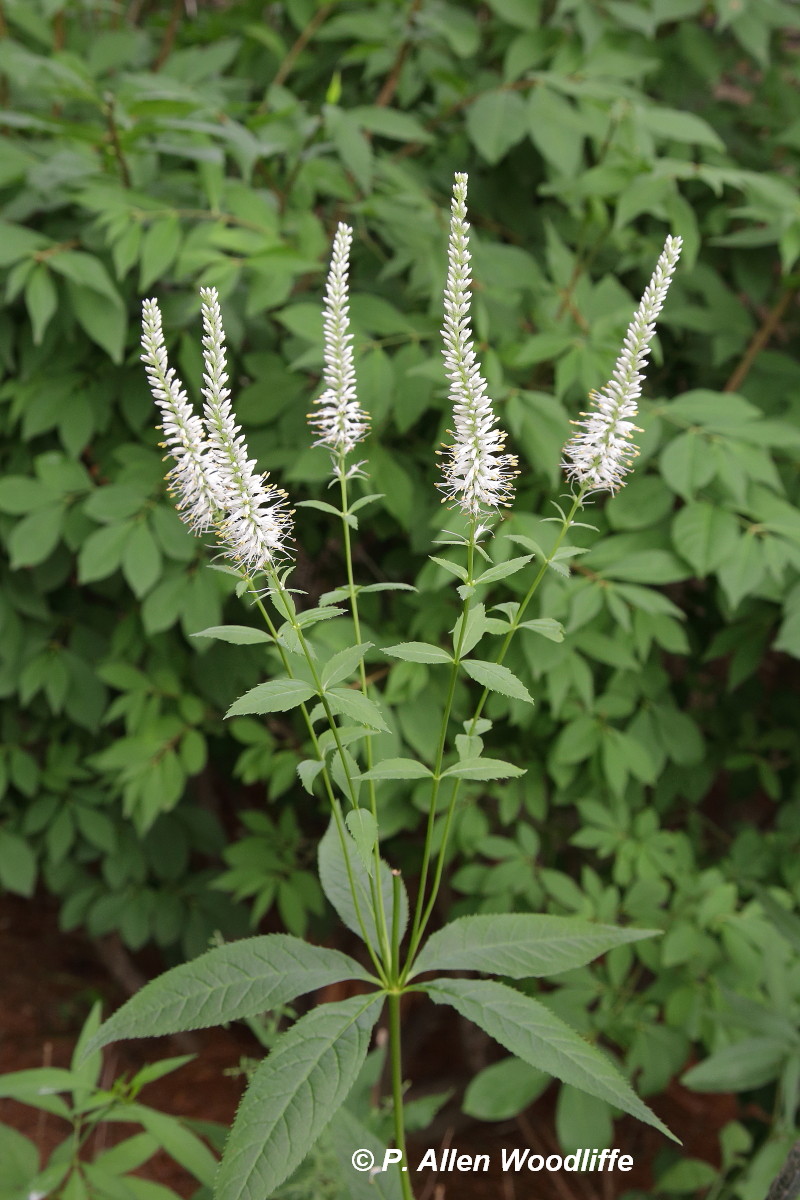
Culver's-root is a rarity of the tallgrass prairies.

While I was on my way to check on the Nodding Pogonia, the endangered orchid that only occurs in Canada at Rondeau, I came across this moth in the grass along the trail. It is a Giant Leopard Moth, and fairly uncommon. I think it is only my second record for Rondeau.

The orchids I was searching for were not out in flower on this visit, but a few days later, found some that had been in flower the day before. The blooms only last for a single day. This photo is from a previous year, and I have been checking up on this orchid in various ways for exactly 50 years! Needless to say I will be out again shortly when the conditions are right for the next blooming period, so stay tuned for an update (hopefully!).

With a fair bit of moisture in recent weeks, it bodes well for a good showing of fungi. They are fun to find and photograph, but not as much fun to try and identify. Here are some of the more distinctive or colourful ones I have encountered in recent days. The first ones have not been nailed down as to species quite yet. I often try and photograph the gills on the underside, as they can assist in their identification.


This next one is quite possibly a Lactarious psammicola. I am not aware of a common name.
This next one is probably a Red-mouth Bolete.
And finally, a Yellow Earth Tongue, sometimes called an Orange Earth Tongue, and typically grows out of a mossy log.


If you would like to subscribe, or unsubscribe, to Nature Nuggets, send an email to: prairietramper@gmail.com


Friday, 7 October 2016

Late season prairie veg and leps

This early autumn splurge of warmer weather has benefited some lingering tallgrass prairie vegetation as well as the persistence of butterflies. A good spot to see this in Chatham-Kent is the Mitchell's Bay North Shore Nature Trail. Butterfly diversity is diminishing, and with the forecast cooler trend beginning this weekend it will likely continue to diminish. But the ones that are around do provide some good photo ops.

Cabbage Whites continue to be super abundant. Clouded Sulphur and Orange Sulphur are also fairly abundant.

Cabbage White

Clouded Sulphur

Orange Sulphur

An occasional Red Admiral, here sipping nectar on a Spotted Joe-pye-weed, may still be around.
Red Admiral

Monarchs are on the move, heading southwest towards their overwintering site in the Mexican highlands..

Common Checkered-Skippers, those diminutive and attractive little later season visitors, are still around. Some of the later blooming asters are good spots to check for them.
Common Checkered-Skipper

While the dominant colour of flowering plants in early autumn is the yellow of various goldenrod species, there are a few others tucked away. Surprisingly this Gray-headed Coneflower (Ratibida pinnata) was seen in good flower recently.


One that does not occur very commonly anywhere in Ontario is Biennial Gaura (Gaura biennis). It blooms early on a sunny day, and typically closes up by late morning.


A relatively rare autumn orchid is Great Plain's Ladies'-tresses (Spiranthes magnicamporum) occurs. There are several Spiranthes in the area in the late summer and early autumn, but even though this is S3 and therefore ranked as reasonably rare, it is by far the most common Spiranthes located here at this time of year here in the southwest.

Not restricted to prairies by any means, is this Pokeweed (Phytolacca americana). It has attractive white flowers that develop into succulent looking bluish-purple berries. Birds love them! But don't you try eating them....all parts of the plant are quite toxic to humans and other mammals.


This next species, the brilliant Cardinal Flower (Lobelia cardinalis), normally is in flower in early to mid-August. For some reason this one decided to extend the season.

If you have been paying attention to non-raptors passing by the various hawk watches in southern Ontario recently, you may have noticed tens of thousands of Blue Jays passing by, heading southwest. Are they all heading to Texas in support of their American League namesake???


Go Blue Jays!!!!

Wednesday, 27 August 2014

Tallgrass prairies of Walpole, in their prime

I have been fascinated by prairie and savanna from at least as far back as 1973, when I was working at Rondeau. And since the 1980s, I have had the privilege to be able to explore some of the finest tallgrass prairie and oak savanna in Ontario, and arguably Canada. The prairies of the Walpole Island First Nation are indeed remarkable and spectacular. One of the prairie sites has, on more than one occasion, hosted a breeding pair of Henslow's Sparrows!

You may remember a previous post, in early July, where I was able to visit one of the more remote prairies at Walpole Island, along with the owner and her family. It looked like this:


I had memories of this site from a few years earlier, when it was in its peak of colour with the Dense Blazing-star in its prime, along with several other showy species, so we planned to re-visit in early August to again see it in that showy condition. On the way in, we saw various prairie flowers in their prime, including Flowering Spurge.

Flowering Spurge (Euphorbia corollata)


Grey-headed Coneflower was also doing well. It is provincially ranked as S3, meaning there are fewer than 80 locations for it in Ontario and is vulnerable to extirpation..

Gray-headed Coneflower (Ratibida pinnata)


As we got to the site we were headed for, we were not disappointed.

This image was taken from a very similar vantage point as the first one in this post, but at a slightly different angle.

Dense Blazing-star (Liatris spicata) is one of the prairie plant species which many consider to be iconic.....that is, when one sees it, it evokes a sense of place that is a high quality tallgrass prairie. Mind you it can grow in some rather disturbed sites as well, but in a setting such as the one above with a multitude of other quality prairie species, it truly is an indication of a special place. Dense Blazing-star is a Threatened species under the Endangered Species Act. Under the Provincial Ranking system, it is S3.


Purple is the primary colour, but if you look closely at the image preceding this, you may have noticed a white plant. It is a rare white colour form; less than one per cent of all blazing-star stems are white. It serves to add to the diversity of colour at this time of year when so many prairie plants are purple against a green background.


On the day of our visit, it was a wonderful day to see some butterflies as well. Monarchs, Red-spotted Purples and Black Swallowtails were fairly abundant, but the one that caught my eye was Giant Swallowtail. There were several flitting about, enjoying the nectar of the rich purples available to them in this setting. Giant Swallowtails are ranked as S2 in the provincial ranking system, meaning that there are likely fewer than 20 populations and have a restricted range in Ontario and are very vulnerable to extirpation.

In both of these cases, the swallowtails chose to sip on the flowers of an ironweed rather than the blazing-star and that seemed to be the case most of the time. I'm not sure if the deeper purple colour was more attractive, or maybe the nectar was more satisfying. I'm not a butterfly whisperer to know that detail.

There are two species of ironweed on the Ontario prairies. For many years it was believed there was just one species, but in the early 1990s while a botanical colleague and I were photographing some prairie plants on Walpole, he realized there was something different about some, and after a closer examination of images and confirming using technical manuals, I concurred, thus adding with some certainty that there was in fact another species. The differences are somewhat subtle, and are based in part on the number of florets (small, individual flowers on the flower head). One species is Tall Ironweed and the other is Missouri Ironweed. The next photo is of the latter, and most recently confirmed, species. It is provincially ranked as S3.
Missouri Ironweed (Vernonia missurica)
Of course tallgrass prairies are more than just colourful wildflowers, although they are the showier plants. But as the name 'tallgrass' suggests, grasses are a major component of such a prairie. A healthy prairie in the mid-west consists of about 70% grasses, although there are only a handful of species making up that ~70%. Here in the eastern range of the tallgrass prairie biome, it is believed that wildflowers, collectively called 'forbs', make up about 50% of the vegetation in a healthy prairie, and grasses the other 50%. This may be due in part to the greater amount of precipitation in the east. Prairie grasses in general have deeper root systems than most forb species, so that in the drier part of the prairie range in the mid-west, the grasses have the advantage over the forbs. It may also be partly due to the greater presence of savanna, those prairie-type habitats where up to 25% of the cover is made up of fire resistant trees, usually oak species. Some forbs that do well in an oak savanna will also do well in a tallgrass prairie.

Indian Grass (Sorghastrum nutans) is one of the main grasses to be found on a tallgrass prairie. Grasses have flowers too, although most people do not pay much attention to them. This particular plant was in good flower, with the bright yellow stamens visible here.


In this next photo, there are some tall grasses visible amongst the forbs, although more in the background. They are Big Bluestem (Andropogon gerardii), a.k.a. Turkeyfoot, named because of the 3-4 flower and seed spikes at the top that may resemble the foot of a turkey. It is by far the most abundant grass of most tallgrass prairies.


Also in this image is a Tall Sunflower (Helianthus gigantea) visible in the upper right. In a few days, this scene will have taken on a decidedly yellow look, as the many goldenrod species open up. There are some goldenrods in this image that are in a tight bud stage, but have not yet opened.

I will be posting more on Ontario's tallgrass prairies in the future!