Showing posts with label Louisiana Waterthrush. Show all posts

Tuesday, 17 May 2022

May is Wood Warbler Month!

 It is also Lyme Disease Awareness Month, but I won't go into detail about Lyme Disease on this post. If you want to read one of my most informative posts on that subject check out this link. 

May is the month when many birders are out on the hunt for those (mostly) colourful birds that are arriving from southerly areas, heading to our area to nest or stopping by for nutrients before continuing on their way to more northerly breeding grounds. While this year has been average at best for warbler movement, almost all of the regular species have appeared, at least in small numbers. One always hopes for a major event when warblers seem to be 'dripping from the trees'. That hasn't happened to any great extent yet this year, but one can always hope.

In the meantime, I thought I would feature a few photos of many of the warblers, which I have been fortunate to capture digitally over the years. Almost all were taken at Rondeau and in the spring, when they are at their most colourful, before they turn to those 'confusing fall warblers'. They are in no particular order. If it is labelled (B), it has been known to breed in Chatham-Kent, and especially at Rondeau. If it is labelled (M), it is a migrant moving on to more northerly habitat.

American Redstart (B)

Black-and-white Warbler (M)

Bay-breasted Warbler (M)

Blackpoll Warbler (M)

Blackburnian Warbler (M)

Black-throated Blue Warbler (M)

This next one, the Black-throated Green Warbler, has not been confirmed as a breeding species at Rondeau, but has probably nested. And given the number of conifer plantations that are becoming more mature in scattered parts of CK, it is possible that it has nested.

Black-throated Green Warbler (B?)
These next three are interesting. The first one is Blue-winged Warbler, an elusive and not common species. It has possibly nested in the area, but it has not been confirmed.
The Golden-winged Warbler, next, is not common either. In fact its numbers have declined considerably over the last couple of decades, and it is now a Species At Risk, with the status of 'Special Concern'. Part of the reason for the decline is that it shares habitat with the Blue-winged Warbler, and they regularly hybridize. The result is a hybrid known as 'Brewster's Warbler', which depending on the family lineage, can result in quite a variable plumage.
Golden-winged Warbler (M)
The image below shows an example of a Brewster's Warbler.

 Canada Warbler is next. It is also listed as 'Special Concern' due to declining numbers.
Canada Warbler (M)
Common Yellowthroat, next, is common and nests regularly in the area, especially in wetlands and shrubby areas.
Common Yellowthroat (B)
I include two of the following species, Cerulean Warbler, since the male and female are quite different in appearance. This species used to be a regular nesting species at Rondeau, but is quite irregular now. It is a Threatened species in Ontario. They are often fairly high in the trees, so getting a good photo is not easy!
Cerulean Warbler, male (B)

Cerulean Warbler, female (B)
Cape May Warbler (M)
Next is Chestnut-sided Warbler. It has nested at Rondeau on very rare occasion, being much more common farther north.
Chestnut-sided Warbler (B)
A species that used to be a Species At Risk in Ontario is shown next, a Hooded Warbler. It was quite unusual to see one, but in the last couple of decades, their numbers have increased considerably, and have been removed as a Species At Risk. It is seen somewhat regularly at places like Rondeau, and on occasion one might see two or three in a day on migration. It has not been confirmed nesting at Rondeau, although it is believed that attempts have been made.
Hooded Warbler (M)


Louisiana Waterthrush, next, is also a Threatened species, with its breeding range in Ontario limited to the very south. It has nested at Rondeau on rare occasion.

Louisiana Waterthrush (B)

A very similar looking warbler is the Northern Waterthrush, next. There are subtle differences, such as the width of the light stripe above the eye, the amount of speckling on the throat, and the slightly yellowish cast to the belly feathers. It is more common, but does not nest at Rondeau as far as any records show.

Northern Waterthrush (M)

Magnolia Warbler (M)

A regular, but not common species is the Mourning Warbler. It has nested at Rondeau on rare occasion.

Mourning Warbler (B)

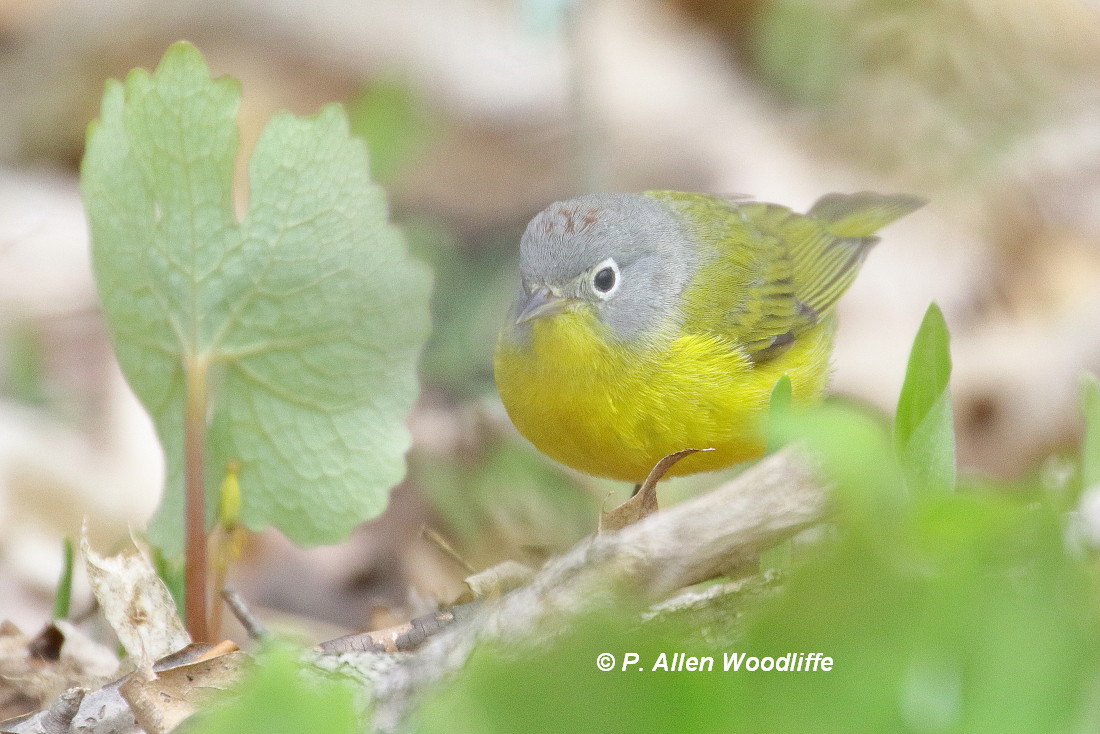
Nashville Warbler (M)

Northern Parula (M)
Next is an Orange-crowned Warbler. It was photographed in the autumn, as you can tell by the seed heads of a goldenrod in the photo.
Orange-crowned Warbler (M)

Ovenbird (B)

Palm Warbler (M)
This next one is a Pine Warbler. It is a winter shot, as I got it coming to a feeder in January!
Pine Warbler (B)
I have featured Prothonotary Warbler on many occasions, as it is Rondeau's unofficial bird species, and certainly my favourite.
Prothonotary Warbler, male, (B)

Tennessee Warbler, (M)
The Townsend's Warbler is a western species. I found the first Rondeau record back in May of 1983. Interestingly, the Rondeau area has had more records of this species than any other location in Ontario. It is more often found in late fall here. This photo was taken in late November.

Worm-eating Warbler, next, is a southern rarity. There are not many records for Rondeau, with barely one report annually.

Worm-eating Warbler (M)

Wilson's Warbler, (M)

Yellow-rumped Warbler (M)
Yellow-throated Warbler, next, is generally a southern species. There are a few records for Rondeau, and at one point, for several years in a row, a male showed up in the vicinity of a cottage and the Visitor Centre. On one occasion there was a female as well, and it is believed that attempts were made to nest, although in spite of the search efforts of various birders, it was never confirmed.
Yellow-throated Warbler (M)
One of the most common warblers in southern Ontario and elsewhere, is the Yellow Warbler. It is an abundant breeding species, and it is not unusual to see several dozen on a day in May. On occasion, one may encounter more than 100 in a single day in May.
Yellow Warbler (B)

There are several other warbler species that have been recorded at Rondeau, some of which are almost annually occurring. These include Kirtland's Warbler, Prairie Warbler, Swainson's Warbler, Kentucky Warbler and Connecticut Warbler. For various reasons, I have yet to be able to photograph any of these five. Will it happen in 2022? Maybe!


If you would like to subscribe, or unsubscribe, to Nature Nuggets, send an email to prairietramper@gmail.com


Wednesday, 25 May 2016

A picture doesn't always tell it all

My previous post highlighted some of the wood warblers I have seen at Rondeau this spring. Typically only one image per species was used. And that created a problem....hence this post.

I included this image of a Northern Waterthrush.
And that elicited a comment by a well-known Ontario birder that it should be re-labelled as a Louisiana Waterthrush.

I can't say that I blame Brandon for this comment. He is a highly respected and knowledgeable birder, and has served admirably on the Ontario Bird Records Committee (OBRC) for several years. From the angle showing this bird, the image does have some characteristics of Louisiana: the broad light coloured supercilium and the appearance of fewer, more spaced out darker streaks on the flank. However, and this is the reason for the title of this post, this single picture doesn't tell it all.

This next one is of the same bird taken three minutes earlier.
In this one, the yellow wash over the entire lighter part of the feathers is obvious, but what is more telling is the heavily streaked marks on the breast feathers. Even more conclusive is the numerous finer streaks in the throat region. All of these clearly identify this as a Northern Waterthrush.

Had the bird been singing, it would have helped, but this one was quiet.

Almost exactly a year later, I photographed this waterthrush within a short distance of the Northern Waterthrush. It wasn't singing either.
 In this side view, the overall light colour of the bird is decidedly white. The streaks on the flank appear to be few and widely spaced.
This bird hopped up on the railing along the trail, and here one could see the streaks on the breast, but they aren't as densely spaced as the Northern Waterthrush above. And again, quite conclusively, is the white unspotted throat. This bird is the much rarer Louisiana Waterthrush.

I realized after posting the previous 'Warbler Parade' blog and reading Brandon's comment that for a more challenging species it would have been helpful to include additional supporting photos to substantiate the identification. I expect that is why bird field guides are more useful when they show illustrations rather than photos. A good illustrator can often show all the important characteristics in one or two illustrations, whereas it might take half a dozen good photos to do the same.

Over the years, I have had single images of birds sent to me for identification. I'm sure many reading this post have received some also. While some images are relatively easy to figure out, when a single photo is received that does not show the critical characteristics, one is left with making an educated guess.

I am sure this is a dilemma for members of the OBRC. Sometimes a single photo is all that is received, and without the critical characteristics being shown, it can be difficult to accept or reject a rare record. I admire the willingness of the OBRC members to sift through the various types of reports from year to year, to decide what records are acceptable and what records are not!

So thanks, Brandon, for the comment on my previous post, and for indirectly pointing out the need for me to be more thoughtful in labelling certain types of images!


Wednesday, 20 May 2015

Solitude returns....but there is lots to see!

The last couple of weeks or so have been pretty chaotic at many birding hotspots in southern Ontario. It is totally understandable, given the concentration of many of the more colourful feathered critters, which are especially easy to see before the opening leaves obscure them. However the concentrations of birds as most birders would like, were not all that plentiful. A case in point was on this past weekend, one of the busiest in the early season for most southern Ontario provincial parks. Birders, as well as other park users enjoying this holiday weekend were visible in large numbers. But the birds were not.

I chose the less travelled trails, such as one of the middle sections of Harrison Trail. In about an hour and a half, I saw two other birders and two cyclists.
There were a few warblers, including Canada, American Redstart and this male Hooded Warbler which was singing up a storm. It looked like it was in good habitat....will this be the year that this species at risk is confirmed breeding at Rondeau?

Along the deer exclosure off of Bennett Ave, I had two Pileated Woodpeckers right close by. They were both males, vying for territory, it seemed, and were on opposite sides of this tree trunk at times, but those photos didn't turn out.

Other resident species are easier to find, such as Great Crested Flycatcher and Eastern Kingbird.
Great Crested Flycatcher

Eastern Kingbird
Even combing the forest edges for several hours on the weekend would only bring the average warbler list to between 15 and 20 species. But later in the day, warblers were seen concentrated in unexpected places. In a cluster of spruces and Red Cedars situated on a vacant cottage lot along Lakeshore Road, I had 15 species of warblers in about 35 minutes, certainly a greater diversity than I had seen that day to that point. Unfortunately they were hard to photograph as they very actively foraged among the coniferous branches in the fog. The only shot that turned out reasonably well was this one of a female Black-throated Blue Warbler.

Since the holiday weekend, the park has been considerably quieter. Even the busiest trails are virtually empty.
Spicebush Trail
One can sprawl out on the trail to photograph wildflowers and not be worried about impeding the progress of a birder with his face to the skies.
Foamflower
Foamflower close-up
 There are hundreds of violets around the trail. This Long-spurred Violet, easily told by its long hind spur and pale bluish petals, is one of the most abundant right now.
One of the tiniest flowers, and one that even wildflower enthusiasts do not see often, is Mitrewort. One has to get on hands and knees with a hand lens to really appreciate the intricate detail of its tiny flower, which measures only 3-4 mm in diameter in real life.
Mitrewort....overview


The sloughs are awash with colour, more now than at any other time of year, as the Yellow Water Buttercup is abundant and easily seen from the trails.

Orchids are starting to appear....but only if you know where to look. There are two species in bloom right now: Large Yellow Ladies'-slipper and Showy Orchis. The former is one I have seen at three isolated locations in the park. One has disappeared due to vegetation succession; the easiest one to find did not flower this year; the largest population is well off the trail in a remote area and has not been checked.
Large Yellow Ladies'-slipper from a previous year
 Showy Orchis is more widely spread, but not abundant. It is much smaller and more easily missed.

Yesterday was a great day to be out. I saw my first American Lady and Eastern Tailed Blue butterflies.
American Lady
A Common Nighthawk was noted on the horizontal branch of a large oak tree.

Wild Columbine is abundant along forest edges and openings. Hummingbirds can be seen hovering under the delicate flowers, seeking the nectar. That is one photo I am still hoping for......

The Tuliptree Trail continues to be a favourite spot for birders, and for good reason. The resident pair of Prothonotary Warblers provide lots of entertainment. At one point, I had this male Prothonotary foraging almost right overhead, and sometimes almost at eye level and too close to focus! These shots were hardly cropped at all.


And a Louisiana Waterthrush, normally a warbler species that appears in late April and very early May, just showed up in the last few days. It is a species that has nested in the past.....I photographed a nesting pair less than 250 metres from where I took this shot yesterday......maybe it will nest again this year?