Showing posts with label Red-shouldered Hawk. Show all posts

Wednesday, 24 October 2018

Some birds of late October

As is typical of this time of year, there are a few lingering migrant birds as well as the usual early winter species. It is always fun to see what is around. Rondeau, Erieau and the sewage lagoons at Blenheim are certainly worth checking regularly

Of course one of the really unexpected species to show up in Rondeau is that mega rarity, the Great Kiskadee which is still hanging out.
I suspect it is so totally disoriented that it really doesn't know where to go, so its days are likely numbered. Will it stick around in time for the upcoming Christmas Bird Count on December 16? Wishful thinking, I know I know. There are less than two months to go, but I expect the weather will be too much for it. But given the survival of a Vermilion Flycatcher, another southern Texas and Arizona flycatcher, for the Wallaceburg CBC in late December in 2015, I guess anything is possible!
Vermilion Flycatcher of 2015
Of course the mini invasion of Nelson's Sparrows, one of which is featured on the header for this blog at the moment, has been a nice surprise these last couple of weeks too.

Shorebirds are usually past their peak presence by now. However the extended summer weather of late September and early October probably kept them back, so that now there are some impressive numbers. For example a recent stop at the Blenheim Sewage Lagoon produced a good variety, with some birders counting about a dozen species. I went on a really windy day. How windy was it you ask? It was so windy there were white caps in one of the main ponds! This made it challenging to hold binoculars, 'scope or camera lens steady. When I was concentrating on photographing, I purposely laid my scope on the ground so it wouldn't blow over.

Highlights included 4 Hudsonian Godwits (HUGO). Even one is noteworthy, but 4 is almost unprecedented. It seems that three of the birds stuck together most of the time, with the 4th one often off by itself. Add the single bird still persisting at Keith McLean Conservation Area, 5 HUGOs in the Rondeau checklist area at one time is quite unusual.


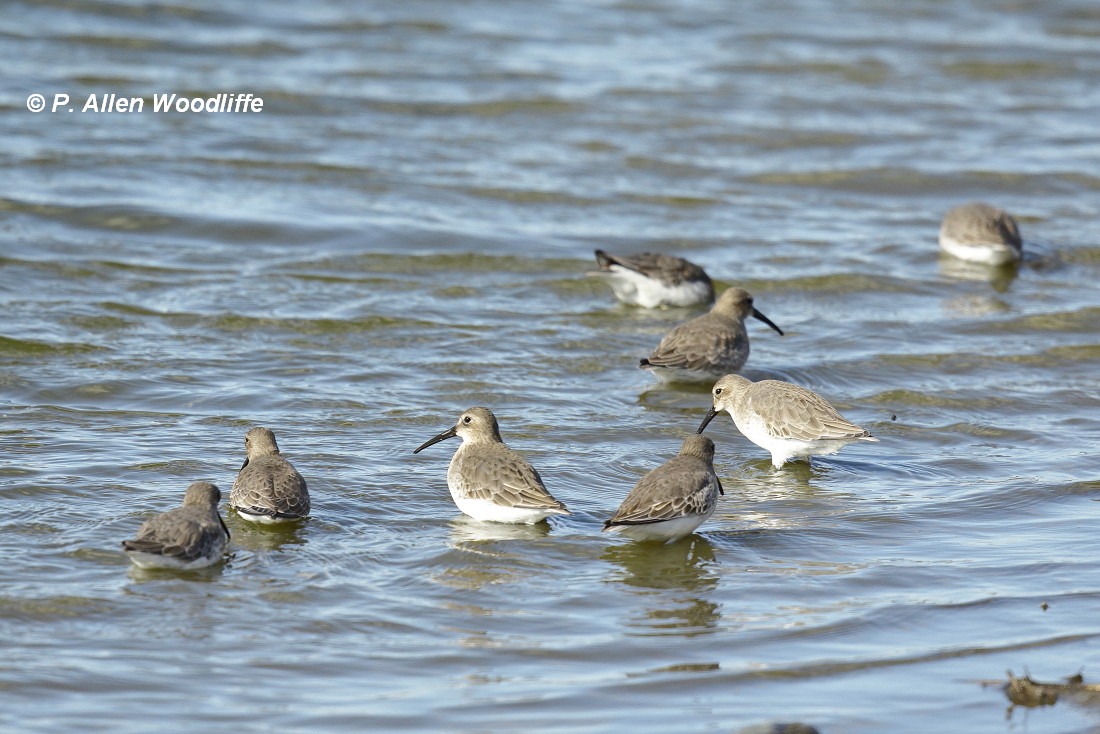
There are very large numbers of Dunlin around right now, with some conservative estimates at these sewage lagoons at least 400 in number. This next photo shows about 65-70 Dunlin partially or wholly in the photo. The large shorebird towards the centre left is a HUGO.

Dunlin
Other shorebirds seen lately, but more difficult to photograph, include White-rumped Sandpiper, Western Sandpiper, Baird's Sandpiper, Semipalmated Sandpiper, both yellowleg species and Wilson's Snipe, among others.
Greater Yellowlegs
I went to Rondeau a bit later that day. There was a stiff NNW wind blowing, which is usually good for raptor movement. I spent a couple of hours in an open spot at the campground which provided a relatively good view to the north and west, as well as being somewhat sheltered for me. A more exposed site might have been more productive, but on a day with strong wind gusts, one has to hang on to the 'scope and tripod or it may be blown over. It can happen, and did on one occasion when I was in the Morpeth Cliffs area, and the base of the scope broke off. Fortunately it was a Vortex scope, with a lifetime warranty, so I eventually got a replacement at no cost.

On this day there was a large number of Turkey Vultures passing through, as is often the case. I spotted both Red-shouldered Hawk and Red-tailed Hawk, along with Sharp-shinned and Cooper's Hawks, as well as American Kestrels. The next two images are of a Red-shouldered Hawk, while the third one is of an immature Red-tailed Hawk. The very cloudy sky made photographs a bit more challenging.


There were other birds passing by, including Tundra Swans.....
....and Eastern Bluebirds. I had a flock of 5 Bluebirds that landed near by, and another flock of 27 that didn't.

An Orange-crowned Warbler stopped by in a nearby patch of goldenrod, searching for a meal. It found a larva of some sort, as shown in this next photo.

There were other birds too, of course. There was a large number of American Robins scattered throughout the park. Puddles on the roadside were great places to see them, along with Hermit Thrushes, as well as Yellow-rumped Warblers.
 Blue Jays are passing through in large numbers, with many exiting Ontario according to the hawkwatching stations close to the Ontario/Michigan border. Some will stay, of course, depending on the acorn abundance or the number of well kept bird feeders in the area.
 Dark-eyed Juncos are always fun to see, and at least some of them will remain over the winter....
 ...as will White-crowned Sparrows, such as this immature one shown next.
All in all, it has been a good few days, and who knows, perhaps the best is yet to come!


Monday, 6 November 2017

Mostly birds on the move

Southern Chatham-Kent, especially Rondeau, has been worth spending some time at. Not because of the weather, since it has been overcast, windy and rainy for much of the last few days, but this is a time to catch up with some mid-autumn migrants.

Last Friday there was a bit of sun, and some brisk north to northeast winds. Perfect for Golden Eagles, I thought, so I spent some time in the campground of Rondeau, which is now closed to camping until next April. There is lots of good views of the sky, and I had seen Golden Eagles from this location before, but not today. The only eagle I got was this immature Bald Eagle. I later found out that during the hawkwatch at Hawk Cliff farther east that day, they had 43 Golden Eagles go by! Hopefully some will still make their way by Rondeau.

I was surprised at how little raptor action there was, but I was kept busy with a few other species. American Robins were numerous, feeding on the abundant crop of Red Cedar berries.


They frequently came to a puddle on the road for a sip of water.
 At times, they were sharing the puddle with Cedar Waxwings.
 Pileated Woodpeckers are not normally found in the open campground, but presumably since the camping season is over....why not? There was a pair busily digging in a willow tree for some nourishment.
 Both Golden-crowned and Ruby-crowned Kinglets are quite common, but hard to photograph. This Ruby-crown paused just long enough this time.
 A few Rusty Blackbirds were also making use of the puddles.
 And what would a campground be without a Raccoon? This fellow was looking a little winsome, since his normal source of food was gone until next spring.

On Saturday morning, I met up with Steve Charbonneau and Blake Mann for a couple of hours at daybreak at the Dog Beach access, scanning for waterbirds going by. It was very overcast and quite windy, but at least the brisk east wind off the slightly warmer water kept the temperature at about 9C, not the 3C it was when I left home. Birds were fairly plentiful, but hard to photograph under such dark and windy conditions, especially since most of the birds were out beyond good camera range. We did get a few loons, and all three scoter species, along with a few other ducks. Two Long-tailed Ducks flew by, but I only got one barely decent record shot.
 There were several small groups of Red-breasted Mergansers zipping by.

A couple of Bald Eagles came by....the bland sky made it challenging.
Several flocks of Sanderling as well as a few Dunlin flew by, with some of them landing briefly on the shoreline for a snack.

A bit of time was spent later along both the South Point Trail as well as the campground, but with the wind, birds were not abundant. On the way home that day I decided to check out the Erieau pier area, since the east winds were favourable to provide shelter on the west side of the pier. It would be a good time for a Purple Sandpiper or Red Phalarope to show up. At least one Purple Sandpiper was seen heading that way a few days ago, but neither the sandpiper nor the phalarope were noted on Saturday. I only got 4 Dunlin at the edge of the pier. This image has been cropped, but I didn't crop the feathers on the bird's forehead....it was like that already!

Today was cloudy to begin with, but the winds were moderate from the north, and there was a promise of some sunshine as the day went on. I decided to set up along one of the open road areas near the Morpeth Cliffs, hoping that raptors on the move would be blown down close to the lake shore and follow it along. Turns out it was a good decision. Over the course of almost three hours, I ended up with eight raptor species (including Turkey Vulture....technically not a raptor, but it migrates along with them) plus the two Sadler brothers and a flock of about 15 Tundra Swans that appeared to have just arrived from points farther north. Highlights included Peregrine Falcon, Red-shouldered Hawk and lots of eagles! In fact of the 160+ birds I noted passing by, I got 13 Bald Eagles and 6 Goldens! A lot of the raptors were moving quickly, or at quite a distance, which made getting decent photos difficult. I would guess that the two Golden Eagles below were at least one kilometre away, perhaps two. So some were at least greatly cropped record shots.
Cooper's Hawk

Golden Eagle (subadult)

Golden Eagle (juvenile)

Red-shouldered Hawk
Things were quietening down by around 2:30 so I decided to check out the Ridgetown Sewage Lagoons on the way home. There was the usual complement of Canada Geese, a couple of Cackling Geese, Snow Goose, some more Tundra Swans, Norther Shoveler, etc.
And for anyone planning to drop in there, some construction activity is going on, so part of the northern lagoon area was inaccessible.
Rear view of Snow Goose (blue phase)


Sunday, 22 November 2015

Just before winter arrives some Cave Swallows appear

There were some quite nice days lately, albeit windy ones. But that all changed on the weekend when many of us experienced our first taste of winter for this time of year.

Some of the weather earlier in the week was conducive for the arrival of rarities such as Cave Swallows. And they did not disappoint. A handful were reported in scattered places along Lake Erie. By Friday, they had arrived in the Rondeau/Erieau area in even larger numbers. Jim Burk had 5 in the vicinity of a farm field just northwest of Erieau. Steve Charbonneau and Brian Morin had one or more at Erieau. Adam Timpf and Brett Fried reported 5 along the east beach of Rondeau, right across from the Visitor Centre. Since the east beach was relatively sheltered from the brisk SW winds, it seemed like the place to check out.

I had already been in the park for several hours in other areas and hadn't been aware of the influx of Cave Swallows posted by various observers earlier in the day. I hadn't even seen another birder during that time. Yes, I know, I'm a bit old school as I don't have the latest gadget that keeps me connected to Ontbird postings when I am in the field. I'm not against the latest technology, but I don't want to be tied to it or interrupted by it. I can enjoy being out in the field seeing what I see when I see it in a sort of serendipitous way. I know I will miss things that others report, but I realized long ago that chasing things that in some instances were only there for the moment was too frustrating.....so I'd rather enjoy what was where I happened to be.
At any rate, I decided to check along the beach at the traffic circle, thinking that it was even more sheltered from the wind and there may be some interesting waterbirds visible or maybe even one of those rare flycatchers that we hope for this time of year. As I approached the open beach, I noticed a swallow zip along the beach heading north! I didn't have time to get my binoculars on it as it crossed the narrow gap, but I noted the square tail and rusty rump even from a distance. Cave Swallow! I continued out and looked in the direction the bird had flown. A moment later I had two more go right overhead. I looked southwards along the beach to see if any more were on the way, when I noticed another birder several hundred metres away. It was Mike Bouman, who had seen some Cave Swallows himself.

As we got together to combine our efforts, Brian Morin and Steve Charbonneau appeared on the scene a short time later. With four sets of eyes the birds didn't have a chance. We watched 5 more Cave Swallows zip by, and I do mean zip. It was still breezy and with a tail wind and the erratic flight pattern of the swallows, they were impossible to get good photos of. In a couple of cases the birds flew almost within reach, and certainly much too close for the camera to focus on. They were either coming right at us or flying directly away from us. This is the best shot I got.....as the Cave Swallow zoomed away. Now if we had been able to convince them to fly a little farther out so we could get a side view as they passed by, the results may have been more to our liking........
A few years ago, in late October 2010 to be more precise, there was an influx of Cave Swallows in the area. I had seen several one evening at Erieau at the fish tug harbour, but the light was very poor. I went before daybreak the next day, since they had been seen to roost the night before, and in the much better light, I got the following photos. They had roosted underneath the piers between the fish tugs.


Earlier this day, I had spent time along the South Point Trail (east) which has lately been a good spot for birds. But it seems that most of the lingering warblers and such were nowhere to be found. I guess the trail area was too exposed to the wind. The lake was quite riled up.

 Birds were very few and far between. Maybe those late warblers were back in a more sheltered area, or maybe they had finally left. Hopefully they hadn't perished. The most interesting birds I saw were two Red-shouldered Hawks.
My next stop was the Dog Beach, but it was way too breezy for anything of note. Even the waterfowl out in the lake were sparse. There were some nice shadows and patterns in the sand, however.

The next area to check out was the campground. Much of it was relatively sheltered from the wind, and the birds were more plentiful. Some of the usual species as well as late migrants were around. There were at least 8 Eastern Bluebirds feeding on Red Cedar berries.
Eastern Bluebird
 As many as 9 Fox Sparrows were in a shrubby tangle, and almost always backlit.
 Red-bellied Woodpeckers were quite vocal.
And a butterfly! Mourning Cloaks are known for late season flight on sunny days before they go into hibernation, so it wasn't totally surprising.
 There were several Inky Caps (Coprinus sp) visible in the grassy areas.
From there, I headed to the beach at the traffic circle, which I started off this post with. Steve, Mike and Brian had decided to continue along the east beach to look for more Cave Swallows, and wait for Josh Bouman to arrive. I heard later that there were more, not surprisingly. I decided to go to Erieau, which was my intention all along. I hadn't planned on spending the better part of an hour along the east beach, but that is the serendipitous nature of it.

It was definitely breezier at Erieau. I stopped to check out Duck Bay, and was rewarded with lots of waterbirds, probably at least 8000 birds, including a Eurasian Wigeon. It is presumably one of the birds that has been seen for the last month or so. The wigeon, with its brick red head, shows up just to the left of centre in this next photo, a greatly cropped one.
 There were several thousand American Coot. We had more than 8000 coot one year on a Christmas Bird Count, so these numbers on this day were not all that surprising. This next photo shows a very small part of the spread out mass of coot.
 Along the bay shoreline are mats of vegetation, and there were approximately 70 Dunlin seen feeding, and at least one White-rumped Sandpiper among them.
Mostly Dunlin
I continued on towards the main channel of Erieau and met up with Garry Sadler. At the channel I noted an adult Bald Eagle perched in a tree along the south beach of Rondeau. Yes there is an eagle there, but it is a loooong way away!

I watched an adult Lesser Black-backed Gull on the far breakwall, likely the same bird that has been there for at least a week. When I glanced away for a moment I glimpsed a Cave Swallow flying a little above eye level right up the channel, heading for Rondeau Bay. But by the time I got my camera out the car window, it was too far gone. I had followed the ABCs of bird photography...Always Bring Camera. However I am going to coin another rule: AHCAR Always Have Camera At the Ready :-).

I then went over to where the fish tugs are moored, hoping for some more Cave Swallow action. Gary and I watched for at least half an hour before the daylight was dimming and the temperature dropping. We saw either one bird on two occasions, or two birds. Were they the same birds that Steve and Brian had in the morning, or were they different birds? With the number of Cave Swallows reported throughout the Rondeau checklist circle that day, who knows, but Steve and I estimated that at least 18 birds were around, and likely more. Whether they survived the rather abrupt change in the weather with below freezing temperatures, brisk NW wind and snow in the next 24-48 hours, is unknown but I expect their prospects were rather dim.