Showing posts with label Beech Blight Aphid. Show all posts

Tuesday, 19 September 2017

Three 'hids': Orchids, Syrphids and Aphids

Last week I had the occasion to show Ontario Parks staff the Nodding Pogonia (Triphora trianthophora) at Rondeau Provincial Park. Given the fairly recent change in Ontario Parks (OP) staff, none of them had ever seen the orchid. And given the orchid's official Endangered status, it was important for OP staff to see it first hand, and have a greater appreciation for the challenges in understanding and ultimately managing for this orchid. Many readers will know that it is a favourite species of mine. I have been observing the species annually for almost 45 years, including having study plots set up in one of the main areas for over 30 years.

This is what we hoped to see, although it is a little late in the season for it to be in its prime.
 We did see a few plants that had drooping flowers, indicating they were in bloom a day or two earlier. But since each flower only lasts for a single day, and all the ones that are ready to open up do so on the same day, the chances of seeing them in flower is limited. We did see plants that had bloomed earlier in the season progressing nicely and forming seed capsules so that is encouraging. A couple of years ago it was so dry that the few flowers that may have opened (and there was no concrete evidence that any did) did not produce any seed capsules at all, which is not good for a species that is endangered and with its entire known Canadian population limited to Rondeau!
Developing seed capsule

The survey of 2017 resulted in only 51 plants being counted, although there is at least one other location in the park which likely had a few individuals. However that location is even more remote, and seldom looked at.

While we were at the Triphora site, we came across some great examples of the Beech Blight Aphid, a.k.a. Boogie Woogie Aphid.


The latter name is due to its action when a branch is bumped or it otherwise feels threatened. They all make themselves a little bigger with their rear end stuck higher, waving a thread-like feature of their anatomy. Supposedly this collective behaviour might scare away any birds looking for a meal along the branches.

After leaving the Triphora site, I took the OP staff to the site of another orchid. It is Autumn Coralroot (Corallorhiza odontorhiza). It is tiny as well, although not endangered. This first photo shows what it might look like from a metre or so away.
 Obviously it doesn't stick out like a sore thumb, but when you get down on hands and knees and look closely, it is attractive. These next two photos show some relatively open flowers. This species is also known to self-pollinate, and sometimes the flowers don't open at all.

 Once pollinated, the flowers and developing seed capsules droop even more, before eventually becoming upright. The capsules will split open in several spots, allowing the extremely light seeds to be transported by even gentle breezes to a location potentially suitable for them.

I also took a bit of time on a recent visit to check out some of the goldenrod, where late season pollinating insects abound. There were the usual wasps and flies. On this occasion I was checking out the Syrphid flies, also known as hover flies or flower flies. The black and yellow patterns are attractive, and help identify them to species. Due to the great number of Syrphids, I posted some of the images on BugGuide, an on-line database designed for people across North America to post images and have them identified. In spite of some of the varied reference books I have at home, the number of insects one will come across is huge, and this on-line database is immensely useful. Here are three Syrphids species that I photographed, although when I initially photographed them, I thought there might have been more than three species. I was not aware of the different patterns between males and females of the species.
White-banded Flower Fly (Eristalis dimidiata) female

Erstaliis dimidiata male

Transverse Flower Fly (Eristalis transversa) female

Eristalis transversa male

Helophilus sp


Friday, 26 August 2016

Endangered orchid, Boogie Woogie Aphid, shorebirds and more

Late August is normally prime time for one of Canada's rarest orchids. The endangered Nodding Pogonia (Triphora trianthophora) only occurs in Canada at Rondeau Provincial Park. The numbers have fluctuated considerably, so annual monitoring is beneficial to understand how the population is doing. I have had a study plot in place since 1985, and have monitored the population there almost every year since.


Nodding Pogonia

It is a small, but very attractive little orchid. I posted a fairly extensive blog about it previously, so will not repeat myself here. If you want to know a bit more about this endangered species, check out this blog post. 

A couple of days ago I met with park staff to visit the study area to see what this year might have in store. I was concerned about the excessive dryness in June and July, as moisture to keep the delicate tuber type root healthy just below the diminishing leaf litter is critical for the species survival.

We parked along the road and headed into the forest, crossing ridges and sloughs to get to the study area. Once there, we checked out the places where this species had been known to flower in previous years. After awhile, it was very evident that it was not a good year for Nodding Pogonia. We saw a grand total of three plants, one of which had grown well but been affected by a blight of some kind. The other two plants had flowered briefly a few days earlier, and had one or two developing buds that, if conditions are favourable, may yet flower.

On the next ridge over, also occasionally good for this orchid, we saw another three plants, none of which had flowered yet but had developing buds. Some years have had over 1000 plants in this general study area. It looks like this year will be less than a dozen. The species is known to fluctuate from year to year, but with the diminishing leaf litter and very dry conditions, perhaps the delicate tubers will not survive dormancy to try another year....time will tell.


While searching for the orchid, my survey colleague called me over as she had noted something quite unusual....it was a branch of an American Beech tree covered with fuzzy white things.
When the branch was bumped, the little fuzzy white things would raise up their hind ends and wave a filament up in the air to make it look like it was dancing!

This is the Beech Blight Aphid, a.k.a. the Boogie Woogie Aphid due to its hilarious behaviour of a branch full of fuzzy white things waving back and forth in unison!

A closer look:


These aphids suck out a lot of sap from a beech tree. After sucking the sap, they excrete copious amounts of a honey dew type of liquid. Since the aphids are concentrated on branches and sometimes even leaves, the honey dew may drip down on a lower branch in considerable concentration. This resulting concentration of honey dew supports the mould Scorious spongiosa, which is especially evident after the leaves have fallen, and may last well into the next summer.
This process seldom does any real or long-term harm to the tree, although sometimes individual branches may die.

Another interesting observation on our orchid search was discovering a small caterpillar that initially looks like a bird dropping. Such mimicry is part of its defense. It also has large eyespots, presumably to appear more fearsome to a would-be predator.
This is the very young larva of a Spicebush Swallowtail butterfly. After it goes through a few growth spurts, it will be a bright green with large eyespots, before going into the pupal stage and eventually emerging as an adult butterfly. I wonder how many times I have passed by such imitation bird droppings without giving them a second glance?

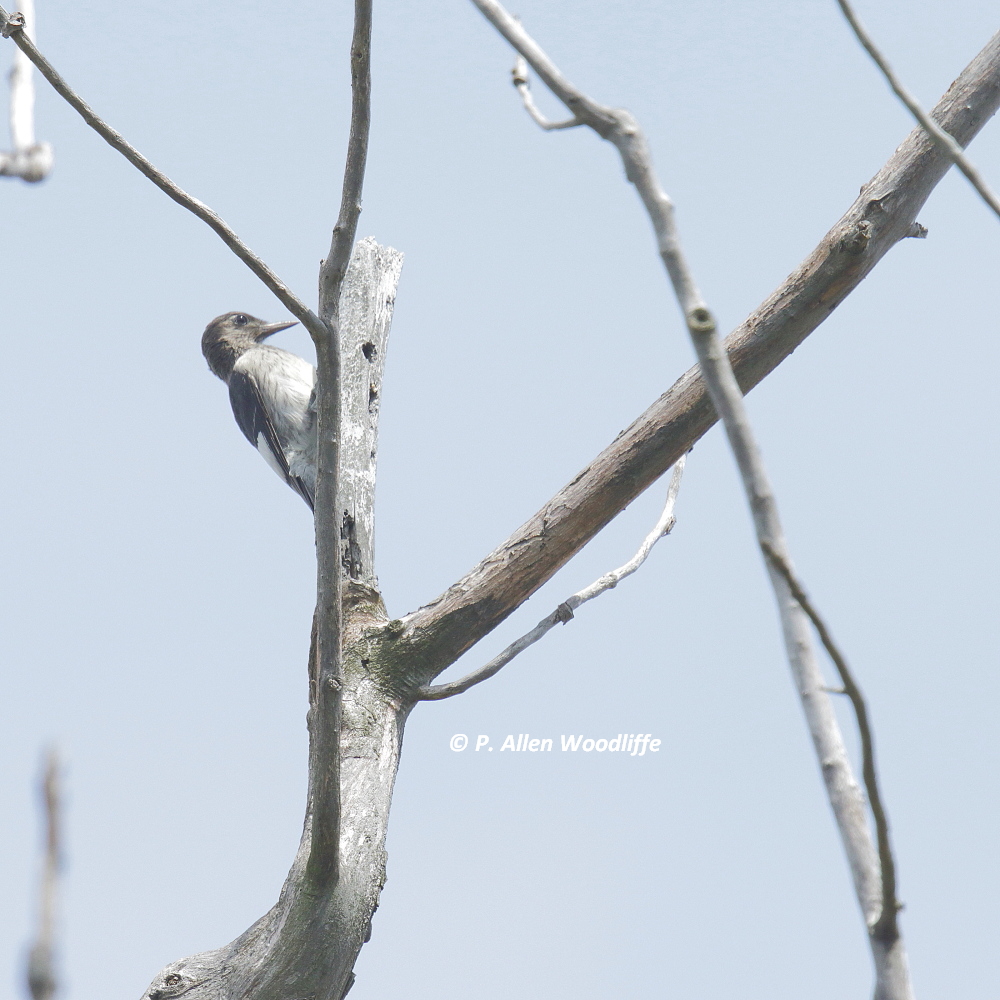
I had heard from the McArthur's that Red-headed Woodpeckers were hanging out in the vicinity of their cottage. We had hoped earlier in the season that a pair of adults would nest in a partially dead cottonwood tree, but that didn't happen. They must have found a location more to their liking. Regardless, both adults and young were now showing up. Although they remained quite high in a dead cottonwood while I was there, I managed to get a few shots, which I had to crop considerably.
Adult Red-headed Woodpecker

Young of the year Red-headed Woodpecker

After leaving the park, I decided to check out the Blenheim Sewage Lagoons. I must admit that I was hoping for a Common Ringed Plover, so I wouldn't be tempted to travel to Toronto to see one (Note: I haven't gone to Toronto, and likely won't). Not surprisingly, I didn't see one here. In fact I didn't even see its look alike relative, the Semipalmated Plover, on this visit. But it was still worthwhile, with half a dozen or so species of shorebirds. Sometimes they are very skittish and getting photos is difficult. I find that if there are a lot of Killdeer, the other shorebirds are more skittish, responding to the startling cries of the Killdeer. When Killdeer are fewer, the other shorebirds are more tolerant of birders.

There were the usual species.

Least Sandpiper

Semipalmated Sandpiper
Lesser Yellowlegs
And there were some less common species including this next one which is my first of the year,
Baird's Sandpiper
Stilt Sandpipers are relatively uncommon in the spring, but more common in the fall as juveniles show up.
Stilt Sandpiper
Although it was windy, I walked along one of the more sheltered paths to see what butterflies were there. I got some very nice shots of the rare Common Checkered Skipper on an earlier visit, and I saw at least 11 individuals on this one. However I only had my camera gear that was the equivalent of a 22X binocular, which could only focus at about 3 metres, so I was pleased to get even one shot that turned out half decent. It blends in quite well on the top of this Wild Carrot.


Thursday, 27 March 2014

Timberdoodle, Boogie-woogie aphid, etc.

It looks like spring is becoming more apparent. I noticed this sign on my travels in Chatham-Kent over the last few days. Thank-you to all who took it to heart and stopped praying for snow :-).


A visit to Rondeau was on the agenda yesterday, March 26. The snow is definitely diminishing, and the ground beneath the bird feeders was almost totally devoid of the white stuff, showing the winter's accumulation of seed hulls. The feeder was reasonably busy, with the usual mix of American Tree Sparrows, Dark-eyed Juncos, White-breasted Nuthatches, Black-capped Chickadees and others. Song Sparrows are becoming more abundant throughout the park, with several seen picking through the accumulated seed litter.


The usual Eastern Towhee was busily picking through the seed as well. Even though there are more of these critters in the park these days, this one was behaving very similarly to the one present all winter, including following the same pattern around the feeder, so I presume it is the same bird.


American Robins are everywhere now. I must have seen about 100 over the course of the day, usually in groups on lawns, but some even in the woodlands of the park. Males arrive first, and are distinguishable by their darker heads. I only saw males today.


One of the highlights of the day was finding an American Woodcock, sometimes known as the Timberdoodle. They typically show up in early March. I glimpsed it out of the corner of my eye while I was driving slowly along one of the roads, so after parking nearby, I got out and carefully approached it. It did not seem to care that I was there, even though I was aiming my telephoto lens at it! American Woodcocks are members of the shorebird family, although they are somewhat atypical; they spend most of their life in upland areas rather than wetlands, grasslands or along shorelines as most shorebirds do. They can be found in wet woods, where probing into the soft earth with their very long bills is a little easier.


They are quite cryptic, relying on their camouflage to make them difficult to see, especially from a distance and if they are immobile. In fact while I was trying to photograph this bird as it wandered through the underbrush, it was very difficult to get a clear shot.

I watched this bird for awhile, and found its feeding behaviour curious. The long beak is well adapted to probing in the earth; the tip of it is flexible so that it can open and grasp an invertebrate critter, including worms. Both the beak and tongue are raspy, enabling the bird to grip slippery critters.

On several occasions I noticed this bird stick its beak into the ground to more than half the length. It remained completely motionless like that for several seconds before withdrawing it.


I was surprised how often the bird came up with a wriggling worm! The sandy ground with the layer of leaf litter must have thawed out earlier than I expected. If you look closely at this next image, you might be able to see the worm, although by the time I took this photo, the bird had managed to manipulate it lengthwise to make it easier to swallow.


The woods are still fairly quiet. Aside from the occasional woodpecker pecking, I did notice some lumpy black things on branches of American Beech trees. They are uncommon but when you find one lumpy black thing you likely will find several on the same tree. This is called Sooty Mould.


It is present due to the Boogie-woogie Aphid. Let me explain......


During the late summer, if you are walking through a beech/maple forest, you might come across branches of American Beech trees that have sections looking like they are covered with snow, which is absurd because it is during the heat of summer. If you look closely at the real thing, you should be able to see parts of it waving around. These are long filaments at the back end of the little white Beech Blight Aphid. If you bump into the branch, all the aphids will start wiggling their hind ends, causing the filaments to wave vigorously, presumably to scare off the offending intruder. But that is where its Boogie-woogie handle comes from.

Aphids suck the juices out of the branches, but not normally enough to cause serious damage to the tree, although sometimes if they are too abundant, some branches can die. After feeding on the juices, the aphids excrete a substance called honeydew, which accumulates below the colony of aphids, ending up either on the ground or on other branches. It is this accumulation of honeydew which in turn supports the establishment of the fungus, known as Sooty Mould.

Another highlight was seeing Eastern Phoebes....at least three of them, all along Lakeshore Road. It was out of the wind, and presumably there were a few more insects available for this predominantly insect eater. But they did not want to cooperate for the camera, so I just admired them from a greater distance.

After leaving Rondeau, I took a side trip to Erieau. As the weather warms up, the ice will recede even more, making photographing waterfowl more difficult so I wanted to give it another try. As expected, there was lots of diversity and numbers, although nothing I hadn't seen before. But some readily swam or flew by the vehicle, so I had to capture a few more shots for the files. I don't really know why I need more photos of Redhead, Canvasback and others.......

The following one shows a side by side comparison of a female Redhead trailing a male Canvasback. The bill and head profile are useful characteristics to separate the two. Canvasbacks have a long, dark bill and a gradually sloping forehead, quite different from the shorter, lighter bill of the Redhead with its higher, steeper forehead.


Lesser Scaup are still present as well, although their numbers seem to be dropping.


Common Mergansers are actually common at the moment. I have posted photos of both the male and female recently, with the female showing a very noticeable crest.

I leave you with the photo below, showing a female in flight, and virtually crestless.