Showing posts with label Virginia Bluebells. Show all posts

Sunday, 28 May 2023

Rare, Threatened and Endangered Wildflowers

 A few days ago I decided to forego any serious birding activities, as this is also the time of year when some of the rarest, most threatened and endangered plants can be found, but it takes some planning.

One of the rarest plant species is an orchid, the Small White Ladies'-slipper (Cypripedium candidum). It formerly grew in small number of widely scattered places in Ontario, but currently it only occurs in an area of eastern Ontario, and on the incredible prairies of Walpole Island First Nation. Due to my working relationship with the folks at WIFN, I have been privileged to have seen them there on a number of occasions from about the mid 1980s until the early 2000s. However I had not seen them for quite awhile, so made contact with someone I have worked with over the last couple of decades or more, and made arrangements to check them out. We ventured to one of the largest and most remote prairies, and bingo, found a couple of dozen or more.


The photos above show pure examples of this endangered orchid. What is even more intriguing in some ways, is that it may hybridize with the Small Yellow Ladies'-slipper ( Cypripedium parviflorum). Finding some of the variable hybrids is always rewarding. These next photos show the variability in their colour, and are known as Andrew's Lady-slipper (Cypripedium X andrewsii). As you can see, they are not pure white or pure yellow, but may vary. Their sepals are typically more purplish than those of the Small White's as well.


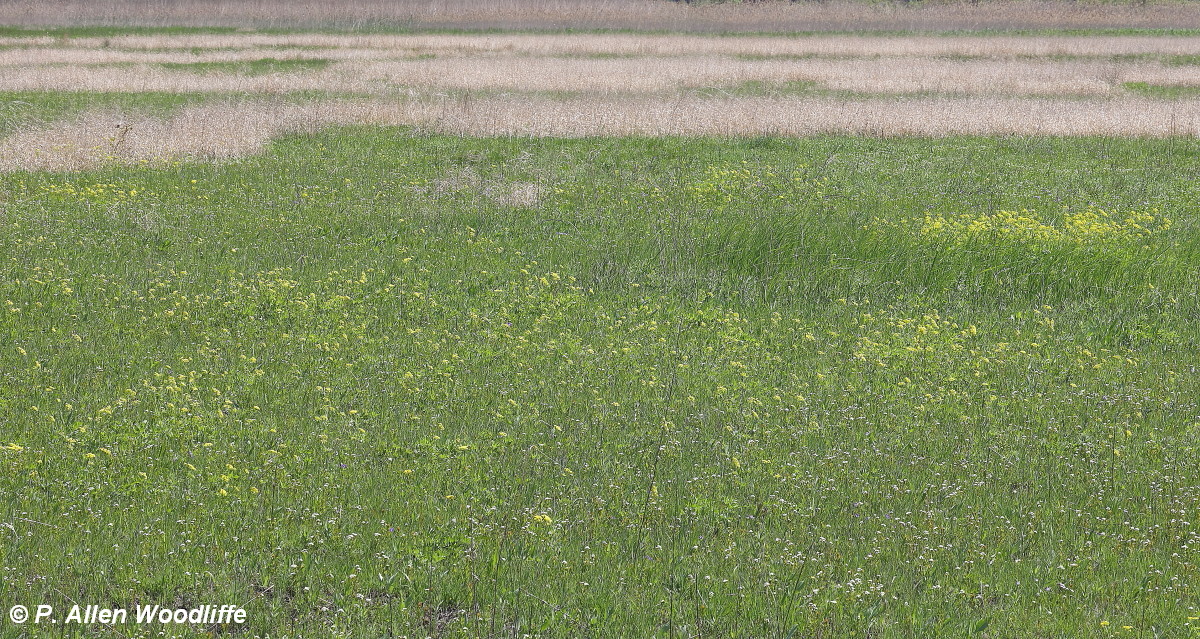
There were other plants of interest on this prairie, but I didn't spend a lot of time with them. This first photo shows a small portion of this phenomenal prairie, much of which was burned this late winter or early spring, creating great conditions for tallgrass prairie. In the first photo, in the middle range, there are quite a few small yellow flowers.

They are Golden Alexanders (Ziza aurea). It is relatively widespread in Ontario.....


 ...unlike this next one, the smallish Yellow Star Grass (Hypoxis hirsuta) which is also endangered, as it is found in less than half a dozen places in Ontario.

I had other rarities to catch up to on this day, and since I was more or less going by the Sydenham River Nature Reserve, owned by Ontario Nature, decided to stop in and see how the Virginia Bluebells (Mertensia virginica) were doing there. I had seen a fantastic display of them a week or so earlier, in Elgin County, but hadn't seen this population on the Lambton/Middlesex border for a couple of years.


They weren't quite as spectacular as in some years. Whether it was due to unusual water levels, or the way the spring unfolded as some of them seemed to show being hit with a touch of frost, or something else. I didn't get to the most impressive part of the site which is not easy to get to. However I was able to enjoy quite a few clusters and individuals throughout part of their normal range here.

They bloom prolifically for a relatively short period, but are likely 95% finished by now.

I left the SRNR and headed to my next target area, to see another endangered species. It was in  Middlesex County, in the Strathroy area, and the species to check up on was Drooping Trillium (Trillium flexipes). In Canada, it is only found in Middlesex County, with a possibility of a population in neighboring Elgin.

I hadn't seen this population for about 14 years, and wasn't certain I could find it, if it still existed. But persistence, and a reasonable memory, of its location proved to work, and I found about 15 plants. It droops more than other Trillium species....

...and a key characteristic is the very short filaments of the anthers, a closer look at these next two photos will show.

I was pleased to find that at least some individuals remained, and had I taken more time to explore, may have found others.

On the way home, I stopped at a couple of places in the Skunk's Misery and Thamesville area, where I expected to find good flowering populations of yet another endangered species, although much more widespread across southwestern Ontario than the other species featured here. It is Eastern Flowering Dogwood (Cornus florida), a largish shrub that can get to small tree size on occasion. These first two photos were taken from the roadside, so I didn't have to go far.


The flowers themselves can vary somewhat in appearance, as the next two photos show. They will have bright red berries when the fruits are ripe later in the summer.

Another endangered species is one that many years ago, was planted in a small prairie patch. It is Moss Phlox, (Phlox subulata) and likes open sandy situations, flowering right at ground level.

So there you have it: a variety of rare, threatened and endangered species that even keen botanists seldom see. These are just a small sample of the incredible diversity of rare flora here in southwestern Ontario!


If you would like to subscribe, or unsubscribe, to Nature Nuggets, send an email to: prairietramper@gmail.com


Saturday, 13 May 2023

Wildflower parade continues; Virginia Bluebells are a highlight

 There are lots of birds around these days, but wildflowers often get less attention. Therefore this will be another post which features the magnificence of many landscapes that birders frequent, but may not always pay as much attention to. That being said, I want to start off with a species of wildflower that is overall quite uncommon, but where it occurs, can be overwhelmingly dominant. I am referring to Virginia Bluebells (Mertensia virginica).

It is not a species that occurs in Chatham-Kent as far as I know, at least not naturally. It will be in an occasional private garden. But the populations I know of and have immersed myself in over the last decade or so are in two places in Elgin Co, and another in a nature reserve that borders Lambton and Middlesex.

These wonderful plants are relatively short-lived, but are dominant when in full bloom. The photo above was actually taken a few years ago at the Sydenham River Nature Reserve. The ones that follow were taken along a hiking trail in Elgin Co, where my sister and her husband invited me to join them a few days ago on their annual trek to see these beauties. It took the better part of an hour along the trail to get to the first of three patches, including a few ups and downs along the trail, so definitely not in the relative flatlands of Chatham-Kent! It covered several acres along Dodd Creek. Most were in full flower, with a few pink undeveloped ones yet to appear.

As in many populations of plants, there can be some anomalies, such as this next one which is fully open but has retained its pink colour.
It was a beautiful day and we had the place to ourselves. Sunny, mild with hardly any wind, and the only sounds were a few Baltimore Orioles vying for territory in the trees above, as well as the babbling creek nearby. (Thanks Susan and John!)


All in all it was a wonderful few hours enjoying this piece of creation.


Closer to home, I continue to be on the search for wildflowers while out birding or whatever. This first one is Blue Cohosh, the later blooming species compared to the one I featured a couple of blogs ago. The flowers are noticeably yellowish, not purplish.

Violets continue to be abundant, with this Downy Yellow Violet one of the most common.....
...a far less common species is this aptly named Long-spurred Violet, which grows in small scattered groups rather than being as widespread as either the yellow or blues ones.
Large-flowered Bellwort appears in clusters here and there.

There are still some Red Trilliums, and I have a hard time resisting them.
Skunk Cabbage was in its prime a few weeks ago, but I missed them at that time. It is not common in most places that I travel.
It is mostly visible by its leaves, rather than flowers these days.
A wildflower soon to be out is Canada Mayflower. The leaves, as shown next, are fairly widespread, and I suspect there may be a few out in flower that I haven't caught up to.

White Trillium continues to show well....

...as in this scene from Clear Creek Forest Prov Park.
Wild Blue Phlox is scattered here and there along roadsides and trails at Rondeau.
Wild Geranium is becoming more plentiful, and the flowers can vary a little in appearance.

Wood Anemone is relatively diminutive, but always pleasing to see if you get down close to it.
...and the sloughs of Rondeau, while dropping in water levels slightly due to the lack of precipitation over the last few days, continues to support members of the Yellow Water Crowfoot.

There will be a steady, but slightly decreasing stream of wildflowers appearing in the next few weeks due to the closing of the forest canopy. Some will likely appear in a future post.


If you would like to subscribe, or unsubscribe, to Nature Nuggets, send an email to: prairietramper@gmail.com


Tuesday, 14 September 2021

Blacklighting and more at Sydenham River Nature Reserve

 Sydenham River Nature Reserve (SRNR) is a fascinating natural area overlapping the border of Lambton and Middlesex counties. The Sydenham River is of high quality and, naturally, meanders through this woodland and floodplain. The SRNR is owned by Ontario Nature, and is adjacent to the wooded McAlpine Tract, owned by the St. Clair Region Conservation Authority. Altogether, this mosaic of extensive woodland upstream and downstream makes for an impressive natural area.

One of the things that, in my opinion, makes the SRNR stand out is its impressive array of an uncommon spring wildflower, Virginia Bluebells. There are hectares and hectares of it, and it is truly a highlight of spring.

One of the most impressive views is along the river itself.

The woodland is inviting during the freshness of springtime, where the water flows quickly and quietly. This quite large Sycamore tree is a landmark of sorts....
...but even in the quiet of autumn, where smaller watercourses meander before entering the Sydenham, the atmosphere can be refreshing and inspiring.

I don't get to the SRNR frequently, but mainly for specific purposes, such as to view and photograph the bluebells. But it is also a very worthwhile location to set up my black lights, to see what I can attract to my illuminated sheets. Surely such a high quality natural area might have a good diversity of species, right? At least that is the hope, and although I have only had the lights on at SRNR on three occasions over the last couple of years (so far) it has always been worthwhile.

It isn't easy to get to many parts of the reserve for black lighting. So far I have only set up at one location, and that is at the end of a dead end road at the bottom of a hill, where I am surrounded by wooded portion of the nature reserve, as well as the McAlpine Tract and an open area recently planted into prairie vegetation. It is quiet, sheltered from the wind, with only occasional sounds of traffic from the paved road more than a kilometre away. One can really enjoy the remoteness of this spot.
I set up one of my lights on a sheet covering part of my vehicle, at the end of the road. The other sheet is over a rope tied between two trees down a woodland trail, about 100 metres or so away. The sky darkens, the wind calms down, the temperature and humidity are promising for lots of insect action, and so I turn on the lights. And wait.

The first few insects to arrive are caddisflies, tiny beetles and always at least a few mosquitoes. Fortunately the mosquitoes have never been a huge problem. It is usually a few minutes before the first moths arrive. 

Caddisflies are not easy to identify. iNaturalist is helpful, and this one turns out to be of the genus Pycnopsyche.

In about 3 hours of black lighting on each of three occasions, I've photographed well over 100 species of moths, and a few dozen non-moth critters. Some are quite colourful and nicely patterned, while others are much more drab to the human eye, or so worn that they are almost impossible to identify. Here are some of the more distinctly patterned ones, partly due to their freshness.

Banded Tussock Moth

Beautiful Wood Nymph

Black-banded Brocade

Blackberry Looper

Chickweed Geometer

Dark Olethreutes
This next one is quite uncommon in Ontario. It is related to the Grass-veneers, and is called a Delightful Donacaula.
A small, but fairly common Grass-veneer is this Elegant Grass-veneer.

Friendly Probole
Some have odd, to us, stances, such as this Grapevine Looper.

Green Leuconycta


Hairnet Acleris
Some aren't so vividly marked, but have well-defined patterns, such as this Interrupted Dagger.
Those Wooly Bear Caterpillars you see roaming about in the fall, early spring or even on warmish days in winter, will develop into this next one, the Isabella Tiger Moth.
A very distinctly patterned moth, as well as being colourful is this next one. It is known as Moonseed Moth, not at all common in Ontario, but widely scattered.

Painted Lichen Moth

Showy Emerald

Soft-lined Wave

Striped Oak Webworm

The Badwing

Thin-winged Owlet

Three-spotted Filip

Two-banded Petrophila

White-spotted Hedya

American Idia

Arcigera Flower Moth
One thing that moth-ers are always on the lookout for are members of the silk moth family, such as Cecropia or Luna moths, or members of the underwing group, noted for their flashy underwings. Most of the silkworm moths would have been present a bit earlier than my visits, so maybe next year. This next one is a member of the underwing group called The Bride, which has a hindwing of golden and black bands, when it is visible.

Clover Hayworm

Cross-lined Wave

Indigo Stem Borer Moth

Large Tolype

White-lined Snout

Of course along with the brightly and/or distinctly patterned moths, there are always too many less distinctly marked ones, due to their specific species, or just because they have been damaged or have had to many of the colourful scales worn off. And some are very small and harder to distinguish. This Black Duckweed Moth, shown next, is very small, with a body length of only about 6-7 mm.

The Canadian Melanophila, is often less distinctly patterned, especially when worn.
Some species even when fresh are a bit challenging, This next one is quite worn as well, but is likely a member of the Leucania genus.
Some worn and damaged ones are likely to show up on the sheet, such as this next one which is not confirmed, but is probably a Wavy-lined Fanfoot.

As mentioned there are always a few non-moths creatures attracted to the light, and they can be fun to add to the photographic collection. Here are a few examples.

Green Stinkbug
This next one doesn't have a common name, but is a type of Weevils
Conotrachelus elegans

Northern Flatid Planthopper
Next is a Treehopper, probably of the Telamona genus.
Leafhoppers are often present and both fun and challenging to photograph. Some are only 3-4 mm long, while the largest ones may be 5-6 mm long. Some are quite distinctly, even wildly, coloured.
Saddleback Leafhopper
I'm not sure of a common name for this next one, but it is Tylozygus bifidus.
One of my all-time favourite leafhopper species to find and photograph is this appropriately named Red-banded Leafhopper.
Each visit results in finding some fascinating elements of nature. It is a bonus to get some decent photos of them. And even in between photographing the visitors to the illuminated sheet, there are other satisfying aspects of a night-time outing to a natural area such as the SRNR. It may be listening to coyotes howling back and forth to each other off in the distance, or giving a whistle-trill of an Eastern Screech Owl and have them respond close by. Or watching a 3/4 moon arise through the trees before illuminating the grassy meadow nearby while a deer forages along the edges. The joy of such an outing is so rewarding amidst all of the daily hustle and bustle that we are normally subject to. I hope to get to the SRNR again before the season is over.


If you would like to subscribe, or unsubscribe, to Nature Nuggets, please email me at: prairietramper@gmail.com