Showing posts with label Ruby-throated Hummingbird. Show all posts

Saturday, 14 September 2024

A new to me endangered species, among other photographic findings

 On one of my recent excursions to St. Clair NWA, I came across a plant that was not abundant, but scattered here and there along the cross-dyke trail. After photographing it and searching its identity, I came to discover that it is Marsh Tickseed (Bidens trichosperma). I had never seen it, or at least never noticed it before. It is considered Imperiled in Ontario and Canada.

While at first glance, it could easily just be passed off as a sunflower type, which it is, the key characteristic to note is the large, but finely divided leaves, unlike any other sunflower type that I am aware of.

Of course any visit to SCNWA will turn up other things to aim the camera at, including:

Northern Harrier

While some of the Sandhill Cranes will be out feeding or resting outside the NWA, sometimes mixed in with geese, they often fly into the NWA for over night, so being ready for them in the evening can be successful.

In checking the range and locations for the Marsh Tickseed, I found out that there are a couple of records for Rondeau. I had never seen it there before. Since this was prime time for it to be in flower, and most visible, I decided to check out similar habitat along the Marsh Trail at Rondeau.

While I was not successful in finding it there, yet, I have another location in the park to examine. But over the course of my 10 km hike, I did come across other things that I aimed the camera at.

Straw-coloured Flat Sedge
This next one, Swamp Thistle, looks a lot like one of the other thistles in this group, but its particular colour of purplish as well as the general shape of the flower head and the supporting flower structure is distinctive.
Swamp Thistle

White Turtlehead

Smeared Dagger moth caterpillar on a sedge

I only had my camera with the 100 mm macro lens so as to be able to photograph plants. Had I taken my other camera with the big telephoto lens, I could have gotten some great shots of a pair of adult Bald Eagles soaring not all that high up against a blue sky (much closer than this next photo, which was taken awhile ago)....

....and a close-up of a Sandhill Crane that flushed out of the marsh not far away (again, this is one from awhile ago). But since I knew I was going to be out for a long walk, I didn't want to burden myself with the second, larger camera gear.

On another occasion, while searching for plants in the interdunal meadows of the southeast beach of the park, I came across a few things such as:

Bristly Sedge

Common Buckeye caterpillar
An adult Common Buckeye was busily flitting around close by, sometimes hunkered down amongst the grasses.

Little Green Sedge
This next pink beauty is a Small-flowered False Foxglove, which was quite abundant in the lower damp areas. It was on this species that the Common Buckeye caterpillar was feeding on.
Along a drier trail I found these white forms of Great Blue Lobelia, usually a deep blue colour.

Along the Erieau Marsh Trail, I came across:


Least Sandpiper
..and some skulking Wood Ducks.

A visit to the Mitchell's Bay North Shore Trail enabled me to get much more open photos of Wood Duck....

...as well as another Common Buckeye...

...a Differential Grasshopper (sometimes hard to figure out where the common name comes from...)...
...this Great Blue Heron...
...and of course one or more of the typical half a dozen Great Egrets that are often found and quite photogenic. This one had just grabbed a fish, which is still showing at the side of it beak.

Last but not least, I made a brief stop at the Keith McLean Conservation Lands, and while photo ops were not plentiful on the visit here this particular time, I did manage to capture one of this Ruby-throated Hummingbird perched at the top of this dogwood shrub.


If you would like to subscribe, or unsubscribe, to Nature Nuggets, send an email to: prairietramper@gmail.com


Saturday, 20 June 2015

Rondeau, end of spring

It is that time of year again when in less than 48 hours, the days will start to be shorter. Not that anyone will really notice for a few weeks, fortunately.

I've been out in the field a fair bit (more on that in a future post), but only at Rondeau on fewer occasions than normal. Nonetheless, there is always lots to see there!

A Ruby-throated Hummingbird is nesting in a quite accessible location along the South Point Trail. After checking her a couple of times, I think she is still incubating, but that may soon change, and hopefully I will be able to catch some of the feeding action.
There are a lot of butterflies along this trail, using the combination of woodland edge adjacent to an extended shrubby habitat, which results in lots of sunny areas. It is always a good strategy to keep an eye on animal poop on the trail, and not just so that you don't step in it. Butterflies are attracted to it! In the following photos, Northern Crescents are sipping away at this delicacy...judging by the amount of what appeared to be deer hair in it, it was likely the scat of a coyote. At times these attractions can be quite busy, with at least 4 crescents in the one photo, and a Question Mark is approaching this buffet in the third photo.


There are often swallowtail butterflies along this trail.
Giant Swallowtail
One seldom gets a chance to capture more than one species side by side, but on one occasion recently two species obliged. There was no special choreographic effort to get them so synchronized...it was simply a matter of waiting until the wind either subsided or blew them over simultaneously.
Eastern Tiger (l) and Giant (r)
Along the woodland edges, Canada Anemone is often prolific.

A brief stop at the Visitor Centre resulted in an encounter with three freshly emerged Red-spotted Purple butterflies. For some reason they were more interested in the boardwalk behind the VC than the surrounding vegetation.
The sloughs along the Tuliptree Trail were a good spot to see dragonflies. A large number of Blue Dashers had recently emerged and were fighting for their territories. They are medium sized dragonflies that have the characteristic pose showing their wings angled forward.
Blue Dasher female
Blue Dasher male
Common Whitetail female
On occasion, Blanding's Turtles can be seen basking in the bigger sloughs. 
Also on the boardwalk over the slough one often sees these Six-spotted Tiger Beetles, which interestingly enough often have more than six spots!

At another trail parking area, I noted a lot of bees buzzing and cruising just above the vegetation. It turns out that it was a colony of Digger Bees. They are often found in drier sandy soil with low, patchy vegetation, where the females dig into the sand so they can lay an egg. Fortunately they seldom sting, although like most bees, will do so if they feel threatened or provoked. Note the one bee right at the entrance while another hovers slightly above and to the right of the sandy mound.
Towards the north end of the park, several of us have been hearing and watching a pair of Acadian Flycatchers. This species is endangered in Canada and Ontario. Rondeau has long been known as a stronghold for them. There are usually at least a couple of nests noted along accessible trails each year, so given the amount of unexplored good habitat elsewhere in the park there are likely several more pairs nesting annually. Fortunately efforts in recent decades have shown that they are more widely scattered across southern Ontario than they were once thought to be. They almost always nest in an American Beech tree, often over the edge of a slough. For some reason one of the pairs decided that the edge of the road was appropriate. Note the location of the nest as indicated by the white arrow. It is easily identified by nesting material hanging well below the actual nest.

Here's hoping that they produce some young Acadians, rather than cowbirds!


Friday, 23 May 2014

Rondeau area update: May 22 & 23

I've been away for a few days.....maybe you have noticed my absence. Marie and I were in North Bay, visiting our daughter and new son-in-law. I'll post a bit of that trip in a future post.

We got back late in the evening of Wednesday, May 21 and I was ready for my 'Rondeau fix'. So on Thursday morning, I headed to Rondeau. The birds along the north end of Rondeau Road were not abundant, but there were a few warblers on the move: Blackburnian and Magnolia especially, and some of the resident warblers were in full song. There were lots of vireos, including Yellow-throated, and a few Empid flycatchers including Yellow-bellied. Pileated Woodpeckers were around, but not very vocal this day. They have a territory and nest site in this vicinity and so are particularly quiet.

Blackburnian Warbler


Rose-breasted Grosbeaks are still around in good numbers...not quite as plentiful as they were a few days ago, however. Presumably some of the ones currently around will remain to nest.


The Spicebush Trail had loads of wildflowers. Lots of different violets, some lingering trilliums, Pepperwort Toothwort and many others. I will do a special post just on some of the wildflowers there. I'll include one of my favourites for now: the White Baneberry, a.k.a. Doll's-eyes, for reasons that will become apparent in a future post.


A Wood Thrush has taken up residence along the west side of the trail, so hopefully some decent pics of adults feeding young may be in store. I also heard a partial song of an Acadian Flycatcher just a bit north of where one has nested in the last couple of years, so hopefully that bodes well for this species.

At the Visitor Centre feeders there was a fair bit of bird activity. Mostly the usual ones, but what caught my eye was this gorgeous adult Red-headed Woodpecker!


It was particularly attracted to the suet feeder and was rather feisty in discouraging some of the other competitors for this type of nutrition.


Later I went to the Dog Beach access, hoping to see some shorebirds, and in particular Whimbrel. Spotted Sandpipers were kicking up a fuss, as were some Killdeer.

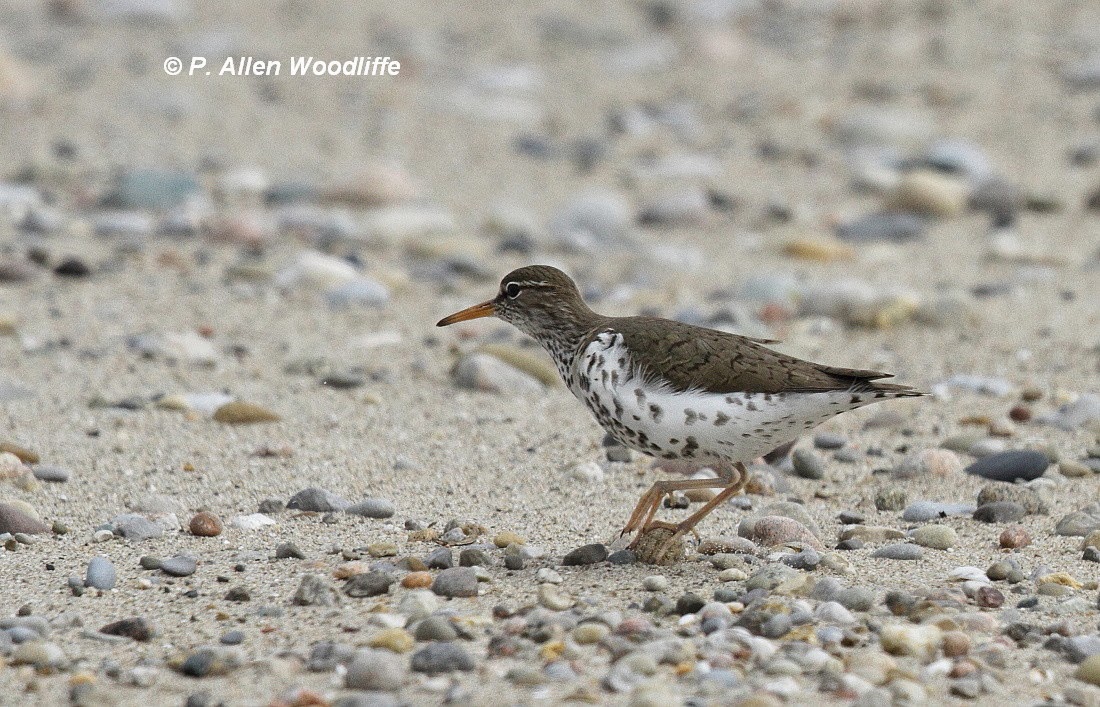
Spotted Sandpiper

And then I noted a flock of three largish shorebirds with long down-curved bills come closer....Whimbrel! They landed briefly nearby, but were quickly airborne again.


Another large flock of at least 250 Whimbrel were well out over the lake, and disappeared without coming close enough for even a long record shot.

On the return along Lakeshore Road, I noted a chipmunk in a tree....not the usual place to see them, but they are avid climbers and on occasion I have seen them near the top of a 30 metre high tree. This one was at a better level for photographing, in spite of the heavy cloud cover and poor lighting.


Today I took a quick trip to Erieau, to see if any more Whimbrel were in the area. This species only passes through in a very short time period.....usually no more than about a week. But none were visible today. I did see 6 brightly plumaged Ruddy Turnstones on the far breakwall.

Along the Erieau Rail Trail there was a smattering of warblers, about 8 species in all. Highlights were Canada Warbler, Wilson's Warbler, Orange-crowned Warbler and Mourning Warbler along with some of the more regular migrants and residents. The dull light and shrubby conditions made getting photos particularly challenging.

Wilson's Warbler
An Eastern Kingbird and Ruby-throated Hummingbird were a bit more cooperative.

Eastern Kingbird

Ruby-throated Hummingbird