Showing posts with label coyote. Show all posts

Friday, 12 February 2021

Where there is water, there are birds

 Open water is a significant attraction for many species of birds, especially at this time of year. Just like humans, birds need water to drink, if nothing else. Of course the term 'waterfowl' implies the importance of water to that group, and many open water areas in wetlands and rivers are a great place to find concentrations of them. With the current cold weather, areas of open water are very limited, not surprisingly. The warm water outlet along the Thames River, on the downstream side of Chatham, is very popular with various water birds. I've made several visits there over the past few days. 

 Certainly Mallards are by far the most common, with typically more than a hundred of them in the area.

 Of course with the warm water flowing into the river, it is also attractive to small fish, and that turns out to be a food source for ducks. In spite of the fact that many ducks are primarily vegetarians, when they are hungry enough any source of food and protein is important. I've even seen Canada Geese gobble down the occasional fish!

There is a small number of American Black Ducks, closely resembling a female Mallard but darker and with a greenish, rather than orangey, bill.

A few domesticated Mallards are present, showing a mix of normal Mallard colours but often with patches of white, since they may have hybridized with domestic white Pekin ducks.
One of the most colourful of our native ducks is the male Wood Duck. A pair of Wood Ducks has been present most of the time.
The female woodie is less vibrantly coloured.
There is at least one female Hooded Merganser, the smallest of our three native merganser species, usually around. In the second photo, there is a Mallard close by, giving an idea of scale.

A female Common Goldeneye has been hanging out as well.
Of course there always seems to be a large number of Canada Geese around. Some are on the ice, but a majority of the several hundred individuals can often be seen on the snow-free grassy river slope across the river.
A few gulls may be around, but not always. This next bird is a Herring Gull. A much rarer Iceland Gull has been seen from time to time.
Where there are concentrations of waterbirds, predators of waterbirds may be around waiting for an opportunity to pounce on some unsuspecting or weakened individual. I have seen an immature Bald Eagle, shown next in the trees across the river from this patch of open water, as well as a full adult Bald Eagle flying through or perched nearby.

On a much smaller scale of open water, are some large ditches which are fed by springs. One such ditch just south east of Blenheim often has one or two Wilson's Snipe present, their long bills probing the unfrozen muddy bottom for some morsel.

A little more unusual for the location, is this Northern Mockingbird. It shows up from time to time, and while it likely is feasting on some berries in the nearby bushes, it will come to the water for an occasional drink.
Right nearby where the mockingbird was, this Red-bellied Woodpecker was found. It probably had nothing to do with the water in the ditch, but was more interested in the woodlot close by.

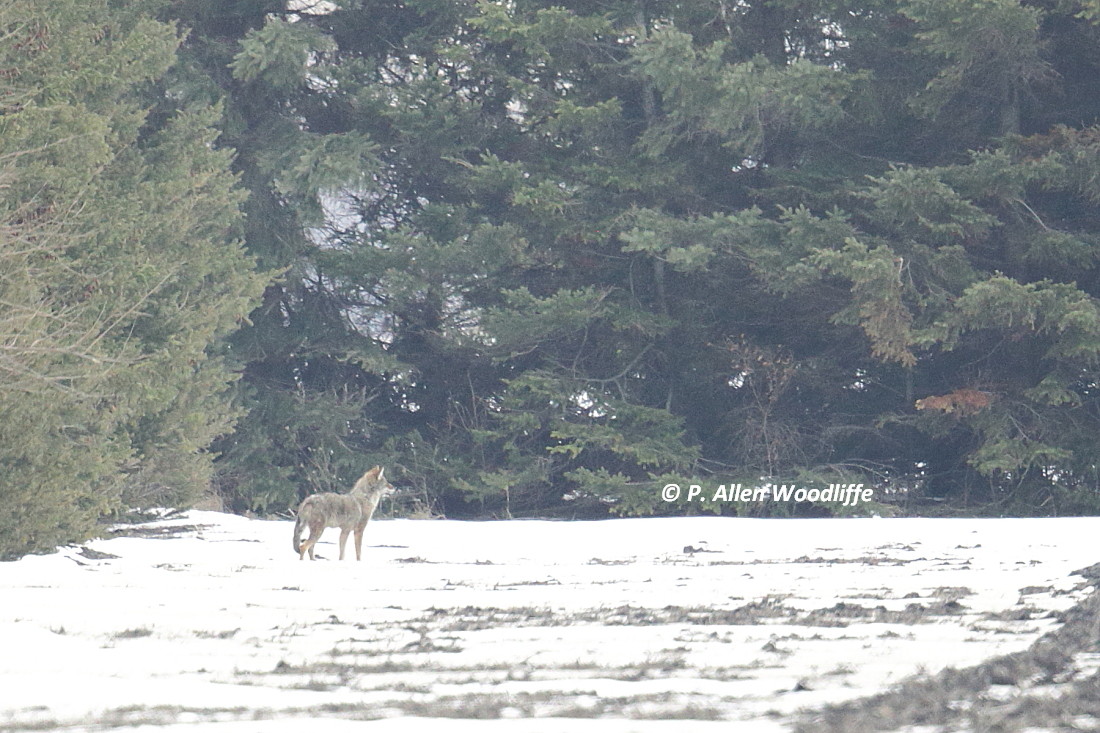
A day or so ago I decided to roam around the former Dover Township, northwest of Chatham. There really isn't any open water readily available given all the cold and snow, so this departs somewhat from the open water theme above. With the landscape almost entirely covered by snow, I really wasn't expecting to see any Snowy Owls. I expect more than one of them saw me, however. But it was still very much a worthwhile time to roam around. I managed to get a few distant photos of a coyote scampering across a field. Being hunted as much as they are, I suspect they are very wary of any vehicle that stops. This individual was probably at least 500 metres away, and although it kept loping farther and farther away, it would stop from time to time and look around. The light wasn't the best angle with the bright sun bouncing off the snow; these are highly cropped.


Another highlight of my roaming around that day was encountering this Merlin perched in a tree. It was a little leery of me stopping the vehicle and pointing something out the window at it, and I only got three or four photos.
I am quite sure that this is the first time I have ever photographed a Merlin!

Closer to home, a periodic walk through Paxton's Bush shows that the resident Great Horned Owls are still around. I'm not sure where they are going to nest this year, as the tree stub they started with in 2020, is not available to them. In case you missed it, you can read up a bit about last year's saga by checking out this. Nonetheless, the owls are still here, although this first photo shows three birds.

Given how close it is to the beginning of the nesting season, and how territorial this species can be, I was a little surprised to see three birds so close together. Presumably the third one might be offspring from last year, and may be learning the ropes for its future activities. Marie and I go for somewhat regular walks to Paxton's Bush, and we will be keeping an eye out for the whereabouts of this nesting location.


Friday, 9 February 2018

Early February Finds

I'll get back to the series on Natural Areas of Chatham-Kent soon, but I want to get this more timely post made.

Birding in winter can be a challenge to find much diversity. Thank goodness for feeders! Recently I wandered around part of the former Dover Township west of Chatham to see what I could find. Some Snow Buntings were around, but not close enough. Some Horned Larks were a bit more willing to stay close enough to the road. They are early migrants, singing away already.
 This next photo shows the 'horns' a little better.
While driving slowly I noticed a canid off in the distance. It went through the end of the hedgerow, and stopped briefly due to something of interest off in the distance, and allowed me to get this photo.

The warm water outlet at the west end of Chatham had a few ducks, but of most interest was this female Belted Kingfisher.


A trip to Rondeau went well. Not surprisingly the greatest bird diversity was at the several feeders in the park. There were the usual things: Dark-eyed Juncos, Am Tree Sparrows, White-breasted Nuthatches, Blue Jays, Northern Cardinals, Red-bellied Woodpeckers, Downy Woodpeckers and such. Several Red-winged Blackbirds swooped in at one for a feed.

Downy Woodpecker


 I know....who bothers to photograph House Sparrows!

Away from the feeders there were a few things scattered about. I came across this White-throated Sparrow feeding along the side of the road.

This Hermit Thrush was the first of 2018 for me. It was hanging out in a brush pile at the pony barn.
Outside of the park I spent a fair bit of time driving back roads, hoping to come across a Northern Shrike, but it was not to be. On the way home one time, I checked for the ongoing Wilson's Snipe. It was there, but much farther back from the road, so only got a distant shot.


Saturday, 23 September 2017

Rondeau nightlife

The park is fairly quiet these days. However with the continuation of mid-summer temperatures insect activity is still in full swing. It is a great opportunity to set up the black light in an otherwise dark environment to see what comes in. It is a bit late in the season for any type of large silkmoths, such as Luna or Cecropia....that will have to wait until next June or early July. But there are myriad other moths as well as beetles, bugs, flies etc.

A few days ago, I went out and found an out-of-the-way location to set up in the early evening (Park staff were aware of my interests, and were most interested and supportive.) Once my equipment was in place, I settled down to wait until it was fully dark. I didn't want the light on any longer than necessary, as it was not in the ideal location for a car battery to die!

I heard the occasional Wood Thrush in the forest, and there were a few warbler type chips as well. Right at dusk, a Great Horned Owl was hooting up a storm, but quite distant. I decided to try whistling for Eastern Screech Owls, and after a little encouragement, one responded not too far away. A little later it, or another one, came in quite close all on its own. There were probably at least three screech owls calling while I was there.

Just at dusk, I heard one of the resident coyotes howling. It was probably at least half a kilometre down the Harrison Trail. A little later, I heard another one howling, and this one was probably no more than 200 metres away, if that. A couple of coyotes farther south were conversing with this closer one. I even howled a couple of times myself.....it would have been interesting to know what the coyotes thought of that stranger in close proximity!

Other flying things arrived as the dusk settled in.

Mosquitoes weren't a huge problem, but they made their presence felt. I was hoping that after dark they would become less of a problem, and that is indeed the way it turned out.

(Note: I have various excellent reference books which are invaluable in determining what I am able to capture digitially. However I also rely on an online database called BugGuide to discover or confirm these insects, and most of the ones I take end up being added to that database.)

A brown stinkbug was an early arrival.
Banasa calva
A surprise guest was this backswimmer! I wasn't anywhere near water, and in fact even most of the sloughs are quite dry, so I'm not sure what this critter was doing.
Notonecta sp
Moths did arrive. A relatively large and distinct one was this Large Tolype.....
Tolype velleda
 ...a much smaller and less patterned one was this Gold-striped Leaftier.
Some are as yet unnamed.

A medium sized moth that varies considerably in its colour is this Large Maple Spanworm.

 On one occasion a Large Maple Spanworm decided to settle on the stick I was using to suspend the black light. Since I took all of the photos with a flash, I didn't notice what seemed to be a pair of eyes lurking in the background until I was processing them on the computer. Was it some kind of night creature with glowing eyes watching me curiously?
 A closer, highly cropped look shows them to be two very tiny yellowish-green leafhoppers! Unfortunately they are slightly beyond the narrow field of focus, so don't show up really clearly. They are very tiny.....probably no more than about 2-3 mm in length.
This next image shows a 'large' leafhopper of the Gyponana genus. There are more than 22,000 described species of leafhopper worldwide, and it is believed that there are more than 100,000 species, many of which have not been described or likely even discovered. There are 'only' about 3000 in North America......

Leafhoppers are never large.....but they may seem to be when compared to their smaller relatives. It is about 6 mm in length so it is a comparative large species
 But on this next photo, one can see both of these species showing the relative size.

Another leafhopper, possibly a member of the Scaphoideus genus and also distinctly patterned also decided the black light was worth checking out.....
 ....as was this Syrphid Fly.
Toxomerus geminatus
I didn't want to press my luck with the car battery, so after about an hour and a half I decided to call it a night. The number of new insect arrivals were slowing down.

I wasn't sure what to expect when I first set up. But the night life of calling Great Horned and Eastern Screech Owls, along with the periodic coyote chorus, all the while under a brightly lit starry sky, was very much worthwhile and totally enjoyable. And the insects didn't disappoint either. In fact, I am quite sure I will take advantage of the continuing warm nights and try it again real soon!