Showing posts with label Turkey Tail. Show all posts

Friday, 20 December 2024

Winter owls and fungi

 Okay, owls and fungi aren't a normal mix of topics I cover. But it works for the moment. Owls have become more visible at this time of year, and are always highly sought after by keen birders and even casual ones. Some are year-round residents, such as this Eastern Screech Owl.

It shows up regularly in the cavity of this American Beech tree at Rondeau, although it can be frustratingly absent for long periods. I managed to photograph this on the day of the Christmas Bird Count, as well as a day or so afterwards. Speaking of the CBC, this count totaled 102 species! Considering the windy, cool and rainy weather, that was quite remarkable, but with a good number of excellent birders out to cover their territories, it turned out quite well. This count regularly ends up in the top one or two counts in Ontario.

Continuing with the owl theme, a Barred Owl, usually a resident of much more northern areas, showed up at a small conservation area within the count circle, where a good stand of pine trees were established a number of years ago. It was only seen on one day, and fortunately it was within the CBC count period although not on the count day, so it gets to be added to this year's overall count. I went out to look for it the following day, but was unsuccessful in finding it. Another keen birder had been out slightly earlier in the day, and also did not see it. I know when a Barred Owl showed up in Rondeau on our CBC several years ago, which my birding partner and I discovered, although it remained in the park for several weeks, it moved around quite a bit, so one was never sure where to find it. This next photo is of the one we discovered on that CBC in 2018.

A few years later, in January of 2023, I photographed this next one, in the village of Shrewsbury.

It was sometimes quite visible from one of the streets, and there were many people who got to see it. Again, it moved around so wasn't always found at the same spot, but a little bit of perseverance often paid off. It remained in the area for several weeks. Hopefully the one that was seen just a few days ago in the local conservation area will show up again!

Another even more northern owl species that may show up in southwestern Ontario in winter is the Snowy Owl. It isn't a guarantee every year, but some years there can be quite an influx. A couple of years ago, on the St. Clair NWA CBC, there was a total of 23 Snowies observed! But the following year, there were none. It has been mostly absent this late autumn, but one has shown up intermittently in the area not far from Mitchell's Bay. Sometimes they are sitting on a pole and quite photographic, but more often than not, they are well out in a field, and even with a high powered lens and lots of cropping, the photo is a good record shot only, such as this next one.

Moving on from owls, the late autumn is a good time to look for the fruiting bodies of lingering fungi. Here are some of the ones I have found.

Fan-shaped Jelly Fungus

A type of Inkap
Not sure about this next one, but it could be a Honeycomb Coral Slime Mould.

Aspen Oyster Mushroom
These next two are in the Bonnets (Mycena) group.


A Common Gilled Mushroom

Rosy Crust

Milk-white Toothed Polypore


Pear-shaped Puffball
These next two show different angles of the fairly common Turkey Tail.

A few birds were willing to be photographed on some of my travels.

Hairy Woodpecker
Horned Grebes are in their winter plumage, and scattered here and there, but are typically quite shy for photographers as they dive under and pop back up a little way from where they went down. I managed to get these next two photos in the marina at Erieau.

There were about 20 Killdeer seen on the above mentioned Christmas Bird Count. I photographed one of the 4 I found a day or two later, along the marsh trail of Erieau.
And while Rondeau Bay is mostly unfrozen, it means most waterfowl are well out from shore, probably with the lingering effects of the recent hunting season causing them to be cautious. However some birds, such as this male Redhead, lingered also in the marina at Erieau.

Not something I would usually find while out exploring, but this kayaker chose a day when Lake Erie was quite calm, and paddled quite a way along the east beach of Rondeau, heading to some unknown destination. Perhaps Erieau?


If you would like to subscribe, or unsubscribe, to Nature Nuggets, send an email to: prairietramper@gmail.com


Tuesday, 16 January 2024

Fruit on the Forest Floor, Part II

 I had another post topic planned for this time, but for various reasons, it will have to wait a bit longer. So in the meantime, without a lot of birds to report on now that Christmas Bird Counts are over and winter has settled in, I will catch up a bit on this fungi topic. The first part of this topic, which explains a lot that I won't repeat here, can be found at this link. 

On to fungi! 

The ones featured here were photographed in the fall of 2023, as winter isn't exactly prime time for fungi. Some might still be visible, but with the snow and cold of course, they just aren't going to be in good fresh looking condition.

This first one is a member of the Bonnet group, based on the shape of the cap.

Next is the Ochre Bracket.
It is always useful to get an overview of a fungus, as well as a closer view of the underside. These next two show an Oysterling.

A fungal group that really caught my eye is this next one. It is likely the Pestle Puffball, although it might just be a Puffball. There were well over 100 of these scattered across a well rotting log, and even on the ground, undoubtedly growing on rotting wood just below the surface. This huge cluster was along the Black Oak Trail of Rondeau.
Next is a type of Ramaria, a coral root.
Here is a Ringless Honey Fungus. It grows so close to the ground that I couldn't get any idea of the underside without breaking pieces off.
 

This next one with the bright, colorful cap is a member of the Russula group.

Clearly there are critters in the wild that like feeding on mushrooms, as this slug is doing.
Next is probably another type of puffball, in its early developing stage......
...as it matures, the covering will start to dry and open. It is at this time that a drop of rain, or some other slight disturbance, will result in a little 'puff' of the spores inside to release into the atmosphere, to drift off and find a suitable growing surface, hence the name of puffball.
Some names are quite descriptive. This one is probably a Stinking Orange Oyster......
...as is this one, photographed as late as December 30!
Next shows the upperside of Trametes gibbosa, a type of shelf or bracket fungus.....
...and this is the underside view. It shows little round holes where the spores disperse from, rather than gills of many other types of fungi.
Next is Trametes pubescens.....
....and a species of Tricholomopsis, which due to the hole on the top, shows both the shelf type of form as well as the gills.
Turkey Tail, shown next, is one of the most common members of the Trametes group.
Less common, at least where I have been, is this White Jelly Fungus.....
...and last, but not least for this post, is the quite delicate, but attractive Woolly Oyster Fungus, not common at all in my experience. The upper side has a fuzzy/wooly look....
and this angle shows the gilled underside and the delicate parts of the edge and upperside.


If you would like to subscribe, or unsubscribe, to Nature Nuggets, send an email to: prairietramper@gmail.com

Sunday, 17 October 2021

Fall Forays for Fungi Fotography...fun and fascinating!

 Fall is a great time to find fungi, especially when it has been warm and wet like it was over the last few weeks. I have been out at various wooded areas specifically to find and photograph fungi, with a fair bit of success. I also wanted to put my newest Canon camera, the R6 mirrorless body, to work using its impressive sensor along with the tilt viewing screen which enabled me to get ground level photographs without having to lie on the ground to see through the view finder.

A type of Honey Mushroom
Back in my university days, I elected to take a course on fungi, a.k.a. mycology, which I thought would help round out my education a bit more and be useful in the early stages of my interpretive naturalist career. My professor was none other than Dr. George Barron who, unbeknownst to me at the time, was a very distinguished mycologist who received various national and international awards for his research and contributions to mycology. After he retired, he wrote an exceptional book entitled Mushrooms of Ontario and Eastern Canada, published by Lone Pine Press. It is useful for all of the provinces and states that touch on the Great Lakes and downstream.

 Another useful source of information is this link.

Identification to the species level is not easy. Some may be identified by their macro characters, such as the morels, but many are only identified for certain through an analysis of their spore prints or through dissection. Therefore many of the ones I feature on this post are not identified to species, and some of those that are, are my best guess based on the reference sources I have, or via iNaturalist. Even iNaturalist will only give a general indication of what species it is, since identification based on a single photo is not nearly the same as spore prints and/or dissection, especially since the above ground parts of the fungi are quite short-lived and change considerably. Some may only be visible in good condition for a few hours or days, and disappear once their purpose of dispersing spores has been completed.

Fungi aren't everyone's favourite elements of nature, I get that. But the world would be a much different place if it weren't for the million and a half or so species of fungi that are known across the world. They are at work underground, on leaves, as well as in dead or living wood. Some are the wood-decaying fungi, such as those bracket fungi you see growing on dead or living trees.

There are others that grow from the ground, and are key to providing moisture, nourishment and protection to the tree roots in exchange for some sugars they get from the tree's photosynthetic activity. In fact a mature living tree will have hundreds of thousands of kilometres of hyphae, or mycorrhizae, wrapped around the roots. Those fungal threads in reality make up the bulk of each individual fungus. That is why fungi are critical to a healthy forest, and even when plantations are attempted in agricultural lands, do not do well since the mycorrhizae in the soil have been destroyed through repeated disturbance from tilling and chemical application. The part of the fungus we see above ground is only the fruiting body of the fungus whose sole purpose is to disperse thousands of tiny spores from the gills or pores, to continue the process.


They can be valuable as a source of food for creatures of the forest, including rodents, but also for invertebrates such as this slug, which may in turn be a source of food for something else. Of course we know that some fungi are sought out to be eaten by humans as well, even though many are not edible. 


With that, I will feature some of my most favourite photos that I have taken over the past week or so. All were taken at either Rondeau or Clear Creek Forest provincial parks, or at the municipally-owned McKerrall Woods.

Some are quite distinctive, such as this Bear Head's Tooth, shown first....

....and the Crown Choral fungus, next.
This next one is the White Jelly Fungus.
Sometimes one encounters just a glob, which is probably the Abortive Entoloma. It is a fungus which is parasitic on other fungi, typically on one of the Honey Mushrooms (Armillaria spp.)

Bracket fungi are fairly common. Some have gills such as the first couple show.


Common Fibre Vase

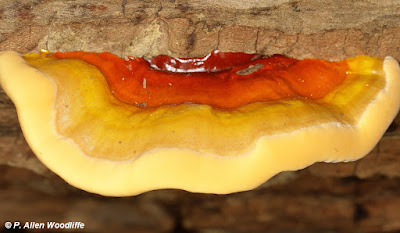
Some are quite colourful, especially members of the Ganoderma genus, which often show a shiny lacquered surface.
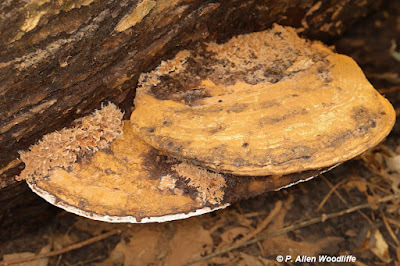
One of the more common bracket fungus types is the Turkey Tail, which has quite a variety of patterns.

Others have tubes instead of gills, such as these, from which the spores are released.

Occasionally you may find a fungus with another other fungus growing on it, as these next two photos show, with the second photo showing a close-up of a fungus growing on the other. I have seen this occurrence on occasion, but haven't got many photos to show.

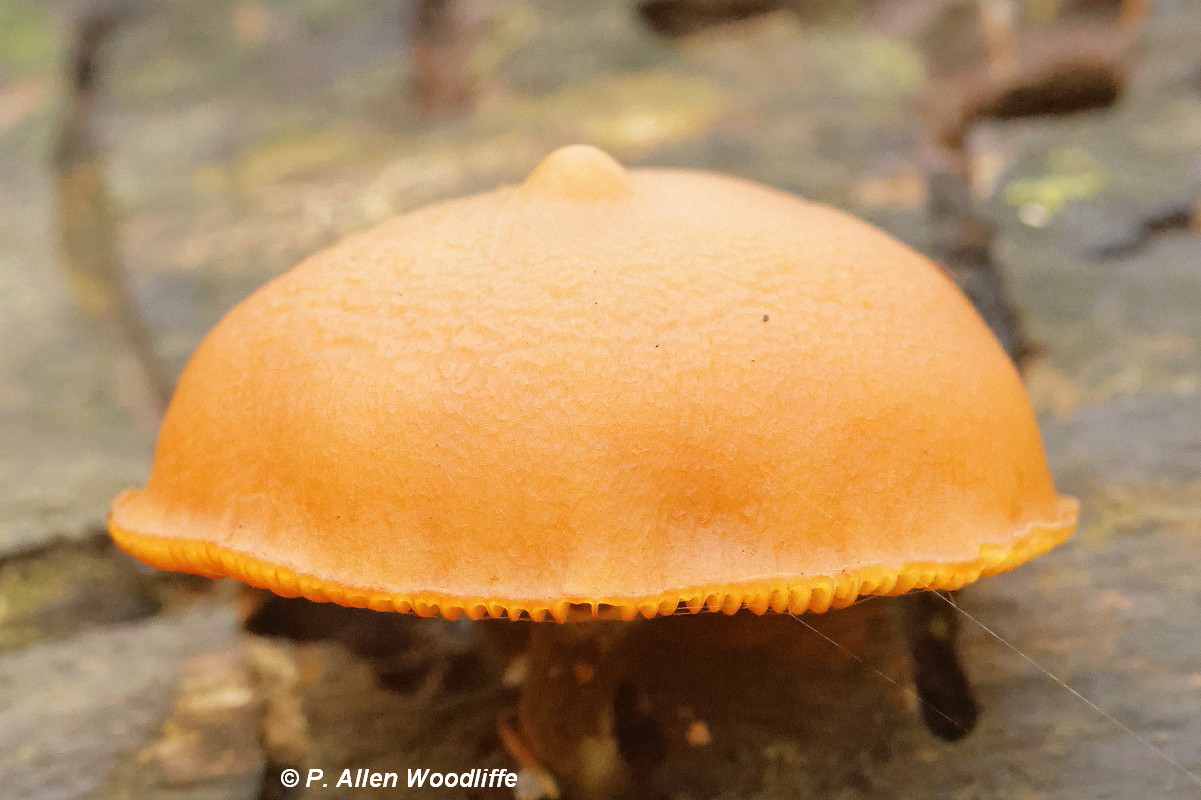
Some are quite colourful. One of my favourites to find and photograph is this next one, the Orange Mycena.

Another colourful one, but more subdued is this Cinnabar Chanterelle.

Scarlet Waxy Cup

There are numerous small, less colourful ones, which are attractive in their own way. The first two are probably members of the Honey Mushroom group, sometimes called Bonnets.


One you may find on lawns is the Fairy Ring Mushroom. This was in the picnic area of Rondeau, and it commonly occurs in a ring, appearing fairly quickly overnight, hence the reference to a fairy visiting and creating this arrangement.
This is a close-up of one of the mushrooms in the fairy ring.


This next one is possibly called Angel's Wings.
And some are very small, spreading across the cut surface of a log.
There are quite a few in the slime mould group. The one below is a type of Stemonitis, also known as a Chocolate Tube Slime. It has numerous feathery strands that disperse powdery spores with the slightest breeze.
A fungus that may be better known to some readers is the Giant Puffball. When it is fresh and edible it is almost pure white, with an interior that is solid white. But it doesn't remain in that condition for long, as its prime purpose is to disperse spores, so it quickly deteriorates by turning a yellowish brown, and as the outer layer is damaged or falls apart, releases thousands and thousands of spores.
Much smaller puffball types are this Pear-shaped Puffball.

Some mushrooms are deadly poisonous. Some of the most deadly are the Amanita group, which may have a colourful scaly cap. I don't have any recent photos of them, but I did come across this Golden Pholiota on one of my outings, which has a scaly cap as well. It apparently is edible.

The world of fungi is definitely fun to explore, and there are so many great photo ops!


If you want to subscribe, or unsubscribe, to Nature Nuggets, send an email to prairietramper@gmail.com