Showing posts with label Narrow-headed Marsh Fly. Show all posts

Wednesday, 1 April 2026

Some warmer season niceties

 The ups and downs of the early spring days can be rewarding. At least with the periodic upswing, migrating birds are on the move, and a greater variety of fauna can be appreciated.

I have been to Rondeau on a few occasions, in between rainy days. One of my purposes is to get a fair bit of exercise instead of hanging out and being relatively immobile at home. Some days the camera gets a bit of a workout; other days, not so much. 

In some of my earlier posts, it was plain to see that there was massive amounts of ice on the lake, but it was gradually disappearing. And then there was none.

There is becoming a nice mix of fauna to see. No native spring wildflowers yet, but that won't be long. Wood Frogs are making a bit of noise in the larger ponds of the sloughs.

Tree Swallows are back, swooping after some insects.
A few flies and things are buzzing around, such as this Narrow-headed Marsh Fly
Mourning Cloaks are by far the most numerous butterfly, although I did see one or two of the Eastern Comma type ones but just in flight
There has been at least one Lesser Yellowlegs hanging out in the good shorebird habitat at nearby Keith McLean Conservation Area.
Golden-crowned Kinglets are fairly common.
On occasion, one may see an Eastern Garter Snake out sunning.
Brown Creepers are becoming more numerous, although they hardly ever sit still for a photo! I've even had several show up on trees in my yard at home.
A nice surprise is to see and photograph this American Red Squirrel, which has been hanging around the maintenance area for several years. It is very active, and photos are hard to get. In the case of this one, I had a hard time focusing on it as there was not only a chain link fence to look through, but also branches of a few shrubs.

Other places relatively close to home have proven worthwhile to check out. At St. Clair NWA, there is often a Bald Eagle flying around, but the bland skies don't make it easy to get a good photo of.

On one occasion as I was along the main trail, this Canadian Beaver was swimming by quite close at hand. You don't often see them in the middle part of the day, but there it was.
Sandhill Cranes are almost a guarantee, somewhere either in the NWA or nearby fields.

The Mitchell's Bay trails are worth checking out. Again, Bald Eagles are almost a guarantee, and I often see 4 or more within view, but not always within a good photographic distance. This one is about a year old, due to the brownish back.

Great Egrets are back, and I always look forward to photographing one or more. This first one shows it had recently grabbed what looks to be a small frog.

At other times, they are just busy watching to see what is going on.
There is some great habitat for shorebirds, due to the lower lake levels. This Greater Yellowlegs was a first of the year for me, a little way out from the closest point at which I could observe it.


 If you would like to subscribe to Nature Nuggets, send an email to: prairietramper@gmail.com

Tuesday, 29 April 2025

April showers bring....April Flowers!

 New life is increasing at a steady pace these days. Although there hasn't been a lot of April shower activity, the sporadic bit that we have had, as well as the greater abundance of snow these past few months, has allowed the usual emergence of early spring flowers.

I do most of my spring wildflower exploration at Rondeau, which has some of the greatest biodiversity of anywhere in Ontario. However since it is a peninsula sticking out into the cold waters of Lake Erie, the usual prevailing winds coming off the water affects the temperature at Rondeau making the emergence at least a week or two behind inland areas.

Certainly one of the earliest and showiest wildflower is Bloodroot, a native woodland species that I always consider to be a harbinger of spring.


 At about the same time, is Colt'sfoot. not a native species, but somewhat showy itself. It usually is seen at the edge of woodlands.

As the temperatures increase a bit, and the days get longer, there is a progression of colour. In open, grassy oak woodland, Early Buttercup can dominate. This first photo shows the abundance of this species in a section of the picnic area at the north end of Rondeau.


In the more woodland areas, Dutchman's Breeches are nice to find.
Cut-leaved Toothwort emergence can vary a little, as this one shows that it is just about to open, but not quite. This species can be quite abundant on the rich, forest floor.
Hepatica, shown next, come in two types: Sharp-lobed and Round-lobed types, based primarily on the shape of their leaves. As the leaves of individuals are not always visible, it is sometimes hard to determine which is which. But they are attractive, with the flowers sometimes in a rich purplish colour....
...but more often, as almost white.
Flowers also occur on woody plants, and one of the most dominant species at Rondeau is Spicebush. Due to the more open forest canopy of Rondeau in recent years, as a result of the decline of Ash trees from the Emerald Ash Borer, and the slower decline of American Beech trees due to Beech Leaf Disease, the growth response of Spicebush is quite amazing. When the majority of them are all in flower, it can create a distinctive yellow glow to the forest understorey.
In open, dry sandy areas, Lyreleaf Rockcress is fairly abundant.

Other woody plants that are in flower are members of the willow family. Pussy willow flowers are evident, and on this first one, a type of Drone Fly is sipping away at the nectar. It flew off before I could get a better photo of the fly, but it is quite possibly a Narrow-headed Marsh Fly, shown below.


Narrow-headed Marsh Fly

Flowers aren't always large and showy, and even things like members of the sedge family have flowers of some type. This next one is an Oak Sedge, showing a close-up first, and then a small clump which is fairly common along open forest edges. This one was photographed along the north end of Harrison Trail.


Violets can be fairly common. This is Smooth Yellow Violet, which lacks the hairiness on the stems that are more typical of Downy Yellow Violet.
And of course one of the highlights of the spring wildflower season is the appearance of Ontario's provincial wildflower, the White Trillium. They are just starting to show up at Rondeau, although I expect they are much more common in many inland woodlands. 

These are just a foreshadowing of a much greater variety of wildflowers to come in May, as long as there is adequate April showers! We will certainly see in the next few weeks!


If you would like to subscribe, or unsubscribe, to Nature Nuggets, send an email to: prairietramper@gmail.com


Saturday, 2 May 2020

Birds, and other wildlife, of course!

Even without some of the 'best' spots to spend time in these days, there is lots of wildlife to see! I have continued to get out, safely without seeing many other people, so all is well. Certainly one of the highlights so far are the three American Avocets, as shown in my updated header, with a single bird below. It is certainly one of the most striking of shorebirds, especially in its breeding plumage this time of year. The fact that it is large, and fairly rare for this part of Ontario, makes it all the more appealing. The three of them were discovered yesterday at the Keith McLean Conservation Lands, which is looking good again this year for water birds given the high water conditions.
I spent a bit of time just outside of Rondeau, since the park itself is still closed, and there was a nice variety of things, including my first Baltimore Oriole of the year.....
 ...there were at least three Blue-grey Gnatcatchers flitting about, making photography a challenge.
 Brown-headed Cowbirds are typically detested by birders and non-birders alike. I am not a big fan of them, but they are native, and have managed an interested strategy for long-tern survival. This is a female.
 Hermit Thrushes are fairly plentiful these days, with a few of the other thrush species starting to appear.
 House Finches are often in full song.
 Ruby-crowned Kinglets are darting every which way looking for something to eat. I often don't bother trying to photograph them as they are constantly on the move, but occasionally one is a little more cooperative, remaining in one spot for a fraction of a second.
 Tufted Titmice are not often seen, but these days they can be pinpointed more easily since they are in song.

 White-throated Sparrows are fairly common these days as they scrounge amongst the leaf litter looking for something to eat. This particular day, the ones I saw were all back lit, making the photos less vivid.
In other locales, there have been a few other birds to enjoy. While American Robins are quite abundant these last few weeks, I came across this one near Paxton's Bush. The speckled nature is the result of the partial loss of pigment in the feathers. There is a recent article in the Ontario Field Ornithologists publication Ontario Birds, which features a variety of species that have shown this phenomenon.
 Also at Paxton's Bush, I have recently seen Blue-headed Vireos....
 ....and Black-throated Green Warblers.
 A flooded field is always worth checking out. In addition to several Wilson's Snipe on this occasion, I also found three Pectoral Sandpipers.
 All of the expected swallow species have been back for awhile, and Purple Martins are gathering at martin houses. There is an easily accessible martin house at Mitchell's Bay park, where I shot the male and female shown here.

 Turkey Vultures are frequent. I haven't caught up to a Black Vulture yet this year, but I keep looking.
 Yellow-bellied Sapsuckers are quite regular these days.....
 ....and Chipping Sparrows are common on lawns and other short grass sites.
I photographed this Chipping Sparrow while I was waiting to 'shoot' a Red Fox. I had been notified of a fox den on a piece of private property that I had access to. The first evening I was out, I watched and waited for more than two hours, without seeing the fox. I did see more than 20 species of birds while I was standing waiting. But the second time I went out, after an hour and a half, and just as it was getting very dull, the fox showed up briefly. I saw him/her for about 15 seconds and managed three photos. Since it was running through a shrubby area, the focus was thrown off, and so I only got this one photo that was worth keeping.
There are other types of wildlife to shoot at this time of year. Again, while I was waiting for the fox to show, I photographed this cottontail. Clearly it has survived being close by the fox's hangouts, at least for now.
 Eastern Chipmunks are out and about, and often fairly vocal.....
 ...as are their larger relatives.
 On the occasional sunny day, a wetland can have dozens of Painted Turtles out soaking up the sun, necessary for the egg development inside the females so they can lay them in another month.
 The Narrow-headed Marsh Fly is one of the most abundant types of syrphid flies in the spring, and throughout the year for that matter.
 Mourning Cloaks are flitting around or pausing to soak up some sunshine....
 ...as are a few Red Admirals.
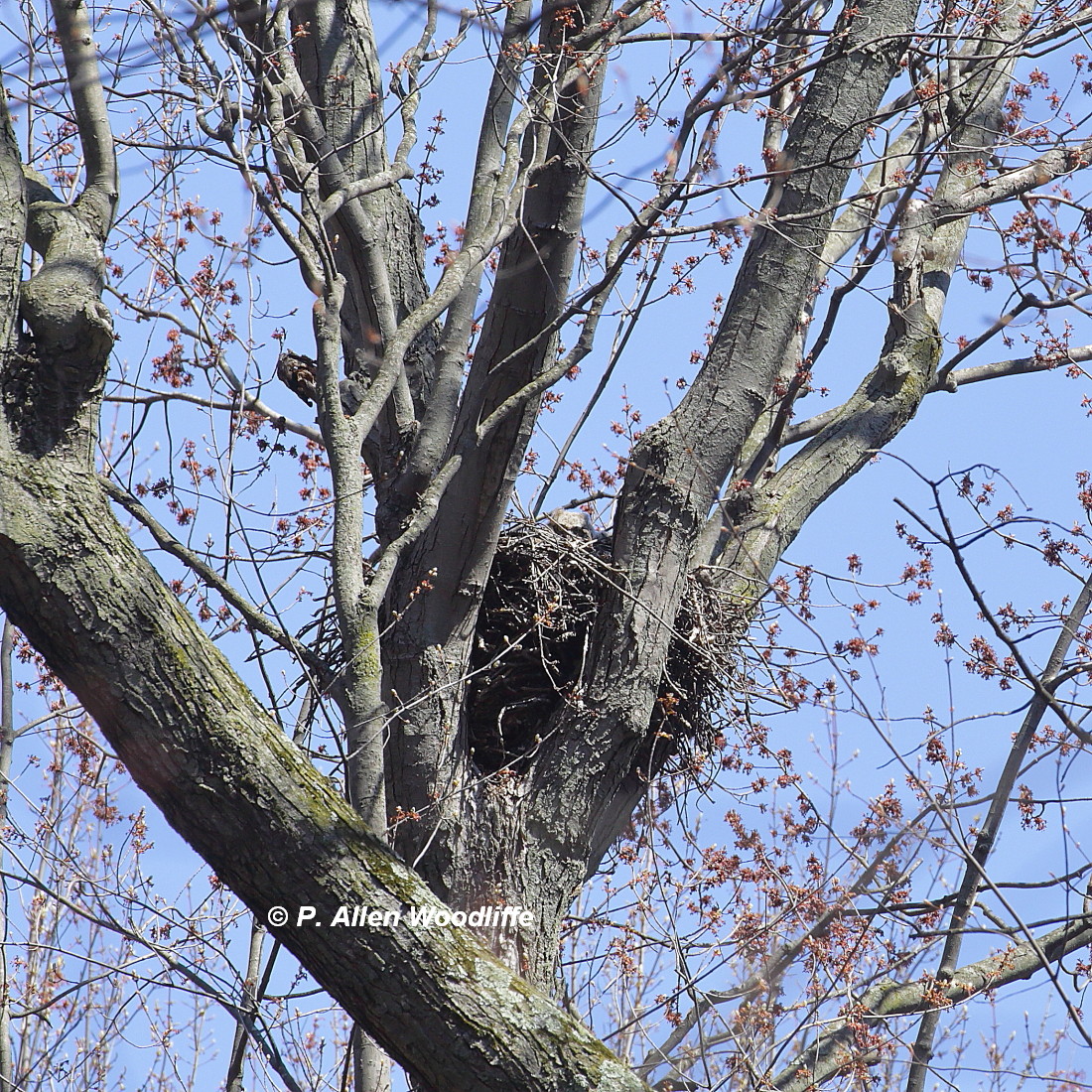
 And a Great Horned Owlet, not the ones at Paxton's Bush, is growing and will soon be leaving this nest. You can just barely see it peering out at me, as I am possibly the first human this owlet had seen.
Ahhh...spring time! So much is happening, and there is so little time to catch up with it all!