Showing posts with label Northern Parula. Show all posts

Saturday, 20 May 2023

An Endangered Species, good numbers of warblers and other birds

 It is a special highlight when the presence of a seldom seen endangered species, and in this case, a very cooperative one, occurs. I am referring to the endangered Loggerhead Shrike, quite a rarity even in its normal breeding range, which hasn't included southwestern Ontario for many decades. But one was seen a bit north of Erieau a few days ago, and for some reason has decided to stick around for several days. Not that the habitat is any good for breeding, as it is predominantly very open farmland rather than the open alvar habitat it prefers. I have been fortunate that it has decided to stick around, as during the first 3 days of its presence I was too pre-occupied with other things and couldn't get to see it. Fortunately this morning I managed to track it down and get a few photos, although the sky was quite bland.

I had driven by this spot a few moments before and the bird was not visible. When I did see it, it was quite busy preening. I suspect it had taken a bath in a close by creek, and then came up to the wires where it preened the entire time I watched it. Maybe if it sticks around a bit longer, I will get a photo of it looking sleek and with a nice blue sky background.

The warbler parade is well underway at places like Rondeau, and while I have seen quite a few of the ~30 plus species that regularly show up, I have not been able to get photos of them all. But some have cooperated for me, at least for a record photo, as follows.

American Redstart

Bay-breasted Warbler
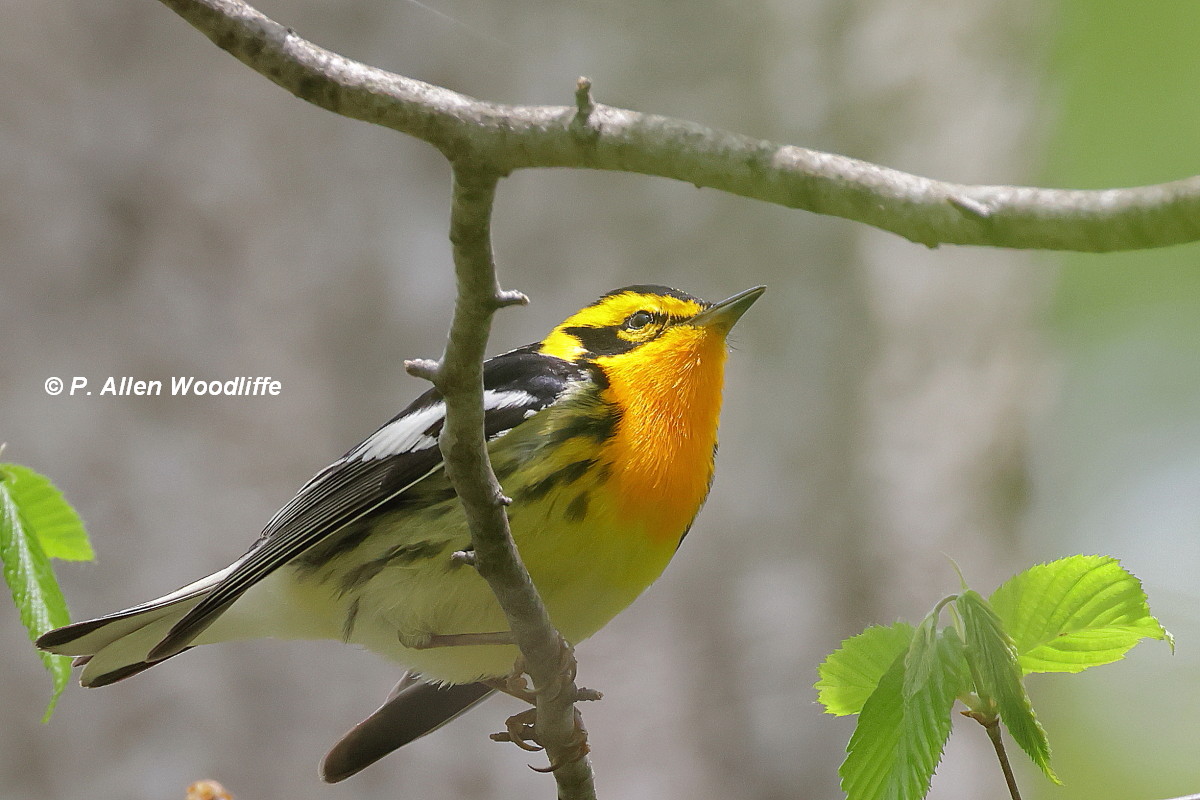
A real crowd pleaser is this next one, the vibrant Blackburnian Warbler.

More subdued is the Black-throated Blue Warbler, especially the female, shown first.

A species at risk is Canada Warbler, easily told by its gray back, white eye-ring, yellow throat and belly separated by a black necklace.

The female Cape May Warbler, next, is also quite subdued compared to the male.

Chestnut-sided Warbler has occasionally nested at Rondeau.
The Northern Parula has been quite uncommon in some years, although it is fairly plentiful this year.
Yellow-rumped Warblers are typically the first one to arrive in spring, and some years the occasional one may even overwinter. There are still some around now, although they are often gone north by now.

Of course there are numerous other species to look for and enjoy. Eastern Kingbirds like open spaces, and this one decided sitting on a park sign along the beach was to its liking.


Gray Catbirds are quite numerous these days.
House Wrens are busily checking out potential nesting sites....
...or perched on a stub ready to declare its territory.
Red-headed Woodpeckers are not common, but are present in small numbers.

Savannah Sparrow
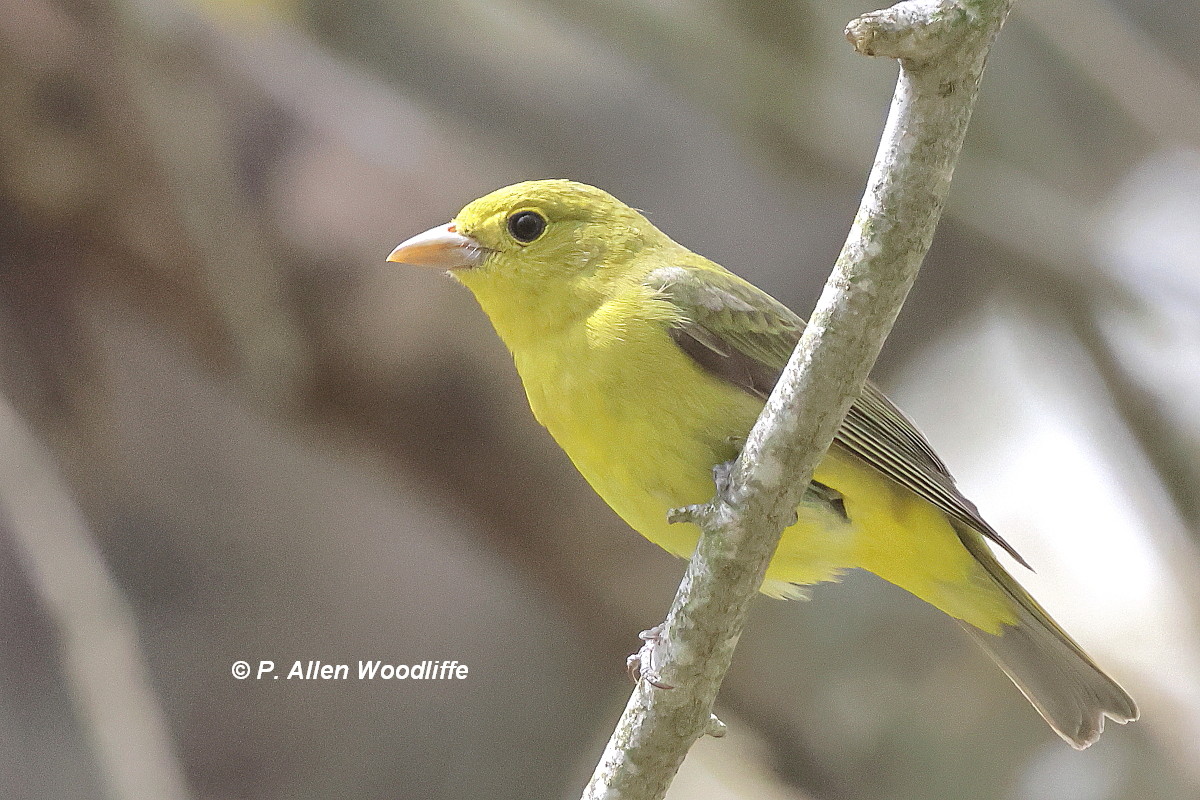
Scarlet Tanagers are here and there, and the females are much more subdued than their bright red counterpart.
Warbling Vireos, next, are fairly common, but are not terribly brightly coloured.
Not everyone likes the Brown-headed Cowbird, a female of which is shown next, but they have their role in nature.

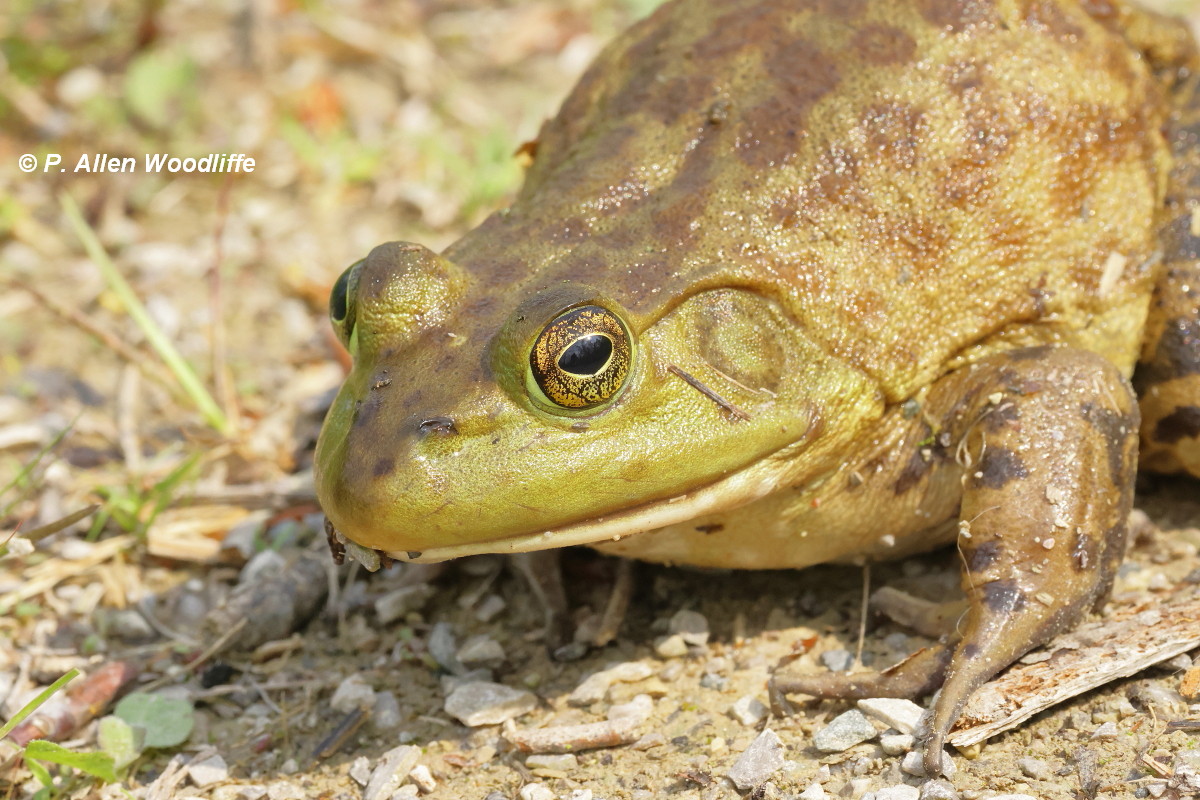
Of course there are other critters to see along the way. This Bullfrog was right on the path, and although he puffed himself up as I walked by, he didn't move off.


This Common Five-lined Skink is anything but common. In fact it is legally endangered. The fairly bright orange face is indicative of its breeding condition.
And Northern Ribbon Snakes, shown next, are also a species at risk. It looks a lot like an Eastern Garter Snake, but the lines are a little more distinct with a brighter yellow, and there is a small white patch in front of its eye.

There is always something to see and appreciate! If it isn't birds, it is reptiles, amphibians, butterflies, wildflowers, fungi, etc., etc, or just the peaceful natural landscape!


If you would like to subscribe, or unsubscribe, to Nature Nuggets, send an email to: prairietramper@gmail.com


Sunday, 9 October 2022

More migrants, some late leps, a cactus conundrum and a house of yesteryear

 Autumn is unfolding as it should, and that means there are lots of things to photograph. A few days ago I was out in the Erieau area. I took time to check the main pier, as the uncommon Purple Sandpiper could appear any day. I walked all the way to the end, flushing a multitude of the usual gulls along the way, but only came up with a single Sanderling right at the end.

Maybe next time there will be a Purple Sandpiper to greet me.

A walk along the Erieau Marsh Trail and McGeachy Pond Trail is often worthwhile, so I included it in my itinerary. There was a nice mix of passerines, including:

Eastern Phoebe

Northern Parula

There were several others, but due to the very contrasty light, were hard to photograph.

Butterflies, on the other hand, were typically out in the open where they could benefit from the sunlight energy while nectaring on the flowers. The deep purple of New England Aster seemed to be the main flower attraction.

Orange Sulphur

Clouded Sulphur
The first two are pretty common, but these next ones are much less common. In fact the Fiery Skippers, of which there were several, were the first ones I had photographed this year.

Bronze Coppers, shown next, are to be expected at some point and usually much more common than the Fiery Skippers.
Female

Male

I also spent a bit of time up along some accessible areas along Lake St. Clair. There were some migrants, not surprisingly, including a good number of Blue Jays on the wing....


 ...and some even landed for another shot.


There were a lot of Yellow-rumped Warblers, by far the most abundant warbler almost everywhere you go these days.

And since it is still relatively early in the season, a few Great Egrets are to be found, and occasionally are in an excellent spot to be photographed.

On another outing, I photographed this Prickly Pear Cactus. Cacti of this type are popular, and always fun to be found. But they present a problem, mainly in the taxonomy. What species is it? For many years, the cacti known in southern Ontario were called Eastern Prickly Pear (Opuntia humifusa). A bit later, taxonomists changed the name to Opuntia cespitosa, and most of the ones are still known as that. However this first one apparently is a different species, known as Grassland Prickly Pear (Opuntia cymochila). It is more of a western species, but due to the arrangement and angle of the spines, is believed by Opuntia experts to be this species. This makes for an interesting element to Ontario's Opuntia, as this particular population in the former Howard Township was quite abundant back in the 1940s. A former co-worker of mine, when I was at Rondeau back in the late 1970s, told me of this population which occurred in a large sandy area almost right across the road from where he and his wife lived. His wife was a teacher at the schoolhouse just down the road, and walked by this population almost every day. That was back in the mid 1940s. However as time went on, the sandy area was converted to agriculture, and it eliminated most of the cactus. Now only a couple of dozen plants persist in the road allowance.

Another population of cactus occurs at Rondeau, in the southeast beach dunes. They do not occur there naturally, as some unknown persons transplanted them there in about 1994. They have done fairly well there since. This population has been determined to be genetically similar to the naturally occurring population on Pelee Island. Therefore the species is legally endangered under the province's Endangered Species Act. The conundrum is: what to do with these plants? They are endangered, sort of, but it is debatable whether transplants are covered under the Act. Or should they be removed, since they may end up being a problem species in an otherwise highly significant natural habitat in one of the most significant provincial parks in Ontario? At the moment, park staff are reluctant to remove them, so they continue where they are.

On quite a different topic than the ones above, here is one of the most photographed abandoned houses in southwestern Ontario, perhaps in all of Canada if you believe some reports. It is known as the Guyitt House, and if you google that name, you can find out lots more information about this house. Regardless, it is along the former Hwy 3, now the Talbot Trail, in eastern Chatham-Kent a short distance east of Palmyra and few kilometers before you get to the Elgin Co border. It was built in the 1840s and was occupied up until about the mid-1980s. I took these photos at various times in about 2010-2011. It has continued to deteriorate, but does so 'gracefully' and it is interesting to see the process.

I took these next two and processed them to reflect an earlier age

This next one was taken during a full moon, with a long exposure of slightly more than 300 seconds using the moon as the sole source of light. You can tell it was a long exposure by seeing the white streak just to the left of the chimney on the right hand side, which is how far a star 'moved' in those 300+seconds.

In recent weeks, an unknown person has complained about its condition, and asked the municipality to enforce a by-law forcing the owner to either repair it or remove it. This has caused a great deal of angst for the landowner, who would like to keep it as is, since it is such a popular photographic subject. The landowner gets nothing for it, just the satisfaction of having a popular photographic subject. There has been a lot of support to leave it as is. At this point nothing has been decided, so stay tuned.

Back on the lep theme, here is what Marie and I call our October Cat. It is a fairly well developed caterpillar of a Black Swallowtail. Interestingly although Black Swallowtail butterflies have been in our garden area periodically all season, it wasn't until the last couple of weeks where we could find any caterpillars.


We have seen about 7 in the last couple of weeks. Today we couldn't find any, so it is possible that the remaining ones have gone off to change over to a pupal form, in which it will overwinter.

And finally, a Magnificent Frigatebird appeared near the mouth of the Thames River yesterday. It was initially seen by some fishermen but word didn't get out until late in the day. It was believed to not be in good health. Several keen birders were there first thing this morning, and one group saw it tumble from its overnight roost and fall into the water, barely able to struggle to a log on the bank of the river. Clearly it was not likely to survive. A few people reported seeing it in the morning, and one or more believed a rehabber was tracking it down and taking it in to see if it could be saved.

Marie and I went for a drive out that way in the early afternoon. I had mixed feelings, as I don't chase as many rarities as I used to, and chasing a bird that was almost dead was not all that appealing. We didn't see it, so perhaps it has been rescued by a rehabber. I haven't heard any more on that. Update: it may have been euthanized due to its poor condition.

I wasn't too concerned about not getting to add it to my Chatham-Kent list, as I had the opportunity to see and photograph a quite healthy one off the south beach of Rondeau, back in early July of 2012.


If you would like to subscribe, or unsubscribe, to Nature Nuggets, send an email to: prairietramper@gmail.com


Tuesday, 20 September 2022

Shorebirds, Orchids and Leps

This is post #600 of my blog: Nature Nuggets.  Little did I know at the time back in early 2014, how this would unfold. Thanks to many readers, I find doing this highly satisfying.

 It is a great time to be out exploring, with camera in hand, of course.

The local sewage lagoons have been productive, especially for shorebirds, although things have tapered off in the last 3 days or so. But there has been a good variety continuing to show, such as the following:

American Avocet

Baird's Sandpiper
Typically lots of this next one, a Lesser Yellowlegs....
....and always at least a few Pectoral Sandpipers.

Short-billed Dowitcher
A highlight for at least a couple of days, was this young Willet, a species that breeds a fair way to the west of us here.

Not a shorebird, obviously, but a hunter of shorebirds. From one to three Peregrine Falcons have been seen swooping and diving after shorebirds. This young Peregrine one was a fair distance away, but hovered briefly, allowing me to get this shot.

At Rondeau, there are lots of birds moving through, although they are hard to photograph with the dappled/contrasty light, and lots of leaves.

Northern Parula

Philadelphia Vireo

I also saw almost a dozen White-throated Sparrows, the first ones I had seen this late summer. In pretty short order, they will be one of the most common migrants passing through.

In my previous post, I showed some close-ups of the Autumn Coralroot. Here is an overall view, showing how obscure this little orchid really is! It is about 15 cm tall and in full flower.

In the past few days, Great Plain's Ladies'-tresses are showing up in various grassy places at Rondeau.

The flower spikes have a spicy vanilla fragrance, and the centres of each flower shows a creamy colouration.
I always like seeing a young White Pine seedling make an appearance. Will this one survive to maturity, or will it become nutrition for a White-tailed Deer?

I have been to Clear Creek Forest Prov Park a couple of times, partly to look for a very rare butterfly (Marine Blue) that had been seen, but partly just because the open meadows are great for butterflies and the quiet woods of this old growth type forest is just so inspiring.

I didn't find the rare butterfly, but there was a good variety of more typical ones, including, Common Buckeye, which were actually common.....


Common Ringlet

Common Wood-Nymph
This next one, an Eastern Tailed Blue, was as close as I could get to the Marine Blue.
I was pleased to find at least a couple Great Spangled Fritillary busily feeding on various sunflower types.

Viceroys were fairly common. In fact they outnumbered the similar looking Monarchs.
The couple of Monarchs that I did encounter liked the Teasel...
...as did the Orange Sulphurs.
Red Admirals were very few, at least of what I saw.
I only saw this single Silver Spotted Skipper, but there were likely more.

As I was walking through the open meadow, I noticed this dead tree full of roosting Turkey Vultures. They have been gathering and migrating southwesterly, and the local hawk watch sites have reported them in increasing numbers over the last few days. There are tens of thousands on their way!


In other news, last night I had the black light on in the back yard. Most things I got were fairly typical, but I'm glad I paid a little more attention to this one. It is a Coffee-loving Pyrausta, and is the second one I have had come to the lights in my yard. The first one was back in August, 2020, and at the time it was the first record on iNaturalist, and the first record for Canada. Since then, it has been found in a small number of places elsewhere in Ontario, and someone who was digging through their old moth photos, posted one that was photographed near Leamington back in 2017.
This morning, while enjoying my second cup of coffee in the back yard with Marie, I saw this butterfly come in. I got a quick look, then went and grabbed my camera but it disappeared. Fortunately it came back and I managed to get a couple of photos. It is Horace's Duskywing, a late summer migrant from the south. According to iNat, it is the first record for Chatham-Kent, with only a handful of other records in southwestern Ontario. Most are in Essex Co, with a single record in north Lambton and a couple in the Toronto area.


If you would like to subscribe, or unsubscribe, to Nature Nuggets, send an email to: prairietramper@gmail.com