I've had occasion to check out Bickford Oak Woods Conservation Reserve three times in the last few weeks. It doesn't take all that long to get there, but there aren't any official trails, so one has to be willing to follow some overgrown logging trails, or bushwack their way through once you arrive. At 308 hectares in size (760 acres) and much of it being wetland, it isn't the easiest place to get around, but usually well worth the effort.
Drainage is poor, leading to all sorts of small and large wetland pockets.
 |
| Typical forested wetland of Bickford Oak Woods |
One of the things that Bickford Oak Woods Conservation Reserve (BOWCR) is known for is the only location in Canada for the tree species called Swamp Cottonwood. It was discovered by Gerry Waldron, John Ambrose and Lindsay Rodger in 2002, while doing some inventory work. It is hard to believe that even in this 21st century, new tree species are being discovered in southern Ontario!
 |
| Swamp Cottonwood |
|
Swamp Cottonwood grows to a fairly good size, and occurs in a buttonbush swampy area. There are several dozen trees of various sizes.....the image here is from a very short young plant.
The wetlands are great spots for amphibians, such as this tiny Western Chorus Frog, only about 2-3.5 cm long.

In general, the BOWCR does not have a lot of large trees. It was acquired by business men during a time when industrial expansion of that part of Lambton County was thought to be a good investment. But industrial expansion did not occur in this area, so it sat for decades. It did undergo fairly intensive timber harvest about 50 years ago, as well as some cattle pasturing, so it wasn't in the most pristine shape. But in the late 1990s, the owners called me to see if any government or private conservation agency would be interested in purchasing it, and so a plan of action was put into place. With the extreme generosity of individuals, local field naturalist groups, the Nature Conservancy of Canada as well as Ministry of Natural Resources, it was acquired and eventually designated as a Conservation Reserve. The forest is rebounding from the harvesting and pasturing activity of the past. But hints of such activity remains, if one only looks at the type of tree form that is common to see throughout the drier sections of the forest.
Multi-stemmed tree trunks abound. Oak was a valuable forest product, and so the merchantable timber was taken out. But oaks have a tendency to sucker after harvest, and some of those suckers are now the well established tree trunks. It is quite common to see double and triple stemmed trunks of various oak species.
 |
| Triple-stemmed White Oak |
And on occasion, one may find one with as many as five trunks such as this Red Oak below shows.
With this forest being so large at over 750 acres, it has a significant amount of what is known as Interior Forest, which is the forested portion at least 100 metres from the edge. This is the maximum distance at which edge species, such as Brown-headed Cowbirds, will normally venture in, giving a safer area for birds such as Wood Thrush, Ovenbird and other forest interior species to breed without being parasitized by the cowbird which lays its eggs in other species nests.
Ovenbirds, Wood Thrush, Scarlet Tanager, Yellow-throated Vireo, Rose-breasted Grosbeak and others are fairly common here. Less common species include Cerulean Warbler, Tufted Titmouse and even Acadian Flycatcher. I have seen or heard all of these here from time to time, other than the Acadian......that one is pretty infrequent here.
Some of the largest wetland areas in the BOWCR will support Beaver, and a Great Blue Heronry is in the vicinity of these same interior wetlands.
 |
| Beaver cutting |
I noted this One-spotted Stinkbug along the trail.
And in October, one can easily find Witch-hazel, a shrub that only flowers in the fall.
Some of the property that was formerly in farmland has been left to regenerate, and even had some tallgrass prairie plants and wildlife shrubs established about a decade ago. Right now, these areas are great for butterflies and dragonflies. This first one is a Common Baskettail, but it had me fooled at first because they normally have an obvious dark spot at the base of the wing. It is more noticeable in the second photo.
 |
| Common Baskettail |
Also fairly abundant was Common White tail, as in the next photo showing an immature male of the species.
Twelve-spotted Skimmers were also well represented.
 |
| Twelve-spotted Skimmer |
Wildlife shrubs, such as this Nannyberry, are coming into good flower these days, which is great for butterflies.
 |
| Nannyberry |
 |
| Eastern Tiger Swallowtail |
 |
| Giant Swallowtail |
 |
| American Lady |
In the grasses and clover were some smaller lepidoptera:
 |
| Common Ringlet |
 |
| Juvenal's Duskywing |
 |
| Peck's Skipper |
I'm not 100% certain if this is a Peck's Skipper.....those little rascals are sometimes a challenge unless you get just the right angle to show the important characteristics.....if anyone has a better idea, please let me know.
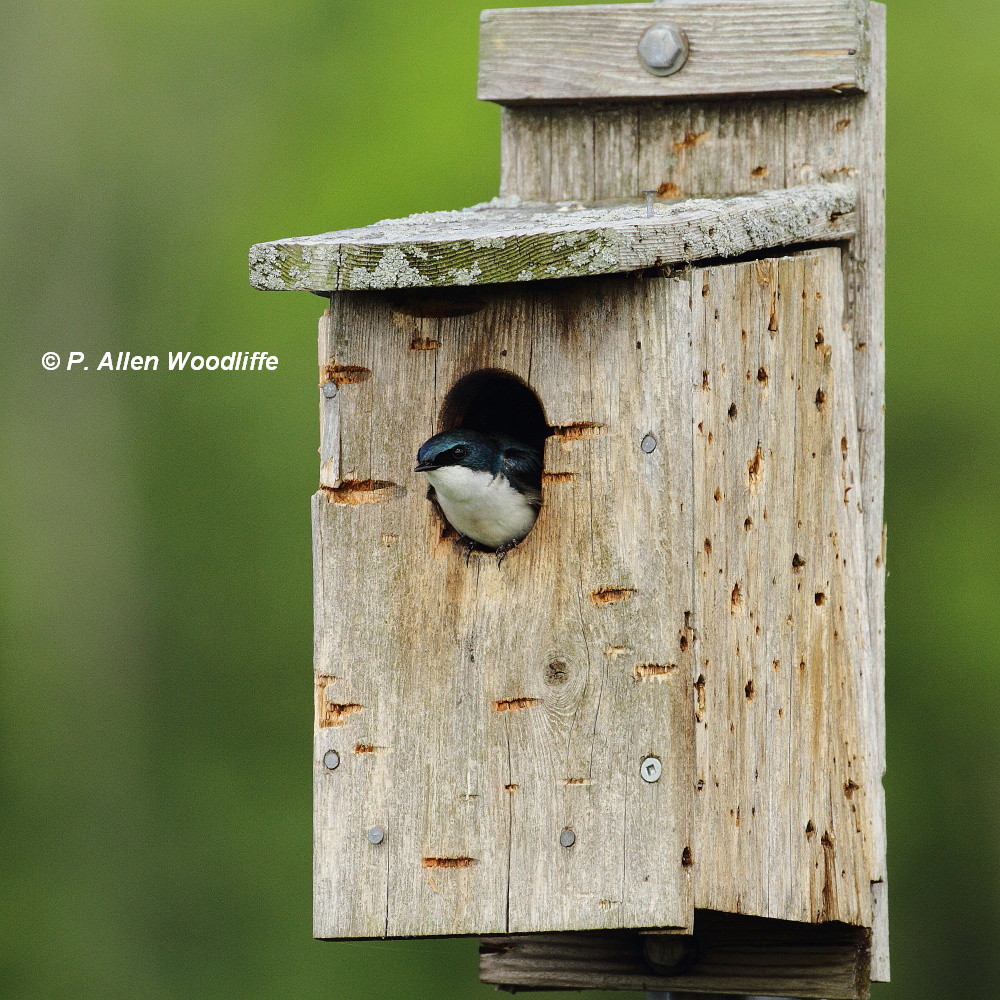
While I was busy photographing butterflies in the open grassy area, this Tree Swallow and its mate were keeping an eye on me.