The Wood Warbler group is the one that many birders consider as the highlight of the spring migration. Birders don't often tally up the number of flycatchers they get in a day, or the number of thrushes or shorebirds. But the number of warblers seen in a day by a single birder is considered a measure of the day's success.
It seems that the numbers and diversity of warblers seen on a daily basis is diminishing. There are currently 40 species of warbler on the Rondeau Provincial Park bird checklist. I recall back in the 1970s and 1980s (yes, I am aging myself) that getting at least 24 species of warbler in a day in mid-May was an average day, and it was sometimes possible to get 30 or more of those 40 species in a really good day. In the last few years, however, it seems difficult to get more than about 25 species in a day, and 20 is more the norm. Some days it is even hard to get 20. Of course the frequent east-northeast winds do not help to draw up the southern migrants or result in fallouts of warbler migrants like they used to.
Beyond the factors of wind speed and directions, I am sure there are other reasons for this apparent decline in warbler numbers and diversity, and that may be the subject of a future post.
The migration of 2016 so far has not been spectacular, but average, in my opinion. Nonetheless, it has been rewarding to spend time on the hunt for migrants, especially warblers. Here is a broad representation of what I've seen and in some cases, been able to photograph. Many of these images have been taken this year, but in some cases I have delved into my archives.
 |
| American Redstart |
American Redstarts are quite abundant right now, and some will stay to nest in the hardwood forest.
 |
| Black-and-white Warbler |
Black-and-white Warblers are one of the earliest to arrive, but do not nest in this area.
 |
| Black-throated Green Warbler |
Black-throated Green Warblers are fairly common, and on rare occasion one or more will linger into the breeding season. There has not yet been a confirmed breeding record of this species in the Rondeau area, although there are unconfirmed records.
 |
| Blackburnian Warbler |
The bright orange throat of Blackburnian Warblers seems to glow,even in dull light. They do not breed in this area, unfortunately. The black, orange and white pattern is very distinctive even to a casual observer.
 |
| Black-throated Blue Warbler |
Black-throated Blue Warblers are fairly common. The female shown in the image above is quite drab compared to her black-throated, blue and white coloured mate shown in the next photo.
 |
| Black-throated Blue male (October photo) |
 |
| Blue-winged Warbler |
Blue-winged Warblers are increasing, at the expense of the declining Golden-winged Warbler. Blue-wings have been recorded nesting at Rondeau on very rare occasion. This one is skulking in the ground vegetation, and did not consider the wishes of the photographer (me) while it was busily searching for food :-).
 |
| Cape May Warbler |
One of the most abundant warblers in the boreal forest region, the Cape May Warbler is an attractive one as well. They are often fairly high up.
 |
| Common Yellowthroat |
The Common Yellowthroat is in fact, common. It is widely scattered in various habitats at Rondeau.
 |
| Chestnut-sided Warbler |
The Chestnut-sided Warbler is a common migrant. On occasion, a pair will be found nesting in the second growth forest sections of Rondeau.
 |
| Hooded Warbler |
Hooded Warblers used to be extremely rare in Ontario. They are officially a Species At Risk. Fortunately their numbers are increasing a bit, and birders are more likely to find one at Rondeau now. They nest in shrubby forest openings over sandy soil. While the species has never been confirmed as breeding at Rondeau, there have been some possible nesting attempts in recent years.
 |
| Northern Parula |
The Northern Parula used to be almost a rarity to see on migration here. In the past, one might see a handful over the course of the spring season, but hardly ever more than one or two in a single day. That has changed, at least temporarily. In 2016 one often had this species on the daily list, with sometimes at least 8 seen by a birder in a day. Reports went as high as 19 by a single observer on one day this spring.
 |
| Northern Waterthrush |
Northern Waterthrush is a regular, but not abundant, migrant. There are no records of it nesting at Rondeau. A close relative, the Louisiana Waterthrush, is much rarer, with its breeding range being restricted to extreme southwestern Ontario. On occasion, the Louisiana Waterthrush has been confirmed nesting at Rondeau.
 |
| Palm Warbler |
The Palm Warbler is one of the first warblers to arrive in the spring. It is easily told even from a distance and in poor light by its habit of pumping its tail. It does not nest at Rondeau.
 |
| Pine Warbler (photo taken in January, 2015, coming to a feeder!) |
The Pine Warbler is another species that arrives early. It has nested on occasion at Rondeau.
 |
| Wilson's Warbler |
Wilson's Warbler is a later arriving species, and continues well to the north of Rondeau to breed.
 |
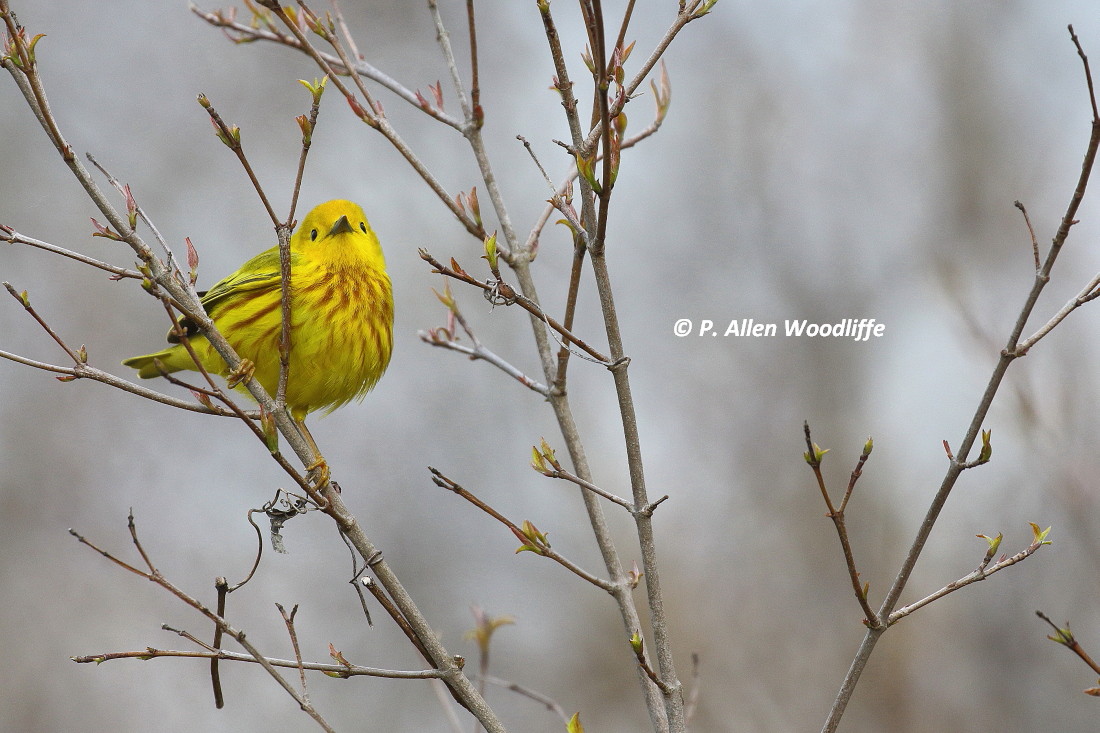
| Yellow Warbler |
I often make the comment that in the 1970s, the National Audubon Society published a 'Blue List' of birds that were of concern due to being in a serious decline. Yellow Warbler was on that list. It is hard to believe, since for a few years now, it is by far the most abundant warbler to be seen in Rondeau and elsewhere. It is not uncommon to see 50 to 100 of these in a single day, and in all different habitats. It is a very common nesting species.
 |
| Yellow-rumped Warbler |
The Yellow-rumped Warbler, affectionately called "butterbutts" by some in reference to its bright yellow rump, is one of the earlier species to arrive, and at times can be very abundant. It does not nest at Rondeau.
 |
| Magnolia Warbler |
Maggies are often fairly abundant but do not nest at Rondeau.
 |
| Prothonotary Warbler |
Prothonotaries are highly sought after to get on one's daily bird checklist. Rondeau has been known as the stronghold for this species ever since Jim Baillie of the Royal Ontario Museum first confirmed them breeding in Canada when he and his colleagues discovered them nesting here in the early 1930s. In the 1980s there could have been as many as 50 pairs in the park. A conservative estimate is that there may be as much as 50 kilometres of linear forest slough habitat in a year with average water levels. Unfortunately due to various factors, the current entire Canadian population of Prothonotaries is estimated to be only a dozen pairs, at the most. It is officially an endangered species, both provincially and nationally. Rondeau still attracts several pairs a year, but due to the difficulty of monitoring those ~50 km of habitat, no accurate survey has been done for a long time.
 |
| Male PROW after having a bath, showing his white tail flashes |
 |
| Worm-eating Warbler |
Worm-eating Warblers are really few and far between in Ontario. It is a southern warbler that is not recorded at Rondeau every year, and when word gets out that one has been seen, it quickly draws a crowd of birders. One was seen along the Spicebush Trail just yesterday, but few got to see it. This photo was taken from along the Spicebush Trail in 2013, when one was cooperatively foraging in some open ground level habitat and it popped up to about eye level on occasion.
 |
| Worm-eating Warbler |
Surely there are more warblers to come in the next few days, and maybe even some rarities. You can bet that some avid birders will be scouring the forests to get some of the later and elusive ones such as Connecticut Warbler (one was seen and photographed on the Spicebush Trail yesterday). Even though the Victoria Day weekend will be a thing of the past in a couple of days, it does not spell the end of the spring migration, although it is surprising how few birders continue with any serious birding after this holiday. I will be out looking when I can, and maybe I will catch up to that elusive Golden-winged Warbler or Connecticut Warbler yet.....maybe even a Kentucky Warbler or Swainson's Warbler will show up! And I would happily settle for another Townsend's Warbler or Black-throated Gray Warbler or one not already on the park list!
Good birding!