Showing posts with label Hepatica. Show all posts

Tuesday, 29 April 2025

April showers bring....April Flowers!

 New life is increasing at a steady pace these days. Although there hasn't been a lot of April shower activity, the sporadic bit that we have had, as well as the greater abundance of snow these past few months, has allowed the usual emergence of early spring flowers.

I do most of my spring wildflower exploration at Rondeau, which has some of the greatest biodiversity of anywhere in Ontario. However since it is a peninsula sticking out into the cold waters of Lake Erie, the usual prevailing winds coming off the water affects the temperature at Rondeau making the emergence at least a week or two behind inland areas.

Certainly one of the earliest and showiest wildflower is Bloodroot, a native woodland species that I always consider to be a harbinger of spring.


 At about the same time, is Colt'sfoot. not a native species, but somewhat showy itself. It usually is seen at the edge of woodlands.

As the temperatures increase a bit, and the days get longer, there is a progression of colour. In open, grassy oak woodland, Early Buttercup can dominate. This first photo shows the abundance of this species in a section of the picnic area at the north end of Rondeau.


In the more woodland areas, Dutchman's Breeches are nice to find.
Cut-leaved Toothwort emergence can vary a little, as this one shows that it is just about to open, but not quite. This species can be quite abundant on the rich, forest floor.
Hepatica, shown next, come in two types: Sharp-lobed and Round-lobed types, based primarily on the shape of their leaves. As the leaves of individuals are not always visible, it is sometimes hard to determine which is which. But they are attractive, with the flowers sometimes in a rich purplish colour....
...but more often, as almost white.
Flowers also occur on woody plants, and one of the most dominant species at Rondeau is Spicebush. Due to the more open forest canopy of Rondeau in recent years, as a result of the decline of Ash trees from the Emerald Ash Borer, and the slower decline of American Beech trees due to Beech Leaf Disease, the growth response of Spicebush is quite amazing. When the majority of them are all in flower, it can create a distinctive yellow glow to the forest understorey.
In open, dry sandy areas, Lyreleaf Rockcress is fairly abundant.

Other woody plants that are in flower are members of the willow family. Pussy willow flowers are evident, and on this first one, a type of Drone Fly is sipping away at the nectar. It flew off before I could get a better photo of the fly, but it is quite possibly a Narrow-headed Marsh Fly, shown below.


Narrow-headed Marsh Fly

Flowers aren't always large and showy, and even things like members of the sedge family have flowers of some type. This next one is an Oak Sedge, showing a close-up first, and then a small clump which is fairly common along open forest edges. This one was photographed along the north end of Harrison Trail.


Violets can be fairly common. This is Smooth Yellow Violet, which lacks the hairiness on the stems that are more typical of Downy Yellow Violet.
And of course one of the highlights of the spring wildflower season is the appearance of Ontario's provincial wildflower, the White Trillium. They are just starting to show up at Rondeau, although I expect they are much more common in many inland woodlands. 

These are just a foreshadowing of a much greater variety of wildflowers to come in May, as long as there is adequate April showers! We will certainly see in the next few weeks!


If you would like to subscribe, or unsubscribe, to Nature Nuggets, send an email to: prairietramper@gmail.com


Friday, 15 April 2022

More exploration of local woodlands and wetlands

 I will get back to the Birds of Chatham-Kent, then and now, series before long, I hope, but as spring slowly and steadily unfolds nearby, featuring my current travels and discoveries is more relevant.

McKerrall Woods is an interesting woodland only a few kilometres from home. I included it in my Natural Areas of Chatham-Kent series awhile ago, and for more information on it, check out this link. It is not well known, but a nice representative upland/lowland woods a little way off the gravel road, and other than when I led a spring wildflower hike to a few folks several years ago, I have never seen anyone there during my visits that I make several times a year. I enjoy the peace and quiet of natural areas, so especially if I think the more well-known natural areas will be busier, I retreat to areas such as McKerrall Woods.

So on a nice, sunny, warmish day on a weekend a short time ago, I set out for McKerrall Woods. As usual, I had the place to myself, other than the normal woodland creatures. Wood Frogs were chortling, and woodpeckers were drumming or otherwise making them selves known. I got my first ever Pileated Woodpecker for this site. I tracked it down, but was not able to get a good photo, so I have delved into my archives here.

Other than that, I got about 20 of the usual species, and had a pair of Turkey Vultures soaring a little above the tree canopy. I have seen them here before, not surprisngly, and thought I had discovered a nest last year but it turned out not to be. Maybe this year I will be more successful.

I've been to Thamesgrove Conservation Area a few times, but mainly when the weather doesn't look all that great for going very far away. It isn't terribly birdy yet, but there is always something, and occasionally I even get a photo or two, such as of this first of season Hermit Thrush.

Even closer to home is Paxton's Bush, which I get to several times a week. I came across my first Bloodroot flowers of the season.

Brown Creepers continue to be in woodlands on their northerly migration, and even our yard on occasion.
If I get a decent chance for a photo of Downy Woodpecker, or any other regular species, I will try to benefit from its cooperation.
Red-breasted Nuthatches are a little more abundant now, as they get into migration mode.
The local Great Horned Owls have utilized this laundry basket nest again this year. The ear tufts of the adult are visible, and a close look indicates there are two fluff balls present.

I include a trip to Rondeau as often as I can, although lately it has never been more than twice a week. That will change soon, I expect. Lots of walking will invariably bring one across a nice variety of both flora and fauna. 

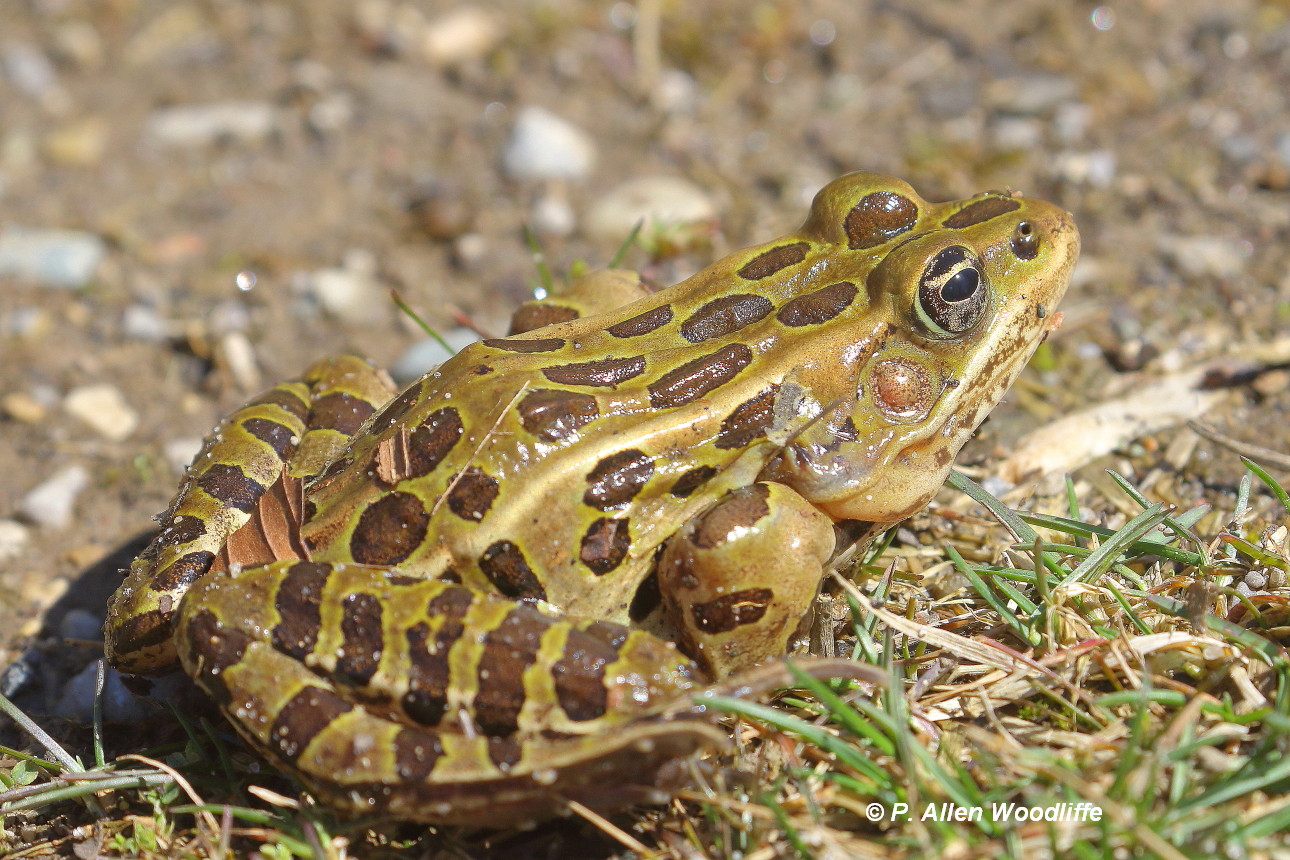
Frogs are plentiful and I have heard Spring Peepers already. Leopard Frogs are calling everywhere, and show up on trails and roads.

On a warmish day, snakes can be seen slowly roaming about, like this Eastern Gartersnake.
I've had a few butterflies, including this Eastern Comma, as well as a couple of Mourning Cloaks that were constantly on the move, so no photos.
Spring wildflowers are appearing, such as this Sharp-lobed Hepatica. Due to the cooler water surrounding the park, winds keep the unfolding of spring a little slower than inland, so it is always nice to see the first native spring wildflowers. There are some non-native species that have already appeared, such as Snowdrops, Siberian Squill and Colt's-foot. They are usually close to cottage lots, so undoubtedly were brought in by the leaseholders.
Sharp-lobed Hepatica
I came across my first migrant warblers of the season at Rondeau, a Yellow-rumped Warbler, looking crisp and clean compared to the more drab overwintering individuals of this species.

I also encountered my first of the year Eastern Bluebird....
.....and an Eastern Towhee that enabled me to get this photo.....
.....as well as one of three Fox Sparrows I noted along the Black Oak Trail.
  One has to be on the lookout for trail 'hazards' as well as the flora and fauna along the trail. Coyote scat is fairly regularly seen, but this one doesn't seem to be coyote since there is no hair or fur in it. I suspect it might be from a member of the weasel family.
This next item is a pupa of some overwintering moth species, as near as I can tell. It was wriggling slightly so maybe it will emerge.

I've checked out some wetlands along Lake St. Clair from time to time as well. Beaver are becoming more plentiful in recent decades, and one sees evidence of their huge houses from time to time.

As I was starting out along the Mitchell's Bay South Nature Trail, I saw my first of the year Barn Swallow, preening on the wire in the vicinity of 4 Tree Swallows.
When I started down the trail, I was interested to see the huge number of Midland Painted Turtles out basking in the sun. In my first time past this group, and close to the beginning of the trail, I counted 77 individuals. As I continued down the trail, I tallied a total of 142 individuals, quite a remarkable number.
On the return, I took a closer look at this first bunch and noted that more turtles had emerged to sun themselves. When I recounted, I found that there were at least 20 more, bringing the overall total to about 162! I was hoping to find a Blanding's Turtle in with them, but all were painted.
Double-crested Cormorants are not uncommon at all...
...nor are Song Sparrows.
Golden-crowned Kinglets were present in small numbers, flitting and feeding amongst the shrubbery.
There were several Great Egrets, not surprisingly, but they don't often cooperate for a camera. One has to peer through the taller Phragmites vegetation to have any hope of a relative clear photo.
Bald Eagles, such as this sub-adult, are frequently seen from a distance. The partial back lighting didn't make it any easier to get this photo.

Happy Easter, everyone!


If you would like to subscribe, or unsubscribe, to Nature Nuggets, send an email to: prairietramper@gmail.com


Tuesday, 7 May 2019

Paxton's Bush Owls and Owlets

Bird migration seems to be in full swing right now but I will interrupt my posts on that topic just to bring folks up to date on what has been happening at Paxton's Bush, here on the north side of Chatham. I wrote about it in my Natural Areas of Chatham-Kent series about a year ago, and you can read some background on this site here.

As has been the case the last few years, the resident pair of Great Horned Owls have nested, this time quite a bit closer to the residential area. Local birders and photographers have been keeping a close eye on this process, and two young birds have been successfully raised. One of the first photos I took of them this year was this next one, with one of the owlets peeking over the top, and a nice glint of the setting sun in its eye.
 One of the adults was always fairly close by to keep an eye on things.
The adults being watchful has been beneficial, to be sure. One day not long ago when I was watching the owls, I heard a loud, intensive chittering. It turned out that the local Cooper's Hawk was in the area, and swooped down almost to the owl's nest. Immediately one of the adult owls came onto the scene, and got between the hawk and the owlets. The light was very poor for photos, so I didn't get much, but this next photo shows the adult Cooper's Hawk in a nearby tree where it was taking a short break before its next attack.
On several occasions the hawk even swooped quite close to the adult owl, and the owl even seemed to flinch. There was never any direct contact that I could tell. The whole process seemed to last about 5 minutes, until the hawk returned to its side of the woodlot. There is a pair of Cooper's Hawks nesting in this woodlot as usual, and it is my speculation that the owls, being a night predator, may have harassed the hawks to some extent, and now the hawk was returning the favour during the daylight hours when the owls were more sedentary. Just a guess, however.

Meanwhile in spite of the drama, the owlets have continued to grow, and at times have sat up right out in the relative open.

And then one day, the oldest owlet decided it was time to venture out, and left the nest for good. Its flight capability, I think, left a lot to be desired, as for a couple of days it was seen on or very near the ground. I expect its first flight was more of a glide and flap rather than an effective flight, and once it was on the ground, it really couldn't get up into the trees where it would be safer.

This next photo shows where we found it. It is with a wide angle lens, so you have to look hard to see it.
A much closer look........
.....and closer still.

These previous photos were taken across the creek from the north side, just 40 metres or so west of the bridge. These next ones were taken on the south side, before crossing the bridge, with the owlet looking back over its shoulder.


The other owlet was still in the nest, and will likely leave very shortly if it hasn't already. The first one eventually found a way to climb up a leaning tree to a much safer height, and as the leaves continue to open, it will be much more difficult to see.

On one occasion just before I had arrived at the owl nest viewing location, I caught a bit of movement out of the corner of my eye. A furry critter was hunkered down under some developing Mayapple. It was a Groundhog.
 A closer look revealed something in its mouth.
 It retreated a bit until I had moved on down the trail a bit, and then it emerged. The thing in its mouth was a young Groundhog.
 It scooted across the trail and headed for another sheltered spot.
After awhile I noticed a Groundhog running along the creek at the edge of the nearby field. I suspect that with all the rain, its initial burrow was flooded, and the adult was moving its young to a higher and drier location. But the new location is a lot closer to the owls, and it is always possible that the owls may end up dining on Groundhog one of these days.

There is at least one pair of Mallards in the woodlot area.
In the last day or so, people have seen an adult Mallard with as many as eight ducklings trailing behind. Most won't survive, and in fact while they are young, might end up in the talons and tummy of the Cooper's Hawk.

Blue Jays seem to be always present.
Typically there are a few warblers, vireos, tanagers and grosbeaks to be found, but that mix of songbirds changes daily as many are stopping for a rest and a few meals to replenish their energy so they can continue their northerly migration.

A parade of wildflowers is present, and over several weeks there will always be something to see.
Hepatica
Trout Lily
Red Trillium
But although the vegetation is constantly changing, the presence of Great Horned Owls is almost a sure thing any time of the year, although most times they are difficult to see.