Showing posts with label Hooded Warbler. Show all posts

Tuesday, 17 May 2022

May is Wood Warbler Month!

 It is also Lyme Disease Awareness Month, but I won't go into detail about Lyme Disease on this post. If you want to read one of my most informative posts on that subject check out this link. 

May is the month when many birders are out on the hunt for those (mostly) colourful birds that are arriving from southerly areas, heading to our area to nest or stopping by for nutrients before continuing on their way to more northerly breeding grounds. While this year has been average at best for warbler movement, almost all of the regular species have appeared, at least in small numbers. One always hopes for a major event when warblers seem to be 'dripping from the trees'. That hasn't happened to any great extent yet this year, but one can always hope.

In the meantime, I thought I would feature a few photos of many of the warblers, which I have been fortunate to capture digitally over the years. Almost all were taken at Rondeau and in the spring, when they are at their most colourful, before they turn to those 'confusing fall warblers'. They are in no particular order. If it is labelled (B), it has been known to breed in Chatham-Kent, and especially at Rondeau. If it is labelled (M), it is a migrant moving on to more northerly habitat.

American Redstart (B)

Black-and-white Warbler (M)

Bay-breasted Warbler (M)

Blackpoll Warbler (M)

Blackburnian Warbler (M)

Black-throated Blue Warbler (M)

This next one, the Black-throated Green Warbler, has not been confirmed as a breeding species at Rondeau, but has probably nested. And given the number of conifer plantations that are becoming more mature in scattered parts of CK, it is possible that it has nested.

Black-throated Green Warbler (B?)
These next three are interesting. The first one is Blue-winged Warbler, an elusive and not common species. It has possibly nested in the area, but it has not been confirmed.
The Golden-winged Warbler, next, is not common either. In fact its numbers have declined considerably over the last couple of decades, and it is now a Species At Risk, with the status of 'Special Concern'. Part of the reason for the decline is that it shares habitat with the Blue-winged Warbler, and they regularly hybridize. The result is a hybrid known as 'Brewster's Warbler', which depending on the family lineage, can result in quite a variable plumage.
Golden-winged Warbler (M)
The image below shows an example of a Brewster's Warbler.

 Canada Warbler is next. It is also listed as 'Special Concern' due to declining numbers.
Canada Warbler (M)
Common Yellowthroat, next, is common and nests regularly in the area, especially in wetlands and shrubby areas.
Common Yellowthroat (B)
I include two of the following species, Cerulean Warbler, since the male and female are quite different in appearance. This species used to be a regular nesting species at Rondeau, but is quite irregular now. It is a Threatened species in Ontario. They are often fairly high in the trees, so getting a good photo is not easy!
Cerulean Warbler, male (B)

Cerulean Warbler, female (B)
Cape May Warbler (M)
Next is Chestnut-sided Warbler. It has nested at Rondeau on very rare occasion, being much more common farther north.
Chestnut-sided Warbler (B)
A species that used to be a Species At Risk in Ontario is shown next, a Hooded Warbler. It was quite unusual to see one, but in the last couple of decades, their numbers have increased considerably, and have been removed as a Species At Risk. It is seen somewhat regularly at places like Rondeau, and on occasion one might see two or three in a day on migration. It has not been confirmed nesting at Rondeau, although it is believed that attempts have been made.
Hooded Warbler (M)


Louisiana Waterthrush, next, is also a Threatened species, with its breeding range in Ontario limited to the very south. It has nested at Rondeau on rare occasion.

Louisiana Waterthrush (B)

A very similar looking warbler is the Northern Waterthrush, next. There are subtle differences, such as the width of the light stripe above the eye, the amount of speckling on the throat, and the slightly yellowish cast to the belly feathers. It is more common, but does not nest at Rondeau as far as any records show.

Northern Waterthrush (M)

Magnolia Warbler (M)

A regular, but not common species is the Mourning Warbler. It has nested at Rondeau on rare occasion.

Mourning Warbler (B)

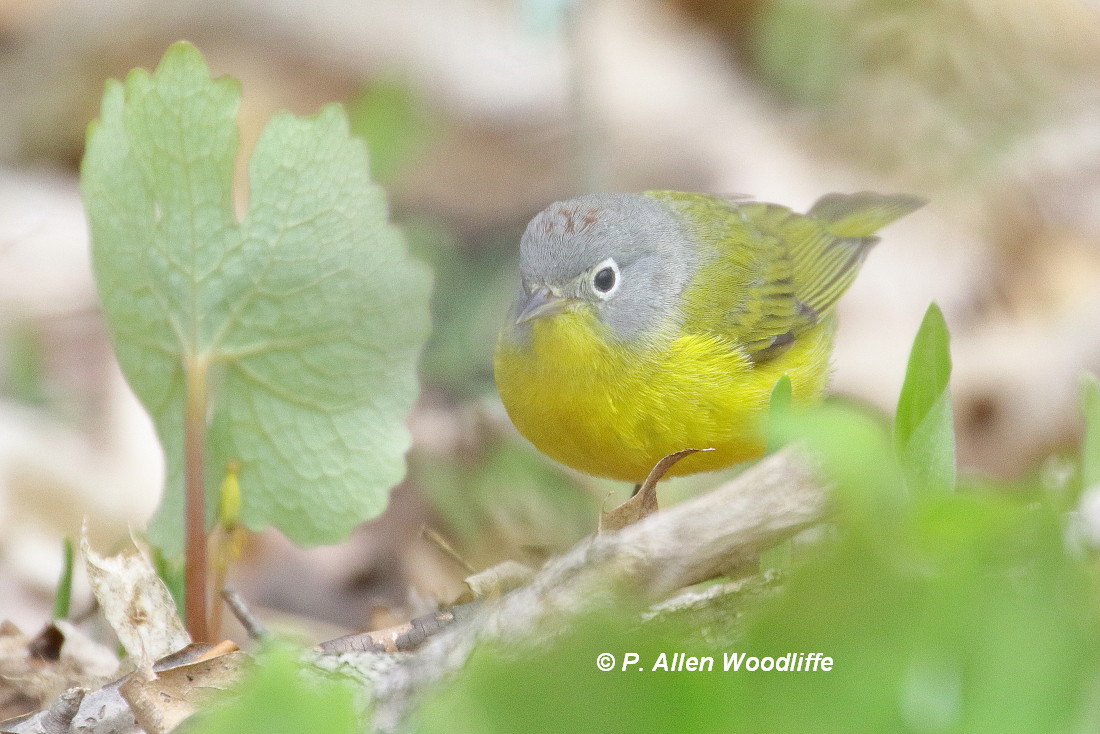
Nashville Warbler (M)

Northern Parula (M)
Next is an Orange-crowned Warbler. It was photographed in the autumn, as you can tell by the seed heads of a goldenrod in the photo.
Orange-crowned Warbler (M)

Ovenbird (B)

Palm Warbler (M)
This next one is a Pine Warbler. It is a winter shot, as I got it coming to a feeder in January!
Pine Warbler (B)
I have featured Prothonotary Warbler on many occasions, as it is Rondeau's unofficial bird species, and certainly my favourite.
Prothonotary Warbler, male, (B)

Tennessee Warbler, (M)
The Townsend's Warbler is a western species. I found the first Rondeau record back in May of 1983. Interestingly, the Rondeau area has had more records of this species than any other location in Ontario. It is more often found in late fall here. This photo was taken in late November.

Worm-eating Warbler, next, is a southern rarity. There are not many records for Rondeau, with barely one report annually.

Worm-eating Warbler (M)

Wilson's Warbler, (M)

Yellow-rumped Warbler (M)
Yellow-throated Warbler, next, is generally a southern species. There are a few records for Rondeau, and at one point, for several years in a row, a male showed up in the vicinity of a cottage and the Visitor Centre. On one occasion there was a female as well, and it is believed that attempts were made to nest, although in spite of the search efforts of various birders, it was never confirmed.
Yellow-throated Warbler (M)
One of the most common warblers in southern Ontario and elsewhere, is the Yellow Warbler. It is an abundant breeding species, and it is not unusual to see several dozen on a day in May. On occasion, one may encounter more than 100 in a single day in May.
Yellow Warbler (B)

There are several other warbler species that have been recorded at Rondeau, some of which are almost annually occurring. These include Kirtland's Warbler, Prairie Warbler, Swainson's Warbler, Kentucky Warbler and Connecticut Warbler. For various reasons, I have yet to be able to photograph any of these five. Will it happen in 2022? Maybe!


If you would like to subscribe, or unsubscribe, to Nature Nuggets, send an email to prairietramper@gmail.com


Friday, 29 April 2022

Bird influx continues in southern Chatham-Kent

 The Birds of Chatham-Kent, then and now, series, will continue eventually, but right now, spring birding is heating up nicely. My previous post discussed this somewhat, based on a couple of really good days last weekend. While there hasn't been any major weather changes to bring huge numbers, that may happen over the next few days. In the meantime, there has been a very pleasing variety of birds to be found, if one is willing to cover a fair bit of habitat and area.

I have put my energy of recent days checking out places like Rondeau Provincial Park and Keith McLean Conservation Lands. It has been well worthwhile. I haven't had a 100 species day yet, but I did get an 85 species day.

Birds are scattered, with the very south end of the park being more or less the most productive, but the narrower north end of the park can be good as well. As the saying goes, birds are where you find them! It is a bonus when the photo ops occur at times, and so what follows features some of those photo ops.

There was the occasional White-throated Sparrow which over wintered, but very few. It is always a treat to see some nice fresh looking ones, and hearing them singing on occasion. It is one of the most abundant land birds in the park at the moment, with seeing several dozen quite easily as they scurry throughout the forest and edges.

White-crowned Sparrows are just starting to arrive. I have yet to see more than a handful even after several hours of birding.
Hermit Thrush is the first of the Catharus thrush species to show. It is the most common of this genus right now, but Swainson's Thrush, which follows, is running a close second, and will very soon be the most common one.

Brown Thrashers are rather skulky birds. There are a few around, although undoubtedly much more common than what any daily bird checklist will show.
Closely related to the Brown Thrasher is the Northern Mockingbird. There has been one or two lurking around the maintenance area for a couple of weeks, or in the nearby picnic area. I have seen it, or another one, on several occasions, and they usually can be somewhat cooperative for the camera.
One of the real highlights for me in the last few days was to see not one, but probably two, Sedge Wrens. Another birder reported three of this species in the same area. Given that they are very furtive, scurrying around dense grass mats and shrubby areas, there could be quite a few of this elusive species. In all of my birding/photographing years, this is the first time I have been able to successfully photograph one.

Members of the Wood Warbler group are what many birders equate with highlights of spring migration. There has been a moderate influx of species diversity considering the relative early aspect of the season. At least 16 of the ~40 species on the park checklist have been reported at Rondeau as of yesterday. I've only seen about 10 species in the last week or so. However the major part of their migration has yet to come, so there is lots of time over the next few weeks to see most of them. Will there be any new species added to the checklist? Only time will tell.

Palm Warblers are one of the early species.....

....as are Black-and-white Warblers.
Another highlight was to see a fairly cooperative male Hooded Warbler scurrying around a brush pile at the north end of the park. This species used to be quite a rarity in Ontario, but in the last couple of decades, has gradually expanded its breeding area so that while it is still uncommon, it isn't quite the rarity it used to be.

White-breasted Nuthatch is a permanent resident of the southern Ontario woodlands. Now that the breeding season is here, it is more common to hear their 'yank-yank-yank' calls along the trails.

Of course there are other things to see along the trails as well, including butterflies such as this American Lady....

...and sometimes a dead critter. This is a Short-tailed Shrew. It didn't show any overt signs of trauma, so why it died is a mystery. They are secretive creatures that spend most of their lives in the leaf litter or underground.
Eastern Gray Squirrels are abundant, of course.....
...and Spicebush is dominant throughout the wetter areas of the woodlands. It is about in peak flowering right now.

At one point I spotted this Red Fox crossing over the road from the campground, and heading south into a shrubby thicket. It wasn't apparent whether it was just on the hunt, or heading to or from a den. It is one of the few times I have seen a fox in the park, and the first time I have photographed one in the park. Their numbers have dwindled due to the high numbers of Eastern Coyotes in the park, which will prey on things like fox and feral cats etc.

As mentioned, I have also been checking out the Keith McLean Conservation Lands. There is lots of shorebird habitat, as has been the case for the last few years. There have been some rather rare shorebird types over the last few days, such as American Avocet, Willet and Marbled Godwit, but none of them have stayed for long, in some cases just a few hours at most. I didn't see any of them. Much more common are shorebirds such as Dunlin.....

....and Least Sandpiper, although it is a bit early for this species.
Lesser Yellowlegs, next, and Greater Yellowlegs, are around in small numbers.
In the cattail edges there are lots of sparrows, including an occasional American Tree Sparrow, most of which have moved farther north.
Brown-headed Cowbirds are seldom appreciated by birders, but when a good photo op shows up such as this female, I will try and make the best of it!
Cedar Waxwings have not been all that common lately, but I saw a small flock of about 8 feeding on some berries.
The nesting platform seems to be holding the interest from a pair of Osprey.
Tree Swallows are by far the most abundant swallow species right now. Hopefully they can survive any future cold spells that sometimes occur in early May!
The main highlight for me at KMCL was this Grasshopper Sparrow. It had been hanging out in the same vicinity as an even rarer Lark Sparrow. I have not caught up to the Lark Sparrow, but did manage to see the Grasshopper Sparrow on a recent visit. It was somewhat back lit, so I had to do a bit more processing than normal to get this result. It is the first time I have photographed this species, so was glad for the opportunity!


If you would like to subscribe, or unsubscribe, to Nature Nuggets, send an email to me at: prairietramper@gmail.com