Showing posts with label Dark-eyed Junco. Show all posts

Tuesday, 25 November 2025

Another cattle egret, a snake, a millipede and more

 If the forecasts are accurate, we will be experiencing another blast of winter in the next few days. Fortunately I was able to get out to a few places, including Rondeau, to continue some exploring of late November and enjoy some lengthy walks. I hadn't caught up to anything out of the ordinary regarding birds.....just wasn't in the right place at the right time. But there were a few of the expected species that paused long enough for my camera.

American Goldfinches are present most of the year, but many from farther north have been migrating through in good numbers over the last week or so. 

Dark-eyed Juncos are quite common, and at least some will be around all winter.
Of course Downy Woodpeckers are present all year.
I always look forward to seeing Fox Sparrows in late autumn. This vividly patterned sparrow likely will be present in very small numbers over the winter, but are often hard to find.
Northern Cardinals are another year-round species, fortunately, especially for those with winter feeders....

...as are Red-bellied Woodpeckers. They have been busy storing some of this year's abundant acorn crop in crevices in trees, in case feeders don't meet their needs.
Wild Turkeys are permanent residents and get a little more bold in wandering around open areas in the autumn when the park is quieter, looking for acorns.
There are often a few other creatures out and about. Of course Eastern Gray Squirrels are also looking for acorns and such. I enjoy watching their acrobatics, etc. This one is suspended by its two hind feet while the two front feet are handling something it is nibbling on.

It is getting late in the season for cold-blooded creatures, but just yesterday I came across this Eastern Garter Snake sitting at an open spot along the trail.

Another cold-blooded creature is this Common Pink Flat-back, a type of millipede, roaming across Gardiner Ave.

Certainly a bird highlight of recent days is yet another Western Cattle Egret, seen by many on several occasions at the Keith McLean Conservation Lands. I have seen it on at least three different days from the road, but on one occasion I decided to park there and try and get some decent photos. Here are some of the results.


This is the second time I have seen one in the last month or so. It may be the same one that moved over from its previous spot just north of Erieau where it disappeared from after a few days. Unfortunately for this individual, some recent observers have reported that it was seen to be limping, and wondered if it could be captured and taken to a wildlife rescue place. I'm not sure if that is possible, as when I got these photos, it was walking okay but more importantly it could fly quite well. So unless it ceases to be able to fly, and can survive for a bit longer given the wintry weather forecast, it will probably not be rescued. It is a juvenile, and is clearly well beyond its normal range, so it might just be a victim of its unfortunate wandering well beyond safe habitat.

In addition to Rondeau, I have been meandering around parts of the former Dover Twp, which is actually closer to home, and I always enjoyed exploring St. Clair NWA. However the NWA is closed for trail repairs until early January, so my exploring in Dover is more random elsewhere. But there have been things of interest even though the Gray Kingbird featured at the heading, is long gone somewhere. 

Tundra Swans are becoming more numerous, but often are feeding so far away from the road I didn't bother trying to photograph them. This small group was a bit closer.

 This Red-tailed Hawk remained on the pole long enough for a photo or two. While the species is a year-round resident in C-K, there are lots migrating through from their more northern range.

Sandhill Cranes are hard to find these days. However I came across a couple at the edge of a corn field just north of Mitchell's Bay on one occasion, where I was able to put my long lens with teleconverter to use to capture this one digitally.

If you would like to subscribe to Nature Nuggets, send an email to: prairietramper@gmail.com

Saturday, 15 November 2025

Autumn migration continues

 The weather ups and downs continue, as does the bird migration. The snow of a few days ago is just a memory. Not sure how long that will last.

I've been out here and there, although one of my regular 'go to' spots, the St. Clair NWA, continues to be off limits due to trail maintenance. I have meandered around the former Dover Twp a bit, and have managed to get a few photos of seasonal things, including the following.

At one spot that I regularly check out at this time of year, I encountered at least 14 Sandhill Cranes back against the edge of the field. This first photo is of a few at the south end of Walpole Island.... 

...and this next flight shot is of 4 of the 14 a bit farther north....
 ...that flew from the far edge of this field.

Tundra Swans are arriving in ever increasing numbers. Soon many will be seen in flight almost anywhere in the southwest, or out on the recently harvested fields of corn. That is until the corn stubble is plowed up.

Heading south, a stop at the Keith McLean Conservation Lands did not turn up much in the way of shorebirds, but I did manage photos of a few Red-breasted Mergansers swimming by...
...and three Killdeer showed up about the time I was ready to leave. A low, searching flyby of a Northern Harrier did short work of the Killdeer stay, however.

Camping is over at Rondeau, and now it is all available to fellow birders, a few dog walkers, and some birds. This Blue Jay was maybe hoping for a return of some campers, to provide some handouts on the picnic table.

Cedar Waxwings are fairly plentiful and widespread these last few days.
Dark-eyed Juncos are quite abundant.
It is always a highlight to see Fox Sparrows, and this is their time. They can be found at the edge of the roadways...
...or partially hidden as they dig out something in the leaf litter.
Northern Cardinals are here year-round, but not always cooperative for a photo, as this female was, sort of.
White-breasted Nuthatches are fun to watch going up or down a tree either searching for something they have hidden in the cracks in the bark, or putting something away for a future meal.
White-throated Sparrows are increasingly abundant, and at least some will stay over the winter.
Blackbirds are passing through in good numbers, including the Rusty Blackbird. Note to potential Rondeau hikers, the park will be closed for a couple of days at a time in order that the November/December deer hunt can take place. In preparation for this hunt, some cracked corn has been put out at feeding stations, and I sometimes check them to see what critters are taking advantage of the food. I found 6 Rusty Blackbirds at one spot, as shown next.

The raptor migration is winding down, and although technically not a raptor, Turkey Vultures are always counted at the various hawkwatches. Turkey Vultures have gone through in their normal many thousands, and seeing one now is more of a rarity.

 In other news, not related to Rondeau, I had a friend from the K-W area send me a photo of a bird that had been coming to his suet. He is not an avid birder, but enjoys what comes to his back yard feeders. At first he thought it might be a female Evening Grosbeak, and indeed a few of them are making their way south. However it turned out to be a female Summer Tanager! Summer Tanagers are not common or predictable in Ontario at anytime of year, but more likely to be encountered in the summer. That said, they can show up at really unexpected times. In checking the rare bird report for this past week, there had been one seen in Toronto a few days ago. This next photo is of one I photographed at Rondeau back in December of 2015! It was feeding on the berries of a vine that had been growing up the chimney of this cottage.

With birds, expect the unexpected!

If you would like to subscribe to Nature Nuggets, send an email to: prairietramper@gmail.com


Wednesday, 24 October 2018

Some birds of late October

As is typical of this time of year, there are a few lingering migrant birds as well as the usual early winter species. It is always fun to see what is around. Rondeau, Erieau and the sewage lagoons at Blenheim are certainly worth checking regularly

Of course one of the really unexpected species to show up in Rondeau is that mega rarity, the Great Kiskadee which is still hanging out.
I suspect it is so totally disoriented that it really doesn't know where to go, so its days are likely numbered. Will it stick around in time for the upcoming Christmas Bird Count on December 16? Wishful thinking, I know I know. There are less than two months to go, but I expect the weather will be too much for it. But given the survival of a Vermilion Flycatcher, another southern Texas and Arizona flycatcher, for the Wallaceburg CBC in late December in 2015, I guess anything is possible!
Vermilion Flycatcher of 2015
Of course the mini invasion of Nelson's Sparrows, one of which is featured on the header for this blog at the moment, has been a nice surprise these last couple of weeks too.

Shorebirds are usually past their peak presence by now. However the extended summer weather of late September and early October probably kept them back, so that now there are some impressive numbers. For example a recent stop at the Blenheim Sewage Lagoon produced a good variety, with some birders counting about a dozen species. I went on a really windy day. How windy was it you ask? It was so windy there were white caps in one of the main ponds! This made it challenging to hold binoculars, 'scope or camera lens steady. When I was concentrating on photographing, I purposely laid my scope on the ground so it wouldn't blow over.

Highlights included 4 Hudsonian Godwits (HUGO). Even one is noteworthy, but 4 is almost unprecedented. It seems that three of the birds stuck together most of the time, with the 4th one often off by itself. Add the single bird still persisting at Keith McLean Conservation Area, 5 HUGOs in the Rondeau checklist area at one time is quite unusual.


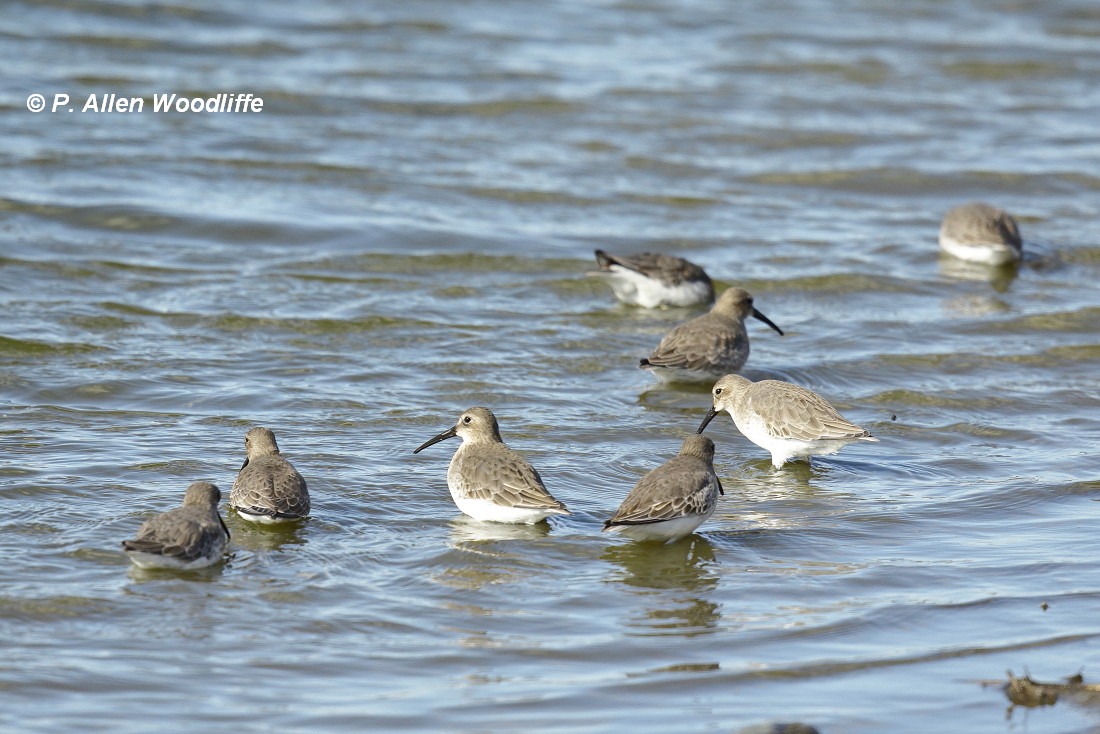
There are very large numbers of Dunlin around right now, with some conservative estimates at these sewage lagoons at least 400 in number. This next photo shows about 65-70 Dunlin partially or wholly in the photo. The large shorebird towards the centre left is a HUGO.

Dunlin
Other shorebirds seen lately, but more difficult to photograph, include White-rumped Sandpiper, Western Sandpiper, Baird's Sandpiper, Semipalmated Sandpiper, both yellowleg species and Wilson's Snipe, among others.
Greater Yellowlegs
I went to Rondeau a bit later that day. There was a stiff NNW wind blowing, which is usually good for raptor movement. I spent a couple of hours in an open spot at the campground which provided a relatively good view to the north and west, as well as being somewhat sheltered for me. A more exposed site might have been more productive, but on a day with strong wind gusts, one has to hang on to the 'scope and tripod or it may be blown over. It can happen, and did on one occasion when I was in the Morpeth Cliffs area, and the base of the scope broke off. Fortunately it was a Vortex scope, with a lifetime warranty, so I eventually got a replacement at no cost.

On this day there was a large number of Turkey Vultures passing through, as is often the case. I spotted both Red-shouldered Hawk and Red-tailed Hawk, along with Sharp-shinned and Cooper's Hawks, as well as American Kestrels. The next two images are of a Red-shouldered Hawk, while the third one is of an immature Red-tailed Hawk. The very cloudy sky made photographs a bit more challenging.


There were other birds passing by, including Tundra Swans.....
....and Eastern Bluebirds. I had a flock of 5 Bluebirds that landed near by, and another flock of 27 that didn't.

An Orange-crowned Warbler stopped by in a nearby patch of goldenrod, searching for a meal. It found a larva of some sort, as shown in this next photo.

There were other birds too, of course. There was a large number of American Robins scattered throughout the park. Puddles on the roadside were great places to see them, along with Hermit Thrushes, as well as Yellow-rumped Warblers.
 Blue Jays are passing through in large numbers, with many exiting Ontario according to the hawkwatching stations close to the Ontario/Michigan border. Some will stay, of course, depending on the acorn abundance or the number of well kept bird feeders in the area.
 Dark-eyed Juncos are always fun to see, and at least some of them will remain over the winter....
 ...as will White-crowned Sparrows, such as this immature one shown next.
All in all, it has been a good few days, and who knows, perhaps the best is yet to come!