Showing posts with label Purple Twayblade. Show all posts

Monday, 19 June 2023

Rare and uncommon birds, a very rare orchid, and others

 There are a few rare to uncommon bird species around, mixed in with the expected species. One of the highlights of recent days is the arrival of Dickcissel. It used to be a rather extreme rarity up until a few years ago, and any reports of them immediately created a rush of birders anxious to get them on their life or year lists. While there is still a quick response by birders when one is reported, the occurrence of Dickcissels in southwestern Ontario is not quite the novelty it once was. The beginning of their fairly regular occurrence began in 2017, and I wrote about it for the April, 2018 edition of Ontario Birds, which you can read about here.

Dickcissels have appeared in several places in the south and mid western parts of Chatham-Kent so far in recent days, and I went to a spot where a sizeable grassy/prairie type field had been established a few years ago. I had a couple of the birds there last year, and sure enough, almost as soon as I pulled up to the edge of the road, there was a male singing away. Fortunately this species sings at a pitch that even my ears can easily detect, and this bird came and went several times, giving me lots of photo ops right from the vehicle.
I had been out to another site, privately owned, where I had them last year, but so far, they had not shown up. I will check in another few days. It was not a lost cause, as I was treated to a male Bobolink intent on feeding young at a nest......
....and lots of Savannah Sparrows.
The real bird rarity of the area was even rarer than a Dickcissel. It was a Cassin's Kingbird that showed up in southern Essex County. Its rarity status was clearly demonstrated by the dozens of birders that descended on the site as quickly as they could get there, giving variable views. I am sure it was an Ontario lifer for many. I did not venture there to see it however. It was in late November of 2013 when I found one of this species at Rondeau! Unfortunately it was dead, but still identifiable. It was resting in the sand dunes of the southeast beach of the park. It quite likely had been hanging out along the edge of the dunes and oak savanna, and had gone unnoticed by birders in the area, not all that surprising since it was in late November when birders do not frequent that area very often. With a cold spell of several days earlier, the amount of insects available to it had likely diminished, causing it to perish. It had deteriorated by the time I found it, but it was salvaged and eventually ended up at the ROM.


Far less rare, but still nice to see and even get a few photos of, were several bird species at the local sewage lagoons. About 5 White-rumped Sandpipers were using the sprinkler cells.


The White-rump is easily told by being larger than similar looking Semipalmated Sandpiper, with that latter species shown on the left side of the next photo, and also by the greater black markings extending farther along the flanks. It also has a reddish base to the underside of the beak and longer wings that extend beyond the tail when at rest. And of course the white rump, which shows in flight.

It is uncertain whether these White-rumps are just late in going north, given the vagaries of weather patterns over the last month or so, or early in returning. I had been told by someone much more expert than I, several years ago, that White-rumps go north fairly quickly and even overshoot southern Ontario for the most part, to get a good start on nesting in their arctic territories. But if the weather conditions there are not favourable and nests fail, then the birds will abandon further nesting attempts and slowly move south, appearing here in southern Ontario by mid-June. With that in mind, I suspect these birds are ones that are on the return.

A common shorebird species is the aptly named Spotted Sandpiper, and there are always a few at the sewage lagoons.

Not a shorebird, but a Song Sparrow, next, which occurs in a wide variety of habitats. This one was scurrying around amongst the vegetation at the edge of the sprinkler cells, often just out of sight.

A quick trip to Rondeau was not terribly birdy in the area I explored, but there is always something to see, and even get photos of. Gray Catbirds are not always so cooperative, but this one was advertising its territory and less concerned than usual about me.

Mourning Doves are often well beyond photo range.
The Common Five-lined Skink is anything but common, and is in fact endangered, but can be seen occasionally on a sunny log.
And in sunny spots along the woodland trails, the Six-spotted Tiger Beetle can be found quite regularly. Just so you know, it doesn't always have six spots, however.

One of my outdoor forays involved heading to Clear Creek Forest Provincial Park, a favourite destination at various times of the year. On the way there, I stopped to see how a very large Black Gum tree was faring, given the sometimes extreme wind, snow and ice conditions over the winter. It was doing fine. The flowers are not very impressive, and this next photo shows some deteriorating flowers as well as some early developing drupes, or berries, which will be much larger and blue at maturity.

It is a large, impressive tree, and the only location in Chatham-Kent that I am aware of. The next photo shows it just a bit past the peak of autumn colour, when the leaves are a deep red. This was taken in the mid-autumn of 2022. Maybe this coming autumn I will get it at its peak!

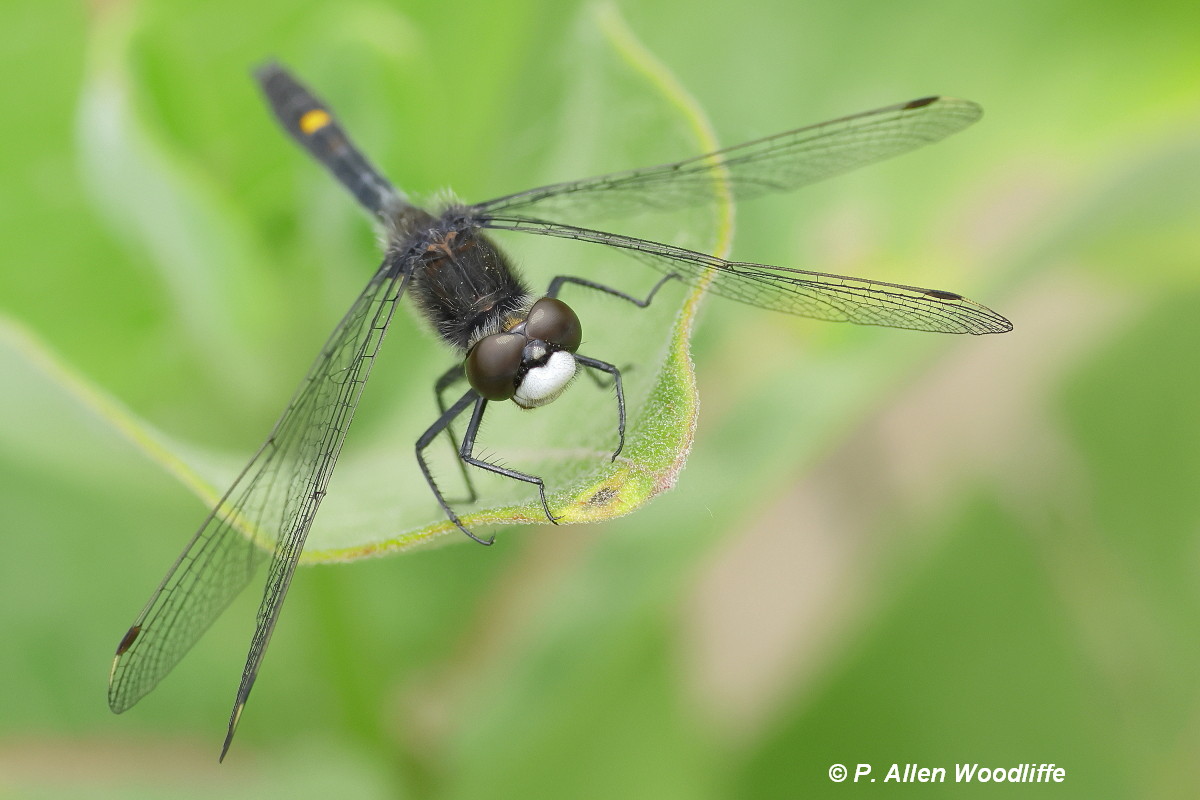
Any visit to Clear Creek Forest PP entails being on the lookout for anything and everything. A walk around the former gravel pit on the north side, can be good for dragonflies, and on this occasion I got these next two species:

Calico Pennant

Dot-tailed White Face

It was a coolish day, and I anticipate an increase in ode diversity over the next few weeks. 

My main purpose was to check up on a very rare orchid: Purple, or Lily-leaved, Twayblade (Liparis liliifolia). En route to that spot, I came across this Northern Crescent butterfly.....

...as well as a Virginia Ctenucha moth.
 I was successful in finding the orchid, in spite of it being partially hidden under other, more profuse vegetation, and overall it was in fine shape for photographing.
It is an endangered species, with very few locations for it in Ontario, and only one in Quebec.

Given its subtle appearance, and growing amongst other vegetation, it would not surprise me if it occurs in a few other places, but just hard to find!


If you would like to subscribe, or unsubscribe, to Nature Nuggets, send an email to: prairietramper@gmail.com


Sunday, 3 July 2022

Grasslands, wetlands and other odds and ends

 I've been out intermittently these last few days, depending on the weather, and trying to mix my day time excursions satisfactorily with my night time black lighting.

Grasslands are always intriguing. Most of the ones I've visited lately aren't really tallgrass prairie types, at least not yet, but they have some long term potential. But even hayfields can be worth checking out.

One spot a bit west of Chatham has been a hayfield for a few years, although it is periodically pastured or cut for hay. But it is suitable for attracting grassland birds, and has had Dickcissels there on a somewhat regular basis in recent years. There were 2-3 males there recently, although they seldom come within good photogenic range from the road. Given that it is private property, that is as close as one can get. A visit to it a few days ago enabled me to get a couple of decent record photos.

It isn't super sharp and is heavily cropped, but at least the sun was at the best angle and the background worked well. I went back to this spot a couple of days later hoping for better success, but by that time the cattle had been moved into this area and had trampled a lot of the vegetation. Given how dry the weather had been, the cattle had to be moved somewhere from their other pasture, so it wasn't a total surprise. Unfortunately there were no Dickcissels to be seen or heard.

In a more encouraging scenario, some friends of ours had purchased an agricultural field next to their woodlot, and had a mix of pond/wetland, prairie and hayfield established over the several hectares of this new acquisition. I've had the pleasure of advising them on the tallgrass prairie portion of it, and even scattered some native prairie seed that I had available to me to help it along. So I get to visit it on occasion, and a few days ago I went out to see if any grassland birds had taken to it. I was pleasantly surprised to see a few, including lots of Savannah Sparrows, 

....and at least 3 Dickcissels. It was well away from the road, and I was able to get some better shots of this species in various spots. Sometimes they were sitting up on a tall Dock (Rumex sp.) species as this first photo shows.
At other times they would be on a developing sunflower, singing away and advertizing their territory. I noticed a couple of times when one male would be chasing another one, so it looks like they have found this spot to their liking. Both of these Dickcissel photos are heavily cropped as well. I plan to get out again, and see more evidence of their approval of this site.

I went out to the Dealtown Crown Land, which back in the '90s, was planted into tallgrass prairie to be the source of seed for future restoration projects. After a few years, a better location for the prairie seed nursery was found so this ceased to be a priority for managing for that purpose. As a result, much of the site is quite shrubby, although there are some good sized open grassy areas, and I was hoping that some Dickcissels had shown up as they had in previous years. But none were to be found on this visit. There were lots of other birds, but nothing unexpected. I managed to get some photos of other species, just so it wasn't a complete wash. There were several Cedar Waxwings, which will be in nesting mode by now....


...and a few Mourning Doves. This one had a nest with two eggs, in a Red Cedar tree.

I've been out to St. Clair NWA on occasion as well. There is always something to see and photograph here.

Evenings are great, as the daytime temperatures cool a bit, the bird activity seems to pick up. And the golden light of late day conditions work well. This Tree Swallow was using a nest cavity just below where it was sitting.

Canada Geese are abundant, not surprisingly, but are also photogenic at times.....
...Mute Swans, well they are an invasive nuisance species, but also photogenic. One can see why they were imported decades ago to dress up gardens and ponds.
Unfortunately they do create havoc to many native waterfowl species.
There is a pair of Northern Harriers, formerly known as Marsh Hawks, occupying a territory at this NWA. Once in awhile, one might get a fairly decent photo of them as they flyby, like this female did.
Of course wetlands are heavily occupied by Red-winged Blackbirds. There is no shortage of them here, and one can get some pretty decent photos of them in the golden glow of the evening.

On other occasions, I have been there in the morning, and had some photographic fun. Again, Red-winged Blackbirds can be easy subjects....

...but capturing them in flight is a much more challenging proposition.
Great Egrets are more predictable with their flight lines.
An Osprey was perched high on a dead branch overlooking the NWA.
....and a pair of Northern Flickers were busily chiseling out a hole, and taking time out for some copulation.
Getting flight shots of Barn Swallows was even much more challenging than for the Red-wings. Swallows are smaller, and fly quickly and erratically, so even with the capabilities of my camera having multiple focus spots specifically for this type of photography, I deleted far more photos than I bothered to save.

I also checked out the Fletcher Ponds, which can sometimes be good for a few birds. It is like an island in a sea of agriculture, so can be a magnet for birds in on occasion. However on this visit it was surprisingly quiet. The only thing of note was not a bird at all, but a Species At Risk plant: Climbing Prairie Rose. It looks a lot like other species of rose, but a couple of the main features to differentiate it is the three leaved arrangement, and the stem of the leaf has a couple of wide wings at the base, with each wing resulting in a separate pointy look to it. These can be seen to the left of the flower.

Another botanical highlight of the last few days is to come across a new population (to me) of a provincially rare orchid: Purple Twayblade. I found a loose cluster of 7 plants at Clear Creek Forest Prov Park, 5 of which showed evidence of flowering. However they were all well past their best, and this single flower shown below was the best example remaining. Now that I know where they are, I hope to check them out more strategically next year.


If you would like to subscribe, or unsubscribe, to Nature Nuggets, send an email to: prairietramper@gmail.com


Saturday, 4 June 2022

Promoting Prairie

 Today, June 4, is National Prairie Day. At least it is in the USA, but hasn't been recognized as such in Canada yet, which is unfortunate since tallgrass prairie is a significant habitat type throughout many provinces. Regular readers will know that I am a huge fan of tallgrass prairie.

The first three photos are representative of some of the 100+ prairies I have explored in the mid-western US, mostly in Missouri.

Diamond Grove Prairie

Golden Prairie

Treaty Line Prairie

These next two are from southwestern Ontario.

Island Prairie, Walpole Is
The following photo is of a small patch that occurs at Rondeau, and features an impressive stand of Butterfly Weed. It could arguably be called part of a Black Oak Savanna. The large Black Oak with its spreading limbs certainly fits the savanna theme.

Prairies are becoming increasingly recognized for their value beyond the species diversity they support. Certainly grassland birds are becoming quite rare, as are some of the multitude of invertebrates inhabiting them. But even more so, old growth grasslands, which means grasslands that have never been plowed, store huge amounts of carbon. An old growth grassland has enormous amounts of herbaceous material below the surface. Some high quality species have root systems that go 6 metres or more below ground.

Some of the rarest plants in Ontario occur in tallgrass prairie, or the closely related oak savanna. This first one, Tall Green Milkweed, only occurs in one location in Ontario.

Eastern Prairie White-fringed Orchid is technically not limited to prairie, but usually has its greatest abundance there. It is a Species At Risk (SAR).
Closely related, but now gone from Canada, is the Yellow-fringed Orchid.
Giant Swallowtails, at one time considered a candidate as a SAR is seen feeding on Ironweed, a species limited to prairies.

Ironweed
An endangered species and therefore a SAR, is Slender Bush Clover.
Rough Blazing-star is a SAR.
Its more common relative, Tall Blazing-star, can be quite dominant in some limited prairies.
Another orchid, Purple Twayblade, is a SAR.
Pink Milkwort, next, is limited to only a couple of prairie sites in Ontario.
Goat's-rue is also a SAR, being limited in Ontario to only a couple of places.
This next photo shows one of the largest populations of a rare prairie species, Colicroot. Unfortunately this prairie patch was completely destroyed to allow for an expanded highway development.
A Cylindrical Blazing-star meadow graces some of the beach dune area of Rondeau. Although technically not a tallgrass prairie in the normal sense, it is a variation of it, and supports mostly tallgrass prairie plant species.
Prairie and savanna can occur in the same area, as is the case for this scene from Ojibway Prairie Provincial Nature Reserve in Windsor, which features a tall candelabra type plant called Culver's root
A little more on the oak savanna side of things is this scene featuring a Black Oak savanna at Rondeau Provincial Park.

Tallgrass Prairie and Black Oak Savanna: two of the most endangered habitats in Ontario. I encourage you to get out to explore and appreciate them!


If you would like to subscribe, or unsubscribe, to Nature Nuggets, send an email to prairietramper@gmail.com