Showing posts with label American Rubyspot. Show all posts

Saturday, 24 August 2024

An endangered orchid, and lots of odes

 Sometimes the days go slowly, and other times the days go more quickly. Some of it is weather dependent, and at other times, it is in dealing with some of the other major issues in the aftermath of Marie's passing. I have been out roaming around locally as time, weather and energy permits.

One of the priorities in the world of nature during August, is to do some monitoring of an endangered orchid, and specifically the Nodding Pogonia (Triphora trianthophoros), which is only known in Canada to occur at Rondeau. Its location is for the most part, being kept a secret by park staff due to its small nature and endangered status.

 I have been following this special orchid for about 50 years. Given that the individual flowers only remain open for a day, there have been some good days this year, and other days not so good. I expect to devote an entire blog post about this species and my 2024 experience with it, so keep an eye out for it.

This is also a good time to try and track down various species of odonates or odes (damselflies and dragonflies), and I have had some moderate success in this. They are best found near water, of course, and my 'go to' places include a few spots along both the Thames River and Sydenham River, as well as Clear Creek Forest Provincial Park, St. Clair NWA and Rondeau.

On one occasion as I was heading to Clear Creek Forest, I came across an unfortunate scene.

This large adult Eastern Fox Snake, which is a Species At Risk and with its main population primarily limited in Canada to southwestern Ontario, had been crossing Talbot Trail when a vehicle ran over it.

At Clear Creek Forest, things were a bit more positive, and I have been there on more than one occasion to photograph odes and a few other things that provided an opportunity.

Blue Dasher

Blue Dasher

Calico Pennant

Double-striped Bluet

Eastern Amberwing

Eastern Pondhawk female

Eastern Pondhawk male

Variable Dancer

Widow Skimmer

None of the aforementioned odes are particularly unusual, although the Double-striped Bluet is probably the most uncommon of the ones shown. I particularly liked the Variable Dancer, the only damselfly where the male is an obvious pink/purple colour. I did see the rarer Comet Darner on a couple of occasions, but very briefly and there was no opportunity for a photo.

There are typically a few other invertebrates that get my attention here, such as:

Bronzed Tiger Beetle

Great Spangled Fritillary

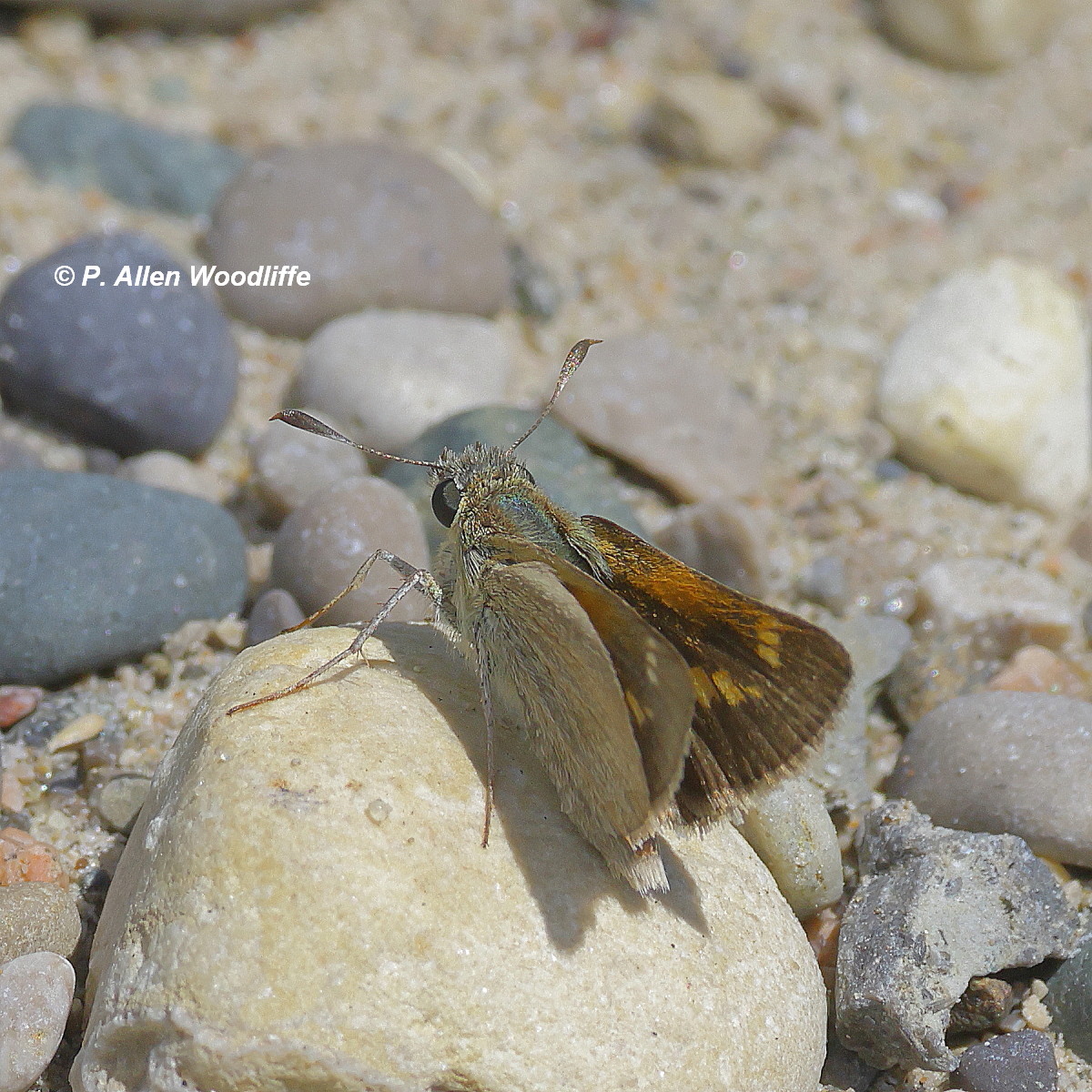
Tawny-edged Skipper

Viceroy

The local rivers are definitely worth checking out, as they feature some of the more challenging damselflies to see and photograph. With all of the rain over these past several months in their overall watersheds, however, the water levels continue to be a bit high, and the banks are a bit muddy and therefore slippery. Caution to gain access to even the limited places must be adhered to! Nonetheless, with care and a bit of time, there are a few that make it worthwhile. These include:

American Rubyspot

Blue-fronted Dancer

Ebony Jewelwing female
This next one is very rare, even considered endangered in Canada. It is the Smoky Rubyspot and for the most part, is very limited to the rivers of southwestern Ontario.

While on the prowl for odes, I came across this American Snout butterfly busily feeding on some goldenrod. It is not a common species, and I hadn't seen one for quite awhile so was glad to get a few photos.

At other places, such as Rondeau and SCNWA, there are various odes as well, although none that I came across were particularly uncommon.

Halloween Pennant
There were lots of Ruby Meadowhawks, shown next, flitting around.
I only got a frontal photo of this one, and it is likely a Ruby Meadowhawk as well, although there are at least a couple of others that look similar and a careful look at some more obscure feature is required to make definite call on it.

While I was busily focussing on the meadowhawks, I saw this caterpillar roaming around. It is the larval form of the American Dagger Moth.

And on various milkweed pods, I came across clusters of the Large Milkweed Bug.

Monday, 12 September 2022

Late Orchids and other rare to endangered species

 As promised in my previous post, this one will focus primarily on orchids, some of them quite rare, that occur in the August/September time frame.

As is featured in the current header, Nodding Pogonia (Triphora trianthophoros) is one of the rarest in Canada. While I have seen it in flower in very late July and as late as mid-September, typically about the third week in August is when it is at its peak.The following photos of this orchid were taken on August 25. It is legally Endangered, as the only known location for it in Canada is at Rondeau Provincial Park.

 It is very small, as you can probably tell from the first photo. They rarely exceed 12 cm in total height.

The flowers, all of which are developed to a certain point, will open simultaneously for a single day, can be slightly more than 1 cm in height. Singles are the norm, and it is always nice to see them with lots of magenta.
Doubles on the same flower seem to be plentiful at times.....
....while three flowers on the same plant, open all at the same time, is more unusual. In checking on this rare orchid annually since the early 1970s, I don't see a triple flowered one every year.

As tiny as Nodding Pogonia is, here is one that is even less conspicuous. It is Autumn Coralroot (Corallorhiza odontorhiza) and is also quite rare, although not as rare as the first one. It is a bit taller on average, but the flowers are much less showy. There are two varieties of this orchid. The one shown here is var. pringlei, and this is the 'open-flowered' variety. Even though the drooping flowers are open, the seed capsules are already well-developed. The form with flowers that never really open is even less obvious. In both cases, self-pollination occurs. To give you an idea of how small this is, it was taken with a 100mm macro lens plus 68mm of extension tubes, and then cropped some more.


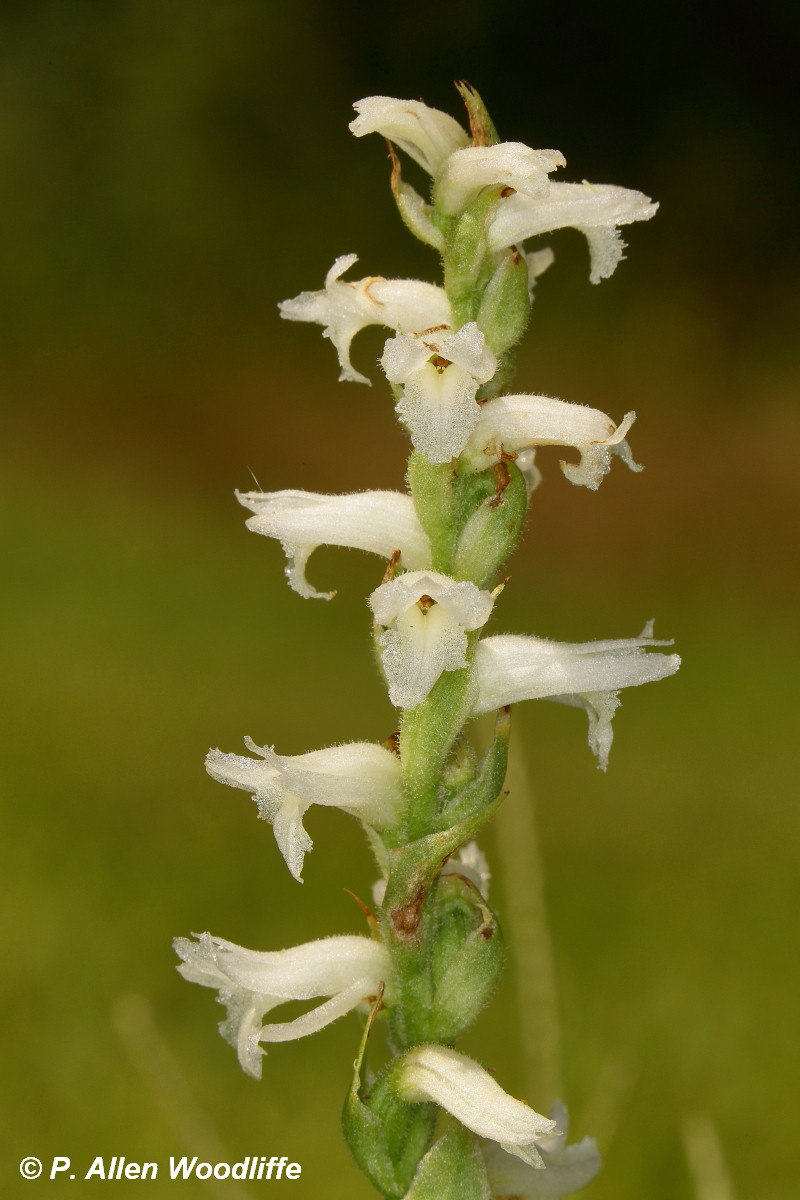
Sticking with orchids a bit longer, there is an interesting group of them in the Ladies'-tresses genus, and some can be challenging to tell apart. A previous post featured the most common one at this time of year, the Sphinx Ladies'-tresses (Spiranthes incurva). I photographed it at Rondeau a few weeks ago. While looking for an endangered gentian in eastern Chatham-Kent, I photographed this same species.

Its flowers are almost entirely white, with little or no fragrance. The brownish spots appearing are an indication that it is past its best. It was photographed on Sept 1, and normally would have been in its peak condition around the third week of August
It has small leaves at the base.

A similar looking one is this next one: Southern Slender Ladies'-tresses (Spiranthes lacera var. gracilis). It is quite dainty, and not easily seen amongst the fairly dense prairie vegetation.

A closer look reveals one of the key characteristics of its spiral flowers: the distinctly green centres of each flower.

Sometimes the spiraling of the flowers takes on a slightly different look with a more drawn out spiral.

It is an extremely rare species, with only this one population showing up in the iNaturalist database. There are older records that I am aware of, but they have not been seen for several decades, primarily due to a change in the overall vegetation.

I have been out to check on another extremely rare orchid of this group: Yellow Ladies'-tresses (Spiranthes ochroleuca), but it was not visible on this date. It occurs on a normally fairly dry sandy site, and it is possible that the extremely dry late June through early August period may be the reason it hasn't appeared. Or maybe I was a few days too early, so I will be out checking for it again soon.

Another one in that genus, while considered rare in Ontario but is relatively common at Rondeau, is Great Plain's Ladies'-tresses (Spiranthes magnicamporum). It is a bit early for it at the moment, but should be showing up in the next week. It is a more robust looking species, with a slightly creamy centre as well as a spicy vanilla scent, and no basal leaves. It grows in grassy areas.


Not an orchid, but an Endangered gentian, is the White Prairie Gentian (Gentiana alba). It grows in the same vicinity as the Southern Slender Ladies'-tresses, and so I combined the time out to photograph them both. There are three sub-populations of this gentian, and at the moment, are the only ones known for Canada. Key characteristics are the creamy white flowers, most of which are fairly closed but not always tightly closed. The flowers also have slight ridges, typically with greenish lines. The plant grows best in high quality tallgrass prairie/savanna vegetation communities.

They can sometimes be confused with another gentian, commonly known as Bottle Gentian (Gentiana andrewsii), which is fairly widespread in a broader vegetation community. Normally they are quite a deep blue, but on occasion they can be white. Such was the case where I was investigating a reported occurrence of the White Prairie Gentian (WPG) in eastern Chatham-Kent. We didn't find any WPG, but did see this white colour form of the Bottle Gentian. The flowers are more tightly closed, and doesn't have the more obvious ridges with greenish edges.

Just to add a little non-botanical information to this post, while I was in eastern Chatham-Kent on the hunt for some of the species above, I stopped by a couple of spots along the Thames River to look for some rare, and very rare, damselflies. The first one is much more common than the second species: American Rubyspot. It has a partially reddish area near the base of the wings, and their abdomen shows definitive brighter rings. They don't always sit in an ideal place to photograph them, but when they do, the patience required is worth it. In Ontario, it is found in many scattered locations west of the Toronto to Barrie area.


Much rarer is the Smoky Rubyspot, next, which shows a bit of red near the base of the wings, and a smoky tip of the wings. Also the abdomen is only faintly ringed, if at all. In Ontario and Canada, it is found primarily along the Sydenham River, the lower reaches of the Thames River and in a couple of places along the Ausable River.

I also managed to check on a couple of rare plants I knew about in the area, both of which are ranked as Endangered. The first one is Eastern Flowering Dogwood (Cornus florida), and while it is not in flower now, it is still quite distinctive. It has a small cluster of red berries.....

...and the large buds of next year's flowers are quite prominent.
In the same general area is a remnant of a population of Eastern Prickly Pear Cactus (Opuntia cespitosa), also Endangered. It was once part of a large population that was widespread across a sandy hillside back in the 1940s, according to a former co-worker of mine who lived across from the site. But eventually the hillside was converted to agriculture, and only a small remnant persists along the roadside.


If you would like to subscribe, or unsubscribe, to Nature Nuggets, send an email to: prairietramper@gmail.com


Sunday, 31 July 2022

Grassland bird search, leps and odes

 It is the final day of National Moth Week, and while I have been out searching for them, there are lots of other things to be looking for. More on the moths in a future post, but for this one, I will highlight some of the other things I have been up to.

A check of the Blenheim Sewage Lagoons can often be worthwhile, especially now that shorebird numbers are increasing as they meander their way south. I stopped in earlier this week and spent most of my time trying to photograph the shorebirds that were utilizing a large weed mat along the side of one of the cells.

This first one is a young Spotted Sandpiper, easily told by the evidence of barring across the back.


Semipalmated Sandpiper

Pectoral Sandpiper
This next one is a Greater Yellowlegs. While the bill doesn't look as long is it might, it is probably due to the angle. It is more substantial than the slender bill of the Lesser Yellowlegs, a few of which were nearby for comparison.

An American Avocet was seen and photographed here a day or so later, but it apparently didn't stay long. One has to keep checking to see most things that pass through!

One of the projects I was involved with these past few days was to do a search for grassland birds at two fairly large tracts of land that had been planted up into prairie. The project took some time to get approved, so while it should have been undertaken at the end of May through to the third week or so of June, it was do it now or not at all.

The first site I visited was this. The area in the foreground of the first photo was mostly non-native grasses, but the birds liked it nonetheless. Past the tree alongside the creek a little way back, is a quite large area of planted prairie, probably in the order of 50 acres or so. It was planted almost two decades ago, and has been periodically mowed for hay, but other than that, been left alone. These two areas was where there was a huge number of Bobolinks. Clearly they were in large, multi-family groups that had fledged and were making use of the habitat until they got the urge to migrate.

This next photo shows another part of the property, and while it doesn't have as much grass content, it shows a lot more diversity of wildflowers. The Bobolinks were not nearly as plentiful here, but I suspect it could be attractive to Dickcissel and Eastern Meadowlark.
Grey-headed Coneflower

Grey-headed Coneflower
While I was traveling through this second part, a white-tailed doe and her fawn jumped up and scrambled by me.

The Bobolinks were not all that easy to photograph, in spite of their abundance. Altogether, I estimated seeing 109 Bobolinks, so clearly it was a good production year for them. I suspect there were actually more, as it was hard to get a good count when they were in flight. Bobolink is officially a Threatened species in Ontario, so their abundance at this site is certainly good. 

They were often well down in the tall grasses, and once in awhile one would get out in the open, but for the most part, when one decided to fly off, a large group that were hunkered down in the grasses decided to leave as well, and quickly got out of camera range. But on occasion, one would be out in the open long enough to get a quick shot or two. These are all greatly cropped. This first one nay be a young bird, while the second is more likely an adult female.


There were a few males, but most of them were showing signs of moulting and will eventually look more like an adult female.
A Baltimore Oriole stopped by for a very brief photo session.

This area is in the future plans to be surveyed more thoroughly, starting much earlier in the season, since some grassland types are finished nesting and either harder to document or have already moved on. It is hopeful that next year I will come across Eastern Meadowlark (Threatened), Grasshopper Sparrow (Special Concern) or even Henslow's Sparrow (Endangered). I suspect it may also be attractive to a species such as Dickcissel, which does not have any official Ontario status yet.

I wasn't far away from the community of Florence, where the Sydenham River passes through, and there is access to the river. It is often a good spot to check for dragonflies and damselflies, so off I went.

This first one is, I believe, a Blue-fronted Dancer. There were a few of them around.

Ebony Jewelwings, next, are always a delight to see. Their flight seems rather loopy and distinctive.
The American Rubyspot is always fun to see and photograph. I only saw a couple of them here on this day.
I am not 100% certain of this next one, but most of the features, especially the pattern on the thorax, point to it being a Black-shouldered Spinyleg. I have photographed it here before, and it is a known spot.

There were a few butterflies around, but the only one I photographed here was this one, a Red-spotted Admiral a.k.a. Red-spotted Purple. I haven't seen many of them this year.

I spent a few hours another day at another grassland area, this one in southern Lambton County, known as the Sinclair Management Area. It is quite a large area, with probably at least 80 acres planted into tallgrass prairie, mainly for seed production so that other areas can be planted into prairie. Tallgrass prairie used to be a fairly large and important vegetation type in southwestern Ontario, but most has been converted to farmland. Fortunately efforts are being made to restore some area to this vegetation type, although just planting a seed mix does not change it over quickly. It is a start, but what is lacking is the decades, even centuries, it will take to change the soil structure, mycelium and invertebrate fauna that are all part of a healthy ecosystem. But it is a start.

These first two photos show a portion of this site. The first one looks generally north east, the second one generally south east.


A lot of it is primarily devoted to grasses, such as Big Bluestem, Switchgrass and Indian Grass. At this point, the grasses are tall, with some approaching two metres in height. That makes it difficult to see through at times, and early in the morning it is totally saturated with dew, so that means I am quite drenched as I attempt to make my way through it.

For some reason the target grassland birds were not nearly as diverse here as they were at the previous site. Maybe it was due to things like Bobolink already having left the site, which this late in the season is entirely possible. A lot depends on when they got started in the breeding season. Or maybe it was due to the height of the grasses and me not being as able to see birds dispersing as easily as I saw it at the previous site. At any rate, it was a start, and another visit next year at the main part of the breeding season will hopefully shed more light on the use by some of these grassland species. I did see a few Common Yellowthroats.

It wasn't a total disappointment, however. There were a lot of Monarchs, a Special Concern species. 

Monarch feeding on Mountain-mint

Here is a Monarch sipping nectar from Dense Blazing-star, a Threatened species.

I probably saw as many Monarchs as I did grassland birds.

A little later I swung by Clear Creek Forest Prov Park. I hadn't been there for awhile, and thought I might find some interesting odes. Unfortunately they weren't plentiful. I attempted to shoot a few in flight, but as usual, it was quite a challenge. Here are a couple of the best I could do. These are a couple of Calico Pennants, a fairly common species darting all over the place and challenging to track.


Fortunately a few butterflies were easier.

Eastern Comma

Question Mark
This Giant Swallowtail was almost constantly on the move, but I waited it out to get some full frame photos.


If you want to subscribe, or unsubscribe, to Nature Nuggets, send an email to: prairietramper@gmail.com