Tallgrass prairie is one of my favourite habitats to explore and photograph. A great prairie often looks like this in the late winter or early spring, depending on the overall condition of it in the first place.
In just a few weeks after a spring burn, it will look lush and green, with splotches of colour here and there such as what the Butterfly Milkweed contributes in the next image.
But by August, tallgrass prairie really is 'august', as in majestic. Very quickly a kaleidoscope of colours appear: purple, pink, white, yellow and blue, in no particular order.
There are a few august prairies in southwestern Ontario to enjoy. The two I know best are Ojibway Prairie Provincial Nature Reserve in south Windsor, and even larger and more extensive prairies at Walpole Island First Nation (WIFN). The prairies around Ojibway are open to all for exploration and the city-owned nature centre across the road is definitely a must to visit. The prairies at Walpole are not open, however. Most occur on private property, are well away from the road, and permission must be obtained. I always go with someone from WIFN and even then, only when permission has been granted.
This next image was taken on a recent visit, and looking in the same direction as the previous image, albeit a little closer to the lone tree on the right. The purples of Dense Blazing-star stand out tall amidst the gradually increasing yellow of various species of goldenrods.
Where you find Dense Blazing-star (
Liatris spicata), you often also find Rough Blazing-star (
Liatris aspera), a little smaller and with its flower head not as densely packed with flowers. Dense Blazing-star is listed as
Threatened on the respective provincial and federal legislation dealing with Species At Risk (SAR).
 |
| Dense Blazing-star |
 |
| Dense Blazing-star |
Rough Blazing-star is not legally listed, but at S2 in Ontario, is
Imperilled with between 6-20 locations known.
 |
| Rough Blazing-star |
Sometimes you come across a blazing-star that is white. It doesn't show up really well in the next image, as it is in the centre background under multiple stems of Prairie Dock (
Silphium terebinthinaceum), but a close-up of a white Dense-Blazing-star follows.
Prairie Dock is not listed on any SAR legislation, but is S2
(Imperilled). Its large very rough sandpapery leaves which look like a shovel, and tall single flowering stem are characteristic. Note: if you are out on a prairie and need toilet paper, do not be tempted to use the leaves of Prairie Dock!
Another showy purple plant is Missouri Ironweed (
Vernonia missurica). It is very similar to Tall Ironweed (
V. altissima) with the main differences being the number of florets in each flower head.
 |
| Missouri Ironweed |
Sticking with the purple theme, but much, much smaller, is Pink Milkwort (
Polygala incarnata). It is legally
Endangered in both federal and provincial legislation. In Canada, this annual plant occurs only at Walpole and Ojibway Prairie.
While you are down on your hands and knees examining Pink Milkwort, you just might stumble across a very rare orchid: Southern Slender Ladies'-tresses (
Spiranthes lacera var.
gracilis). It isn't restricted to tallgrass prairie. It is only known from a handful of locations in Ontario, and while it isn't yet on a legislated list of SAR, it is S1, meaning
Critically Imperilled since there are no more than 5 locations known for the province. I came across three individuals recently at Walpole Island.
It is small....the third image is several times life size. If you find it, the dark green centres of the individual flowers will separate it from other members of the
Spiranthes genus.
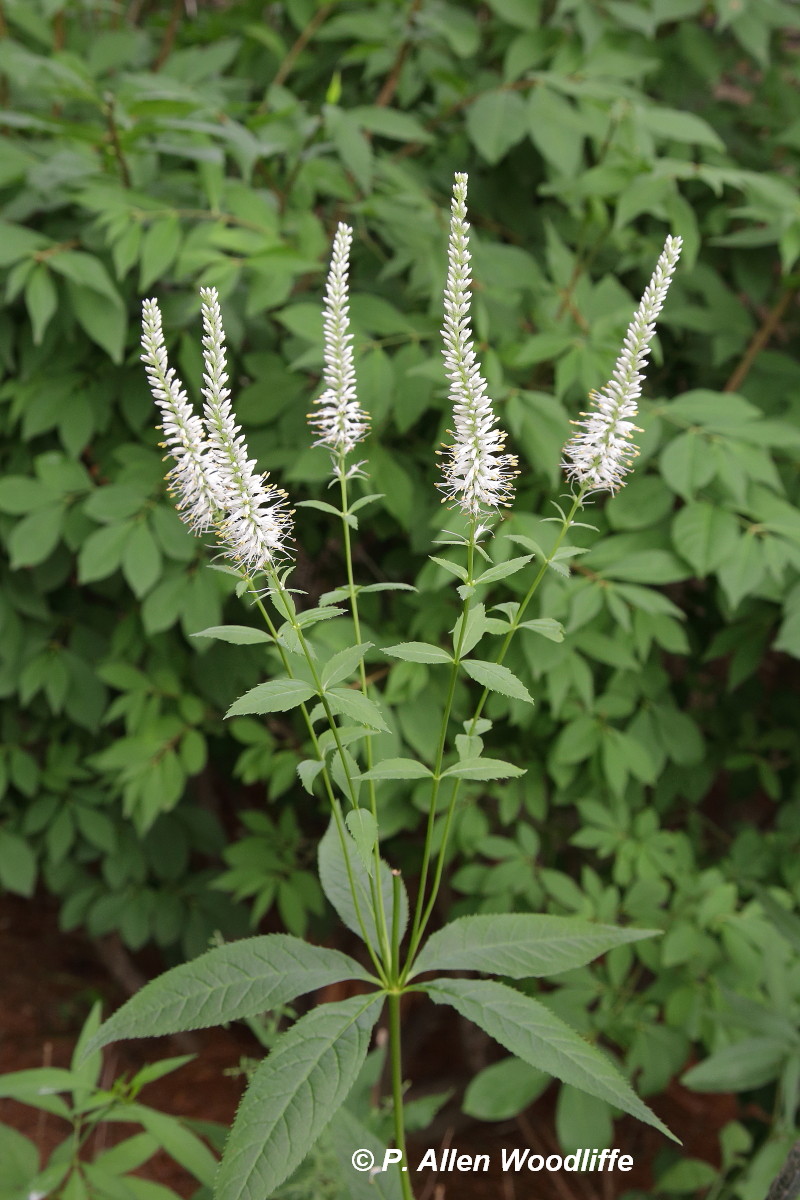
Another prairie plant with a dense cluster of white flowers is more common, and more visible since it is much taller: Culver's-root (
Veronicastrum virginicum). A fully mature plant will have multiple flowering spikes, somewhat resembling a candelabra, while a younger plant will only have a single flowering spike.
Another plant with white flowers at this time of year is Grass-of-parnassus (
Parnassia glauca). The fine green lines on each petal are noteworthy.
There are numerous species of aster and goldenrod just beginning to display themselves on a good quality prairie. Canada Goldenrod is often the most obvious of the goldenrods, but several rarer species are beginning to appear, including Riddell's Goldenrod (
Solidago riddellii). It is easily identified by its long, linear downward-curving leaves which in cross-section are V-shaped. Its flower head is slightly rounded. This next photo is of a plant that is almost, but not quite, out in flower.
 |
| Riddell's Goldenrod |
I plan to show other goldenrods, asters and rare later season tallgrass prairie specialties in a future post.