Showing posts with label Striped Skunk. Show all posts

Saturday, 13 March 2021

Bird Action Increases!

We've had some very nice late winter weather, making it feel more like spring every day. But the forecasts look like things will slow up a bit, which is likely a good thing. Nonetheless, with some warm weather, brisk southerly type winds and lots of sunshine, it has spurred more activity amongst our feathered friends.

It was only a few days ago (March 2) when I took this photo of the piles of ice along the Rondeau shoreline.

In a matter of just a few days, that ice had all but disappeared. 

Waterfowl continued to pour in to the open waters of Rondeau Bay and even the local sewage lagoons. The warm, southerly winds caused most of the Tundra Swans to depart, although some continue to linger. The Greater White-fronted Geese that showed up periodically at Ridgetown over the last week or so seem to have left, but up to 15 Snow Geese were still there earlier this week. Snow Geese are much more of a novelty here than in extreme eastern Ontario, where tens of thousands of them pass through both spring and fall. This first photo shows all Snow Geese, including a single blue colour phase individual, and a single Tundra Swan.

This close-up shows a difference in size between two individuals. I had hoped the smaller one might have popped its head up, to see if it showed any characteristics of a slightly smaller Ross's Goose, but it remained in this sleeping pose. Then, as I was photographing something else, all of the Snow Geese took flight, although I don't think I 'shot' the smaller one in any of the several photos I got. It may have been a hybrid between the two species, which is known to happen with some regularity.


Rondeau Bay attracts thousands of waterfowl. In the last few weeks, Tundra Swans have been in impressive numbers, but most have left and it is dominated now by ducks. They are often too far to photograph, let alone get a good view of, but as was the case yesterday, several rafts of both Canvasback, shown next, and Redhead, were close enough to make the attempt. Note that there is a single American Coot at the far right of this photo.

Since several pairs of Bald Eagles have been observed at the early stages of nesting, with an adult sitting on the nest presumably incubating one or more eggs, I went part way down the west branch of Rondeau's South Point Trail to check out the nest there. It is barely visible from a limited part of the trail, and a 'scope is really useful. This next photo shows a white head sitting above the nest, so it would appear that this pair is also into the nesting cycle. This photo was taken and cropped to about 45X, so not easy to see or photograph.

While I was there, I had three cyclists stop by and I gave them a view through the 'scope, and as they were leaving three young fellows came by and also got a look. None of them had seen an eagle's nest in the park before.

The sunshine has definitely triggered some increase in activity amongst the smaller land birds, and yesterday I was treated to a fair bit of activity in the campground area. I got several firsts of the year, including Tufted Titmouse (they are year round residents, but not always easy to find)...

...a couple of Yellow-bellied Sapsuckers......
..and two Yellow-rumped Warblers. It is likely they were over wintering individuals, although there had not been any reports of them in the Rondeau area for several weeks.

I also had a single Evening Grosbeak perched at the top of a cottonwood tree, but it was seen from a distance and before I could get even a distant photo, it flew north. They were quite frequently seen in mid to late autumn last year, and presumably this is one that was on its return to the boreal forest region.

Other, regular winter residents cooperated nicely for the camera.

White-breasted Nuthatch

Northern Cardinal

House Finch

Golden-crowned Kinglet

Black-capped Chickadee

Red-bellied Woodpecker

Downy Woodpecker, male

Downy Woodpecker, female

Elsewhere in the park, I came across several Turkey Vultures. They will be a regular occurrence from now on....

....and three Killdeer.
This Eastern Screech Owl is showing up in its usual beech tree a bit more regularly.
I came across this Virginia Opossum along the Tuliptree Trail.
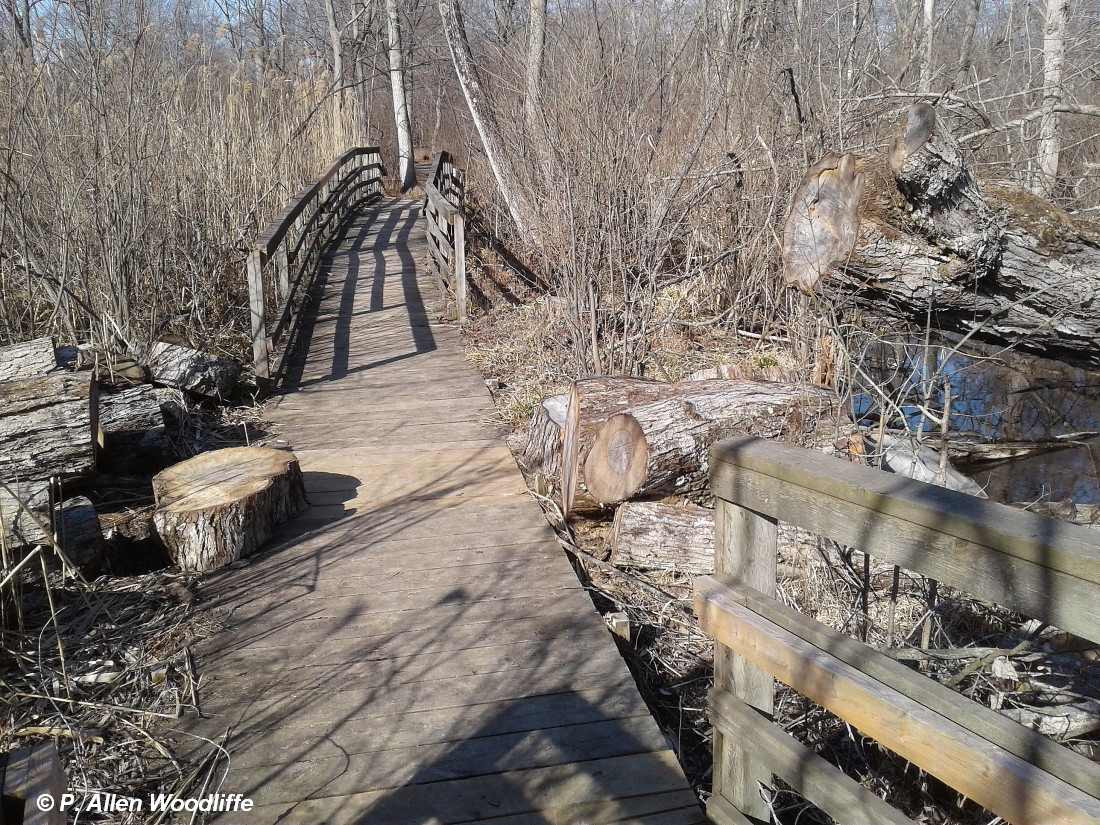
The Spicebush Trail did not have much birdy action, partly because the brisk westerly winds had them hunkered down, or elsewhere. I hadn't been around this trail for several weeks, and noted that since my last time around, a large Silver Maple had come crashing down across the boardwalk, likely due to one of the strong easterly wind events.

On one occasion while returning home, I saw this Striped Skunk scampering along the edge of a field. Normally you don't see skunks out in broad daylight and so far from any cover, although as they emerge in the warming days of spring, they may forage farther afield. A closer look at this individual, however, shows a diseased or damaged left eye. I did use a telephoto lens, but still got fairly close to get these photos. I made sure that the wind was blowing in the skunk's direction, just in case!


Tuesday, 1 April 2014

April 1st....no fooling!

All around the country side, the appearance of winter is changing over. It was only a couple of days ago that the large drainage canals in the former Dover Twp were breaking up. They are mostly open now.


Remnant snow drifts along the road sides revealed what they were concealing beneath the mounds of white. Here a Striped Skunk met its end. Did it get hit by a car or a snow plow while crossing the road (it should have taken notes from the chicken :-)....regardless, I doubt if many people will shed tears over its demise.


Skunks do have a role in nature, and even now, its remains will nourish large scavengers, such as Turkey Vulture or numerous smaller scavengers....the decomposers such as carrion beetles and fly larvae, a.k.a maggots who will do their thing. If natures cleaner-uppers weren't around we would be up to our necks in dead creatures!

I was lured today, April 1, to the Erieau area due to the reports yesterday of Eurasian Wigeon and shorebirds such as Lesser Yellowlegs and Pectoral Sandpiper. It was a very balmy 18C when I left home, but I knew with the brisk southwesterly winds coming off of the ice on the lake, it would be considerably cooler at Erieau.

It was. It never got above 8C, and with the wind chill, it felt barely above freezing. There is still lots of ice along the lakeshore and well out into the lake.


The Rondeau dock, what is left of it. Nature can do the unexpected, sometimes quite violently, and this structure paid the price.

But there are gradually a few open areas showing up in the ice, and a steady dose of warmer temperatures, brisk winds and spring rains will speed up the process! The open water of Rondeau Bay at Erieau is opening up quickly. And Great Blue Herons have arrived back to their nesting tree near Shrewsbury. I saw four birds at the nest tree yesterday, inspecting the nests to see how they survived the winter and what needs to be done to get them patched up for the new season. I am looking forward to getting my kayak out and photographing this small nesting colony in a few weeks.

While I was at Erieau today, I ran into several other birders with similar hopes of finding the Eurasian Wigeon. The partly flooded fields east of McGeachy Pond were perfect.....and there were lots of ducks! American Wigeon and Northern Pintail were by far the most common, and in the greatest numbers I have seen this spring. Green-winged Teal were also fairly abundant, and catching a quick glimpse of their reddish head gave cause to take a second look....Eurasian Wigeon look very much like an American Wigeon, but have the reddish head. There were a few Northern Shoveler and Redhead, as well as Mallards and American Black ducks. But no Eurasian Wigeon. It may have been there, but there were too many low wet spots and too much tall corn stubble...the combination of which is ideal for hiding a single bird. Collectively the half-dozen birders spend at least 11 person-hours scanning all possible spots with 'scopes, but it was not to be seen today as far as we know.

Shorebirds are slowly increasing in numbers and diversity. I didn't catch up to the Lesser Yellowlegs, but I did have two Pectoral Sandpipers and a single Dunlin. Unfortunately they were too far away for a photo to prove it!

I ventured out along the Erieau Railroad Trail. The snow is almost gone, so it made the hiking conditions much better. There were lots of Song Sparrows. I saw a single Northern Flicker as well as a single White-throated Sparrow, the latter of which was skulking in the shrubbery and allowed me to take one record shot. It looked fairly fresh, almost like a spring migrant, but I suspect it was an over-wintering bird. They don't usually come back until the end of April.


Red-winged Blackbirds and Common Grackles were in abundance. Even though they are so common, they are still attractive in their own way.


The partly clear skies and westerly winds just might induce a few more migrant birds to arrive over night!