Showing posts with label Maidenhair Fern. Show all posts

Saturday, 16 November 2019

Autumn reflections

I had planned on posting this a few days ago, but during some recent outings, the birds took priority, especially due to the presence of lingering shorebirds. So I will take the opportunity in this post, to highlight some of the reasons autumn is one of my favourite times of year.

Some folks have told me recently that autumn is not very interesting to them. The forests have lost their greenery and flowers are long gone. Reptiles and amphibians are quickly disappearing, going into their cold weather senescence underground. Birds are fewer and certainly quieter. Even people are not out and about as much, making the trails quiet.

In one sense, these are the exact reasons I look forward to autumn (aside from the fact that October is the month Marie and I were married 43 years ago :-).

Instead of the constant change of wildflowers, various shades of the green growth, and the natural areas being full of action that is sometimes hard to keep up with in spring and summer, autumn can be a time of reflection. We all need quieter times, not the continued busyness that dominates our lives. Certainly the colours change quickly from green to shades of gold, yellow or red before turning brown and then disappearing altogether. And then the colours are even more muted, with varying shades of gray dominating until the white stuff appears.

I had been up to the Sydenham River Nature Reserve not that long ago. It is a relatively recent acquisition by Ontario Nature and is located on the border of Lambton and Middlesex counties. It is a deciduous forest in a largely agricultural landscape, with both the Sydenham River and an unnamed creek going through it. I didn't get to a lot of it, as the boundaries are not well marked, and it is surrounded by private property with numerous No Trespassing/No Hunting signs, so I didn't venture too far this time.  The stream in the following photos is just of the unnamed creek, not the Sydenham.

There are some nice specimens of Common Hackberry here, certainly a Carolinian species that is not all that common even in the Carolinian Forest Zone of Ontario.


Closer to home, I have gone hiking at Rondeau on several occasions. The lake has been riled up from time to time, providing some good photographic moments along the lakeshore. There have also been some serious erosion problems, but at least at the park's south point, there aren't any human habitations under threat.

On occasion, the lake can be quite placid.
The grasses dominating the sand dunes have turned a golden brown. Little Bluestem is one of the most common grasses, and their backlit stems show the fluffy seeds.
On one of my hikes, I was on the lookout for evidence of a somewhat rare orchid. Orchids at this time of year, you ask? Well yes, at least in the case of Puttyroot (Aplectrum hyemale). Its leaves are most visible from November to April, if there isn't any snow on the ground. When it puts up its flowering stem in late May and early June, the single basal leaf has dried up and disappeared. This first image shows a very fresh leaf.
 Here, about a dozen leaves have emerged through some recently fallen maple leaves.
 Only a small percentage of plants will flower in a given year, typically around 10%. Here is a dried up stem with a few capsules.
 One one of my hikes, I came across an unusual sight. The green plant is Maidenhair Fern, a fairly delicate fern species. Most of them by the time of year I took this (Nov 7)  are quite brown and dried up. I guess due to the southern location in the park, and the lake effect which minimized any killing frost, this cluster was still green. It looked quite out of the ordinary to be so green, but with a bit of fresh snow on it.
Due to the temperature of the lake being warmer than the more quickly declining inland temperatures, this 'lake effect', results in the leaves being slower to change from green to gold to brown to gone. Even the south end of the park is delayed compared to the north end. Regardless, the changes throughout the park are fairly rapid in just a few weeks time. This next series of photos were taken along Bennett Avenue.
October 23
October 27
November 7
November 14!
For what it is worth, winter isn't officially here for another 5 weeks!


Saturday, 23 June 2018

In the quiet....

I haven't been out a lot lately for various reasons. But some of the times I have been out, I value them not so much for getting records or photos of a great diversity of things, but for the quiet and stillness I am able to experience. It is therapeutic, both mentally and physically, to escape from all of the craziness that is going on in the world.
It is interesting that the term 'forest-bathing' keeps cropping up from time to time. I read about it again just a few days ago in my most recent issue of Outdoor Photography Canada. Now OPC is a great magazine, don't get me wrong, and I highly recommend it to anyone interested in photography and the outdoors. But I was bemused by this one article, which discussed forest-bathing as a relatively new phenomenon. Indeed, even Wikipedia states that it was developed by the Japanese in the 1980s as a cornerstone of preventative health care.

I beg to differ.

It is no secret that hiking slowly through a good quality natural area, and taking time to 'smell the roses', is good for one's health. Sure, I sometimes go to a natural area for the primary purpose of seeing as many species of things as I can, and so do many other people. There is no harm in that whatsoever. But there are times when visiting a natural area for other reasons is just as enjoyable, and dare I say, a whole lot better for one's health. We all are bombarded by technology that we see and may use, such as smart phones, iPads, television, etc, even out in the field, as well as all the technology that we don't see. There are myriad electronic waves going through the air constantly....after all, where else is all that technology getting the signals from and what is it doing to us. There is more and more evidence that the incidence of brain cancer, for example, is increasing as the use of cell phones has increased, and this is especially problematic with the youngest generation whose skulls and brains are still developing.

The practice of forest bathing is one that I and many others have done for years, and long before the 1980s. It has been done for generations, but no one likely referred to it as forest bathing. We go out to experience nature.....we slow down and de-stress from the constant busyness in our lives. A forest can be like a cathedral, causing one to tread lightly and in awe of our surroundings. We sit or otherwise remain fairly quiet, even motionless, and soak up the fresh air, the multitude of sounds, sights, patterns and colours all around us. We can be in one spot for quite awhile...maybe an hour or more. The longer we do it, the sharper our senses are to what is in our immediate vicinity. Even some of the wildlife may ignore us and carry on in their usual activities, which we likely wouldn't have seen if we had been on the move very much. And there is no doubt that the air is purer with greater amounts of oxygen in it since the photosynthesis of all of the greenery around us takes in the carbon dioxide and produces oxygen with fewer impurities to contend with. You don't find that in cities or rural areas!


Calm, overcast days are some of my favourite times to do this, perhaps more so with the threat of rain, since there will be fewer other people out there. These days are also great for photography, if I want to include that in my time. I recently was at Rondeau and was able to enjoy these conditions. Spicebush Trail was particularly enjoyable. I was there for at least an hour and never came across anyone else. Sometimes I enjoy encountering others and sharing what we all have seen, but sometimes it is even more enjoyable without such an intrusion.
 One part of the trail had an enormous amount of horsetail along both sides, due in part to the higher water levels this spring. I had never seen so much of it here, and it gave some interesting visuals.
 A few of the more typical plants were poking up through the dense mat of horsetails.
Maidenhair Fern
Sensitive Fern
Mayapple
Other things were noted in the rich green background.
Purple-flowering Raspberry
Canada Anemone
Wild Yam
One of the most distinctive features of the Wild Yam is not the flowers, but the distinct heart-shaped, pointed leaves. It is a delicate vine, wrapping itself around some of the mid-sized vegetation. In the fall, the leaves turn a very vibrant golden yellow. The flowers are tiny, and barely visible in this photo, but if you see the tiny bead-like things on an even finer stem, you are looking at them.

A Green Frog remains motionless on a nearby log, seemingly unconcerned with me in its territory but belting out its territorial call every few minutes.
A careful, slow walk along a trail revealed a rare plant: Chapman's Meadow Parsnip (Thaspium chapmanii). I know I have passed by a few of these plants on a number of occasions, barely giving them a second glance, and if it weren't for my slower approach, I would have missed it again. It is a rare species in Ontario, being known from fewer than 20 places.


Maybe on my next visit I will be doing a more aggressive blitz to find as many things as possible. But this time, it was to enjoy the world of nature for a whole different, and immensely satisfying, purpose.


Sunday, 31 July 2016

A walk in the woods can turn up many things!

A healthy woodland is always interesting to explore. There are breeding birds, of course, but not always as obvious with the heavy foliage. Here, a Great Horned Owl is peering out at me.


There is so much more diversity in the other types of wildlife and vegetation, however. And often the human crowds are not much of a problem, at least on some of the more remote trails.
Some things are brightly coloured and easily noticed, such as this Chicken-of-the-woods fungus. They can be seen at anytime, from June through September.

Other orange things include this Wood Lily (Lilium phildelphicum), found along some of the more open sections of woodland.....

...as well as this Michigan Lily (Lilium michiganense).

A bit earlier in the season, one can see this orangey scene at various places of a woodland.
These oblong cavities are characteristic of where a Pileated Woodpecker has drilled into the trunk of a Hop-hornbeam (Ostrya virginiana) digging out insects. The indirect result is the ensuing run of sap. Sap contains good concentrations of sugars especially in the spring, and these sugars are attractive to yeasts for feeding on. The type of yeast here is Cryptococcus macerans. It can appear on many different types of tree and even on wild grape vines and is often seen where there has been a wound that lets the sap out.

There isn't a lot of sunlight getting to the forest floor these days, and wildflowers are not abundant.
You are more apt to see the spring wildflowers in this condition, with their seeds ripening, such as this Large-flowered Bellwort (Uvularia grandifolia).


Where a tree has died, or fallen over, it lets a bit more sunlight to the forest floor, and it is there where there is a greater profusion of vegetative growth. This American Beech tree (Fagus grandifolia) has fallen over, and the growth on the forest floor is beginning to become more prevalent than in the  adjacent shaded area.
 
There are a few flowering plants, however, even in the somewhat subdued light. Purple-flowering Raspberry (Rubus odoratus) is scattered about. Its fruit is not considered edible like many other  raspberries are.

Fringed Loosestrife (Lysimachia ciliata) may be found in some of the damper sections.
 A close-up of the leaf stem shows the fringe, which gives this plant its name.

Another plant found in rich woodlands these days, and mostly restricted to the Carolinian Life Zone, is Richweed (Collinsonia canadensis).
It wasn't until I got these images on the computer that I noticed the colourful little critter on the stem...a Red-banded Leafhopper!
I usually see these leafhoppers on milkweed plants in more open areas, so I was a bit surprised to see this one here.

A close-up from a previous year

Thimbleweed (Anemone virginiana) is not all that colourful, but is distinctive.

This vine, named Wild Yamroot (Dioscorea villosa), is not common, and the flowers are not particularly impressive. Its seeds are more obvious than the flowers, and in the fall, the heart-shaped leaves turn an attractive golden brown.

Maidenhair Fern (Adiantum pedatum) is quite abundant in these southern hardwood forests. It is one of the more delicate fern species, and will disappear with the first frosts.

Bottlebrush Grass (Elymus hystrix) is an obvious grass species well represented along the trails.

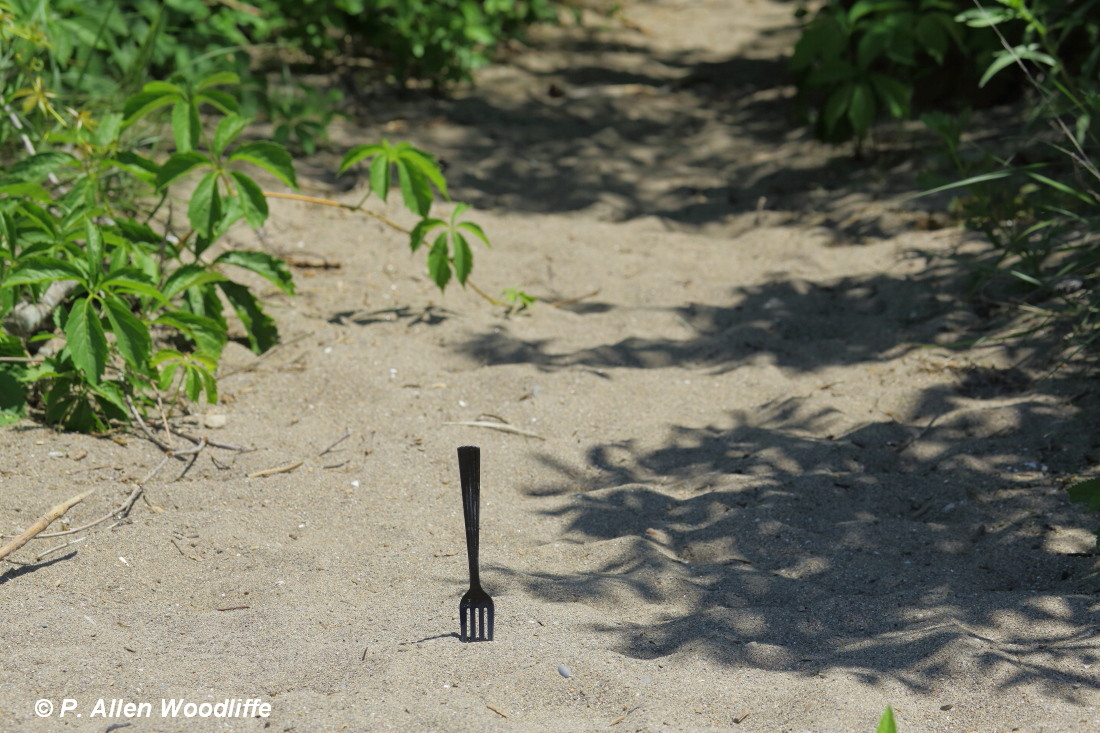
Occasionally one might come across a fork (Forcus plasticus) in the trail :-).

If you look closely to where you are stepping, the distinctly marked caterpillar of a Mourning Cloak butterfly may be crossing the trail.

This next image shows a Brown Stink Bug (Menacles insertus). I didn't handle it to see if it lived up to its name.

Even in the forest, dragonflies occur. Here is presumably a female White-faced Meadowhawk, well away from its normal wetland haunts. The various species of meadowhawk are notoriously difficult to tell apart in the field, especially the females.

Even during these dog days of summer, there is lots to see!