The month of May is typically prime birding season, as most readers will be well aware. While the weather of 2025 has not been ideal for some migration movement, there have been some very good days, and lots of the expected migrants have put in an appearance in varying numbers.
I have been out from time to time, but not as often as I used to. The month of May has been occupied by many other things, as it was just a year ago, that my wife and best friend of almost 48 years passed away. Monday, May 26, is the exact one year anniversary of her passing. Regular readers will be aware of a special blog I posted a few days after she departed from her earthly life, and you can read that blog at this link. Life has not been the same since, of course, and I may have more to say about that later in this post.
However I do try and get out on occasion, and have seen a good assortment of the mostly expected migrants. One of the highlights is to encounter my first of the year Acadian Flycatcher.
Several of the flycatchers in the
Empidonax genus look fairly similar, and it always helps when you hear them vocalizing. This particular bird did not vocalize while I was within earshot, but its appearance was spot on, and it was persistent in hanging around this species prime habitat, and exactly in a place where I have found nesting birds over the last several years. So I feel 99.9% confident in it being an Acadian Flycatcher, and I will be out checking this location periodically.
Some other regular species, and certainly some that are a little less common, include the following.
Another member of the flycatcher family is this one, an Eastern Wood-Pewee.
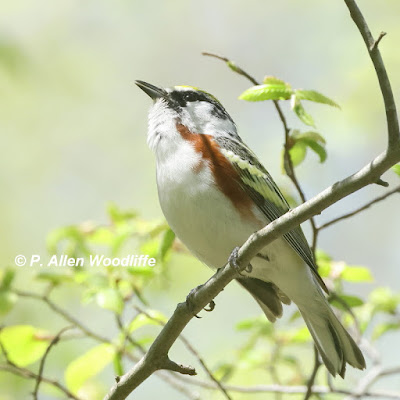 |
| Chestnut-sided Warbler |
Next is a Cedar Waxwing. It is an erratic species, and I have seen very few this winter and spring, but on this occasion I encountered at least a dozen flitting around some newly leafed-out trees.
A much less common warbler, in fact it is a Species At Risk, is this Canada Warbler....
...while Black-throated Green Warblers are much more abundant....
...as is the brightly coloured Blackburnian Warbler, one of my favourites,
Next is a Blue-gray Gnatcatcher, hard to photograph as they are constantly on the move looking for insects to feed on.
Bay-breasted Warblers, are typically a little later to show up in the migration period.
Baltimore Orioles can sometimes be abundant, seeing several dozen in a day without even trying. Of course some will remain to nest.
Hairy Woodpeckers, shown next, are permanent residents, but can sometimes be hard to pin down for a photograph.
Next is a Least Flycatcher. It looks quite a bit like the Acadian Flycatcher, shown at the beginning, but it occurs in much more open forest edges, looks a bit grayer, and when it gives its distinctive 'che-bek' call almost repeatedly, is easy to confirm.
Another member of the flycatcher family is the Olive-sided Flycatcher, which is just a migrant in this part of Ontario. They usually perch in open areas, fairly high up on a dead branch, and sometimes can be heard calling for 'quick, three beers'. I have yet to see anyone delivering beer to this bird, but they keep calling :-).
A frontal view shows a bit of its grayish vest, and it doesn't have a white eye-ring that many of the smaller
Empidonax flycatchers have.
Another permanent resident that occasionally will be visible long enough for a photo is the Pileated Woodpecker. They are always fun to see, and photograph.
One of the bird species that the majority of birders visiting Rondeau are hoping to see is the Prothonotary Warbler. It is an endangered species, and fortunately Rondeau has lots of suitable habitat. It was first discovered nesting in Canada at Rondeau back in 1929. I have been following this species in various ways at Rondeau for more than 50 years, and I have a rough draft of a booklet in preparation to feature this iconic species. I got the first draft completed in early2024, but as mentioned previously, the rest of 2024 and since has carried on with a much different set of priorities. I still hope to complete the booklet, as there is an important story to tell, so stay tuned. Maybe it will be done in time for the 2026 birding season!
 |
| Prothonotary male |
 |
| Prothonotary female |
Certainly a popular bird, although not particularly rare, is the Scarlet Tanager, shown next. Most will continue on their migration farther north, but there are always a few that remain to nest.
On one occasion as I was hiking the west South Point Trail, I came across this carcass along the edge of the trail. It is a Turkey Vulture, and it had been there for at least a few days, as one could detect the decomposition smell....
...as could a few of its fellow vultures. In a tree above the carcass, as well as a few soaring above, were at least 9 vultures that had also detected the decomposition 'fragrance'.
Yellow Warblers are one of the most common warbler migrants, and it nests fairly abundantly here. It is hard to believe that back in the 1970s, it was on the Audubon 'blue list' as a species of concern given what was then, in declining numbers. It certainly has rebounded well!
 |
| Yellow Warbler back view |
 |
| Nashville Warbler |
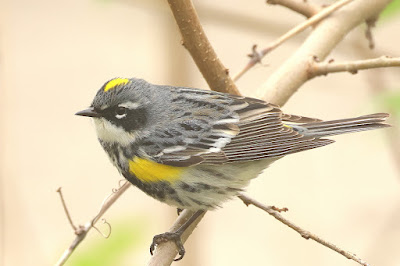
Quite common, especially in the early part of the warbler migration parade, is the Yellow-rumped Warbler.
The rufous morph of the Eastern Screech Owl continues in its American Beech cavity, although it is getting harder to see due to the developing leaves.

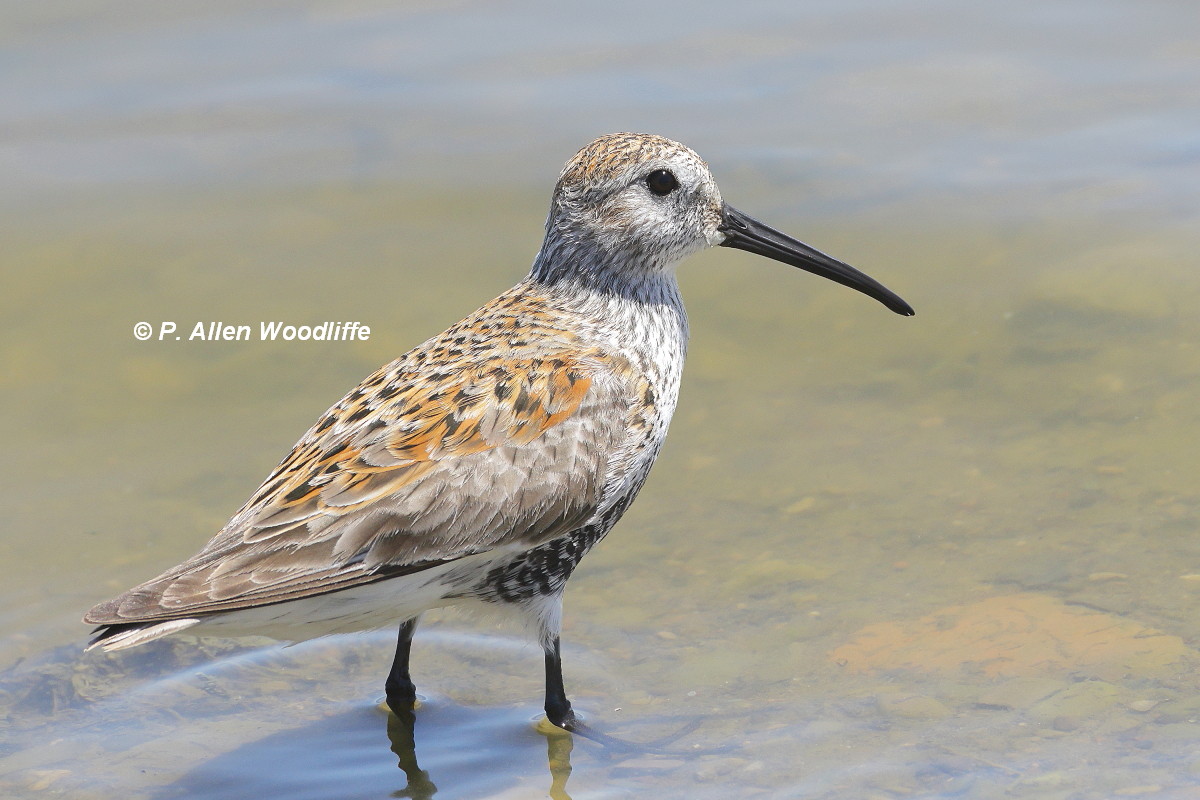
Elsewhere, some shorebirds are showing up, such as this Dunlin....
...and this one is keeping an eye on the sky, on the lookout for a predator perhaps?
Hanging out with the Dunlin were a couple of Least Sandpipers. Due to the legs being in the shadow of the bird's body one cannot clearly see the distinctive yellow legs, but they were yellow.
Great Egrets are always nice to photograph, and large wetland areas along Lake St. Clair are usually productive since the species nests at some of the offshore islands or a bit farther north at Walpole Island.
And Sandhill Cranes are regularly heard, if not seen. A few will remain to nest in some of the larger wetland areas fortunately for birders and photographers.
Wild Turkeys are widely scattered across the landscape, as well as at Rondeau.
I came across this egg of a Wild Turkey along the Black Oak Trail of Rondeau a few days ago, suggesting it is a recent hatch.
As mentioned near the beginning of this post, life has taken on some very challenging and different directions especially in the last year or so. As a result, while I plan to continue Nature Nuggets, I may venture into another blog which will feature many of the things not totally related to the Nature Nuggets theme. The plan is to discuss so many things related to my ongoing life journey, including many things that I could never have planned for, but that will hopefully be apparent when I get to the stage of adding that blog. When it comes out, I will reference it here in Nature Nuggets, so interested readers can have access to the information that it will cover. So many thoughts and ideas are floating about in my mind, and I have started to itemize many, but I need to get them organized before jumping into it, so stay tuned!
If you would like to subscribe, or unsubscribe, to Nature Nuggets, send an email to: prairietramper@gmail.com