Showing posts with label Glaucous Gull. Show all posts

Monday, 29 April 2019

The trickle continues

The spring migration of most species continues to trickle in. Of course many birders are anxious for a big push of birds, especially warblers and other passerines, but with the many north to east winds and very few weather systems with good south to southwest winds, the birds are not getting any help in arriving from their quite southerly wintering grounds. Nonetheless there is always something relatively new, or in larger numbers, to be found when birders put in the effort. There have been about 10 species of warbler reported so far, but according to most eBird reports, it is rare that a birder gets more than a couple of species a day. Hopefully in a week or so it will not be difficult to get 20 or more species of warbler in a day!

Yellow-rumped Warblers have been the most numerous, as expected. Some are fairly drab, not yet having attained their breeding plumage.
 More and more are looking quite dapper.
 I had my first Palm Warbler a couple of days ago. It was hanging around an open grassy area with several dozen Chipping Sparrows, as well as an ongoing Clay-colored Sparrow and a few Field Sparrows.
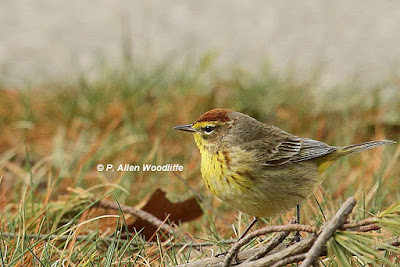
Palm Warbler
Clay-colored Sparrow
Field Sparrow
Other than Chipping Sparrows, found in open areas, the sparrow that is becoming the most numerous is the White-throated Sparrow, which is more often to be found scratching around in the leaves on the forest floor.
Hermit Thrushes are quite common.....
 ....but certainly are not the most common of the thrush family. That honour currently belongs to the American Robin.
Brown Creepers are a lot more common these days, but their small size and cryptic coloration makes them difficult to see.
The great thing about this time of year is that if the birds are few and far between, the wildflowers are showing well, so there is always something to see.
Spicebush
Last Saturday, just before I was heading out, I got a message that there was an Eared Grebe in the lake off of Erieau. This western species is not often seen in this area, so I made Erieau my first stop. Several others were there looking at the grebe already. It was not close, and could really only be satisfactorily seen through a scope. I attempted to get a record photo, but was barely successful, as this following photo was the best of the bunch. Its darker appearance, especially on the neck, as well as the more pointed tufted head, made it a relatively easy identification.
While it was nice to see here, I was fortunate to have seen dozens last July while travelling through southern Saskatchewan and Manitoba, and was also fortunate to have been able to get some fairly good photos of them in prime breeding plumage.
While we were at Erieau watching this grebe, a young Glaucous Gull was observed resting on the far breakwall. Its very large size and almost pure white colour really makes it stand out amongst the gulls.
The gulls got up and were flying around when all of a sudden we noticed about a dozen Willets flying in and landing on the armourstone surrounding the fish tug harbour. While at rest, they blended in really well against the colour and pattern of the armourstone, and initially we thought there were only 11. A closer look at the photo showed an even dozen.
The Erieau Rail trail hasn't been terribly productive lately, although there are always a few things to look at. Certainly the Wood Duck nesting box leaves a lot to be desired as a nesting feature, unless the ducks want one with an indoor swimming pool. I doubt it came with a sump pump, a feature I am glad to have at our place these days.
On the occasional sunny day, Painted Turtles will be out, soaking up some hard-to-come-by sunshine.
After leaving Erieau, I headed to the park. There wasn't much new to add to recent visits. I did stop at the Keith McLean Conservation Lands, as with the high water levels, portions of the fields are flooded, making it attractive to gulls and shorebirds. Steve C had seen about 27 Willets there yesterday. The smallest flooded area is visible from the road, but the better area for gulls and shorebirds is not. One has to walk along the very muddy edge of the trail (the trail itself was partially under water in places) to the bridge and just before crossing it, follow along the creek downstream. It paid off on this occasion. Several folks that I had talked to earlier indicated the Willets were not present, and not much else was either. But on my visit, I came across a couple of Lesser Yellowlegs and at least three Greater Yellowlegs, both expected species. However there were also two Willets, and I was able to get some fairly good photos, which were much better than the ones I got earlier at Erieau.


Gulls were noticeable by their absence on this visit. For some reason there was only this one Bonaparte's Gull at this spot, and there must have been something less than 100% about it, as it let me approach quite closely and never moved. Perhaps exhaustion, or perhaps ate something that didn't agree with it. Who knows...
There are always Red-winged Blackbirds about the wetland edges.

On Sunday afternoon, I decided to check out the Fletcher Ponds, between Merlin and Tilbury. It isn't a large area, but is kind of an oasis in the middle of extensive agricultural fields, so with the various ponds, shrubby areas and larger trees, you never know what might drop in. If you want to know a little more about the Fletcher Ponds, check out my blog post of about a year ago.  It doesn't take a long time to walk the trail and see what was there, and on this day there wasn't a lot. However I did see a few species and heard several Chorus Frogs. And I got my first Ring-necked Ducks there.
In just a couple of days, the month of May arrives. Over about a three week period, there will be a major influx of birders to southwestern Ontario, especially at places as well known for birds as Rondeau. Hopefully the birds will greatly outnumber the birders but there may be some days when they don't. It is always interesting to see the many people who arrive. Some of them you see annually at this time and are easily recognizable. Others will be new; perhaps it will be their first of many future trips to the park. And while some faces are well remembered from past years, others will not be, and have you stumped.


Wednesday, 23 January 2019

Birding in the lull between the storms

As one of our favourite bloggers would know well, the weather of the last weekend was kind of challenging for even getting out of the house, let alone birding. So the last couple of days was a relief, just before the next cold and snowy weather arrives.

The Thames River is quite iced over now, and that means it is time to check the warm water outlet of the water treatment plant, just downstream from the Keil Drive bridge at the west side of Chatham. Sure enough, there was an opening in the ice of about 10 metres by 50 metres, with lots of ducks on the ice around it, or in the water. When it is about the only open water anywhere along the river, occasionally other ducks will stop in, such as Wood Duck, any of the three mergansers, Redhead, Ring-necked Duck or Green-winged Teal. I've even had an immature Black-crowned Night-Heron there. But on this day, it was mostly Mallards, with a few Am Black Ducks, and a gaggle of geese. The only other species of waterfowl was a Northern Shoveler.
 The ducks must have been getting hungry. You don't often see Mallards going after fish, but I guess they will snack on whatever comes along. The challenge is to keep it once you catch it. This female Mallard caught it and got chased out of the water by another couple of Mallards. Once on the ice, there were several others waiting to pick up the chase. I lost track how many times this fish changed beaks before getting eaten.
 The shoveler was often partly obscured when it had the side profile I wanted.
Northern Shoveler, upper right
 Another waterbird was in the area. This female Belted Kingfisher was reluctant to leave the area of open water, not surprisingly, but never landed less than about 50 metres away from me, so this is a greatly cropped photo.
There are still a handful of ducks at Erieau, but with some construction going on where the fish tugs are, they were seldom very close.
Canvasback
All of the snow we've had lately means the plowing of roads, resulting in some nice scrapes in the grass right alongside the road. This is quite attractive to small birds. It was not unusual to see a dozen or more Dark-eyed Juncos mixed with Am Tree Sparrows and a few other species, including Song Sparrow, Fox Sparrow and quite a few Chipping Sparrows. Chippies are certainly not common winter inhabitants, and some winters it is difficult to find even a single one. The roadsides between Rondeau Prov Park and Morpeth were definitely the place to be looking for them in the last day or so. As many as 13 were seen on one occasion. I never saw any more than 6, but anytime a vehicle went by, and especially a snow plow, the birds scattered quickly and were sometimes slow to return to the road side.
Rough-legged Hawks have been few and far between for the winter so far. But this last storm has brought a few into the area. I was following one along the road for a little ways, hoping to get a good flight shot showing its telltale white banded tail and black wrist spots. I got a flight shot, but it was not worth keeping. The bird landed at the top of a White Pine, and I got this photo. It isn't all that different looking than any other large buteo type hawk in this situation and pose.
 Fortunately as it took flight, it showed the typical underwing pattern.

Not far off was this large flock of Wild Turkeys. Turkeys have been a little hard to pick out on the landscape these last few weeks, with no snow cover. This flock was about half a kilometre from the road, and without the snow, I might have missed them altogether. It totalled at least 35 birds, about half of them on one side of the wide hedgerow and half on the other, with an unknown number in the hedgerow itself.
A Ph. D. student from Trent University is using eBird data to assess the usefulness of eBird posts in determining the overall population size in Ontario. It is nice to be able to contribute a bit of data for the research.

As I was approaching Blenheim, I noticed first one, and then another, Turkey Vultures soaring. They weren't high up, but both were moving towards the southwest, probably heading to their over night roost. I got a couple of quick shots, of a black bird against a very bright grayish-white sky....certainly not the ideal conditions for photographing them.
Winter gulls are often worth looking through. There haven't been many along the lake these last few weeks, but landfills and the immediate vicinity often attracts them. The Blenheim Landfill is handy for this purpose, and a couple of days ago when I was driving by there was a good sized flock in a field nearby. They weren't all that close to the road, but I managed to scan through the myriad Herring Gulls and a surprising number of Great Black-backed Gulls to find a couple of less usual species. There was at least one Lesser Black-backed Gull, which I did not get a photo of, and at least one adult Glaucous Gull, which I was more successful at. Before I was able to check the flock more intensively something spooked the gulls and they all took to flight, landing in the same field but a lot farther back.
Glaucous Gull facing, just right of centre
Yesterday birders had several Glaucous Gulls here in the mid-day period. I swung by there about three hours later, but there was not a gull to be seen. That's the problem looking for things that have wings :-).


Sunday, 1 April 2018

Late March finds

It wasn't so long ago that the Rondeau landscape looked a lot like this.
Spring has been slow to take hold, although there have been a few days where it teased us somewhat. But that has been good for a lot of waterfowl diversity, and these last couple of weeks in March have been wonderful for catching great looks at so many species. Rondeau Bay has had thousands, possibly tens of thousands, of ducks, although in the last week or so the numbers have declined as they move on towards their nesting grounds. Mitchell's Bay and Lake St. Clair have experienced a similar onslaught of waterfowl.
Canvasback male
Greater Scaup (rounded head)
Lesser Scaup (taller head with more of a point)
 Northern Pintail are never a really common species in this area, and they like quieter shallower water than the scaup species. Flooded fields are a great place to find this striking species.
Ring-necked Ducks are one of my favourites, although for some reason I don't seem to be able to get the super close-up shots that I would like. There are a couple of Redhead mixed in with this group of Ring-necks.
Redheads, like scaup and Canvasback, can be present in huge numbers.
 Snow Geese are not common here. In eastern Ontario and western Quebec there can be upwards of 100,000 Snow Geese present right now. An occasional Snow Goose, like this 'blue' phase one in the middle below, is a highlight in the southwest.
Sometimes in the flooded fields, a few gulls will congregate. In the flooded field just across the road fro McGeachy Pond, outside of Erieau, there has been both a Lesser Black-backed Gull...
.....and a Glaucous Gull, which also has been seen along the harbour and fish tug mooring area of Erieau itself.
Not technically a species of waterfowl, but a water bird, is this American Coot, which have been around for the last week or so and numbers are building.
The only 'shorebird' I've encountered so far is Killdeer, but I expect a few other species such as both yellowlegs, Dunlin and others to start to show any day now.
On the occasional warm day, a brave Eastern Painted Turtle has been seen out basking in the sunshine.
Great Blue Herons have arrived, and in the usual nest tree just east of Shrewsbury on Rondeau Bay a few have appeared. This nest tree has been collapsing for a few years now. This old willow was first used as a nest tree about 15 years ago. There are only 4-5 nests still there now, with most of the nesting birds having moved a little distance away in a clump of willows.
 Another long-legged water bird is Sandhill Crane, which have been seen in proximity of large wetlands in both the Rondeau Bay area as well as Lake St. Clair.
Birds other than waterbirds are making their presence known. There has been a major influx of sparrows in the last few days, especially Song Sparrows. A reasonable search for birds at Rondeau will usually turn up anywhere from 50 to 125 of them without any trouble. They aren't all that cooperative for the camera, however.

Carolina Wrens are in full song on sunny days. Given the length and severity of the winter, I am surprised to see as many this spring as I do, since winters can be extremely hard on this year-round resident. I guess the abundance of spiders and such were enough to keep them alive.
 Eastern Phoebes have arrived in the last few days, the first of several flycatcher species to show up in the spring.
The woodlands are fairly quiet so far. The Black Oak savanna habitat at Rondeau will be greening up soon, but hopefully, will attract a few Eastern Bluebirds and Red-headed Woodpeckers.
While the lake can be quite riled up in March, one of the windiest months of the year, it can also be quite placid. I enjoyed a walk along the South Point Trail of Rondeau on one of those placid days. I wonder how much longer this tree is going to be upright, given its proximity to the water's edge.
 Since it often is still below freezing at night, and even some days, some ice remains where the wave action has splashed up, making for some interesting photos.


More reminders that winter hasn't left us altogether is the abundance of Snowy Owls still around. Just a few days ago while driving between Chatham and Mitchell's Bay, I counted no fewer than 12 Snowies!

Sometimes they pick the only patch of snow left on the ground.
 When the snow is all gone, they may choose a cluster of corn stalks.

 This one decided being inside a small chain link fence compound beside some gas pipes was the place to be. At first I thought it might not be able to get out, but after I got out of the car to investigate, it promptly got up and out with no trouble at all, and flew out into the corn field a few hundred metres away.
 I left, but apparently it thought the fenced compound was the place to be, as when I came back 20 minutes later it had returned inside the fence!

And now on to what the month of April brings.....