It has been a few posts since I have spent much time featuring birds. Of course it was in between migration seasons, so there wasn't a lot to report on, and there weren't many extraordinary sightings to be had locally. Moths, butterflies and other invertebrates got a deserved profile. But now that the autumn migration is well underway, a post featuring some birds is in order.
Actually shorebird migration has been underway for a while now, and sewage lagoons are as good a place to find them as most anywhere else. The Blenheim lagoons have been fairly productive, with lots of the usual waterbird species, including the following.
 |
Least Sandpiper
|
Lots of yellowlegs, both Greater and Lesser, the latter of which is shown here.
Pectoral Sandpipers are around, but in low numbers.
Spotted Sandpipers are present from spring through until the fall.
I found it unusual to see this Spotted Sandpiper decide to swim, rather than fly, away from my approach. It didn't seem to have any problem.
Certainly less common, and always nice to find, are Short-billed Dowitcher....
...and the slightly smaller Stilt Sandpiper, starting to show signs of its post breeding moult.
Other water birds typically present include Pied-billed Grebe, although it is more often found in cattail wetlands.
A little less common was this group of 5 Redheads. Presumably it is a family group, but it is an uncommon nesting species in southern Ontario. There used to be a good number breeding in the wetlands of Walpole Island area and immediate vicinity, but with the invasion of Phragmites there limiting their former nesting areas, they are not common there at all any more.
Ruddy Ducks usually nest farther west, but there always seem to be a few hanging out at these lagoons in spite of them seeming to be in good breeding condition. Usually they are out swimming around, but I caught this trio on the 'beach'.
It isn't all wetland and pond habitat at these lagoons, and there are often a few other species to be encountered. Bobolinks nest in the adjacent grassy fields, and at this time of year, the males have lost their distinctive black and white plumage, so females, males and young birds all look quite similar. On one occasion when I was at the lagoons recently, there must have been at least a dozen in the vegetation at the edge of the lagoon ponds. Since I was there fairly late in the day, it made for some nice photographic lighting.
Cedar Waxwings were also in the area....
...as was a family of Eastern Kingbirds.
Mourning Doves can be found on almost all visits, and sometimes well over 100 individuals are there. Even though it is anything but uncommon, if a bird gives me a good photo op, I'll take it!
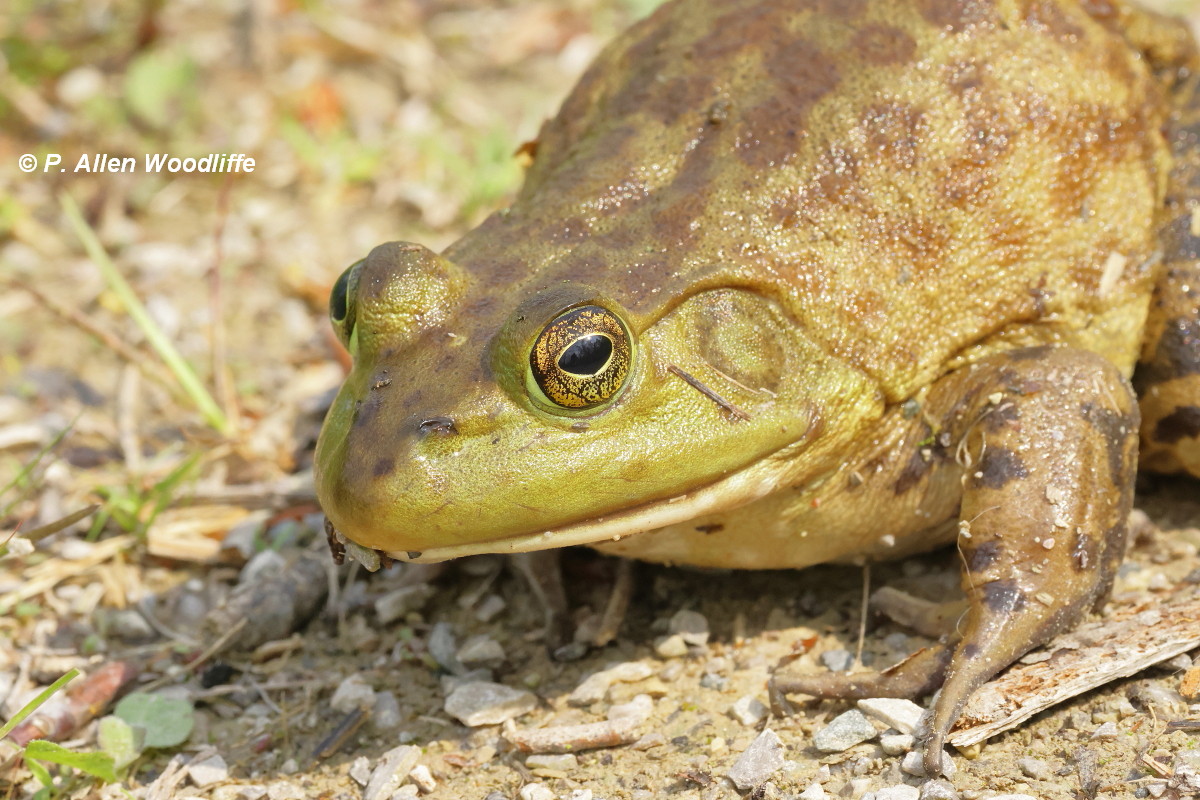
At the edge of one of the lagoons, I saw this large Bullfrog floating in the vegetation on the water. The evening lighting really made its yellow throat stand out! Given how far these lagoons are from the species typical large wetland habitat, it makes one wonder how the species arrived.
I had heard about a Buff-breasted Sandpiper in a harvested wheat field, which had recently had a lot of mushroom compost spread out over it. This was a little bit north of Shrewsbury. While the report came out late in the evening, I didn't have a chance to get out until the next morning. There were quite a few birds of various species scattered across the field, but Buff was nowhere to be found. I did see two Sandhill Cranes off at the far edge of the field, and took these distant shots. One almost disappeared over the far hill, and only its head is showing in the first photo.
A day or so later, there was a report of a Willet in a flooded field out near St. Clair National Wildlife Area. With all of the rain of late, a flooded field was not surprising, and some shorebirds were enjoying it. I got this very distant photo of this young Willet, amongst various yellowlegs and sandpiper types.

In other odds and ends, I was out at Rondeau looking for the endangered Nodding Pogonia a few days ago. This orchid has its entire known Canadian range at Rondeau. I have been watching and monitoring this orchid since the early 1970s, and it is always a highlight to see in flower. But it has very specific flowering conditions, and on this particular day I had hoped to see a few in flower. However the specific flowering conditions did not meet expectations. I should have been there the day before! All of the population flowers for one day, and on the same day, and it would be a week or more depending on the weather before the next set of flower buds would open. But we did find one individual that hadn't totally closed up. It wasn't looking as spectacular as it might have been, but it is the best I could find. Perhaps in a few days I will have more success in capturing some in their prime.

While we were searching for the orchid, we came across this cluster of fungus, known as Pig's Ear. I don't recall ever seeing it before.
Finally, I have a few tallgrass prairie wildflowers growing at home, and one in particular is a bit intriguing. It is Wild Gaura, and while the plant itself can grow quite tall, up to 7 or 8 feet, the delicate flowers only open for a few hours in the first part of the day. By 9:30 a.m. or so, they start to close up. There are lots of flower buds that will open on the following days, however.
If you would like to get future notifications of this blog, contact me at prairietramper@gmail.com
If you would like to unsubscribe, contact me via the same email