Yesterday (Sept 7) it was time for another trip to Rondeau. It is the time of year when, due to the cooler temperatures and bright sunny days, it is so invigorating to get out. There can still be some hot steamy days, but I can work around those.
On the way to the park, I always check one of the harvested wheat fields along County Road 15, across from the Keith McLean Conservation Area. Not that long ago one could typically see a family of Sandhill Cranes feeding in the wheat stubble. It is believed they nested in the wetland at the head of the bay, near The Summer Place campground. I didn't see them on this trip, so possibly they have moved on.

A Willet had been seen on Saturday by Blake Mann at the pond adjacent to the Dog Beach Access, so a stop there was on my agenda. Sure enough, it was still there! (Thanks, Blake!) It was hanging out with 5 Semipalmated Plovers. Willets are not very common this far east, as their normal range is the prairie pothole region in the mid-western part of the continent. In fact I don't see them every year. They pass through for a very brief time in both spring and fall. There are at least half a dozen records for them at Rondeau in late August and early September. Several other birders were around during the day, most of whom saw this bird, I believe. The question is: Willet or Won't It still be there tomorrow :-)

The South Point Trail always has something to offer, so it was next. There were birds, but not many warblers....they must have moved on with the clear skies and northerly winds overnight......although there were a few small passerines flitting well back in the shrubbery. Swainson's Thrushes were plentiful, as were Cedar Waxwings.
The shrubby vegetation found here is the type that produces masses of berries, which are essential fuel for birds. Most of them are dogwoods, and already the white or bluish berries of the two main species of dogwood are noticeably dwindling, so there have been lots of warblers and thrushes passing through recently. There are lots of red berries still around, however.
They look inviting enough, but the reason they are still plentiful is because the birds know that at this time of the year they are too bitter. These berries are of the European Guelder Rose (
Viburnum opulus), a.k.a. Highbush Cranberry. The European variety has been planted elsewhere in the park and beyond for ornamental purposes. After the berries are eaten, the seeds may be dropped a long way away from their original location, and subsequently become well established.
The berries look very similar to the native Highbush Cranberry (
Viburnum triloba). Birds only eat the berries of the European variety after the dogwood berries have been picked clean and even then, they do so reluctantly. In fact sometimes the Highbush Cranberry berries remain on the bushes all winter. By late in the winter the berries have fermented enough to be somewhat edible. If you see a flock of Cedar Waxwings feeding on them at that stage, the birds can even appear a bit drunk due to the fermentation!
There are lots of grasshoppers along the open, grassy areas along this trail. Some of the 'hoppers are identifiable by the colour of their hindwing, but you only see that for a brief time when they are in flight. This large grasshopper below is probably the Carolina Grasshopper, identifiable in part by its long wings (longer then the abdomen), large size and specific arrangement of black markings on the inside of its hind legs. It is widespread across much of southern Canada and the US.
There were a few butterflies around, as expected: Mourning Cloak, Summer Azure, Orange Sulphur, Northern Crescent (lots!) and Eastern Comma were all noted.
 |
| Eastern Comma |
The edges of these semi-open woods are full of sunflower species. One of the most abundant ones at the moment is Pale-leaved Sunflower (
Helianthus strumosus).
 |
| Pale-leaved Sunflower |
Another one that is found along the woodland and open trail edges is White Lettuce (
Prenanthes alba), a.k.a. Rattlesnake Root.
 |
| White Lettuce |
It is also a member of the sunflower family. If you look closely at the stamens of the open flower on the left, you may see a mosquito resting there.
Yet another plant that is often seen along sunny edges, or even open disturbed areas, is the White Vervain. It often looks quite unkempt, especially as it gets older, with very long branching stems, and often a dusty look to its leaves. There are seldom any more than 3-4 tiny flowers present at any given time, but the long branches of the flowering stems last a long time. The plant may go on flowering for well over a month.
There is an abundance of insects and other invertebrates in the dense vegetation at this time of year. In some cases the young are developing, such as these nymphs of the Red Milkweed Beetle.
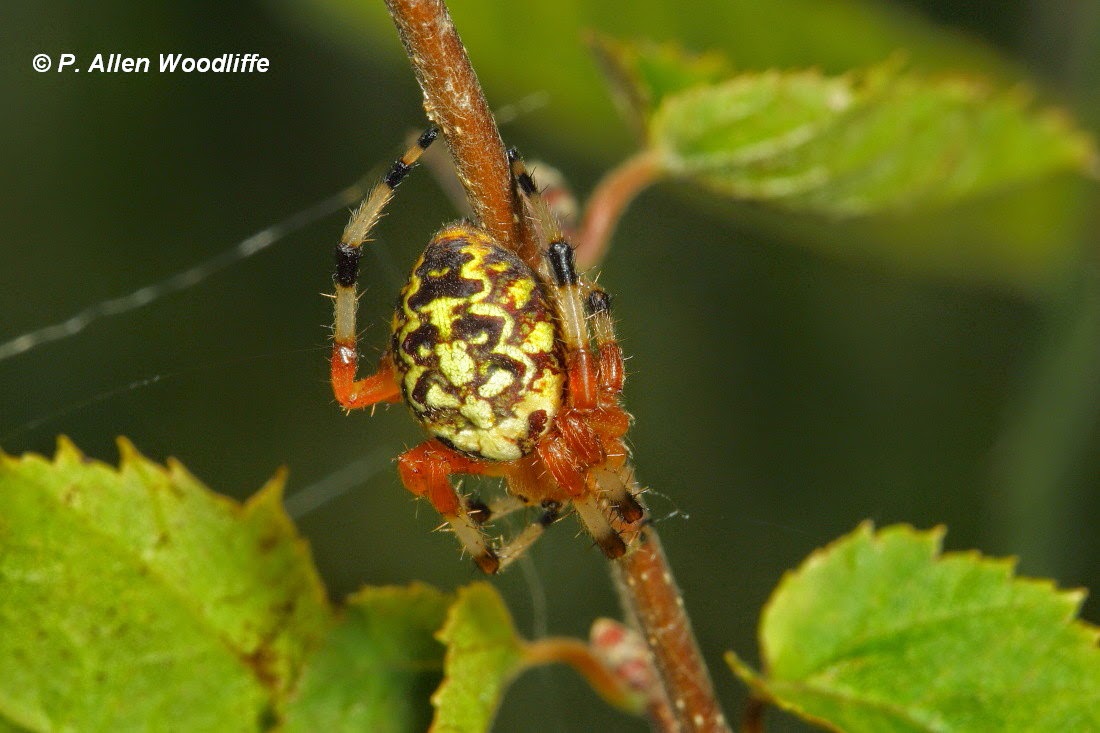
And spiders, which aren't technically insects since they have eight, not six, legs, are in the invertebrate group, and are abundant as well, as they are feasting on the multitudes of insects. One of the more common ones in the shrubbery and grassy vegetation is this Marbled Orb Weaver, as illustrated in the top and side views that follow.
A colourful little critter, isn't it? Most spiders are, if you get close enough to appreciate it :-).
Another species of spider will lay its eggs in a sac and attach it to a sturdy stem with spider silk.
Eventually hundreds of these little spiders, appearing as miniature replicas of the adult will hatch. They will stay in a tight cluster for awhile, exploring their local area via the silk threads but returning to the web cluster. I have images of these spider clusters taken a few years ago.
In the richer and moister parts of the woodland, especially towards the north end of the park, are a few colourful plants which are in flower right now. This first one is Richweed (
Collinsonia canadensis). It is a southern plant and not a weed at all in spite of its name. It is, however, restricted in Canada mainly to the Carolinian Life Zone, of which Rondeau is one of the main areas.
 |
| Richweed |
Another one that has a much wider range, is this Great Lobelia (
Lobelia siphilitica). It is related closely to other colourful native lobelias such as the brilliant red Cardinal Flower often found in wooded wetlands and the pale blue Pale-spiked Lobelia, found in tallgrass prairie.
 |
| Great Lobelia |
The rich, moist woods is also the domain of salamanders. The Blue-spotted Salamander is one of the more common ones of Rondeau.
 |
| Blue-spotted Salamander |
And finally for this post, I present this orchid: the Great Plain's Ladies'-tresses (
Spiranthes magnicamporum). It is the last of Rondeau's 19 orchid species to flower. And it is just getting underway now.
You may recall that I did a post earlier in the season featuring the early season orchids of Rondeau and area. There will be a future post featuring the later season orchids.