Showing posts with label Mourning Cloak. Show all posts

Sunday, 9 November 2025

Mid-autumn things, and a taste of winter

 Autumn, and especially October, is my favourite time of year. The weather is usually quite appealing, not hot and humid, and there are still lots of things to enjoy out in the natural world. And of course October is the month that I got to marry Marie, almost 50 years ago, and that was a significant reason to be thankful.

I enjoy watching the change in colours, as the autumn season winds down. Here is a progression over the last few weeks, from one of my preferred vantage points.

October 8
The next one is a bit brighter, sunnier day.
October 28
And finally, on a partly cloudy but mostly clear sky day.
October 31
I was out a couple of days ago, but it was quite windy and many of the leaves were off. I don't know what it would look like today, Nov 9, but this is what it looked like out my kitchen window!

It probably wasn't quite so white at Rondeau, as the lake effect would have kept the weather slightly warmer, and any snow that fell would not have lasted long.

A bit earlier, there were some sunny and moderately warm days, which can be interesting. Some butterflies were still flitting about. Nothing rare, but nice to see as the season winds down. I had 6 of the first one...

Eastern Comma
...but only a single of this next one.
Mourning Cloak
Some fungi were still developing. This first one, Destructive Pholiota, had fruiting bodies earlier, but they dropped off, or got knocked off, so they tried again.

Oct 28

Nov 4

Pear-shaped Puffball

Other things I took the opportunity to photograph, include:

Hickory Tussock Moth caterpillar

Marbled Orb Weaver
Next is the leaf of a rare orchid known as Puttyroot. It is in the later part of the autumn that the leaf appears, and will stay like this all winter, until the flowering stem appears in late May/early June. At that point, the leaves dry up and aren't normally visible when the plant is flowering.

Next is Silky Parchment, another type of fungus.
Wooly Bear Caterpillars are seen quite regularly.
There is still a good variety of birds to be seen at times, flitting about the shrubbery or whatever, seeking sustenance from the berries. White-throated Sparrows, shown first, were quite abundant in dogwood thickets where the berries of Gray Dogwood, or sometimes a non-native rose can be found.

American Robins are migrating in good numbers, and can be found feeding on the berries of Red Cedar.

There was a fairly good crop of acorns this year, so these next three species are all taking advantage of them.

Blue Jay
This Red-bellied Woodpecker is trying to stash an acorn in a tree limb, planning on feeding on it later in the winter.

Wild Turkeys are scattered about, and feed on acorns as well.
Yellow-rumped Warblers are undoubtedly the most common warbler persisting in the area these days. A small number may stick around all winter.
 
Enjoy any remaining autumn colours....they won't be around much longer!

Tuesday, 15 April 2025

Spring Birding Bonanza

 It has been awhile since my last post. Life continues to be a challenge in various ways, but fortunately I have been out and about these last few weeks, with a good variety of exciting birds to try and track down, as well as to watch for the arrival of normally expected ones.

Certainly one of the bird highlights of recent weeks has been the presence of a beautiful male Tufted Duck hanging out at Erieau. It is native to northern Eurasia, but as it is a bit migratory, it can show up elsewhere.


 This is actually the second one I have seen in the Rondeau checklist area. The first one was back in 1983 when I had one off the east beach of Rondeau, a day or two before the Christmas Bird Count in December. However it was the only time it was noted by anyone at the time. The one in the photos above remained in the Erieau harbour area for several days, allowing many birders from Ontario and beyond to have some excellent views.

Upon returning from Erieau to see this Tufted Duck, a male Yellow-headed Blackbird had been seen just before the village, and I stopped and got this highly cropped photo.


 It isn't super rare, as they do nest regularly in some of the cattail islands in Lake St. Clair, and I have been out in my kayak getting some fine shots of them perched on the vegetation. Nonetheless, they are always fun to find away from their usual nesting area.

Another extreme rarity was the occurrence of a Crested Caracara. One had been seen in southern Essex for a day or two, and then it disappeared. Then one was seen in Chatham-Kent, presumably the same bird, where the word got out and a dozen or more birders were able to see it. However only the two birders who first encountered it got some very nice photos. The bird then moved to the edge of a nearby forest, where it remained for an hour or so before moving on. Due to the distance, and the presence of some branches in front, it was hard to get good focus. The photo that follows was taken and cropped to the equivalent of about 100X, and was the best I could get.

This is the first one I have seen in Ontario, although I missed seeing one that quickly flew over Pelee Island back in May of 1994 even though I was on the island at the time. I have seen them in southern Texas and in Costa Rica years ago.

When the bird left this perch, it flew southeast, and right over the farm at Guilds where I was raised. It would have been a yard bird had I still been there and seen it! When it left, the birders present headed out in various directions to see if it could be re-found. It wasn't, but someone did discover a Townsend's Solitaire coming to some berry bushes in the front yard of some former high school classmates of mine. Fortunately there were enough berries to keep it around, and when I went out the next day, managed to get some photos.


It does show up in the area from time to time, although the last time I saw one was in April of 2011 at Rondeau.

Another couple of rarities have also been seen in recent weeks, although I haven't been out to see them. One species, a Varied Thrush which is a western species, was only seen by one other birder, and fortunately photographed, in spite of the quick arrival of several other birders who were not successful. This species has shown up before, and I remember seeing one coming to a feeder in the Cedar Springs area back in 1979. Another somewhat unusual bird was a female Harlequin Duck, another western species that does show up in the Great Lakes area on an almost annual basis, and one or more have been seen in the Erieau area periodically over the last few years.

Who knows what will turn up next? And that is a reason that birders like to get out to scour areas to see what might be around, especially during the early part of the migration season when things periodically get off course. Maybe my next post will have a few more to show!

But there has been a steady arrival of the expected species, which are always nice to see, and also to photograph, if only to capture the intrigue and beauty of the natural world around us. Here are a few of the ones I have managed to photograph in my recent outings.

 American Tree Sparrows are typically most abundant in the winter, and are infrequently seen this far south by this time of year. Some may linger, as did this one. 

Belted Kingfishers are present near quiet water, on the lookout for a meal. They will breed in the area.
Brown Creepers can occasionally be fairly abundant as they are passing through to points farther north. They are constantly on the move going up a tree trunk hunting for insects, and are often hard to photograph.
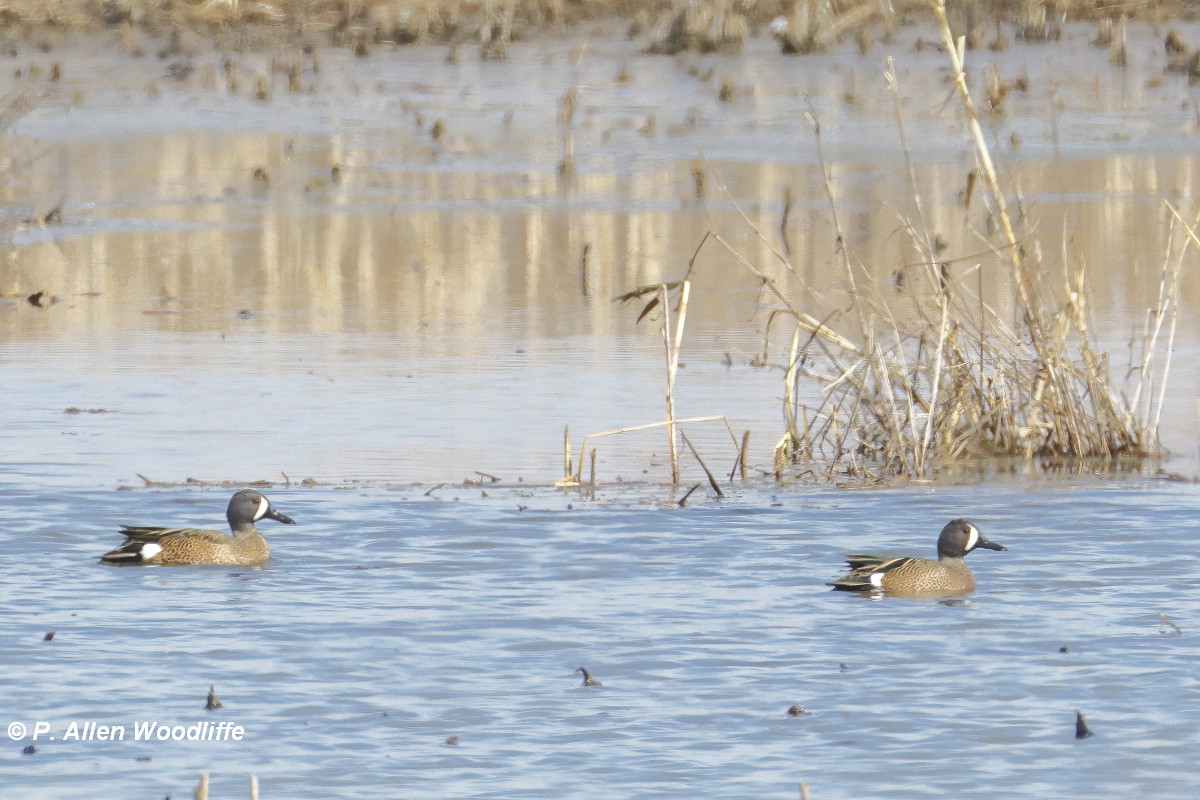
Waterfowl are plentiful, and some like this Blue-winged Teal, are more abundant these days. Some may remain to nest.

Female and male Blue-winged Teal
Warblers are one of the highlights of spring migration. I saw this Yellow-rumped Warbler, my first warbler species of the year, just a day ago, along the road near St. Clair NWA. 
 

Yellow-bellied Sapsuckers are fairly regular right now, but will be diminishing as May rolls around.
Turkey Vultures are frequently seen. Some even will remain in C-K for the breeding season.
Northern Flickers are increasing in number, and some will remain to nest.
Hermit Thrush is one of the earliest of the Thrush family to arrive, and will be continuing to their more northerly breeding grounds so as to be almost entirely gone from the southwest by mid-May.
Great Egrets can be seen in some areas, especially those wetlands adjacent to Lake St. Clair, as they nest in some of the high quality wetlands in that vicinity. 

The following two owl species are year round residents. This first one, the Eastern Screech Owl, can sometimes be seen in a hollow in this American Beech tree along Bennett Ave in Rondeau. It has been somewhat irregular there this winter.


Great Horned Owls are more often heard than seen, and their nests aren't always easy to find. This one nests regularly in a woodlot at the edge of Chatham, and although its nest site varies from year to year. can sometimes be found. I didn't see this one at first as the adult blends in well from a distance, but noted the round, whitish fuzzy head of the young moving around at the edge, which gave it away.


There have been a few non-bird highlights in recent outings. I saw my first Mourning Cloak butterfly a few days ago. It was just flitting along the trail, so I didn't get a photo, but used one from my archives to show here.

I did manage to see and photograph this Spring Azure. Some butterfly specialists have lumped the Spring and Summer Azure into one species as they are difficult to separate and their seasons overlap. Apparently one needs to have a specimen to look at under a microscope to see how the wing scales overlap. However given that the season at Rondeau is delayed due to the lake effect of the cold water, keeping the temperatures at the park several degrees cooler than the mainland, this is about as early as one could expect, and so I choose to call it a Spring Azure.


If you would like to subscribe, or unsubscribe, to Nature Nuggets, send an email to: prairietramper@gmail.com 


Thursday, 23 March 2023

Some first sightings of the season

 I have been a bit busy working on a project which I hope to announce soon, but have still been able to get out and see some of the new hints of spring. For example earlier this week, I saw my first butterfly of the year, a Mourning Cloak. This species overwinters as an adult, so on a warm day, it can suddenly appear. It wasn't all that warm, a mere 4C but sunny and with very little wind; still it was a nice hint of other thingst to come.

In the bird world, I now have seen 5 species of shorebirds in the last little while, with things like Pectoral Sandpiper.....


.....and Dunlin being the latest arrivals this week. Actually a Pectoral Sandpiper had been seen by others a week or two ago, but I never caught up with it.

Dunlin, while typically being one of the latest autumn shorebirds to be seen (we got one on the Christmas Bird Count last Dec), the date of seeing this one yesterday is unusual. In checking sightings on eBird, this individual seems to be the first one of the season here in Ontario.

Both of these shorebirds were observed at the Erieau Marsh/Rail trail, and there is always a few species of waterfowl to be seen. In fact there are often thousands of ducks within binocular/scope view as they rest on the bay before heading off to their breeding ground. Most are too far away to bother with a photo, but some of the 'puddle ducks' are close enough to give them a shot.

Blue-winged Teal have just arrived in small numbers

Green-winged Teal have been around for a couple of weeks or so....
....as have Northern Pintail.

While not technically a waterfowl, I also saw this American Coot at the McGeachy Pond Conservation Area just outside of Erieau.

Mute Swans, well what can I say. If there is any open water, even throughout the winter, there will be some (too many!) around. This one is just resting on a mud flat along the Erieau trail. Some are even on their nest already.

In other swan news this escapee, the Whooper Swan, continues in the Erieau area, either on the bay or in the roadside pond on the way to Erieau.

Continuing with the swan topic, I was at the Mitchell's Bay South Shore trail yesterday and saw a lot of Mute Swans, as well as this Trumpeter Swan. It is native, and staging a comeback in Ontario. It is noticeable by its size, as large as a Mute Swan, but with a large, all black bill and a wide black area just in front of the eye.

Continuing with the waterfowl theme, I finally caught up to Greater White-fronted Goose. There had been a few seen here and there for several weeks, but never right where I was. That changed yesterday when I saw 11 of them at the Blenheim Sewage Lagoons. I met another birder there, and together we managed to locate them at the far end of the lagoon site. They allowed us to approach, slowly and carefully, to within about 150 metres before they decided that was close enough, and so flew off to another berm on the southeast side of the lagoon system. We left them alone there, and the next day (yesterday) two more had joined them.


Also along one of the two Mitchell's Bay trails, I saw two Sandhill Cranes, and they are definitely getting into breeding mode as I noted an attempt at copulation.


I also saw my first Great Egret of the year, a bit early for the species given the un-spring-like weather over the past few weeks.

A Ring-billed Gull isn't something I normally decide to photograph, but this one gave me a good setting, and it was in prime breeding plumage, so I took it!

Rounding out some new spring sightings, I added these two species of turtles: Midland Painted Turtle...

....and Blanding's Turtle.

There were actually at least a dozen or more of the painted turtles out basking, but were quick to plop off into the water before I was able to get positioned through the shrubbery to get the photo I was attempting. The Blanding's Turtle, on the other hand, was quite tolerant.

Hopefully there will be a lot more first of year sightings in the near future!


If you would like to subscribe, or unsubscribe, to Nature Nuggets, send an email to: prairietramper@gmail.com