Showing posts with label Northern Shoveler. Show all posts

Wednesday, 3 April 2024

A bit of an influx of (mostly) spring arrivals

 In spite of the cool down of late, reflecting more normal weather conditions, birds continue to trickle in. Of course some may never have left, but more of their kind seem to be showing. For example, Northern Flickers were hard to come by over the winter, but now it is not unusual to see a dozen or more in a single outing.

Likewise are the Golden-crowned Kinglets.

Chipping Sparrows are definitely new for the season on the bird front....

....as are Eastern Phoebes. They are notably hardy considering they are a flycatcher, but can survive in the cold by feeding on spiders and such, tucked under the eaves of buildings if necessary, at least for awhile.

They are quite active, on the hunt for small flying insects and don't often give the best view, but you take what you can get!

On the water bird front, the diversity of ducks continues, with more and more of each species to see. Many will be leaving for their nesting grounds soon, if some haven't already, but there are still lots around.

Canvasback

Common Merganser pair

Northern Shoveler
While the female Northern Shoveler has the same body style, the plumage is vastly different!
 
Horned Grebes
 
Shorebirds are beginning to appear. While Killdeer have been seen frequently in recent weeks, I came across this Greater Yellowlegs feeding along a muddy edge of a recently drained down channel not far from St. Clair NWA. Its smaller relative, the Lesser Yellowlegs, has been reported recently but I haven't caught up to one yet. It won't be long, I am sure.

Turkey Vultures are increasing in numbers, most often seen in flight.

But later in the day, or when the soaring conditions aren't what they like, they will come to roost.

Horned Larks are frequently seen along the roadsides and field edges. Some are paired up, and likely are in the early stages of nesting in the un-tilled fields.

Regular bird residents sometimes give a good photo op, which I may take advantage of.

On a nice sunny and partially warm day, this Eastern Grey Squirrel was tolerant of my presence, as it soaked up the sun on a convenient branch and didn't seem to move a muscle.
As mentioned in previous posts, the nesting season for some is already well underway. This next photo is of a nest that can be seen, with some difficulty, along the west South Point Trail at Rondeau. At first I wasn't sure if it was an occupied nest or not, but after taking this photo with a good zoom, and greatly cropping it, I noticed the white tail feathers sticking out towards me. They are a little difficult to see against the bland sky background. It isn't as nearly as visible as the subsequent photo, taken several years ago along the Marsh Trail.
This nest came tumbling down a couple of years afterwards, due to some high winds that took the whole tree down.
And the Black-billed Magpies continue along Fargo Road. Some observers have photographed them with nesting material in their beak, heading for the nest tree.

If you would like to subscribe, or unsubscribe, to Nature Nuggets, send and email to: prairietramper@gmail.com


Saturday, 9 March 2024

The season is getting noisier, and busier!

 As the days go by, it is definitely becoming more spring-like in the world of nature. Butterflies are more evident, as I saw several of these Eastern Commas flitting about on a sunny, warm day recently. Some paused long enough to land and soak up a bit of sun, so I managed to get a few photos.

The trails sometimes had amphibians out and about. I saw half a dozen of these out on the Rondeau Marsh Trail a short time ago.
Leopard Frog
Killdeer are showing up in increasing numbers. I saw at least 7 along the Erieau Marsh Trail. It is possible that due to the mild winter weather, some may never have left, but they are more abundant now than during winter, such as it was.

Red-winged Blackbirds are quite abundant anywhere there are wetlands...
....they are often singing, as only Red-wings can sing, clearly trying to establish territories. I have seen them in conflict with other males fairly frequently.
Sandhill Cranes are more frequently seen now, but more often heard first. I had at least 7 along the Rondeau Marsh Trail, some of which were paired up, and making themselves heard.

Even though this is a pair, take a closer look at the one on the right. It is missing its right eye, but other than that, seemed to be acting and sounding quite normally.

American Robins are increasingly abundant, and they provide easy targets for the photographer. Mostly the males at this point, although I think I have seen the occasional female.


Northern Cardinals are more apt to be singing, although often they are partially obscured in a coniferous tree or some other tangle making it hard to photograph them.
Almost all of the waterfowl species are back, and getting paired up. With so much open water, many of them are not often in good photo range, but these three Northern Shovelers cooperated reasonably well.


Some waterfowl are becoming notable by their absence. There are very few Tundra Swans around now, as most have begun their northward journey.
Pileated Woodpeckers can be more often heard these days, as their distinctive drum roll tapping becomes apparent as they re-affirm their territories, which presumably were much more flexible over the winter. It won't be long before they are getting down to some serious egg-laying!
Red-bellied Woodpecker, another year-round resident, can be found more easily.

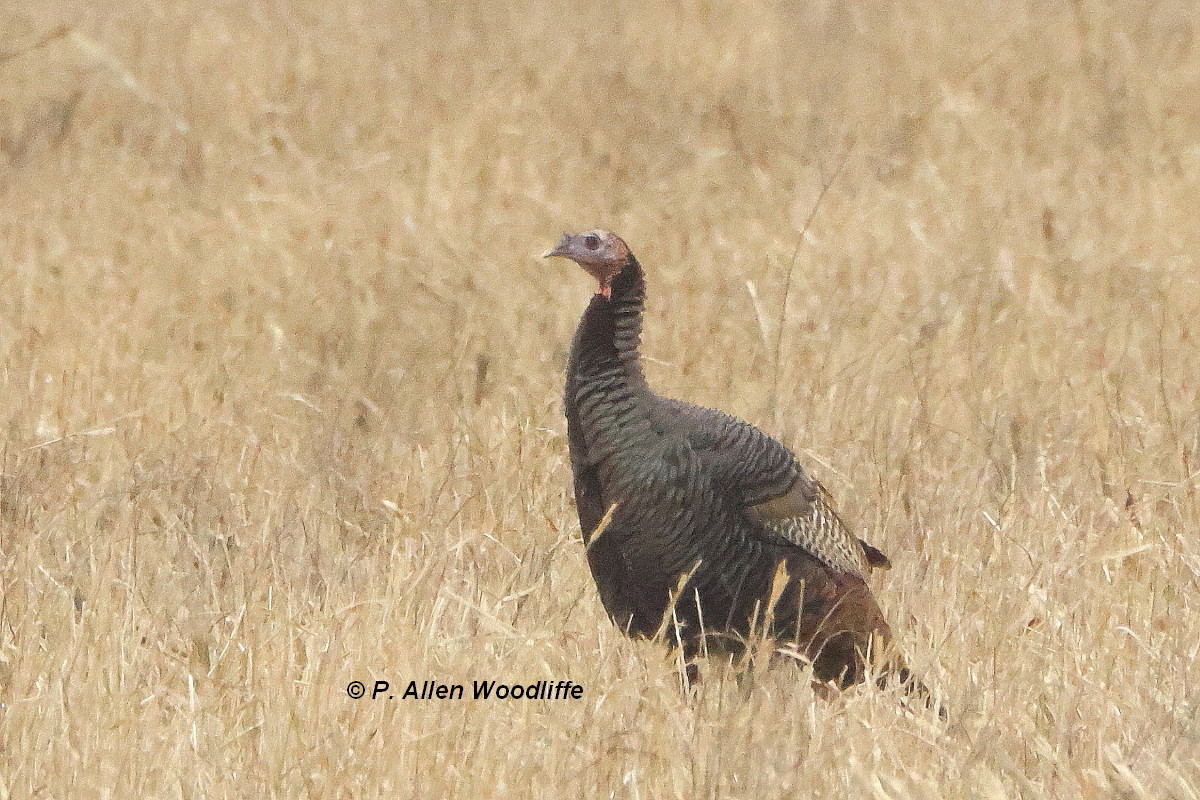
Wild Turkeys have been harder to find lately. Of course up until there was an Ontario re-introduction program established in about 1984, they were impossible to find. But after 1984, the population in Ontario expanded rather nicely. However in the last few years, they are less frequently seen in fields or at the edges of wooded areas. I suspect it is partly because the warm dry weather last autumn allowed many landowners to till the soil rather than leave it in stubble that the turkeys would forage in. I also suspect that the increase in coyotes over the years has taken its toll on the turkeys and their ability to nest and raise young. So it was nice to find a good-sized flock of about 62 birds widely scattered in this grassy field in between a couple of woodlots.


Of course Eastern Screech Owls are also year-round residents, and on occasion one will be quite evident as it looks out of its wood duck nest box that it over wintered in.
There are other things going on. While walking some of the roads and trails of Rondeau, I noticed this Raccoon, wandering around. It was walking rather erratically in the middle of the day. Not a healthy sign for this species. It had no fear of me, and as it got closer and I was able to get this photo, I could see its right eye was non-functional, and even its left eye showed some cloudiness. Quite likely it was suffering from distemper, which happens regularly with raccoons on a 3-4 year cycle. When they get to this stage, not much can be done about it, and so this individual's fate is likely sealed.
On a brighter note, at least from a native mammal point of view, the Eastern Chipmunks have been quite active in the last week or so, and occasionally one will stop long enough at a suitable distance to allow for a photo. They are always a crowd pleaser.When their population gets quite large, one sees more road-killed chipmunks. So far I haven't seen any road kills, but then the park visitation hasn't been all that abundant yet.

If you would like to subscribe, or unsubscribe, to Nature Nuggets, send an email to: prairietramper@gmail.com


Saturday, 24 February 2024

Mid 'Winter' Birding?

 OK technically, early to mid February is mid-winter, but with temperatures sometimes being like late March or even early April, it has felt anything but winter. I don't mind not having to shovel snow, however.

We did have a bit of snow in mid-January, and so the Mourning Dove nest that was occupied in late summer.....

....was now looking like this.

 But since then, I am sure even some of the not-so-regular winter birds are even a bit confused. Things like American Robins have been fairly widespread, even plentiful at times.

Killdeer are beginning to show up in widespread areas. Perhaps some of them never really left southwestern Ontario.

Areas that typically are partly to totally frozen over, such as the Thames River at Jeannette's Creek, just upstream of where it outlets into Lake St. Clair, is mostly wide open.

No Great Egrets here like has happened occasionally in the past, but typically three or more Great Blue Herons are hanging out within sight of the boat launch.

When the river is mostly frozen over, but with some open spots remaining, there can be a concentration of water fowl. And when that happens, there can be a concentration of Bald Eagles perched on trees along the river, keeping and eye open for an available injured bird to swoop down upon. On one occasion when these conditions occurred, I counted at least 28 eagles from this vantage point!

Elsewhere in wetland areas that are sometimes open and sometimes frozen over, there are lots of waterfowl using them. The Ridgetown Sewage Lagoons are productive, but mostly for Canada Geese. However there is often a much rarer goose species mixed in amongst them, such as a Snow Goose. In this case it is a young blue-phase Snow Goose, showing the mostly dark body and blotchy white head....

...as well as a Greater White-fronted Goose, or Speckle-belly, with its orange bill, white at the base, and brownish feathering with black bands across the belly.
Both species are smaller than the average Canada Goose, so sometimes are hard to pick out when they are at a distance or mixed in with a lot of other geese. If the head of the White-front is not visible, sometimes the orange legs are. This next photo shows all three species together.

Canada Geese are by far the most abundant.


In other wetland areas, and sometimes in roadside ditches, one can come across various duck species. I came across these Northern Shovelers near Bear Creek.

The males are quite striking.....
....this one is going through its plumage development, and in a few weeks will likely look as crisp and clean as the other male.

Along another roadside ditch I came across a pair of Wood Ducks. They are often quite skittish, even though the hunting season is over, and the female was a short distance away so I didn't get her photo. But I manages a couple of quick shots of the male from the vehicle as follows.


While I was out roaming around the former Dover Twp, I encountered this Snowy Owl. I had checked this spot on numerous occasions over the past few weeks, as this general area often has one or more Snowies, but this year they have been hard to find. This is my first one of the winter.

It is barely a record shot, as it was several hundred metres from the road. With my telephoto lens combination, and further cropping, it is shown at about 100X magnification!

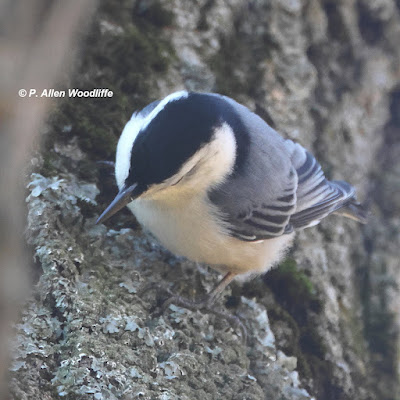
I've been to Rondeau a couple of times in recent days....no big surprise there. Birds have been quite widely scattered, and not always photograph-able. I managed to get this White-breasted Nuthatch as it scurried around a tree trunk....
 

 The long-staying Red-headed Woodpecker continues in its usual little wooded patch at the corner of C-K Rd 15 an Wildwood Line.


If you would like to subscribe, or unsubscribe, to Nature Nuggets, send an email to: prairietramper@gmail.com