Showing posts with label chicken of the woods. Show all posts

Friday, 1 December 2023

Fruit on the forest floor, Part 1

 No, I am not talking about walnuts, or acorns or something like that scattered on the forest floor. I am referring to fungi.

There are many, many types of fungi, and the part that we see growing on the forest floor, or a rotting log, is the fruit of the fungus plant. The main part of the fungus is underground, or in the rotting log, in the form of extensive mycelial threads that act to decompose the rotting log. But more than that, the threads cover extensive areas and travel for huge distances underground. These mycelial threads are actually known to 'communicate' with each other, and share energy, and they are critical components of what makes a forest healthy.

So the actual fungus is just the fruit which bears the seeds or more correctly, the spores, which are dispersed by the breezes. The names and shapes of such fungus are highly varied.
Aborted Entoloma

I have spent a fair bit of my time roaming about forests in the late summer and fall, on the lookout for fungi. They are busy doing their thing under ground, or in a log, for a good part of the year, and seem to be the most visible during the more humid periods of the season when they get to the fruiting stage, although some fruit even in spring. Sometimes I consider my outing to be part of a fun, fall, foray for fungi!

They aren't all colourful, like many warblers or wildflowers, but are fun to find and photograph regardless.

These 'fruits' release their spores, through their gills. Gills are often shown like this following fungus, known as member of the Agaricomycetes group of fungi. The type of gills aren't always visible from the top. In looking at the first photo above, the gills are not noticable unless you break off or look underneath the fungus. Given that most fungi grow quite low and on the ground, looking underneath is challenging, so some mycologists, the name for persons who study fungi, break off the fungus to see the type of gill.


Other fungi have hidden types of gills, such as this next one, known as the Bear's Head Tooth fungus.
This next one, illustrated by the next three photos, is fairly common, at least in forests where American Beech are common. It is known as the Beech Rooter fungus.


Note to the reader: while I have attempted to put a name to the fungi that are in this post, and I believe many of them are correct, I am anything but a specialist when it comes to fungi. I rely fairly heavily on the Computer Visualization capabilities of the database on iNaturalist, where there are thousands of examples of various species which it will compare to, in order to come up with a strong possibility. Over time, specialists in the mycological field will take a look and either confirm or correct its name. So while I believe most identifications here are fairly accurate, there is no guarantee that 100% of them are at this point.

Back to some fungi.

Some are small, looking like a small parasol. This next one is a member of the Bonnet's group.

They can be quite colourful, such as this Chantarelle Waxcap, next.....
...or are typically less colourful as these next ones demonstrate,
Deer Mushroom

Deer-colored Mushroom

Closeup of Deer-colored Mushroom
Most of the fungi shown above, were growing out of the ground, or a moss covered log. One fungus that I came across was growing out of the end of a Tulip Tree log which had been cut to clear a path. It was a bit larger than normal and quite distinctive. I got a couple of photos with the camera I had in hand. It is known as the Destructive Pholiota.
I went back to the fungus a couple of days later with a different camera/lens combination. The fungus had changed a bit...
....a closer look at the underside showed the gills as well as the brownish ring at the upper side of the stem. It didn't last long, however. The fruits of fungi seldom last in good condition for any more than a few short days. As soon as the spores are released, the fruit head deteriorates quickly.
I don't know who comes up with the names of fungi. This next one is called the Dog Vomit Slime Mold. While some fungi are edible, just the name of this one is enough to turn one off! I have no idea of whether it is edible or not......
Not all fungi grow out of the ground. This next one is known as Dryad's Saddle, and typically grows out of the side of a dead tree trunk.
A fungus that is fairly widespread and visible is this next one, the Chicken-of-the-woods.

A lot less colourful is Hen-of-the-woods, shown next.

As mentioned, looking underneath the 'cap' shows the gills, as this Honey Waxcap shows.

This next one is a member of the Hygrophoraceae group. Yellow ones like this do not seem to be all that common.
This next one is the Lion's Mane Mushroom.....
....and this next, colourful one is one of my favourites, the Mycena leaiana, or Orange Mycena.

As mentioned at the beginning, these fungi are exceedingly important in the transfer of energy not only to other fungi. Trees and non-woody plants obtain significant amounts of energy from the mycelial threads that are extensive underground. It is what helps to keep a forest healthy. When one part of a forest is disturbed, that disturbance can be communicated to other parts of the forest via these mycelial threads and end up causing problems. And that is why forests that are logged or otherwise have the soil disturbed decline in health. Their connection to the multitude of other plants is severely disrupted. It is also why attempts to establish a plantation on a previously worked up agricultural field is seldom very healthy, at least not for many, many years. The constant work-up of the soil through cropping, as well as the application of so many chemicals to benefit the agricultural crop, has destroyed the mycelial threads and severely limits the trees growth and development. It may take many decades for the soil to become more natural with mycelial threads for the transfer of energy to the multitude of the forest inhabitants.

That's it for this post, but I expect to feature more fungi in a future post!


If you would like to subscribe, or unsubscribe, to Nature Nuggets, send an email to: prairietramper@gmail.com

Sunday, 31 July 2016

A walk in the woods can turn up many things!

A healthy woodland is always interesting to explore. There are breeding birds, of course, but not always as obvious with the heavy foliage. Here, a Great Horned Owl is peering out at me.


There is so much more diversity in the other types of wildlife and vegetation, however. And often the human crowds are not much of a problem, at least on some of the more remote trails.
Some things are brightly coloured and easily noticed, such as this Chicken-of-the-woods fungus. They can be seen at anytime, from June through September.

Other orange things include this Wood Lily (Lilium phildelphicum), found along some of the more open sections of woodland.....

...as well as this Michigan Lily (Lilium michiganense).

A bit earlier in the season, one can see this orangey scene at various places of a woodland.
These oblong cavities are characteristic of where a Pileated Woodpecker has drilled into the trunk of a Hop-hornbeam (Ostrya virginiana) digging out insects. The indirect result is the ensuing run of sap. Sap contains good concentrations of sugars especially in the spring, and these sugars are attractive to yeasts for feeding on. The type of yeast here is Cryptococcus macerans. It can appear on many different types of tree and even on wild grape vines and is often seen where there has been a wound that lets the sap out.

There isn't a lot of sunlight getting to the forest floor these days, and wildflowers are not abundant.
You are more apt to see the spring wildflowers in this condition, with their seeds ripening, such as this Large-flowered Bellwort (Uvularia grandifolia).


Where a tree has died, or fallen over, it lets a bit more sunlight to the forest floor, and it is there where there is a greater profusion of vegetative growth. This American Beech tree (Fagus grandifolia) has fallen over, and the growth on the forest floor is beginning to become more prevalent than in the  adjacent shaded area.
 
There are a few flowering plants, however, even in the somewhat subdued light. Purple-flowering Raspberry (Rubus odoratus) is scattered about. Its fruit is not considered edible like many other  raspberries are.

Fringed Loosestrife (Lysimachia ciliata) may be found in some of the damper sections.
 A close-up of the leaf stem shows the fringe, which gives this plant its name.

Another plant found in rich woodlands these days, and mostly restricted to the Carolinian Life Zone, is Richweed (Collinsonia canadensis).
It wasn't until I got these images on the computer that I noticed the colourful little critter on the stem...a Red-banded Leafhopper!
I usually see these leafhoppers on milkweed plants in more open areas, so I was a bit surprised to see this one here.

A close-up from a previous year

Thimbleweed (Anemone virginiana) is not all that colourful, but is distinctive.

This vine, named Wild Yamroot (Dioscorea villosa), is not common, and the flowers are not particularly impressive. Its seeds are more obvious than the flowers, and in the fall, the heart-shaped leaves turn an attractive golden brown.

Maidenhair Fern (Adiantum pedatum) is quite abundant in these southern hardwood forests. It is one of the more delicate fern species, and will disappear with the first frosts.

Bottlebrush Grass (Elymus hystrix) is an obvious grass species well represented along the trails.

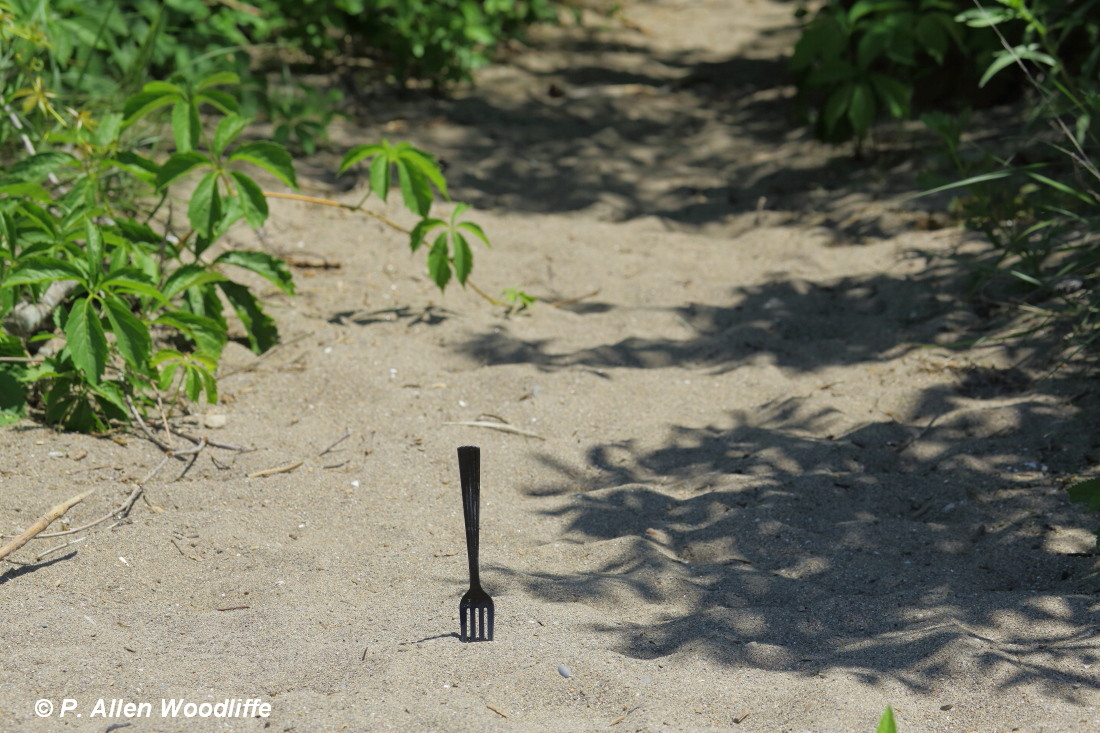
Occasionally one might come across a fork (Forcus plasticus) in the trail :-).

If you look closely to where you are stepping, the distinctly marked caterpillar of a Mourning Cloak butterfly may be crossing the trail.

This next image shows a Brown Stink Bug (Menacles insertus). I didn't handle it to see if it lived up to its name.

Even in the forest, dragonflies occur. Here is presumably a female White-faced Meadowhawk, well away from its normal wetland haunts. The various species of meadowhawk are notoriously difficult to tell apart in the field, especially the females.

Even during these dog days of summer, there is lots to see!


Wednesday, 22 October 2014

The colours, they are a-changing

That isn't really news, if one takes even a casual look around the landscape these days. Even after a short time, the changes can be dramatic.

I have been to Rondeau a couple of times over the last week, and this is what looking north on Rondeau Road just north of Gardiner Ave looked like the first time.


Four days later, it looked like this.


Bennett Avenue showed a similar trend.


Not a lot of difference in the four days compared to the previous set from a couple of kilometres south at Gardiner Ave.

Here is a dry slough south of Bennett Ave. The very large tree on the right is a Silver Maple and is just a bit more than a metre in diameter.

The roads can still be a magnet for reptiles and amphibians, as they soak up the sun beating down on the pavement. I've seen a few dead ones in the last couple of weeks. Fortunately this Northern Ribbon Snake was crossing on a less travelled portion of the road system, and on a rainy day when there was less traffic and the pavement wasn't warm to hold it on the pavement.


I came across this large cluster of a bracket type of fungus known as Chicken of the Woods. It is present all year around, but the fruiting bodies on rotting logs are most noticeable in the late summer and early fall.


Rotting logs are great for other things as well. Salamanders love them.

Red-backed Salamander

I noted this attractive,, small, grayish white spider clinging to the underside of a piece of rotting wood. I haven't determined what kind it is yet.


Harrison Trail is fun to explore, sometimes for the scenery....


 ...and sometimes there are other things!

This is a stinkhorn fungus. It is something you often will smell before you see it. In fact I smell them regularly in the late summer and early fall, but I seldom see them. The breezes can carry their odour for a ways, and one can't always follow the wind currents upwind to find the offending fungus. I didn't actually find the stinkhorn that I was smelling on this trip....this photo was taken a couple of years ago. Some stinkhorns are orange, other species are more muted in colour.

The stinkhorn doesn't produce spores that are dispersed by wind currents as most fungi do. Instead, the tips of the fungus produce a distinctive, with the emphasis on 'stinct', odour that attracts flies that are normally attracted to decomposing things. When the flies walk around on the smelly tip of the fungus, the spores are transferred to their feet and delivered to the next thing that they walk around on.

Much more attractive are the berries of this Maple-leaved Viburnum (Viburnum acerifolium). The maple like leaves are obvious, and the blue-black berries are notable at this time of year. This shrub is not common, but regular in a few places along Harrison Trail and elsewhere in the park. It seldom grows more than 2 metres high.

Maple-leaved Viburnum