Showing posts with label Clay-colored Sparrow. Show all posts

Saturday, 23 May 2020

Canada Day! And more.....

Ok officially Canada Day doesn't come for another few weeks. But a couple of days ago, there was an influx of Canada Warblers into the Rondeau area. They were seen in multiple parts of the park, but probably the best location was along Spicebush Trail, where several were seen, including one very cooperative male that gave photo ops for several people. Even during the relative short time I was there, I think I heard at least a thousand shutter clicks.

It was right adjacent to one of the boardwalks, giving people slightly elevated views as it spent several hours flitting back and forth, feeding, resting, searching for food and whatever. It would perch on a stump....
 ....pause and give quizzical looks at the people around.....
 ....flit to a branch....
 ...jump down to the base of a tree hunting for something....
 ...sometimes get bored with the audience....
 ...and occasionally find something to munch on. All in all, it was a very entertaining time with this declining species.
Of course there has been a good variety of other warblers, although I haven't caught up with some of the rarer species.
American Redstart
Blackburnian
Cape May
Common Yellowthroat
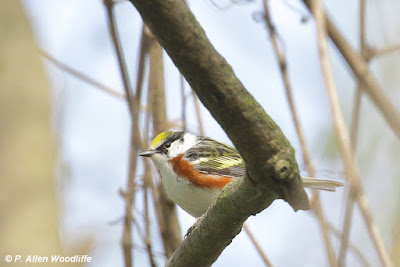
Chestnut-sided
Magnolia
 Sometimes you only get a partial view, and hopefully enough to make a positive identification before it disappears.
Nashville
Orange-crowned
There is a good variety of the usual non-warbler species, including those that may now be here to nest.
Baltimore Oriole
Eastern Kingbird

Eastern Towhee male
 There had been a Spotted Towhee seen in the campground by a few birders. I wasn't in the area at the time, and so missed seeing it. However from photos I have seen, it wasn't very cooperative. It wouldn't be a new Rondeau species for me, as I had one coming to a feeder back in late 1979 when I was the park naturalist. That was before it became an official separate species rather than a western subspecies, so although it was an interesting sighting back then, it wouldn't have created the same stir as today.
Eastern Towhee female
 I've periodically thought that this next species should be the official bird of the Grand River Conservation Authority, given that its 4-letter bird code name is GRCA.
Gray Catbird
 Vireos have not been very abundant as of yesterday, although that could change any day now. Red-eyed Vireos, one of the most common of all songbirds in the eastern deciduous forests, have been noticeable by their absence. I think I have seen less than five so far this spring.
 Warbling Vireos are a little more common.
 Scarlet Tanagers have been around, although not abundant at all.
 Of course the 'resident' White-winged Dove has been back for a few weeks now, and as before, likes to build a nest on Mel's car.


 An Eastern Screech Owl is back in a frequently occupied hole. There is no guarantee that it will be visible, and if anyone goes off the trail to get a closer look, it will very quickly back up and disappear from view.
Yesterday when I was out, I got word of a Clay-colored Sparrow in the campground (thanks, Mike!). Since I was at the north end of the park at the time, I headed over and met Mike. Even though only a few minutes had passed by, the bird was nowhere to be seen. Which is often what birds do. Mike had indicated he had seen it loosely associating with Chipping Sparrows, so we used that clue to continue and broaden our search. However after another 30-45 minutes went by without seeing it, we decided it was gone. We did see several Chipping Sparrows, including this one which was putting the finishing touches on its nest.

 About 3 minutes after Mike and I had gone our separate ways, I heard him call out that it had re-appeared a little way down the campground road, so I hurried over. It was active, and not willing to allow us to get too close, so the long lenses were put to good use.

 Who knows, with the closed campground and open grassy/shrubby nature of the campground vegetation, might it be appealing for this species to nest if it can find a mate?

There is always something else to see along the way, including things like this Eastern Chipmunk. It has been a good year for chipmunks, and with the less traffic during the time the park was closed, fewer road kills. On some trails I have seen more chipmunks than warblers!
 This Eastern Cottontail was out in a grassy part of the campground.
 Leopard Frogs are widespread. I took a break from photographing the Canada Warbler to shoot this guy who was on the other side of the boardwalk.
 Tiger beetles, such as this Six-spotted Tiger Beetle (which can have either more, or fewer, than six spots) can be seen on sunny days along the trails and roadways.
 While walking along a grassy trail a few days ago, I flushed up a Song Sparrow. Its nest was not too hard to find.
 Spring wildflowers are continuing, such as this rarity known as Goldenseal. It occurs in a couple of places at Rondeau, and as of a few days ago, had just about completed its flowering for this season. Due to its rarity and Species At Risk status, its location will not be divulged.
 A spring-time orchid is this Showy Orchis. It isn't large and showy in spite of its name, as it seldom gets more than 15 cm (6") high.

Last year's flowering stalk


Butterflies have not been too plentiful, not surprising given the cool, windy conditions. With the promise of summer-like temperatures in the next few days, I anticipate a lot greater variety very soon!
Red Admiral


Monday, 29 April 2019

The trickle continues

The spring migration of most species continues to trickle in. Of course many birders are anxious for a big push of birds, especially warblers and other passerines, but with the many north to east winds and very few weather systems with good south to southwest winds, the birds are not getting any help in arriving from their quite southerly wintering grounds. Nonetheless there is always something relatively new, or in larger numbers, to be found when birders put in the effort. There have been about 10 species of warbler reported so far, but according to most eBird reports, it is rare that a birder gets more than a couple of species a day. Hopefully in a week or so it will not be difficult to get 20 or more species of warbler in a day!

Yellow-rumped Warblers have been the most numerous, as expected. Some are fairly drab, not yet having attained their breeding plumage.
 More and more are looking quite dapper.
 I had my first Palm Warbler a couple of days ago. It was hanging around an open grassy area with several dozen Chipping Sparrows, as well as an ongoing Clay-colored Sparrow and a few Field Sparrows.
Palm Warbler
Clay-colored Sparrow
Field Sparrow
Other than Chipping Sparrows, found in open areas, the sparrow that is becoming the most numerous is the White-throated Sparrow, which is more often to be found scratching around in the leaves on the forest floor.
Hermit Thrushes are quite common.....
 ....but certainly are not the most common of the thrush family. That honour currently belongs to the American Robin.
Brown Creepers are a lot more common these days, but their small size and cryptic coloration makes them difficult to see.
The great thing about this time of year is that if the birds are few and far between, the wildflowers are showing well, so there is always something to see.
Spicebush
Last Saturday, just before I was heading out, I got a message that there was an Eared Grebe in the lake off of Erieau. This western species is not often seen in this area, so I made Erieau my first stop. Several others were there looking at the grebe already. It was not close, and could really only be satisfactorily seen through a scope. I attempted to get a record photo, but was barely successful, as this following photo was the best of the bunch. Its darker appearance, especially on the neck, as well as the more pointed tufted head, made it a relatively easy identification.
While it was nice to see here, I was fortunate to have seen dozens last July while travelling through southern Saskatchewan and Manitoba, and was also fortunate to have been able to get some fairly good photos of them in prime breeding plumage.
While we were at Erieau watching this grebe, a young Glaucous Gull was observed resting on the far breakwall. Its very large size and almost pure white colour really makes it stand out amongst the gulls.
The gulls got up and were flying around when all of a sudden we noticed about a dozen Willets flying in and landing on the armourstone surrounding the fish tug harbour. While at rest, they blended in really well against the colour and pattern of the armourstone, and initially we thought there were only 11. A closer look at the photo showed an even dozen.
The Erieau Rail trail hasn't been terribly productive lately, although there are always a few things to look at. Certainly the Wood Duck nesting box leaves a lot to be desired as a nesting feature, unless the ducks want one with an indoor swimming pool. I doubt it came with a sump pump, a feature I am glad to have at our place these days.
On the occasional sunny day, Painted Turtles will be out, soaking up some hard-to-come-by sunshine.
After leaving Erieau, I headed to the park. There wasn't much new to add to recent visits. I did stop at the Keith McLean Conservation Lands, as with the high water levels, portions of the fields are flooded, making it attractive to gulls and shorebirds. Steve C had seen about 27 Willets there yesterday. The smallest flooded area is visible from the road, but the better area for gulls and shorebirds is not. One has to walk along the very muddy edge of the trail (the trail itself was partially under water in places) to the bridge and just before crossing it, follow along the creek downstream. It paid off on this occasion. Several folks that I had talked to earlier indicated the Willets were not present, and not much else was either. But on my visit, I came across a couple of Lesser Yellowlegs and at least three Greater Yellowlegs, both expected species. However there were also two Willets, and I was able to get some fairly good photos, which were much better than the ones I got earlier at Erieau.


Gulls were noticeable by their absence on this visit. For some reason there was only this one Bonaparte's Gull at this spot, and there must have been something less than 100% about it, as it let me approach quite closely and never moved. Perhaps exhaustion, or perhaps ate something that didn't agree with it. Who knows...
There are always Red-winged Blackbirds about the wetland edges.

On Sunday afternoon, I decided to check out the Fletcher Ponds, between Merlin and Tilbury. It isn't a large area, but is kind of an oasis in the middle of extensive agricultural fields, so with the various ponds, shrubby areas and larger trees, you never know what might drop in. If you want to know a little more about the Fletcher Ponds, check out my blog post of about a year ago.  It doesn't take a long time to walk the trail and see what was there, and on this day there wasn't a lot. However I did see a few species and heard several Chorus Frogs. And I got my first Ring-necked Ducks there.
In just a couple of days, the month of May arrives. Over about a three week period, there will be a major influx of birders to southwestern Ontario, especially at places as well known for birds as Rondeau. Hopefully the birds will greatly outnumber the birders but there may be some days when they don't. It is always interesting to see the many people who arrive. Some of them you see annually at this time and are easily recognizable. Others will be new; perhaps it will be their first of many future trips to the park. And while some faces are well remembered from past years, others will not be, and have you stumped.