Showing posts with label American Woodcock. Show all posts

Thursday, 12 May 2022

Bird migration continues, with regular, rare and very rare sightings

 Now that we have entered the middle third of May, birders expect lots of bird action. While it seldom is as active as most birders would like, there has been a steady stream of birds arriving.

I have been to Rondeau a couple of times lately, of course. The lake effect of the wind off the water keeps things cooler than inland, and so the leaves on the trees have not developed as far along as trees inland. Therefore the birds even high in the trees are a little more visible.

Almost all of the expected warblers, vireos and flycatchers have been recorded, although not in very great abundance. Here are some of the ones I've been able to capture on digital film so far.

 While looking for a reported Kirtland's Warbler, along with several dozen other birders, this Cape May Warbler obliged at the top of a low red cedar. The Kirtland's never did show up again.

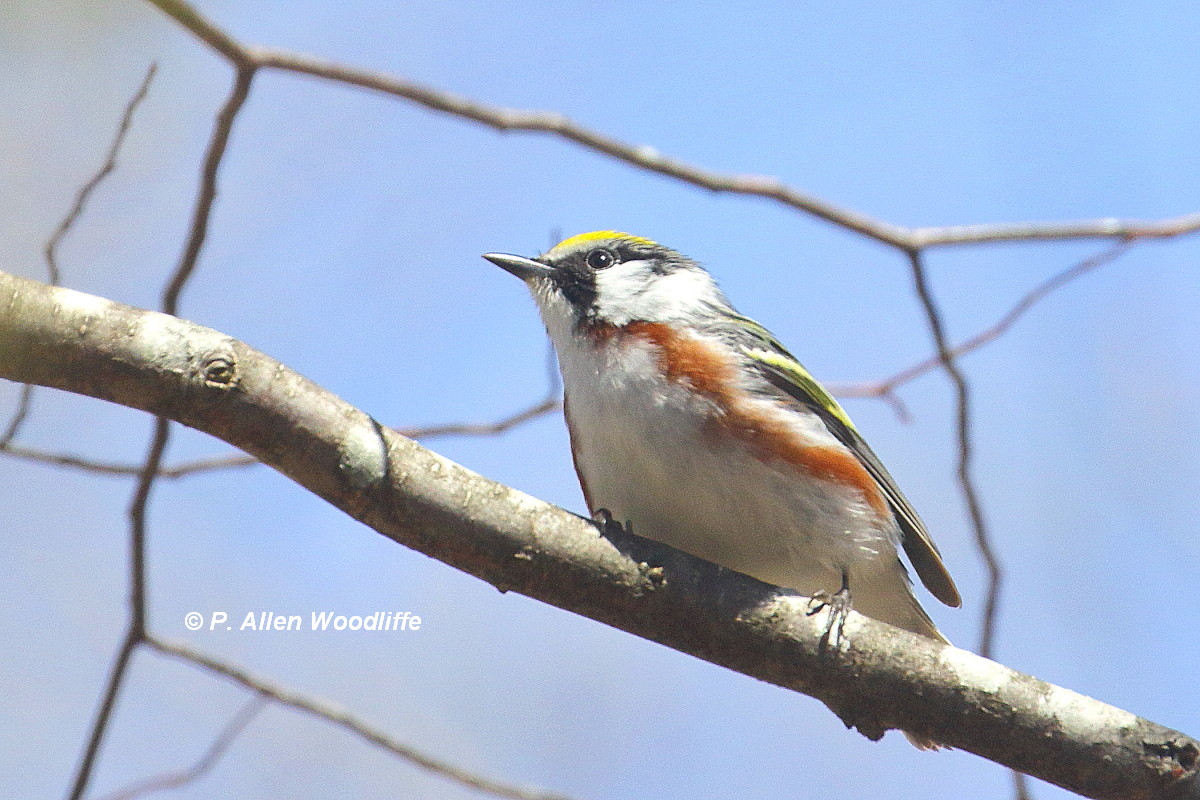
Chestnut-sided Warblers were one of the more common warblers in the last few days.
Magnolia Warblers are beginning to increase in numbers.

Nashville Warbler
One of the warbler highlights of spring, and throughout the summer breeding period, is to see a Prothonotary Warbler. They never cease to draw oohhs and aahhs from any birder observing one.
Only the males have shown up so far, although the females will be arriving soon if they haven't already. Rondeau happens to be the first location in Canada where this species was discovered nesting, and it has remained the main stronghold for this very rare species.
Aside from warblers, things like Blue-gray Gnatcatchers are widely scattered. They are constantly on the move, and get into a variety of postures as they attempt to glean insects from the twigs, etc.
Great-crested Flycatcher is a breeding flycatcher at Rondeau.
Lincoln's Sparrow, on the other hand, is not a breeding species, and they are typically quite furtive along trails and forest edges.
Northern Cardinals are not uncommon, but when one pops up for a photo, I will take it. They are heard regularly throughout the park.
White-throated Sparrows were around by the dozens, even the hundreds, for a few days. Their numbers seem to be dropping now, as they have moved on to their more northern breeding locales. This one was enjoying some morning sun on an otherwise cool morning, and allowed me to approach fairly closely.
Wood Thrush is not a common species, and due to its overall decline in Ontario, is considered a species at risk. Their flute-like calls are always nice to hear in the quiet of evening.
On one occasion, I was heading down a trail to get GPS coordinates of a rare orchid that I had discovered a new location for a few days earlier. I noticed this Turkey Vulture preening and soaking up some early morning sunshine.
On another trail, I heard the distinctive churring of a Red-headed Woodpecker, and located it on a dead tree not far away. It seemed to be staking out its territory, checking out some holes in the tree, and otherwise looking quite at home. While this species is on the decline, the numbers reported at Rondeau this year seem to be a bit higher than the past few years, so hopefully it is a good sign.

American Woodcocks have been back for several weeks, and are well underway in the nesting process. They rely on the cryptic coloration, and so allow quite a close approach.

On sunnier days, one has to be vigilant regarding where one is walking. This Ribbon Snake was on Harrison Trail, and I could have easily missed it.
It is a species at risk, and although it looks generally similar to the much more common Eastern Gartersnake, can be told via its more distinctive yellow lines, and the small white patch in front of the eye.
Red Trilliums are starting to be in good bloom these last few days. They are typically in flower a bit earlier than White Trillium, shown following, and are also starting to appear rapidly in the considerably warmer temperatures of late.

I made a brief stop at Bannerstone Conservation Area, just north of Rondeau. I saw a Bay-breasted Warbler, normally a species that shows in the latter part of the warbler migration...

....and the Tree Swallow boxes look like they have been claimed by some for this season.
I got wind of a pair of Black-necked Stilts being at the Blenheim Sewage Lagoons yesterday, so of course I decided to stop in and look. Sure enough, along with numerous Dunlin, Lesser Yellowlegs and a single Wilson's Phalarope and such, there were the two stilts.

 Quite a few birders had already seen them during the day, but they still allowed a couple of distant photos. These are cropped quite a bit. This is a species that normally will be found in the mid-west, but occasionally show up here in southern Ontario on migration, much to the delight of birders.

The male has a completely black back....

...whereas the female has a brownish back.

I've also spent a bit of time at St. Clair NWA where the large managed wetland complex is a wonderful and accessible spot for finding marsh birds.

Common Yellowthroats are, rather common, although one is more likely to hear them than see them. On occasion a male will sit up in an open spot at the top of the cattails, or in this case the invasive Phragmites, and belt out its call.

Black Terns are a somewhat declining species. On this day, I saw about 18, with many of them flying north along the lake shore so were likely continuing their travels to their breeding grounds. A few will likely remain. They fly a bit erratically, so getting photos is not an easy thing to do!


Eastern Kingbirds like the openness along the wetland complex edges.
Blue-headed Vireos were using the shrubby edges to rest and forage before moving northwards.....
....an Eastern Wood-pewee was also there, but just using the shrubby edges for resting and feeding as well.
Warbling Vireos, on the other hand, like the openness of the cottonwood edges and at least a few will likely stay to nest.

The next few days look quite promising for bird migration, so I plan to be out a few times putting my camera to good use!


If you would like to subscribe, or unsubscribe, to Nature Nuggets, send an email to prairietramper@gmail.com




Friday, 1 April 2022

Birds of Chatham-Kent, Then and Now, Part III

 Part III of this series starts off with King Rail

 However rather than repeat myself, regular readers may remember that I did a complete blog post on this endangered species a couple of months ago. You can read all about it at this link.

Yellow Rail 

I don't have any images of this rare and reclusive species. I have heard them in their breeding habitat up along the sub-arctic lowlands in northern Ontario, but have never seen one.

Then: A rare spring and fall transient. There were a few spring and fall records from the very early 1900s and periodically to 1944. Most were in wetland areas near the mouth of the Thames River and some of the wetlands along Lake St. Clair. Baillie had one at Rondeau on May 11,1939.

Now: an even rarer transient. While this small, elusive species must still pass through southern Ontario on the way to the northerly breeding territories, it is very rarely seen. There have been three relatively records in the southern CK area, one in each of 1996, 2006 and 2020, all in the month of May.

Common Gallinule

Then: considered a common summer resident, breeding in coastal as well as inland marshes.

Now: considerably less common. It can be found regularly in some of the largest wetland habitats along Lake St. Clair, with occasional records at Rondeau. There is not much difference in breeding records between the first and second Ontario Breeding Bird Atlases. However with the more extensive invasion of the non-native Common Reed (Phragmites) in these wetland habitats especially in the last 2-3 decades, it is expected that with less habitat, there are likely fewer records, and the current third OBBA may demonstrate that.

American Coot

Then: an abundant migrant and a regular and plentiful summer resident, breeding in all of the large marshes. There were occasional early winter records

Now: certainly still an abundant migrant, especially in the autumn. For example, occasionally huge numbers may be seen in late autumn and very early winter. Depending on the amount of open water, typically several dozen to several hundred are reported on the Blenheim/Rondeau CBC, with a high of 4002 birds in 1999! Breeding records are fairly low, other than in some of the larger marshes along Lake St. Clair where they can be regularly found in small numbers. Fluctuating water levels and an increased presence of Phragmites has been at least partially the reason for fewer numbers in CK. However there is little to no difference between the first OBBA and the second.

Piping Plover

Then: a rather scarce transient and summer resident. One source in the early '20s indicated the species was numerous between Erieau and Erie Beach, with young seen. There were regular records on the Rondeau beaches as well.

Now: this is an officially endangered species, although the numbers have increased somewhat compared to the dire circumstances of the 1970s and 1980s. They have re-appeared and nested, sometimes successfully, at scattered Ontario locations in the last couple of decades or so. It is seen with a bit more frequency on migration in the southern Chatham-Kent area, although there have been no nesting records since about the late 1940s.

American Woodcock

Then: Formerly a common summer resident, but then becoming rather scarce. As a game bird, it was popular, with up to 60 birds shot by two market hunters in a single day. By the time of Wood's writing, it was increasing in numbers again.

Now: it can be a difficult bird to find, but that is at least partly because it arrives early in the late winter to very early spring and almost immediately begins its nesting cycle. Under good conditions (i.e. calm winds at daybreak or dusk) it can be more easily detected via its courtship display. It is cryptic and rarely even flushes from its nest, relying on its excellent camouflage. There is suitable habitat across CK, and while the first OBBA found it in most of the atlas squares, the second atlas resulted in it being present in all of the atlas squares that had terrestrial habitat.While there is still a hunting season for American Woodcock in Ontario, I do not believe it is very heavily hunted anywhere.

Upland Sandpiper

Then: considered a regular summer resident, never abundant but scattered throughout from April until August. However Wood quoted the Outing writer Ed Sandys as saying in 1897 "he saw thousands of these birds in southwestern Ontario". But certainly by the 1940s, they were restricted to pastures scattered across the county.

Now: I do not have any photos of this species. I don't recall even seeing or hearing one of these in CK during my digital photo era, which is about the past 15 years. The most reliable location in CK for several decades has been in the fairly extensive pasture lands southwest of Charing Cross. I used to see them regularly there if I made the effort. Unfortunately most of those pasture lands and those other scattered pastures in CK have been converted to crop land in the last couple of decades, as crops were more profitable than cattle. There were only about 8 atlas squares reporting it during the first OBBA, and only 3 during the second. Any recent reports of this species are primarily a result of birders hearing one passing through on migration.

Stilt Sandpiper

Then: considered hypothetical. While earlier writers had considered it a bird of the Rondeau region, there were no actual records to substantiate that. The closest known record that Wood was aware of was in Windsor.

Now: it is an uncommon, but regular migrant. It is seen annually most spring and late summer/early fall periods where there is shallow muddy water habitat. Sewage lagoons, not present during the time of Wood's writing, have good habitat, as do flooded field fields.

Hudsonian Godwit

Then: as was the case for Stilt Sandpiper, it was considered hypothetical. It was listed as a bird of the Rondeau region by earlier writers, with no specific records, although McIlwraith stated he had seen it in spring at the St. Clair Flats but again, with no specific dates.

Now: also as was the case for Stilt Sandpiper, it is a fairly regular but uncommon spring and late summer migrant. Sewage lagoons and flooded fields provide suitable feeding habitat for this species on its north and south journeys.

American Avocet

Then: considered an accidental visitant. While early writers of the 1800s considered it slightly more common, at the time of Wood's writing there had been no recent records, and was still considered an accidental visitant.

Now: shorebird habitat has definitely increased since the 1940s, especially with the presence of sewage lagoons. That, and flooded fields during the migration period, have caused an increase in the records in recent decades. It is seen almost annually, with sometimes several records in a year. What makes this mostly a mid-western breeding species a bit more likely here, compared to more northerly breeding migrants, is the fact that extreme southwestern Ontario, and the western portion of CK in particular, has always attracted mid-western species due to the historic prairie habitat.

Wilson's Phalarope

Then: considered an accidental visitant. There was the occasional record in the 1880s, and Sandys listed it as a bird of the Rondeau region but without any date records.

Now: it is a regular migrant and occasional breeding species. As is the case for many shorebird species, the presence of sewage lagoons has affected their presence, as the above photo illustrates. As is the case for American Avocet, this is a mid-western breeding species that is present in southwestern Ontario due to its historic prairie habitat which was present. It is at sewage lagoons where an occasional breeding record has been noted. Here is one I photographed on a nest at the Blenheim Sewage Lagoons back in about 1979, a time when the grassy berms were much less frequently mowed, and there was cattail vegetation allowed to grow in the lagoon ponds themselves.


Birds of Chatham-Kent, Then and Now....to be continued.


If you want to subscribe, or unsubscribe, to Nature Nuggets, send an email to: prairietramper@gmail.com


Wednesday, 2 May 2018

Natural Areas of Chatham-Kent, Part 13 (Sinclair's Bush)

Sinclair's Bush is one of the few areas in Chatham-Kent where you can drive and have forest on both sides of the road. Not for a long way, mind you, but it is a start, and gives a hint of what driving through southwestern Ontario was like a few decades ago. It is not far from where I grew up, and I remember spending time there many years ago, exploring the natural features. It continues to be an attraction to me and others, partly because it is so accessible. Spring time is the perfect time to visit.

So where is this place? Note this first photo, showing the town of Blenheim. Towards the middle right hand side, is the letter "S", indicating Sinclair's Bush.
A closer view, also complements of Google Earth, shows the configuration of the overall woodland. Most of this almost 40 ha woodland complex is privately owned, but in the centre of the site, shown within the blue line, is the approximate boundary of the Conservation Area owned by the Lower Thames Valley Conservation Authority.
This parcel now owned by LTVCA was slated for development in the mid 1980s. It was going to be the site of a single house surrounded by woodland. In fact along the trail, the pipe where a well was dug, is still visible. However local landowners, who took pride in this larger woodland area and were not in favour of the house, joined together with conservation agencies and the Ministry of Natural Resources which had identified the overall site as part of an Area Of Natural and Scientific Interest to oppose this development. Funding from landowners, conservation groups and others as well as a significant contribution from Union Gas, allowed this site to be purchased and retained in its natural condition. It was turned over to the LTVCA.

This site is a mix of upland and lowland forest typical of southwestern Ontario. The rich, well-developed soils support a lush forest.

As mentioned above, spring is one of the best times to visit, before the leaves of the trees are out which shade the forest floor. The spring wildflower display on the CA property as well as those adjacent properties that are privately owned can be impressive! In the earliest period, the lowland forest can have some wonderful displays of Marsh Marigold.

 Dog-toothed Violet, a.k.a. Trout Lily, is in prime condition on a sunny day in early May. On cloudy days, the flowers close up.

 Cut-leaved Toothwort is plentiful.
 Starry False Solomon's-seal is scattered about.
This next one is seldom noticed, although there are good sized patches of it. Normally all one sees is the mostly round green leaves. However if you take a closer look, and move some of last year's leaves that cover the base of the plant, you may see a purplish/chocolate brown flower. It is known as Wild Ginger.
  The flower is in bloom under the leaves, since it is pollinated by ground beetles, not the flying insects that pollinate many of the other flowers you will see here.
 One of the more interesting discoveries I had here was to find the yellow form of the Red Trillium. It is not commonly seen anywhere. I know of only 4 locations for it in Chatham-Kent, although undoubtedly there are more.
 A woody plant that Sinclair's Bush is known for is Pawpaw. The flowers are fully open just as the leaves are developing. The leaves here with the flowers look like ordinary leaves, but they are still quite small.
 The flowers may develop into a greenish fruit. When it ripens fully, it can be fairly aromatic. Note the size of the leaves here.
 To get a fuller appreciation of the leaf size, see the next photo. The leaves at the top are those of Black Walnut, which are not small themselves. But the huge leaves are Pawpaw.

I found my first American Woodcock nest at Sinclair's Bush many, many years ago. This species returns to southern Ontario in late March or early April, and nesting begins shortly afterwards.
The young are able to leave the nest shortly after hatching, and blend in well with their surroundings. Do you see it in this next photo?
 How about here?
 Okay...here is a much closer view.
Red-bellied Woodpeckers are a regular feature here, as it is in many southern Ontario woodlots these days. However that wasn't always the case. In the early 1970s, it was quite a rarity in Ontario. I remember an experienced Canadian naturalist from another province camping on our lawn, since he wanted to get to Sinclair's Bush to see a Red-bellied Woodpecker which had recently been discovered there.
It is a likely place for lots of other birds in season. There are currently 85 species known for this site.

SInclair's Bush is well worth getting off the nearby paved road known as Talbot Trail (Hwy #3) and quietly driving down this rural, gravel road to experience this small remnant of what much of C-K used to look like.