Showing posts with label Swamp Cottonwood. Show all posts

Monday, 14 August 2017

Field Botanists visit Bickford Oak Woods

Last Saturday I had the privilege of meeting a group of about 20 enthusiastic members of the Field Botanists of Ontario at the Bickford Oak Woods Conservation Reserve in west central Lambton County. The outing was planned several months in advance, and the main target species from a botanical standpoint was to see the one and only place in Canada where Swamp Cottonwood (Populus heterophylla) occurs. It was first discovered by the trio of Gerry Waldron, John Ambrose and Lindsay Rodger back in 2002 while they were doing a vegetative inventory in the early stages of this site becoming a Conservation Reserve. It isn't an easy species to find, even when you know where it occurs at this site. One has to access the spot through a planted prairie, then along the woods for several hundred metres, and eventually following an overgrown logging trail for several hundred more metres. It is then necessary to strike off through the woods, cross a muddy creek and then venture another couple of hundred metres to find the buttonbush swamp which has a number of stems of this rare tree. The FBO members were eager, so off we went.

On the way to the spot where the cottonwood grows, we came across a number of interesting species. This first one, Whorled Milkweed (Asclepias verticillata) was a new one for some of the members.
 The wet spots along the trail, of which there were many, had a few stems of this Square-stemmed Monkey Flower (Mimulus ringens).
We came across a Giant Swallowtail butterfly. In this area, one of the main plants that the larvae of the Giant Swallowtail survives on is Prickly Ash (Xanthoxylum americanum). As one might guess by its name, it is a thorny species, and not one that is fun to hike through. Seeing this beautiful large butterfly was a bit of compensation for the time spent shortly after trying to get through the Prickly Ash thickets without getting too scratched up.
 At one point along the creek and floodplain area there were some of these Cardinal Flower (Lobelia cardinalis) in fine shape. It isn't a rare species by any means, and in fact is quite widespread across southern Ontario and beyond, but the brilliant scarlet colour of the flowers is always a treat to come upon.

 Most oaks at this conservation reserve have been logged at one time or another. There are very few large examples remaining. However this White Oak (Quercus alba) is relatively large. Probably because it is growing right along the edge, and has lots of large lower branches, it was less valuable from a timber standpoint at the time the site was logged half a century or more ago.
As mentioned, the intended target species for this hike was the Swamp Cottonwood. This next image shows what the site looks like in the spring, with lots of variable sized trunks of this rare species growing in standing water.
 And this is the characteristic leaf: it is large for a cottonwood, has a heart-shaped base, and the leaf stem is round, not flattened as most Populus species are.

This is the happy group of FBO members, in front of a cluster of Swamp Cottonwood tree trunks.

After achieving our target of seeing the Swamp Cottonwood, we returned to the parking lot and had some refreshments. With about 4 hectares of planted prairie adjacent to the parking lot, we took a bit of time to explore the species present. Big Bluestem, a.k.a. Turkeyfoot (Andropogon gerardii) is the most common grass in most tallgrass prairies.

Gray-headed Coneflower (Ratibida pinnata) is often quite abundant.
 False Sunflower(Heliopsis helianthoides) is one of the many sunflower types found in a prairie.
 Dense, or Spiked, Blazing-star (Liatris spicata) is probably one of the best known, iconic prairie wildflowers. It is a Threatened species in Ontario.
 Compass Plant (Silphium laciniatum) is not common at all, but really stands out on a prairie.

 Another Silphium species is Cup-plant (Silphium perfoliatum). The close-up of the paired leaves show the cup-like aspect which gives it its name.

 Prairie Dock (Silphium terebinthinaceum) is another iconic tallgrass prairie species. The shovel-shaped leaves are clustered at the bottom of a tall, quite rigid stem that sometimes grows more than 3 metres high.
 Tall Coreopsis (Coreopsis tripteris) is another rare prairie plant restricted to the tallgrass prairies of extreme southwestern Ontario.
 Yet another member of the sunflower family that is common on the prairie is Tall Sunflower (Helianthus giganteus). It too often grows 3-4 metres high or even higher.
It was an excellent day, and with great weather right up until the end of the outing. Just as the last of us were packing up the vehicles, it started to sprinkle and there was the occasional rumble of thunder in the background. Before we got too far down the road, the rain came down in torrents.

Thursday, 30 March 2017

Early spring action and a visit to see a very rare species

Earlier this week I went to Rondeau to see what was happening, since I hadn't been for a few days. As I approached the park, it was quite foggy....not what I was hoping for, but eventually it turned out to be a relatively nice day with lots of sun, unlike the kind of weather that awaits Blake on most weekends :-). From the forecast, this coming weekend might actually be fairly nice.

The park was quiet. It was just after 8 a.m. and the deer hadn't ventured back into the more wooded areas yet; more than a dozen were still out in the wide open spaces.

Sparrows are back in good numbers. I noticed lots of Song Sparrows and an occasional Field Sparrow, but any Chipping Sparrows that were seen by others on previous days eluded me.

While photographing this Field Sparrow from the van window, I heard a Pileated Woodpecker call not far away. In a few minutes it appeared, and in fact flew right towards me, just about 5 metres over my head. I wasn't quick enough with the camera out the window, but the sky was very bland and a mostly black bird against a bright gray sky would not have been a great shot anyway. The female flew out just a few minutes later and at least had the decency to land in a tree so I could see a bit of her, and I managed to get this next photo. It has been heavily cropped to eliminate the undesirable background.
As I drove slowly along Lakeshore Road looking for more sparrows and such, I noticed this American Woodcock right at the edge. It bounced and danced on the spot before slowly working its way back into the shrubbery. This next photo is not cropped at all.
There are lots of Killdeer scattered around. This one was hanging out on a parking barrier.

I saw several Turkey Vultures soaring overhead, which isn't surprising since they had arrived in southern Ontario in good numbers over the last week or so. This one was apparently having a picnic in the picnic area, helping park staff clean up some of the carcasses and debris. The carcass looked a little desiccated; I'm not sure how much nutrition the vulture got out of it.
Eastern Phoebes are widely scattered, along the trails, and along the roadsides. I noted about 10, but I expect there were several times that many throughout the park away from the trails and roads. Getting one to stay still for a photograph does not come easy.


As the day wore on, the sun came out and warmed things up nicely. I saw an Eastern Comma along Spicebush Trail, but it was constantly on the move. This photo was from another time.
The sloughs along the trails were quite active with frogs. I heard and saw lots of Wood Frogs and heard the occasional Spring Peeper.
Wood Frog
A dozen or more Wood Ducks were enjoying the quiet of the sloughs as well. Most were males.

This Leopard Frog was a little confused. It was sitting on the white paint at a stop sign. I'm sure the darker pavement would have been slightly warmer since it absorbs the heat from the sun, whereas the white paint reflects it.


Yesterday I went up to Bickford Oak Woods (BOW) in west central Lambton County. It is an intriguing property....a Conservation Reserve managed by MNR&F. There aren't any official trails, just a few very old logging trails, and only a couple of small parking lots. It is about 308 hectares (761 acres) of mixed lowland and upland forest. There is very little topographic relief but being on heavy clayey soils, it holds surface water very well, so any slightly lower area supports lowland vegetation. There are two small prairie plantings for extra diversity, which were planted on the section of former agricultural land between the parking area and the woodland. It makes a nice transition and is a great spot in season for butterflies and dragonflies. 

The goal of my trip this day was to check out the stand of Swamp Cottonwood (Populus heterophylla). BOW is the only location in Canada where this species is known to occur. It was discovered as recently as 2002 by none other than Gerry Waldron, John Ambrose and Lindsay Rodger. While I was with MNR, I contracted them to do a vegetation inventory of this site as it was being promoted as a Conservation Reserve.

The location of the Swamp Cottonwood is not all that hard to find if you know where it is. And that is the challenge. It involves about three kilometres (round-trip) of hiking through the prairie patch, following the edge of the woods, then accessing an old muddy logging trail to get through wet woods, traversing a creek that usually has lots of water in it. And once you get there, you are standing in water, which isn't surprising since after all it is 'Swamp' Cottonwood. The water was about 30 cm deep at the time of this visit, but with the heavy rains in the days since, undoubtedly is much deeper. These next two photos show the Swamp Cottonwood in its preferred habitat, with a dense Buttonbush thicket in the background.


All in all it was a wonderful time, not only because I was amongst a grove of one of the rarest trees in Canada, but due to the time of year and the bright sunshine, there was a very loud chorus of Chorus Frogs along with a few Wood Frogs in this swamp busily calling to attract a mate. In fact it was so loud it drowned out the sounds of truck traffic on Hwy 40, about a kilometre away.

There were a few other things I noted along the way, including at least three Eastern Commas and my first of year Mourning Cloak.
Other wildlife was relatively minimal, with only a few birds (Red-tailed Hawk, Eastern Phoebe, Song Sparrow, Am Tree Sparrow, etc) noted, and a couple of White-tailed Deer which acted like they hadn't seen anyone for a long time. Chances are given the relative lack of human visitation to this Conservation Reserve, they hadn't seen any humans since the hunting season of last year.

I did see a couple of Snowy Owls along Winter Line on the way home. Up to 7 or more have been in that area for much of the winter, but I expect these holdouts will be gone soon. As much as I liked this Snowy Owl photo currently on my blog header, I will be changing that pic very soon to something more appropriate for the season.


Monday, 8 June 2015

Do you know where Swamp Cottonwood is?

I've had occasion to check out Bickford Oak Woods Conservation Reserve three times in the last few weeks. It doesn't take all that long to get there, but there aren't any official trails, so one has to be willing to follow some overgrown logging trails, or bushwack their way through once you arrive. At 308 hectares in size (760 acres) and much of it being wetland, it isn't the easiest place to get around, but usually well worth the effort.

Drainage is poor, leading to all sorts of small and large wetland pockets.
Typical forested wetland of Bickford Oak Woods
One of the things that Bickford Oak Woods Conservation Reserve (BOWCR) is known for is the only location in Canada for the tree species called Swamp Cottonwood. It was discovered by Gerry Waldron, John Ambrose and Lindsay Rodger in 2002, while doing some inventory work. It is hard to believe that even in this 21st century, new tree species are being discovered in southern Ontario!
Swamp Cottonwood
Swamp Cottonwood grows to a fairly good size, and occurs in a buttonbush swampy area. There are several dozen trees of various sizes.....the image here is from a very short young plant.

The wetlands are great spots for amphibians, such as this tiny Western Chorus Frog, only about 2-3.5 cm long.

In general, the BOWCR does not have a lot of large trees. It was acquired by business men during a time when industrial expansion of that part of Lambton County was thought to be a good investment. But industrial expansion did not occur in this area, so it sat for decades. It did undergo fairly intensive timber harvest about 50 years ago, as well as some cattle pasturing, so it wasn't in the most pristine shape. But in the late 1990s, the owners called me to see if any government or private conservation agency would be interested in purchasing it, and so a plan of action was put into place. With the extreme generosity of individuals, local field naturalist groups, the Nature Conservancy of Canada as well as Ministry of Natural Resources, it was acquired and eventually designated as a Conservation Reserve. The forest is rebounding from the harvesting and pasturing activity of the past. But hints of such activity remains, if one only looks at the type of tree form that is common to see throughout the drier sections of the forest.

Multi-stemmed tree trunks abound. Oak was a valuable forest product, and so the merchantable timber was taken out. But oaks have a tendency to sucker after harvest, and some of those suckers are now the well established tree trunks. It is quite common to see double and triple stemmed trunks of various oak species.

Triple-stemmed White Oak
 And on occasion, one may find one with as many as five trunks such as this Red Oak below shows.
With this forest being so large at over 750 acres, it has a significant amount of what is known as Interior Forest, which is the forested portion at least 100 metres from the edge. This is the maximum distance at which edge species, such as Brown-headed Cowbirds, will normally venture in, giving a safer area for birds such as Wood Thrush, Ovenbird and other forest interior species to breed without being parasitized by the cowbird which lays its eggs in other species nests.

Ovenbirds, Wood Thrush, Scarlet Tanager, Yellow-throated Vireo, Rose-breasted Grosbeak and others are fairly common here. Less common species include Cerulean Warbler, Tufted Titmouse and even Acadian Flycatcher. I have seen or heard all of these here from time to time, other than the Acadian......that one is pretty infrequent here.

Some of the largest wetland areas in the BOWCR will support Beaver, and a Great Blue Heronry is in the vicinity of these same interior wetlands.
Beaver cutting
I noted this One-spotted Stinkbug along the trail.
And in October, one can easily find Witch-hazel, a shrub that only flowers in the fall.
Some of the property that was formerly in farmland has been left to regenerate, and even had some tallgrass prairie plants and wildlife shrubs established about a decade ago. Right now, these areas are great for butterflies and dragonflies. This first one is a Common Baskettail, but it had me fooled at first because they normally have an obvious dark spot at the base of the wing. It is more noticeable in the second photo.
Common Baskettail
 Also fairly abundant was Common White tail, as in the next photo showing an immature male of the species.
 Twelve-spotted Skimmers were also well represented.
Twelve-spotted Skimmer
Wildlife shrubs, such as this Nannyberry, are coming into good flower these days, which is great for butterflies.
Nannyberry
Eastern Tiger Swallowtail
Giant Swallowtail
American Lady
In the grasses and clover were some smaller lepidoptera:
Common Ringlet
Juvenal's Duskywing
Peck's Skipper
I'm not 100% certain if this is a Peck's Skipper.....those little rascals are sometimes a challenge unless you get just the right angle to show the important characteristics.....if anyone has a better idea, please let me know.

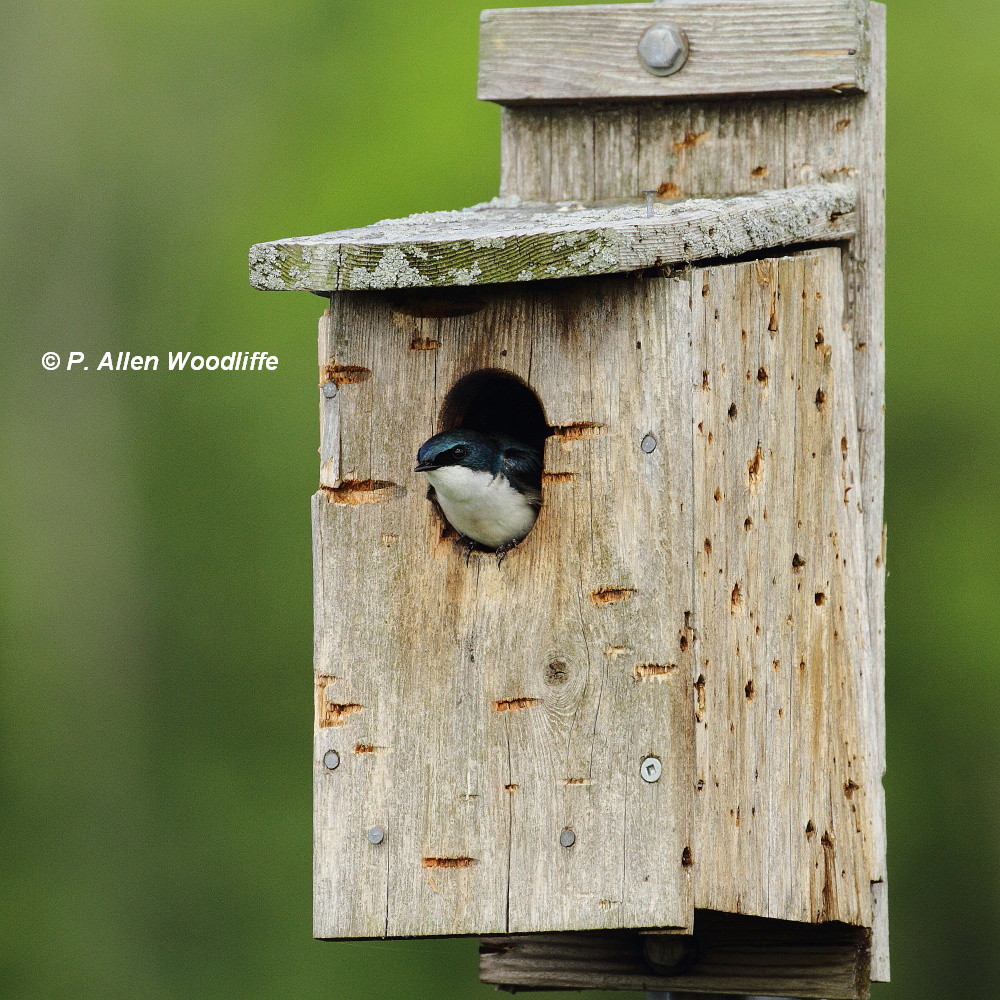
While I was busy photographing butterflies in the open grassy area, this Tree Swallow and its mate were keeping an eye on me.