Showing posts with label Common Wood-Nymph. Show all posts

Wednesday, 12 July 2023

Rondeau Butterfly Count

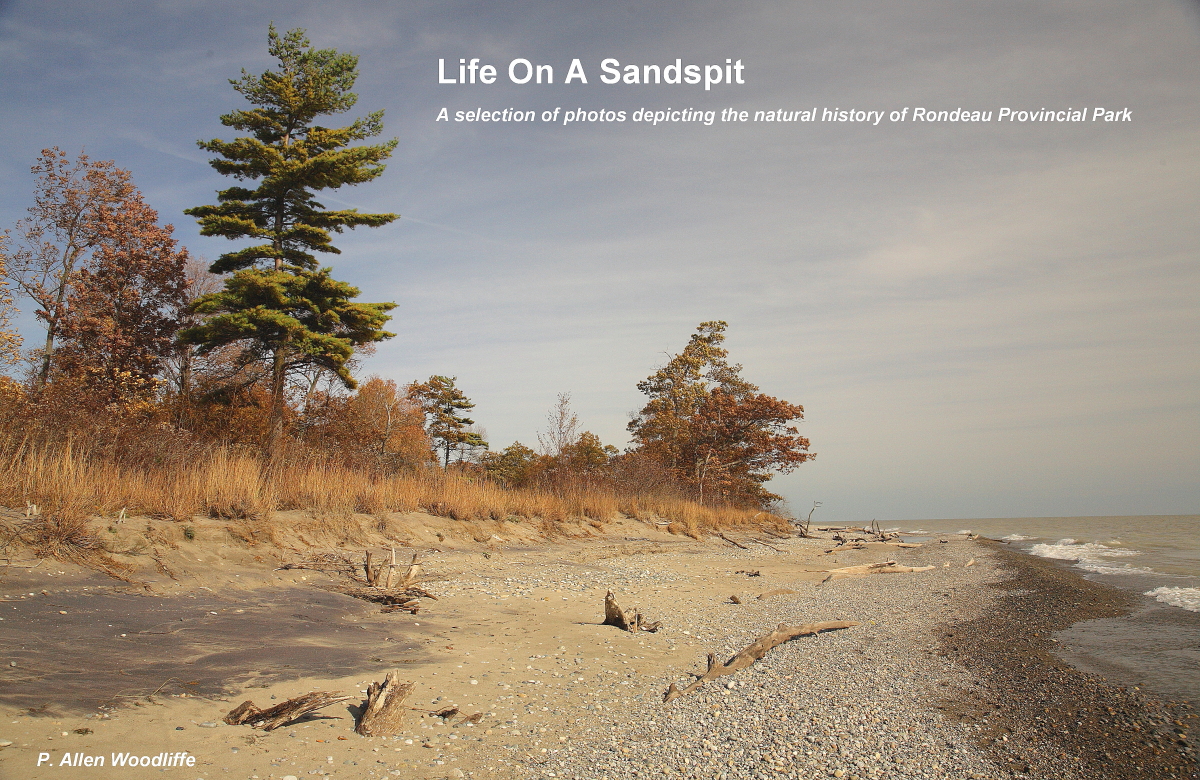
Just a brief note regarding Life on a Sandspit: it seems to have garnered a lot of interest and is doing well.

It is currently available at the Friends of Rondeau store (inside the Rondeau Visitor Centre), as well as the Bayview Market, just outside the Rondeau PP gates. It is also available via the Sydenham Field Naturalists, and you can see it, along with other nature publications on their web site here. I am slowly finding other local sites where it may be available, and will provide updates on those as they occur.

On to the butterfly count post.

Just a few days ago, on July 9, was the annual butterfly count, for the Rondeau area. Over the past 22 years, it has ranged from 35 to 47 species, averaging about 41 species. I don't have the final tally for this year, but based on the area that I and my colleagues did for this one, I think we will definitely be below average both for total species and individuals. I usually get about 18 species, but this year I got only 15. Of course weather is always a factor, and the cool, cloudy, misty weather this year did not bode well. And a downpour of heavy precipitation in the afternoon for some, did not help at all. Nonetheless, it can always be worthwhile to get out and see what is around. The following photos are ones I took while meandering through the several spots I normally cover. I didn't get photos of all the species I recorded, and the results vary.

This first one is the only swallowtail species I encountered, and just one individual!

Black Swallowtail
Bronze Coppers, next, are not a guarantee, and I only saw this one. Fortunately it cooperated to get the kind of photos that allowed me to separate it from the American Copper.

If this count was taken a few years ago, I would have no problem identifying this next one as a Summer Azure. However the lepidopterist taxonomists have examined the Celastrina genus a little differently, and it apparently is not quite so easy, so this one could be as Summer Azure, but I left it as Celastrina sp.

Common Wood-nymph

Eastern Comma

Eastern-tailed Blue

Little Wood-satyr
Monarchs, shown next, got off to a slow start in the count, but as the day wore on, I came across several areas where Common Milkweed was present in the hundreds of plants. One area could have even had more than a thousand plants, so getting several dozen Monarchs was not hard. If I had been able to carefully survey this largest milkweed site, I could have easily doubled the number of Monarchs, but by that time I was losing energy so I did most of my surveying via scanning the large field with binoculars.
Crescent butterflies are normally fairly common, but for some reason, that wasn't the case on this day. I had just this one Northern Crescent.
Although the ? on this next butterfly isn't all that visible, it was indeed a Question Mark.
Red Admirals, at 57 individuals, were by far the most common of the butterflies, other than Cabbage Whites at about 70.

Of course anytime one is out in such habitat, there are always other things to see, so I took advantage of the photo ops I was given. This Eastern Gartersnake was quietly sitting along the edge of one of the first trails I took. I presume it was trying to soak up some of the non-existent sunshine, as it never moved even a bit, although I got quite close.


Along the Erieau Marsh Trail there were the usual things like Great Blue Heron.....
...and even a Trumpeter Swan.
Song Sparrows were common in most areas.....
...as were Red-winged Blackbirds.
Along one area, which follows an old Railway Track, I saw three Wild Turkeys, but true to their character, did not allow me to get very close. This next photo is highly cropped.
Along this same part of the area I covered, I noted several clusters of a Species At Risk, known as Prairie Rose.
And I even saw the occasional day-flying moth that enabled me to shoot it: the Eight-spotted Forester.

Once all the results are tabulated, I will update the results for this count, but as far as I can tell in talking with several other counters, it will not be one of the better ones. Every year is different! Update: there was a total of 1777 individuals of 36 species recorded on this day, so definitely on the low end of average.


If you would like to subscribe, or unsubscribe, to Nature Nuggets, send an email to: prairietramper@gmail.com


Sunday, 25 July 2021

Butterfly count during National Moth Week

 I had intended to get this post featuring my efforts for the Rondeau butterfly count out a few days ago. 

Really. 

But alas, many other things happened, not the least of which was processing well over 1000 images of moths taken over the last little while, including those during this past National Moth Week.

The Rondeau butterfly count was held on July 18. It was supposed to be the week before, but the weather had something to do with it. Sunny conditions are much more appealing to butterfly activity than rain, so the 18th it was.

My territory isn't some of the most productive habitat, but someone has to do it. I started off in the Erieau area, covering the McGeachy Pond trail as well as the Rail Trail. Butterfly diversity wasn't plentiful, but maybe it was too early in the day. Others described the slowness of activity before 10, and that was certainly what I experienced. Nonetheless, I did what I could to not only see butterflies but hopefully get a few photos. Certainly some of the most popular nectaring plants were past their best. I did manage to get about 8 species of butterfly here.

Certainly there was no shortage of Cabbage Whites, and this first photo shows the way one normally sees them once they have stopped fluttering.

On occasion you can catch them with their wings open.
There were a few Eastern Commas.....
...but only a single Red Admiral.
Summer Azures were not plentiful either at least along these two trails.
The day before I had been at Rondeau, and probably saw at least 100 of these Summer Azures along one trail. The difference was that at Rondeau, there are more coyotes, who don't pick up after themselves, leaving their digested food remains out in plain view and available for things like certain butterflies.

There were at least three of such coyote discards, with as many as 20 or more azures vying for a place at this dining spot.

Maybe if people out walking their dogs along the Erieau trails were not so responsible at picking up after their canine pets, I would have seen more of these azures. Just kidding, of course, and there is no certainty that the dog food remains would be as appealing to butterflies as the menu that coyotes feed on.

 This American Toad was resting on one of the boardwalks going out into the marsh.

 When there weren't many butterflies to focus on, there were a few birds. Nothing out of the ordinary, but there were the usual Yellow Warblers.....

....and Singing, er Song, Sparrows.

I next met up with Keith and Steve to check out an old field type habitat closer to Blenheim. It is getting more grown in, so it isn't as productive as it has been in years past. It was a good spot to find Common Wood-Nymphs, which although they were plentiful and easy to document when in flight, typically drop down in the vegetation and make it difficult to see let alone get a photo.

Next stop for me was along the Fargo Road railway tracks, where there is a wide vegetated area for several kilometres, some of which was adjacent to the only wooded area in my territory. There were a few more butterflies, including Monarchs, which were usually found at each site I checked out.

I got a single Question Mark.....
....and a tattered hairstreak, which I concluded was a Banded Hairstreak.
With the abundance of flowering plants attracting pollinators, such as Spotted Knapweed and milkweed species, I had a few moths to check out. Okay, they aren't butterflies but since it was National Moth Week, I thought I could include these attractive moths that upon a casual glance actually look like a small hummingbird. Hence these are known as the Hummingbird Clearwing, a member of the Sphinx moth group.

A Wild Turkey was out patrolling the tracks when I got there, but decided to disappear into the nearby wooded area before I could get a closer photo.

I did a few other spots, including the B-Fit trail on the south side of Blenheim. There are lots, and I mean lots, of Swamp Milkweed. Probably over 1000 plants in one of the pondwater storm cells that the trail goes around. I was hoping for a deluge of butterflies, but other than Monarchs, there wasn't anything else that I could see.

In a few places were some Swamp Rose Mallow, but only one was in flower. It is a species at risk in Ontario.
At one of the residences adjacent to the trail was a colourful garden full of plants that pollinators love. I saw Monarchs and a couple of Summer Azures, but that was about all. One plant stood out as unusual. It is Queen-of-the-prairie, a tallgrass prairie species but not native to Ontario. It is more common in the mid-west.

The Blenheim Sewage Lagoons were also on my list of places to check out. Unfortunately a lot of the usually best areas had been recently mowed, so there wasn't much to look at. I did see a few ducks, including Ruddy Ducks. Even though they are normally a mid-western species, there always seem to be a few hanging out here throughout the breeding season.

In one section of the hayfield which was cut and baled a few weeks ago, there was a good crop of trefoil and clover. I got my only two Black Swallowtail butterflies here.
Northern Crescents were not abundant anywhere, but I saw a few.
I also checked out the grassy fields along the north side of Blenheim. The wildflowers that were so abundant in the past are largely gone, so it is mostly grasses. Other than Monarchs, there were no butterflies to be seen, but I did note a couple of Bobolinks lingering.

All in all, it was a fairly typical count for my area. Maybe slightly fewer species, but the wet weather just prior to the count, and a slightly later date, might have made a difference. 


Additional note: Please be advised that if you are a subscriber to this blog, the blog site has indicated that sometime after July it will no longer be providing automatic email notices of when this blog is published. I will try and get a subscriber's list assembled and let you know, but in the meantime, if you would like to be advised of the publication of future posts of Nature Nuggets, let me know via this email: prairietramper@gmail.com.

The blog post appears to still have the email subscription function. The blog feeder has just indicated that it will discontinue after July.


Monday, 12 July 2021

More atlassing and related explorations

 Collecting data for the current Ontario Breeding Bird Atlas is beginning to wind down. Not that there won't be some birds in nesting mode for a few weeks yet. One year I was able to photograph a nest full of Cedar Waxwings as late as the first week of September! But for many birds, things are more likely to be gearing up for migration, which for some shorebird species, is already underway.

I've been out several times over the last few days. And as usual, even though I'm more or less focusing on birds, there are so many other things to be distracted with.

On one occasion I was out at the McKerrall Forest, a few kilometres north of Chatham. The birds weren't overly vocal, at least for my ears. I mostly saw or heard the usual woodland species, but did get a good, but distant look at a male Orchard Oriole.

I'm not really 'into' sedges, but this one usually gets my attention. It is called Gray's Sedge, a relatively common woodland species.

If I come across American Beech trees, I check for Beech Leaf Disease, an insidious relatively new disease that may play havoc with any beech trees that have survived other stresses. The disease is relatively identifiable with its dark, blackish bands in between the leaf veins.

When I got to the one end of the forest, I looked out across the bean and wheat field, and noticed a couple of ears sticking up. They quickly morphed into the head of this deer.

After a few moments it decided I wasn't any real threat, so it continued along its way.....
....always keeping an eye on me, but eventually emerging almost totally. However when I finally moved, it decided enough was enough, and so it quickly bounded away to the woodlot at the far side of the field.

I've also been on the CASO trail again, which I described in some detail in my previous post. The light wasn't great, and I didn't get any bird photos. I was able to update or confirm breeding for a few species. I also took note of more of the developing plants along the corridor. Here are a couple of quite frequently encountered ones, and not surprisingly, both are non-native.

Chicory


Globe Thistle

I also had the opportunity to visit Moravian First Nation, also known as the Delaware Nation of the Thames. My friend Darren, a member of this Delaware Nation, had invited me out to explore some parts of it. In part he wanted to show me the devastation by the Gypsy Moths, which can almost totally defoliate a tree. It is certainly at a peak of their 7-10 year cycle, and early in the season the effects can be quite worrisome. However the trees seldom die, but after the hatch of larvae have done their deed in devouring the new leaves, the tree will leaf out, but with smaller leaves.

Gypsy Moth larva

The adults don't live for very long, just a few days. Even though the female, shown here with the lighter colour, has wings, it seldom flies. It emits a pheromone to attract a male, and mating can take place for up to an hour.

I checked a few American Beech trees, and some showed signs of the Beech Leaf Disease.
On a brighter note, we checked one of the populations of Heart-leaved Plantain, a legally endangered species. It flowers in mid to late spring, and at this time of year, only the leaves are visible.
Heart-leaved Plantain looks a lot like another wetland species: Skunk Cabbage, which is fairly common throughout wet woods in southern Ontario. Here the two species are side-by-side, with the plantain on the left and the cabbage on the right.
Another highlight was to see a large stand of Pawpaw, one of the largest stands I have ever seen. Some individuals were almost 40 feet high. I use the term individuals lightly, while they appear as individual stems above ground, it quite likely is one very large clone.

Another nice find was this Silvery Spleenwort, a somewhat rare woodland fern.


It is identified by its long fronds, and especially by the silvery sori on the underside of the leaves.

 Late last week I received a phone call from a friend, who heard a bird call he couldn't identify. Even while he was talking on the phone, I could hear what I thought was a Northern Bobwhite calling. Marie and I went out to see, but the bird had gone quiet, and even after almost an hour, it did not call, so we left. No sooner had I gotten home when Marcel called again to say it was back, so back I went. The bird was calling from the trees in the front yard, and after a very few minutes, I located the bird in the thick of a birch tree. The backlit bird against a rather bland sky made it a challenge to photograph and process.

This is an endangered species also and there were several factors making it difficult to advertise this bird. While I was assessing this conundrum, I found out that it was a released bird, so birders intent on adding this to their list really had no reason to check it out, since only wild birds are considered legitimate.

On Saturday I re-visited the Dealtown Crown Land Prairie. It isn't the easiest place to get to, but well worth it if you like grassland and shrubland birds, as well as lots of tallgrass prairie plant species. The prairie site was established in the early 1990s as a tallgrass prairie species seed nursery. Seeds produced here were harvested and used for various prairie planting in the tri-county area and beyond. It was used for a few years, but then the seed nursery was situated at a better place in Lambton so this site was left alone. While the diversity remains intact, it is becoming much more shrubby, and is in dire need of a prescribed burn. There is lots of grasses of the tallgrass prairie type and when they are as dense as they can be, the vegetation is quite wet. I was soaked well above the knees in fairly short order. Such is the life of prairie trampers!

Immediately upon getting past the forest and entering the prairie site, I was met with this stand of Purple Coneflower. While it is an impressive species, and certainly native to the mid-western tallgrass prairies, it is not native to Ontario. It is most definitely popular with gardeners, however, and shows up in many places.


The butterflies enjoy nectaring on this species.
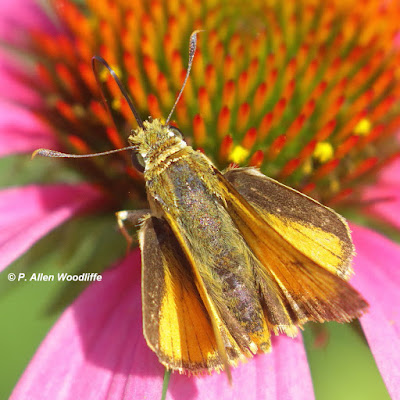
Hobomok Skipper
There were probably at least 100 individuals of this next one scattered across the Dealtown Prairie, the Common Wood-nymph.

Climbing Prairie Rose is a species designated as 'Special Concern' in Ontario and Canada. It was planted here more than two decades ago.
Compass Plant, another rarity, is thriving here.....

...the relatively small and less conspicuous Flowering Spurge is nice to see.

Grey-headed Coneflower is scattered throughout.

Swamp Milkweed is not limited to prairies or swamps, which is fortunate for the many butterfly species that come to visit it.
Wild Bergamot is also scattered here and there.
As for birds, I found a few to upgrade or add to the overall list, including things like Field Sparrow, and Northern Mockingbird, but I didn't get any photos of either of them. I did have this Eastern Kingbird sit up in an open spot.


I was a little surprised to see this Green Heron hanging around, but they seem to be more plentiful than usual in the area this year.


I had hoped that I might find and photograph a Dickcissel, which was relatively common here during the invasion of 2017. Fairly early in my meanderings here I did hear one. Usually they sit up in nice view, but the area I heard it from was quite shrubby. I eventually was able to see through a gap in the shrubs and find this individual on an open branch, but lower than I usually expect it.

It eventually moved to what I consider a more typical spot, and fortunately the light and background made it a quite successful photo op. I saw two males at this site, but no females, so presumably (hopefully!) they might be on a nest.


Additional note: Please be advised that if you are a subscriber to this blog, the blog site has indicated that sometime after July it will no longer be providing automatic email notices of when this blog is published. I will try and get a subscriber's list assembled and let you know, but in the meantime, if you would like to be advised of the publication of future posts of Nature Nuggets, let me know via this email: prairietramper@gmail.com.

The blog post appears to still have the email subscription function. The blog feeder has just indicated that it will discontinue after July.