Showing posts with label Yellow Water Crowfoot. Show all posts

Wednesday, 3 May 2023

A Spring Wildflower 'Walk'

 The warmer than usual weather of a couple of weeks ago spurred a lot of spring wildflowers on their way. But the cool damp weather of the last few days have slowed their growth, and certainly caused the bird migration to stall, with a few birds dribbling through, but not like most birders hope for in late April and early May.

I know there are some readers who look forward to seeing the variety of spring wildflowers, but for various reasons cannot do it like they used to. As one ages, it is hard to get down to ground level to see them up close, and even harder to get back up again! And then there are some folks who have had a misfortune in their lives that limit their mobility in a serious way. I think of one reader in particular, Furry Gnome, who I have known casually for several decades. He has devoted a significant part of his life and career to protecting and promoting natural areas in various ways. Unfortunately a few years ago as a result of some needed surgery, is now limited to a wheelchair. Yet he continues to try and do the best he can. You can read about his adventures in his blog, which I have listed on the side of my blog site entitled 'Seasons in the Valley.'

This blog post is therefore devoted to those like Furry Gnome, who are unable to see spring wildflowers like they would like to, or used to. I am fortunate that I can still get out and about, and even have a camera body with a tilt screen enabling me to see those flowers up super close, without having to get down on my belly to do so.

What follows does not necessarily represent any particular order of flowering, but to a certain extent, just the way they are labelled. Their order of flowering can vary from site to site, depending on how well they are shaded, what the slope of the ground might be which could favour those getting a stronger sunlight to flower earlier.

Unless otherwise noted, all of the following flowers were photographed in the last couple of weeks.

One of the earliest to flower is this one:

Bloodroot

Cut-leaved Toothwort

Downy Yellow Violet
A closer view, which shows some kind of spider approaching the throat of the flower.
Downy Yellow Violet
Early Blue Cohosh
There is another, quite similar species of Cohosh that has greener flowers, and is in flower a couple of weeks later.
Early Buttercup

Dutchman's Breeches

This next one is Squirrel Corn, not nearly as common as Dutchman's Breeches in my experience. The leaves are very similar, so it is necessary to see the actual flowers to determine which species it is.

Yellow Trout Lily, shown next, usually has to have a bright sunny day before the petals open enough to curl back. Sunny days have been few and far between lately so the third one is from a brighter day a year ago.


Very similar to Yellow Trout Lily is White Trout Lily. It isn't as common. Again, it needs a good dose of bright sun to open and the only ones I have seen so far this year are hardly open at all. This one is from a couple of years ago.

Hepatica, shown above, can be one of two different kinds, primarily based on their leaf shape. However early in the season, the flowers typically emerge before the leaves are fully formed, and so are difficult to identify to species. The colours can vary from very white to bluish purple.

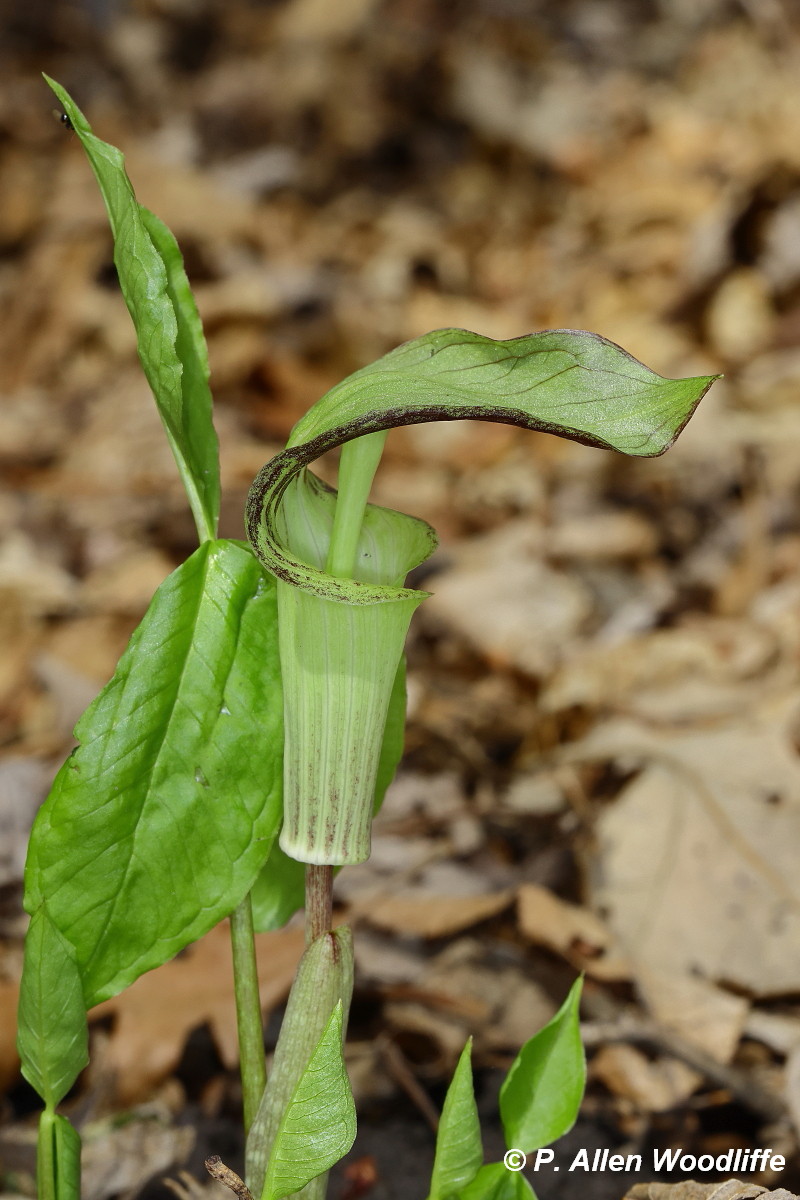
Next is Jack-in-the-Pulpit.
In some of the wetter parts of a woodland, one may come across a beautiful cluster, or many clusters of Marsh Marigold.

Also in the slightly damper parts of a woodland you may come across Purple Cress.

Red Trilliums are always a highlight to see. I am not sure why some have the single petal pointing up, as above, while others have the single petal pointing down.
Red Trilliums always seem to open up a bit earlier than their white counterpart. Most of the White Trilliums I have seen so far are still fairly tightly closed....
...but over the last few days, a few of the whites are showing better.

Spring Beauty, next, is just as its name implies.


One that flowers prolifically, but is seldom noticed, is Wild Ginger. Their distinctive leaves are apparent in various woodlands, but it isn't until you get down and look at the part of the stem right at ground level after brushing away the leaf litter that you can see the chocolatey brown flower resting on the ground. It isn't pollinated by flying insects as most wildflowers are. Instead they are pollinated by invertebrates that crawl on the ground.

A counterpart to the Downy Yellow Violet shown near the beginning is the Downy Blue Violet.
In very wet areas, such as the sloughs of Rondeau, is this Yellow Water Crowfoot, a member of the Buttercup family.
And spring wildflowers are not limited to those fleshy plants growing on the ground. Where there are damp woods, Spicebush, a woody shrub, can be dominant, as it is at Rondeau.
Not a flower in the usual sense, although it is the flowering/spore producing part of a common plant, is this Scarlet Cup, a fungus that is present primarily in spring.


If you would like to subscribe, or unsubscribe, to Nature Nuggets, send an email to: prairietramper@gmail.com


Friday, 29 May 2020

Some great May Highlights

There has been so much to see in May. Birds, of course, but also various wildflowers as well as reptiles, insects, mammals, etc. I have been doing some black lighting, and will devote one or more posts to that topic in the near future. But for now, I will try and catch up with some of the various highlights that I encountered recently, whether it be a rare plant or an opportunistic photo op.

One of the first things you may notice when checking out this post is a new header photo. I hate to see the American Avocets go, but this next one deserves the profile. It highlights a wonderful experience I had earlier in the month at the Sydenham River Nature Reserve. The Virginia Bluebells (Mertensia virginica) are truly spectacular here, but only for a few days. They are so abundant that in the overall site, on both sides of the river, there must be at least 40 acres of them! It isn't a rare Ontario species, but certainly is not common although they can be abundant where they are found. It is ranked as S3, which means there are more than 20 locations but fewer than 100 locations in Ontario. I think it is safe to say that there are fewer than 50 naturally occurring populations in Ontario.


Once they finish flowering, the plant flops onto the ground and quickly gets hidden by other vegetation, and in just a few weeks the entire plant seems to disappear. But for a couple of weeks in early May, it is a sight to behold.

There are other wildflowers about, although not many in the deeper woodland areas which are almost fully shaded now. Jack-in-the-pulpit is quite common and widespread.
 Large-flowered Bellwort can be abundant.
 One of the least observed spring wildflowers is this next one: Mitrewort. The plant is not usually very abundant, but is not rare by any means. However the entire plant is seldom more than 40 cm (16") tall, and the tiny flowers are barely 4-5 mm across.
 In woodland pools, this Yellow Water Crowfoot, a type of buttercup, can be abundant.

On one of my most recent visits to Rondeau, I came across this Eastern Foxsnake, an officially endangered reptile, enjoying the quiet roadway.

Elsewhere in the park were these Five-lined Skinks, also endangered and Ontario's only lizard. It is sometimes called a Blue-tailed Skink, as the one in this next photo shows, but it is only the young ones that have the blue tail. This particular individual is playing Ostrich, with its head buried in the sand. It was quite healthy as far as I could tell, as it quickly scurried away shortly after I got this photo.

Adult Five-lined Skink


I wanted to get to the southeast beach to check on shorebirds. Along the way I came across this clump of Puccoon, the only one I saw in flower that day, but by now, there should be plenty out.

 I did encounter some shorebirds, including these two Ruddy Turnstones, along with Dunlin and Least Sandpiper.
 My real hope was to find a few Whimbrel, a large brownish shorebird with a long, down curved bill and are typically found in the area for only a few days in spring. I was pleased to find 6 birds, and got these 5 in the photo.
I also had a visit to the McGeachy Pond and Erieau Rail trails for a few hours one day. There were a few birds, but the day before it had been really exceptional with numbers and diversity. American Redstarts were plentiful the day I was there, including this young male which really wasn't trying to serenade me I am sure.
 There were at least a couple of Northern Parula, a species of warbler which always used to seem hard to find. This one was quite approachable, almost too close to focus on!
 I saw both Yellow-billed and Black-billed Cuckoos, which are typically hard to photograph. However this Black-billed Cuckoo obliged me for a few minutes.
 The trail edges have lots of this next species along it: Dame's Rocket is very colourful, but not native.
 The wetlands had lots of turtles. I did see a couple of Blanding's Turtles, but got no photos. However this adult Midland Painted Turtle....
 ....and this hatchling of last year, were more cooperative.
The Blenheim Sewage Lagoons are now open to birders, with a municipally provided permit. Birders have to keep numbers down to 5 or less, and practice social distancing. I went to check them out the first day they were open, and unfortunately the overall bird diversity was quite low. Only 4 species of waterfowl (Canada Geese, Mute Swan, Mallard and Ruddy Duck) and only two species of shorebird (Killdeer and Spotted Sandpiper) were there. Nothing to get excited about, and with the water in the ponds very high, and the sprinkler cells totally dry, they aren't going to be very exciting for birds or birders anytime soon. However I did have an unexpected highlight. A couple of Red Fox pups were scampering around, and quite surprised to see a human based on their apparent urgency to get far, far away when I appeared. They were partially back lit, so not the ideal photo but I was certainly happy to get these.