Showing posts with label Ross's Goose. Show all posts

Monday, 15 December 2025

Late autumn, early 'winter' birding in prep for the Rondeau bird count

 I had been out a few times, looking to see what might be around in preparation for the Blenheim/Rondeau Christmas Bird Count on Dec 14.

In spite of the wintry weather, it is surprising that there is as much diversity as there is. Of course there are the usual things, including:

American Coot

Bufflehead
Lots and lots of Canada Geese!


A few Hooded Mergansers, mostly in the unfrozen areas around the Erieau harbour.
A pleasant surprise was to hear, and then get out and see some Ross's Geese. At a distance they look like a smaller version of Snow Goose, and this photo was take at quite a distance. Fortunately the head was visible enough to see the smaller stubby bill, and lack of a 'grin' patch, as well as the typical black wing tips.
In the same field with the Ross's Goose, were a couple of Tundra Swans, and lots and lots of Canada Geese.
In a field near the Blenheim Landfill, there were as many as 27 Wild Turkeys out roaming around on the lightly snow covered harvested field.
My territory for the bird count has almost always been inside Rondeau Park. I have been on this count for ~56 years. In the past it has included both the south beach all the way to Erieau, and then driving up to the Marsh Trail where I walked at least the south half. That typically involved walking a total of about 15-17 km, while carrying a tripod and scope, along with binoculars, and sometimes camera equipment as well. But that was yesteryear, and the Marsh Trail has been inaccessibly by vehicle for several years due to erosion, And while I could do the south beach, there is a much younger generation of fellows, in their 20s, who have more energy and better eyes and ears, so I have passed that area over to them. Instead, I roam around some of the roads and trails in the wooded area of the park, which is a lot less conducive for bird diversity, but there are some things around.

I checked several of the deer feeding stations that had been regularly stocked with cracked corn. (As a result of the two weekend deer culls in late November and early December, there were exactly 50 deer harvested, so the ongoing deer browsing will be reduced, much to the delight of saplings and shrubs, I am sure.) 

Birds immediately flushed even as I cautiously approached, but waiting patiently and quietly caused them to return. I guess their hunger won out!

Some would approach carefully...

...and after a few moments, drop down and start feeding.
White-breasted Nuthatch
Fox Sparrows are rather uncommon this time of year, but will hang out with other more abundant birds, and join them in their feeding frenzy.

Dark-eyed Juncos are quite abundant now.

And American Tree Sparrows are fairly abundant, and widely scattered. 

The bird count was held regardless of the cold, wintry weather, as usual. The day started out at about -14C but warmed up to a balmy -8C. The brisk westerly wind made the wind chill more like about -20C! Not exactly late autumn weather, but every year is different.

 White-throated Sparrows, named appropriately, were scattered here and there, and certainly the feeding piles were helpful.


I saw at least 5 Red-bellied Woodpeckers, mostly in the vicinity of these feeding stations.
Pileated Woodpeckers are never abundant, even though they are year-round residents, so just getting one is sometimes a bonus.
Cardinals are always to be found, near a feeding station or wherever, along woodland edges.

A bit unexpected was to see this Hermit Thrush. We don't get this species on every count.
Blue Jays have been in migration mode for several weeks, with some lingering, and likely will be here all winter. There are lots of acorns for them to find and feed on!
And lastly, this American Tree Sparrow was present at a few feeding stations on the day of the count.
Overall it was another successful count in terms of numbers and diversity. I don't think it is official yet, but at this point it seems that there were 101 species seen. Getting 100 or more is quite a feat! Of course there were many, many energetic and highly capable birders out scouring the entire count area, and that makes all the difference. 

There were lots of Bald Eagles seen, along with a couple of Golden Eagles. Sandhill Cranes, Short-eared Owls, Merlin, Peregrine Falcon and even an Eastern Phoebe were counted. Some shorebirds were even found to be sticking around, including Killdeer and Wilson's Snipe. A couple of warbler species were counted, including Yellow-rumped, which is to be expected, as well as a single Orange-crowned Warbler. The Ross's Goose was found; it was trapped in the ice at the sewage lagoons, but was freed by a couple of birders, and the goose was able to fly away!


If you are still looking for a Christmas gift, both of my two books, Life On A Sandspit, and Natural Treasures of Chatham-Kent, are available locally at:

Book Brothers, King St E Chatham

Mindful Market and Eco Hub, Main St, Blenheim

Mitton's Jewelers and Gifts, Main St, Ridgetown

Bayview Market, just outside the park gates of Rondeau (open Thursday-Sunday) 


If you would like to subscribe to Nature Nuggets, send an email to: prairietramper@gmail.com 


Tuesday, 31 January 2023

Mid-winter birding

 Birding has definitely quietened down, which is typical for the mid-winter period. There are a few lingering species, but most of what is around are fairly typical wintering species. Getting out and about does provide a few photo opportunities, however.

There is still a good number of geese and even swans around, and as long as there is a bit of open water and not too much snow on the fields, I expect that trend to continue. In checking out some of the flocks of geese and swans, one comes across an occasional less expected lingering species. Such was the case when I was checking out the waterfowl at St. Clair NWA recently. After scanning a lot of birds, I came across this Snow Goose. Fortunately it was even on the closest side of the flock making this quite clear photo relatively easy.

As expected, there was a mix of geese and swans.

A closer look at the flock had the bird in the lower right hand side of the photo get my attention. It was a little smaller than the usual Canada Geese, and the bill was a bit smaller as well. At first I was considering Cackling Goose, but it didn't look quite small enough, and the bill looked a bit too large for a typical Cackler. Also the upper chest was light coloured, rather than the darker colour of a typical Cackling Goose. There are many races and sizes in the Canada Goose complex, and I ultimately decided it could be a Richardson's Canada Goose.

There had been quite a few Bald Eagles, up to 40 individuals, reported from the same general wetland complex along Lake St. Clair. That is a notable number, but not entirely unexpected. A couple of years ago on the SCNWA Christmas Bird Count, we tallied at least 58 birds, and there could have been more. In fact there were more reported by all of the observers that day, but I suspected there was some double counting since they are a large bird that would have potentially crossed into more than one observer's territory, so downgraded the total to a mere 58. That was a record for that CBC, and almost unheard of anywhere in Ontario. However eagles migrate here to the southwest, and since there were still lots of waterfowl around to feed on, especially with the ongoing hunting season that might have resulted in crippled ducks and geese, the eagles would likely take advantage of it. And why not if the food is there for the taking.

In some years, Lake St. Clair is almost completely frozen over, and any eagles that persist this far into the winter are scattered far and wide across the ice and along the lake shore areas. With no ice to rest on, and still a fair bit of food to partake of, they are more likely to be found along the shoreline areas.

Since the large number of eagles reported were on an extensive private marsh, I didn't try and attempt to see them. However I did travel to the Jeanette's Creek boat launch area, which provides a good look upstream and downstream along the Thames River, and I have regularly seen a few eagles there. On this occasion when I checked it out, I saw at least a dozen, and since some were on the move a bit, there were likely more. Especially since a lot of the riverine habitat was upstream from where I was able to see, and certainly much closer to where the aforementioned 40 birds were reported.

I managed to get a few photos, but most were quite a distance away, and so were difficult to get good shots of without a lot of cropping of the photos. Some young birds were cavorting in the sky, practicing for when they got old enough to attract a mate or defending a territory. Or maybe they were just enjoying the wonder of flight.

Most were sub-adults, and once in awhile a bird would get a bit closer.
And sometimes this was about the only view.

When I wasn't looking for eagles, I saw and photographed some of the 5 Great Blue Herons that were scattered along the river edge.


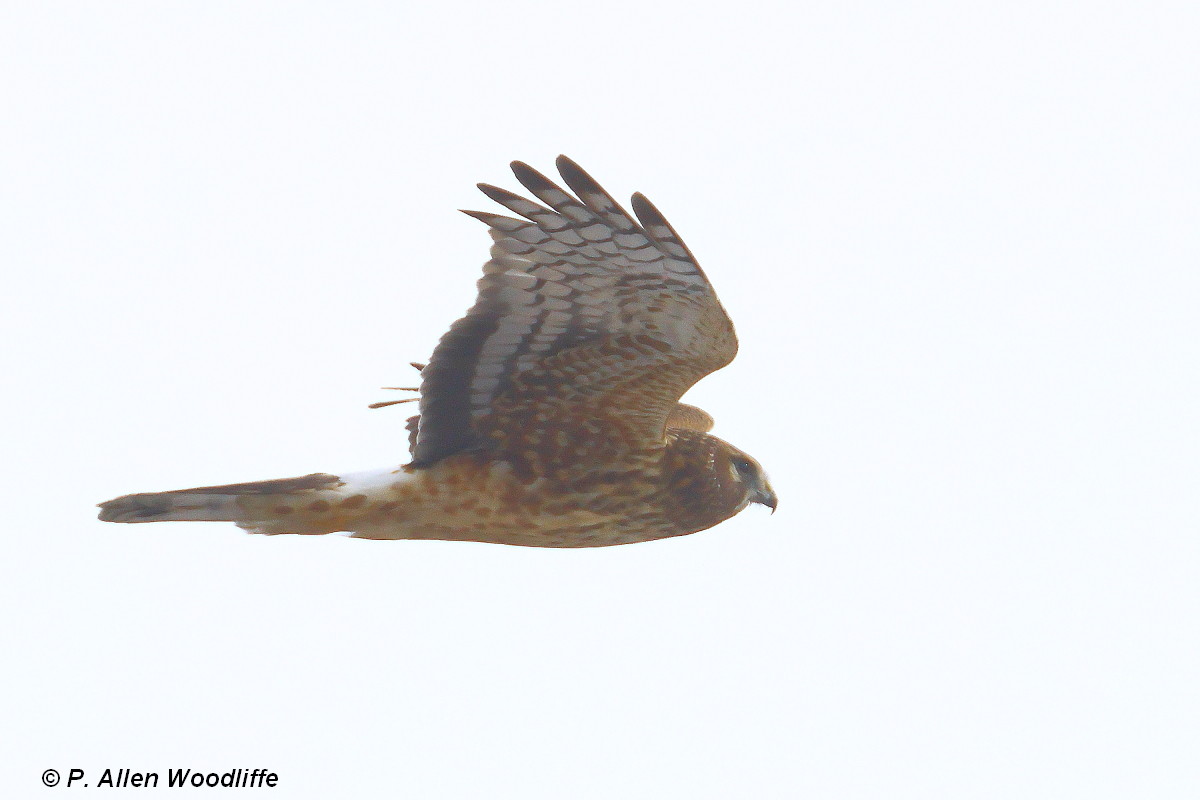
This Northern Harrier came upon me quite suddenly, and I was unprepared with the proper camera settings, so this is the best I could do.

I have been out to Rondeau on occasion (big surprise!), primarily to go for a good walk and photograph a few things that I will deal with in a future post. The woods are fairly quiet this time of year but I still marvel at the forest complex as I walk along. I have managed to see one of the resident Eastern Screech Owls on occasion....

...and a few Northern Cardinals here and there.

Yesterday I purposely stopped by the Blenheim Sewage Lagoons, hoping to see a Ross's Goose that appears either there or in the Erieau area on occasion. There were no geese in the lagoons themselves, but a couple of Mute Swans gave a good photo opportunity. I had to photograph something to show for my time there.....:-)

...and then I realized that there were several hundred geese out on a wheat field adjacent to the lagoons, so drove around to check them out. I wasn't certain I would be able to find a small white goose if it was a long way out on a snow-covered field, but fortunately it was in one of the closer groups of geese.
It was still probably 250-300 metres from the road, so only got a distant and highly cropped shot, but good enough for identification purposes.


If you want to subscribe, or unsubscribe, to Nature Nuggets, send an email to: prairietramper@gmail.com


Tuesday, 15 December 2020

Late Fall Forays

 It is that time of year, when winter hasn't arrived, the woodlands have few birds in them other than the resident species such as woodpeckers, but the unfrozen wetlands still have birds holding off on the migration. 

But a walk through the woods can still be inviting, and there are other things to see such as this rather attractive jelly fungus. 

Fan-shaped Jelly Fungus

I've been out scouring around to see what I can find, as the Christmas Bird Count season is almost here. Technically today, Dec 15, is the first day of the count period, but most counts, if folks are going through with them, will not likely start until the coming weekend. Social distancing is quite easy to do, and it is healthy to get out and get some fresh air and exercise. The big difference for most, will be not to have any meal and tally gathering at the end of the day.

Some of the local sewage lagoons continue to attract lots of waterfowl. The Ridgetown lagoons have been a good place to check lately, with some less common geese species hanging out. There is always a good number of Canada Geese, but several Snow Geese continue to be there.

The 'grin' patch is a key characteristic to look for.....
...compared to the smaller and much rarer Ross's Goose, which doesn't have the grin patch, has a stubbier bill and if you get the right angle, can see a slightly bluish patch at the base of the bill.

Lots of Tundra Swans are coming and going.

There is usually a good variety of ducks, but often many of them are on the far side of the far pond and difficult to get a good close-up photo of. These two Common Goldeneye were in the closest pond.
Sandhill Cranes have become much more common in recent years, but at this fairly late date, most have continued on with their migration. A few groups are still around, such as this one that I 'shot' today up near the Bear Creek Unit of St. Clair NWA.

Snowy Owls are showing up and sticking around, and hopefully will continue to do so for the upcoming bird counts. They seem to be particularly fond of staying well away from roads, so getting a photo at a distance seems to be the only option most times.

Occasionally there will be a couple fairly close together.

The usual mix of other raptors are scattered around, with the most common one being Red-tailed Hawk.


 Rough-legged Hawks are much less common, and the dark phase of this species, shown in the next two photos, is even less common than the light phase.


There will likely be at least a few Northern Harriers around all winter, but they are difficult to photograph. I got this one at quite a distance. Fortunately its white rump is fairly visible.

I was actually on my way to a spot along Stefina Line, south of Blenheim, which periodically has one or more Short-eared Owls, when the Northern Harrier flew by. A bit later I arrived at the large pasture, which has a combination of short grass, some longer and weedier grass and some shrubby trees. As long as the habitat was good for a healthy mice or voles population, it would be good for raptors. I met up with three other people who were also on the lookout for the owls. The Short-ears don't seem to fly during nice daylight, but more often just at dusk. On this heavily overcast day, there was nothing moving, so two of the others left. It was tempting to leave as well, but I figured I was here, why not wait just another few minutes. And then one appeared, albeit briefly, as it flew up from the dark background and its round head and floppy flight was quite evident against the fading sky. There was no real opportunity to get a photo, so I just enjoyed the brief view with binoculars. The image below shows a Short-eared Owl at this same location taken several years ago, when one decided to show itself in much better light conditions and cooperated nicely at least for a few minutes.