Showing posts with label Autumn Coralroot. Show all posts

Saturday, 27 September 2025

Late summer orchids of Rondeau, all are species at risk!

 There are several highlights for botanizing later in the summer. Certainly the main highlight for me is to check on three orchid species that are found at Rondeau, all of which are quite rare in Ontario. One is so rare that its only Canadian location is at Rondeau. Another one is quite restricted, but so very small that the average person would not even see it. The third, and latest flowering one, is rare, but relatively widespread in the park and generally more visible.

 Keen botanists will likely already know the three I am talking about. The first, and rarest one, is the Nodding Pogonia (Triphora trianthophoros). 

Its peak time of flowering is typically the third week of August, although on rare occasions I have seen one or more in flower on even the last day of July. This year I went out into one of its best known locations on August 1, just to see what was happening, and was quite surprised to see several in flower. One even had a double flower!

The tricky thing with this orchid is its flowering strategy. All the buds develop to a certain stage, and then remain as is. It takes a fairly significant drop in the overnight temperature to trigger the buds to open on the morning of the second day following this temperature drop. All the buds that are ready will open, but just for a single day, and it may be a week before the next suitable temperature drop triggers the next set of buds to open.

The weather this August was anything but suitable for this flowering strategy. An overnight temperature would seem suitable, but then the next three nights would see the temperature drop even more! I think the plants were a little confused with this abnormal sequence, and as a result, their flowering was difficult to predict. On more than one occasion I went out expecting, or at least hoping, to see some in flower, but in some cases they flowered the day before and were not worth bothering to photograph. And the next set of buds were not well developed at all. This next photo shows what a single plant looks like, from a distance of about 6", with a 100m macro lens! They can be easily missed, even when one knows exactly what to look for, so I seldom go out unless I am quite sure they will be in flower, and if it is the wrong day, I don't spend much time looking so as to not accidentally step on them.

I do know where some are likely to be found, even if not flowering, and by being extra careful, I managed to find some that were tucked beside a fallen log, and almost impossible to see. This next photo is of a pair of even tinier plants with very undeveloped flower buds, and again, photographed with a 100mm macro lens from a close distance. The plants are merely 4-5 cm high. Even at that, I greatly cropped the photo to get this.

Overall it was one of the poorest years I can remember in my 50+ years of monitoring this endangered orchid. Probably the relatively dry weather at a critical time was partly the cause. However I did manage to get a few photos. These next two were taken in the 3rd week of August window. All were almost pure white, and while I always hope for some with a magenta tinge that I find even more attractive, the second photo is the only one that had even a very slight magenta tinge. Ones with a magenta tinge usually occur towards the end of the flowering season. Oh well, maybe next year.


 After blooming, the seed pods develop, as this next photo shows. Upon ripening, the seed pods will become erect, and start to dry, with the sides of the pod starting to split open so that a slight gust of wind will cause the seeds inside to disperse.

The second orchid I referred to, is about the same size as the previous one, and at least once the flowers open up, will remain open for several days. However for the more common variety of this one, Autumn Coralroot (Corallorhiza odontorhiza) which is also rare, the flowers don't open, but are self-pollinated! The rarer variety, known as Pringle's Coralroot and shown here, has flowers that do open. This first photo shows a group of four plants.

A closer look at the arrangement of flowers.

Closer....


And finally, a 'head-on' view of the lip of a single flower, which is probably only about 4 mm wide.
Not exactly a show piece for the horticultural industry, but an interesting orchid nonetheless, and it is native!

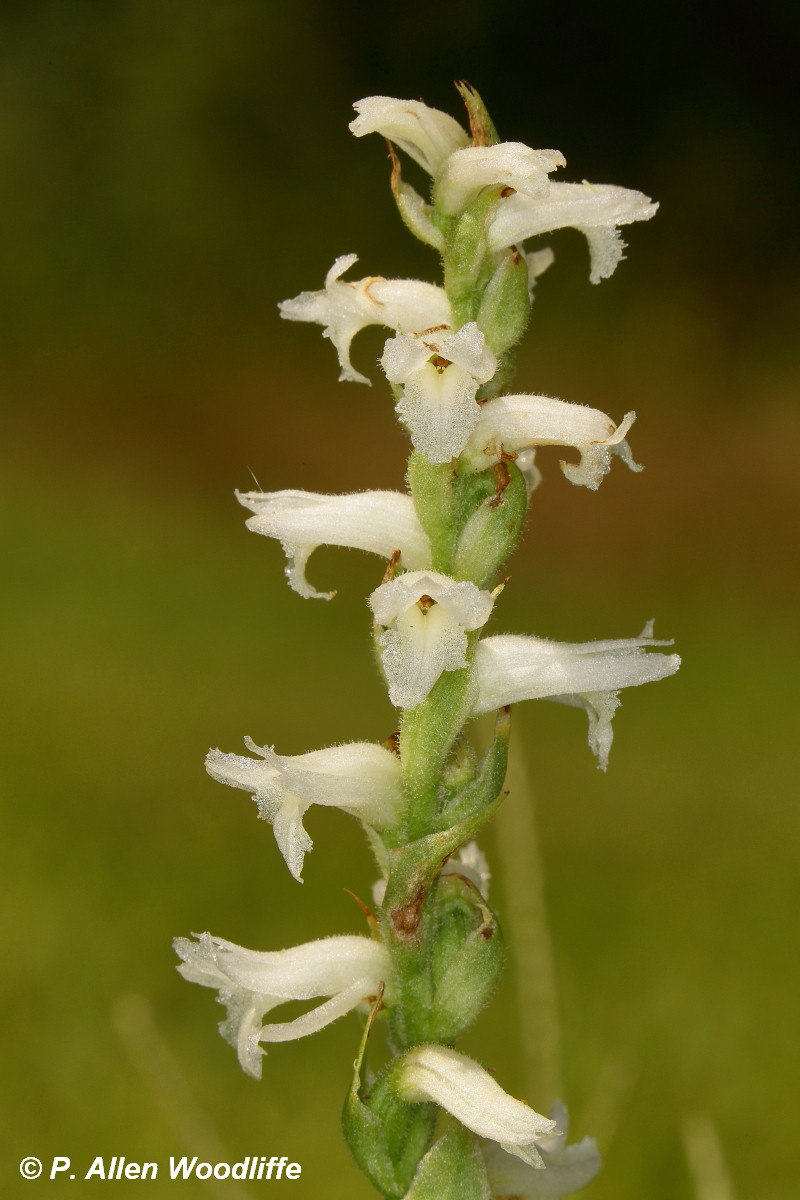
The third, and last orchid to be found flowering at Rondeau is the more common of these three. It is known as Great Plain's Ladies' Tresses (Spiranthes magnicamporum).

I found my first one with a few of the lower flowers starting to open up on September 13.

A couple of days later, there were a few more starting to open.

It is rare that all of the flowers are open at the same time, but sometimes most are. There are other species in the Spiranthes genus that look similar. A couple of the key characteristics of this one is that when in flower, it has a 'fragrance' that I think is similar to hot plastic. But without getting close enough to smell it, a close look shows a slightly yellow/tan colour well inside an open flower. None of the other Spiranthes have this coloration.
There is some slight hairiness to the outer white parts of the flower, and the sepals flare slightly back if viewed from the side.

 That's about it for Rondeau's orchids for this year. But by next May, another one of the 19 species of orchids will appear. Can't wait!


If you would like to subscribe to Nature Nuggets, send an email to: prairietramper@gmail.com


Sunday, 6 October 2024

Late summer orchids

 This post has been in the works for a few weeks, since there have been a few orchid species typical of the late summer, and several are rather rare. Currently there are 19 species of orchids known from Rondeau, 18 if which are native. I have seen all but one species, so far. Of course one of the highlight orchids is that endangered species, Nodding Pogonia a.k.a. Three-Bird's Orchid, which is currently only known in Canada at Rondeau.

It used to be known from a private woodlot in eastern Essex County, but hasn't been seen there for several decades. Forest changes and activities in the forest have undoubtedly resulted in its demise there, but it is still possible. Access to privately owned properties have become increasingly challenging, since the presence of an endangered species might result in restrictions to what the landowner has planned for their property.

Regardless, this species has been known from Rondeau since about the mid 1960s, and their are several locations in the park. Fortunately for the species, these locations are mostly away from existing trails and roadways, although on rare occasion one or more can pop up within view of a trail. I have been following/surveying this orchid since 1973, when I encountered it during my first year of working on the naturalist staff of Rondeau.

It may begin flowering in very late July and even flower into the middle of September, but its peak flowering time is about the third week in August. What makes this orchid so intriguing is that it is very small, and flowering is very weather dependent. All of the potential buds develop to a certain stage, and then stop. It is only after a significant drop in the overnight temperature, that all of those buds at this stage will open. And then they will only remain open for a day, and it may be a week or so before the next set of buds will open, depending on the temperature triggers.

This is what a developing orchid looks like before flowering. You can see by its size relative to last year's fallen leaves it is emerging through, it is anything but showy.

 Its scientific name, Triphora trianthophoros, as well as the Three-Bird's Orchid name, is based on the fact that usually a plant will produce three buds, and on rare occasions, all three will open on the same day! This next photo shows a single plant, with all three flowers open at once. I don't see this every year, but this photo was taken in 2024.


 This photo of the three flowers is located in the extreme upper left of this next photo.

I was quite pleased to come across this concentration of the orchid. Normally they will occur in small groups of three or four, or sometimes just be singles scattered on the forest floor. This was one of the largest concentrations I have seen in recent years. They are so photogenic, I have many dozens of photos from over the years. Certainly a macro lens and flash is required for the best photos.

Sometimes one gets a bit of a surprise along with the photo. This next photo is an example. At first I thought it was just another, typical flower.....

...but when I got a closer look at it on the computer, I noticed something peeking out.
I am not sure exactly what it is, but it is possibly a pollinator. When I was studying this orchid in the 1980s in preparation for writing the official status report, I collected some pollinator insects found on the plants, and it turned out they were mostly of the Halictid group which are types of sweat bees. This individual isn't fully shown, so it is not conclusive, but it has a strong resemblance to members of that group of insects.

A full frontal look at a plant with a single flower, may show the single, small roundish leaf, as in the following photo.

I particularly like the ones that have a tinge of magenta in the flower. Some are almost pure white, but it seems that later flowering ones are more likely to have the magenta tinge. I don't know what causes this, and some years they are almost all white ones.

Moving on to other late summer orchids, I have seen this next one called the Sphinx Ladies'-tresses.

Fairly similar, but flowering a bit later, usually about the middle of September, is this next one, which is called Great Plains Ladies'-tresses. It is a bit larger than the Sphinx and has a slightly yellowish tinge to it, especially when you look down the 'throat' of the flower. It also has a more fragrant scent to it.


The last orchid to flower at Rondeau is this next one, the Autumn Coralroot. And yes, this photo shows it in flower! There are two varieties of this orchid, and one will look like this, with a very small flower that hardly opens and droops downward, but the seed capsule forms anyway. This orchid is fairly rare throughout its range, and although I didn't look intensively for it this year, I only came across this single plant. However being as small as it is, and it isn't exactly showy, it likely occurs in places scattered throughout the pine-oak forest of Rondeau.


If you would like to subscribe, or unsubscribe, to Nature Nuggets, send an email to: prairietramper@gmail.com


Sunday, 27 August 2023

Waterbirds, an orchid and forest spiders

 Water birds continue to be part of the avian show. A good number of shorebirds have been at the sewage lagoons, including Wilson's Phalarope, which seems to be fairly sporadic and elusive for many birders, but this Red-necked Phalarope was nicely cooperative for the few days it was present.


At times it would fly off a bit to join other shorebirds, but then return in close proximity. My presence did not seem to deter it at all, as long as I was just standing quietly and waiting for it to return. There is often up to 10 or more species of shorebirds to gaze at on any given day right now. Lesser Yellowlegs, shown next, seem to be plentiful with sometimes as many as 20 individuals scattered around.

On occasion I have been to St. Clair NWA, especially in the evening on a quiet weather day. Clearly that would not have been last Thursday, when a severe storm was approaching. The weather radar looked ominous, and shortly after sunset, it arrived with a fury. High winds, with rumours even of a possible tornado just to the north of Chatham, and heavy rain came down. We estimated that we got at least 4" (10 c.m.) in a couple of hours, and the high winds knocked many various sized limbs down. In many places, there were entire trees that came down, sometimes onto vehicles and taking down power lines. We were without hydro for almost 8 hours. Certainly not a fun time, and a relatively sleepless night, wondering how long it would last, and would the sump pump keep going? Fortunately we had a small power pack which did keep ours going as long as it needed to.

But back to the most recent SCNWA visit. There were not a lot of birds to photograph, but a couple of the usual ones cooperated. A couple of Great Egrets flew by....

...this Great Blue Heron seemed to have settled in on its roosting spot for the night.
It is always a highlight to see Swamp Rose Mallow in its peak condition at this time of year. But at SCNWA, it is one of the few places where the white version of it can be found scattered about and partially hidden amongst the other vegetation.
As I was leaving, a group of Sandhill Cranes flew over the marsh. Usually you can hear their calls from a kilometre or more away, and sometimes not be able to find them in the sky depending on the distance. This group was totally quiet.


A trip to Clear Creek Forest Prov Park included a brief stop at the Ridgetown Sewage Lagoons along the way. There weren't a lot of things to photograph during my short time there, but this Eastern Kingbird cooperated for a few minutes.

I was looking specifically for fungi to photograph, which I often do in various woodland places after such a wet rainy period of these last few weeks. More on that in a future post. But while there, I saw several of these Citronella Horse Balm still in quite good condition.

There also were a few of the Blue-stemmed Goldenrod coming into flower.

I checked the old gravel pits for odes, but even though it was sunny and not all that cool, there were hardly any to be seen, let alone photographed. I did manage to get this photo of a Yellow-billed Cuckoo sitting out in quite an open spot, a bit unusual for this species.

I have also been to Rondeau on a few occasions, searching for fungi and other things. In some of the open spots there are things like Spicebush Swallowtail....

....and Eastern Tiger Swallowtail.
I wander into the forest, wearing boots to ward off ticks, chiggers and poison ivy. I came across this seedling Shagbark Hickory....
...and unfortunately, an ongoing display of the dreaded Beech Leaf Disease, which continues to run rampant in the Beech/Maple forest.
Along one particular part of the trail, I came across a new location for a rare orchid. It is Autumn Coralroot, an endangered species in Canada, which I don't usually expect to see until late in the first week of September. This was seen almost a full two weeks earlier.
It isn't very showy, but interesting when you get a closer look. This is the species at its showiest.
I often carry a stick with me when wandering through the forest. Not to tackle ticks or anything, but I wave it in front of me to prevent walking face first into a spider web, which can be numerous. This first one is a Spined Micrantha...
...while this next one I have not yet identified to the species level, but is a member of the quite abundant, and often colourful, orbweaver group.
Until next time.....


If you would like to subscribe, or unsubscribe, to Nature Nuggets, send an email to: prairietramper@gmail.com


Monday, 12 September 2022

Late Orchids and other rare to endangered species

 As promised in my previous post, this one will focus primarily on orchids, some of them quite rare, that occur in the August/September time frame.

As is featured in the current header, Nodding Pogonia (Triphora trianthophoros) is one of the rarest in Canada. While I have seen it in flower in very late July and as late as mid-September, typically about the third week in August is when it is at its peak.The following photos of this orchid were taken on August 25. It is legally Endangered, as the only known location for it in Canada is at Rondeau Provincial Park.

 It is very small, as you can probably tell from the first photo. They rarely exceed 12 cm in total height.
The flowers, all of which are developed to a certain point, will open simultaneously for a single day, can be slightly more than 1 cm in height. Singles are the norm, and it is always nice to see them with lots of magenta.
Doubles on the same flower seem to be plentiful at times.....
....while three flowers on the same plant, open all at the same time, is more unusual. In checking on this rare orchid annually since the early 1970s, I don't see a triple flowered one every year.

As tiny as Nodding Pogonia is, here is one that is even less conspicuous. It is Autumn Coralroot (Corallorhiza odontorhiza) and is also quite rare, although not as rare as the first one. It is a bit taller on average, but the flowers are much less showy. There are two varieties of this orchid. The one shown here is var. pringlei, and this is the 'open-flowered' variety. Even though the drooping flowers are open, the seed capsules are already well-developed. The form with flowers that never really open is even less obvious. In both cases, self-pollination occurs. To give you an idea of how small this is, it was taken with a 100mm macro lens plus 68mm of extension tubes, and then cropped some more.


Sticking with orchids a bit longer, there is an interesting group of them in the Ladies'-tresses genus, and some can be challenging to tell apart. A previous post featured the most common one at this time of year, the Sphinx Ladies'-tresses (Spiranthes incurva). I photographed it at Rondeau a few weeks ago. While looking for an endangered gentian in eastern Chatham-Kent, I photographed this same species.

Its flowers are almost entirely white, with little or no fragrance. The brownish spots appearing are an indication that it is past its best. It was photographed on Sept 1, and normally would have been in its peak condition around the third week of August
It has small leaves at the base.

A similar looking one is this next one: Southern Slender Ladies'-tresses (Spiranthes lacera var. gracilis). It is quite dainty, and not easily seen amongst the fairly dense prairie vegetation.

A closer look reveals one of the key characteristics of its spiral flowers: the distinctly green centres of each flower.

Sometimes the spiraling of the flowers takes on a slightly different look with a more drawn out spiral.

It is an extremely rare species, with only this one population showing up in the iNaturalist database. There are older records that I am aware of, but they have not been seen for several decades, primarily due to a change in the overall vegetation.

I have been out to check on another extremely rare orchid of this group: Yellow Ladies'-tresses (Spiranthes ochroleuca), but it was not visible on this date. It occurs on a normally fairly dry sandy site, and it is possible that the extremely dry late June through early August period may be the reason it hasn't appeared. Or maybe I was a few days too early, so I will be out checking for it again soon.

Another one in that genus, while considered rare in Ontario but is relatively common at Rondeau, is Great Plain's Ladies'-tresses (Spiranthes magnicamporum). It is a bit early for it at the moment, but should be showing up in the next week. It is a more robust looking species, with a slightly creamy centre as well as a spicy vanilla scent, and no basal leaves. It grows in grassy areas.


Not an orchid, but an Endangered gentian, is the White Prairie Gentian (Gentiana alba). It grows in the same vicinity as the Southern Slender Ladies'-tresses, and so I combined the time out to photograph them both. There are three sub-populations of this gentian, and at the moment, are the only ones known for Canada. Key characteristics are the creamy white flowers, most of which are fairly closed but not always tightly closed. The flowers also have slight ridges, typically with greenish lines. The plant grows best in high quality tallgrass prairie/savanna vegetation communities.

They can sometimes be confused with another gentian, commonly known as Bottle Gentian (Gentiana andrewsii), which is fairly widespread in a broader vegetation community. Normally they are quite a deep blue, but on occasion they can be white. Such was the case where I was investigating a reported occurrence of the White Prairie Gentian (WPG) in eastern Chatham-Kent. We didn't find any WPG, but did see this white colour form of the Bottle Gentian. The flowers are more tightly closed, and doesn't have the more obvious ridges with greenish edges.

Just to add a little non-botanical information to this post, while I was in eastern Chatham-Kent on the hunt for some of the species above, I stopped by a couple of spots along the Thames River to look for some rare, and very rare, damselflies. The first one is much more common than the second species: American Rubyspot. It has a partially reddish area near the base of the wings, and their abdomen shows definitive brighter rings. They don't always sit in an ideal place to photograph them, but when they do, the patience required is worth it. In Ontario, it is found in many scattered locations west of the Toronto to Barrie area.


Much rarer is the Smoky Rubyspot, next, which shows a bit of red near the base of the wings, and a smoky tip of the wings. Also the abdomen is only faintly ringed, if at all. In Ontario and Canada, it is found primarily along the Sydenham River, the lower reaches of the Thames River and in a couple of places along the Ausable River.

I also managed to check on a couple of rare plants I knew about in the area, both of which are ranked as Endangered. The first one is Eastern Flowering Dogwood (Cornus florida), and while it is not in flower now, it is still quite distinctive. It has a small cluster of red berries.....

...and the large buds of next year's flowers are quite prominent.
In the same general area is a remnant of a population of Eastern Prickly Pear Cactus (Opuntia cespitosa), also Endangered. It was once part of a large population that was widespread across a sandy hillside back in the 1940s, according to a former co-worker of mine who lived across from the site. But eventually the hillside was converted to agriculture, and only a small remnant persists along the roadside.


If you would like to subscribe, or unsubscribe, to Nature Nuggets, send an email to: prairietramper@gmail.com