Showing posts with label St. Clair River. Show all posts

Tuesday, 29 December 2020

End of year stuff, including another bird count

 The year 2020 is just about out the door. Here is hoping that 2021 is much better on a whole bunch of fronts! Meanwhile, getting out and finding birds is still one of the most satisfying, and safest things to do right now, so that is what I've been doing as much as possible.

The Erieau Rail Trail can be good, when the wind isn't blowing too hard since it is quite exposed. Those days are sometimes rare. But a visit not too long ago, just after a bit of snow, gave me a few things to look through. One of the target species was Common Redpoll, which don't always come through this part of the province in good numbers, but this year it has been much better than normal. I was also looking for the rarer Hoary Redpoll, but although one or two others had seen one here, I did not. The flock of redpolls was flighty, so I only got a good look at a few of the ~45 birds that were in the area.

Several White-crowned Sparrows were low down in the snowy branches....
....as were a few Song Sparrows, one of which was partially in view for a short time.

I also got out to roam around the area northwest of Chatham, looking for Snowy Owls. With a bird count in this area coming up shortly, it is always useful to find out where they are hanging out. I found 5, but most were well out in a field and not worth trying to photograph from the road. I did see a woman well out in the field as well, trying to get close enough to get a decent photo with what appeared to be a fairly basic camera requiring her to be up close. The owl was having none of it, however, and kept moving off. I had better luck, as I found a Snowy inside a chain link fenced area, and I was able to get this shot from my vehicle. The owl seemed quite unconcerned.


I also wanted to check on the ongoing reports of Snow Geese and a Ross's Goose at the Ridgetown Sewage Lagoons. I had seen them there a few weeks ago, but am always on the lookout for more and better photos. At first the Snow Geese were on a berm quite unsuitable for good photos. But waiting a bit was the key, as after a few minutes this group got up to go to a field of corn stubble nearby. This photo shows a 'blue' phase, in the upper left, as well as a first year bird, the lowest one on the right. The rest were mostly typical white Snow Geese....
...but not all of them. The Ross's Goose was in this group. It is relatively easily separated from a Snow due to its smaller size, a shorter, stubbier bill with no grin patch, and a slightly rounder head. If you click on the photo, these characteristics may be more apparent.

But the biggest event of the last few days has been the Wallaceburg/Walpole Christmas Bird Count, held on Dec 27. I helped get this count going back in 1986. My territory for most of the last couple of decades has included the St. Clair River north of Walpole Island as well as several roads and more woodland areas inland from the river, so there is a nice diversity of habitat. But the most important part is the river.

Unfortunately the river did not have a lot of waterfowl this year, compared to many years. It seems there hasn't been enough cold weather, forcing birds down from the more northern lakes. There was no ice on the river at all, and not many gulls either. Nonetheless there were enough to make parts of it interesting, but photographing the waterfowl had its limitations. Here are a few of the things I saw.

There were a fair number of Bufflehead, shown first. This one was getting ready for flight, and I got this shot a split second before it lifted off, hence its wing is partially out.

Common Goldeneye was about the most common duck I saw, although the number was still below 100 individuals.
There were a few Greater Scaup....
....and even fewer Lesser Scaup. The photo below actually shows a female Greater on the left, and a Lesser in the center. It is slightly smaller, has a slightly more peaked head, not as rounded, and the dark tip of the bill is much more restricted compared to a Greater.
There were a few gulls, and by far the most common was Herring Gull. I saw a couple of Ring-billed and Greater Black-backed Gulls but they were way too far off, mostly on the other side of the river.
A highlight was seeing a group of seven Hooded Mergansers but from a distance in a wide creek. The best photo opportunity for this species came at about the end of the day, as this male Hoodie was resting on a piece of ice in a narrow creek along a quiet road. I was able to get almost full frame shots of it right from the vehicle.
Mallard.....yes, there are always some Mallards around, so when the photos of more exciting things are hard to come by, why not shoot a Mallard....
...or one of the numerous exotic Mute Swans?
Certainly a little more exciting were 21 Tundra Swans right close to the river shore downstream from Sombra. They are more often seen in fields well away from the river.

As mentioned, I did some more inland areas, where songbirds and non-waterbirds were to be found. I found a fair number of American Tree Sparrows in a couple of locations.

This adult Cooper's Hawk allowed me to get closer than I expected, although maybe it thought it was obscured enough by the branches.
A few Downy Woodpeckers came in to check me out as I 'pished' for birds.
Mourning Doves aren't exactly uncommon, but when a photo op presents itself, I'll take it!
Rock Pigeons were fairly plentiful, although most of them were across the river, roosting on a building connected to a power plant. But there were a few resting on some hydro wires along the road, and with a nice sky background for a change, why not?
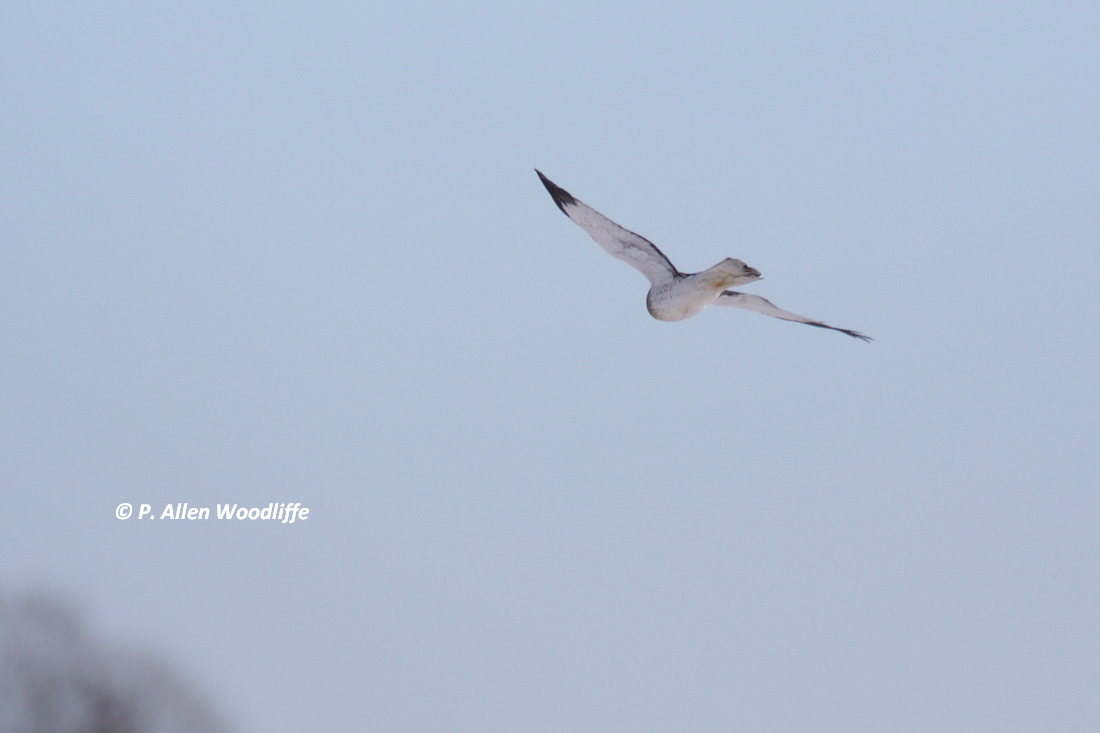
Certainly the highlight of the inland birds was this Short-eared Owl. Okay it isn't all that obvious, and I wouldn't have seen it if I hadn't met Mike B along the roadside who had seen it fly in and land way out in the field. I took a couple of photos of it in mid-morning, but there was just enough sunlight to create some haze, and those photos were not worth keeping. I came by again later in the afternoon when the sun was behind some clouds, and there was no problematic sunlight haze. Unfortunately the owl was always facing the opposite direction, so this is the best I could do. Between the camera/lens combination and some severe cropping, this photo is at about the equivalent of about 140 X!

The count ended up with 85 species plus an unidentified shorebird, which was a bit higher than normal.

This is likely the last post before the new year, as I will be busy preparing for the next bird count on January 1, so with that I will wish all readers a Happy New Year!


Saturday, 24 February 2018

Positives and negatives of all that rainfall

There is no question that the last few days have had many people concerned in the Great Lakes Region. With the warm weather and substantial amounts of rainfall quickly melting the snow pack, there is a lot of water on the landscape!

I've been up along the St. Clair River a couple of times recently, partly hoping to see the King Eider that had been hanging around the north end of Stag Island for a few days. I didn't catch up to it, but saw lots of other waterfowl. The warm weather and rainfall has certainly cleared out a lot of the ice.

A Horned Grebe, hanging out in the vicinity of the Chenal Ecarte at the bridge that goes to Walpole Island First Nation was a bit of an early arrival.
 Common Mergansers were quite common.
 There was the occasional Hooded Merganser.
 Long-tailed Ducks used to be a novelty on this river, but for the last decade or so, have become much more common. Several hundred, sometimes more, are scattered somewhere along the river on any given day.
 Red-breasted Mergansers aren't as abundant as their Common relatives, but a few can be found.
 Redheads are frequently seen, sometimes in large rafts.
Canvasback are reliably seen, although this year they haven't been nearly as common as Redhead.

I saw three Bald Eagles also, all immatures, but not well enough to try for a photo. A Great Blue Heron flushed up from a warm water outflow just south of Bickford Line. No photo there either.

While driving south along the river, I looked over at the edge of a woodlot which belongs to the family of a friend. I knew Wild Turkeys hung out there, as it is within my usual territory for the Christmas Bird Count. Sure enough there were a couple of dozen roaming around in the field just beyond the woods.


With all the rainfall, I knew that the McKeough Floodway would be in use. It was constructed in 1984 in response to the major flooding that Wallaceburg often experienced. The floodway re-directs excess water from the East and North Sydenham Rivers before it gets to Wallaceburg, thereby alleviating some of the flood risk. Sure enough, there was a lot of water flowing through the floodway and entering the St. Clair River safely away from Wallaceburg.
Floodway looking 'upstream' from Baseline Road
 After viewing the floodway I returned home via West Holt Road heading over to Hwy 40. I was pleased to see a Snowy Owl sitting cooperatively on top of a hydro pole, which allowed me to get some reasonable shots.
Upon arriving home on one of these occasions, before all the snow had disappeared, I was surprised to see Am Robins hanging out in our yard. At least a dozen were there, taking turns searching in the leaves near the base of the house which hadn't been covered with snow. They hung around for several days until most of the snow was gone, scattering to other snow-free areas.


Waterfowl were arriving in greater numbers in the vicinity of St. Clair NWA, as expected. I checked them out and saw many of the usual overwintering species, but caught up with Snow Geese and Greater White-fronted Geese as well, although they were too far away to bother with a photo. I did capture these Northern Pintail, however. The occasional one had been around all winter, as had Gadwall, Green-winged Teal and Am Wigeon, but there was definitely an influx of them in the last few days.
The flooded fields were very attractive to waterfowl.

They were much less attractive to the farming community. This part of Chatham-Kent is extremely flat, due to the outwash of receding glaciers a long time ago. This highly productive area dominated by rich black soil is a result of the wetland or prairie vegetation that developed here after the glaciers left. If the water levels of adjacent Lake St. Clair was high, it would be wetland; in periods of lower water level, it would be dominated by wet tallgrass prairie vegetation. But it has very poor natural drainage, so farmers do everything they can to remove standing water as quickly as possible. Pumping stations are strategically located, and in these last few days every one of them has been in operation where tractor powered pumps are going full tilt pumping the water off the fields, through the tile drains, and emptying the offending liquid into the larger drain system.
 This particular photo was taken along Town Line Road and empties into Lake St. Clair at St. Luke's which is the north end of Town Line Road.

The Erieau area is always worth checking out due to the wetlands and waterfront there. Again, this time of year waterfowl are the most abundant bird species. It wasn't many days ago where the extensive ice conditions limited open water to these birds. The main channel often had a bit of open water.
A lone Gadwall was there, hanging out in the vicinity of Am Black Ducks.

A four-legged Mute Swan?
On one of the warmer days I was there, the fog had rolled in making views much more challenging, so I opted for a different kind of photography.

I did see some waterfowl resting and feeding in the wet fields adjacent to McGeachy Pond just outside of Erieau. The fog wasn't quite as thick, but still made viewing and photography challenging. I got these three Greater White-fronted Geese under much less than ideal conditions.


On the way home I decided to check out the Indian/McGregor Creek diversion that protects the south end of Chatham from flooding. It is much smaller than the McKeough Floodway mentioned earlier, but the Indian/McGregor Creek watershed is much smaller than the combined East and North Sydenham Rivers. It wasn't that many decades ago when residents of south Chatham greatly feared the weather conditions we have been experiencing these last few days, as late winter and early spring flooding was almost a regular event. There hasn't been any serious flooding in that area since 1992 when this floodway project was completed. This first image shows McGregor Creek at the corner of Hwy 40 and Boundary Line, looking south. The creek at this point is normally less than 5 metres wide at the bottom with only a little water flowing. Here it is probably well over 100 metres wide.
 This next photo shows McGregor Creek at the corner of Maynard Line and Creek Road. It clearly looks more like a small lake than a creek!
Flooding to some extent does still occur in the immediate area of downtown Chatham. Here is an impressive aerial video of downtown Chatham taken today, Feb 24 just before peak water levels of the Thames River arrive. This video has now been taken down by the owner, unfortunately. But this one shows another section of the river flood downstream from the downtown.


Friday, 29 December 2017

St. Clair River birding and an Aythya curiosity

My territory for the recent Wallaceburg Christmas Bird Count, held on the 27th this year, includes several kilometres of the St. Clair River. Some years it is full of ducks, but this year it was not. There was a reasonably diversity, however.

Long-tailed Ducks used to be quite a rarity here, but now it is a rare to not see several dozen, at least, especially the farther north on the river you go. They are often well out in the middle of the river, so not always easy to photograph.


With the ice quickly building up in the river, the protected area by the Sombra ferry dock is a good place to check out the waterfowl. A female Hooded Merganser was hanging around......
 ....and there were a few Common Mergansers.

Both Greater and Lesser Scaup were near the ferry dock, but I only got photos of Greater. Greaters are easily identified by the round head and, when they are at rest, a slight flatness to the head.

There was a duck that at first glance was an easy call as a Ring-necked Duck. I got a few photos, but when I started looking more closely at them on the computer, I had some questions.

Ring-neck (l), Redhead (r)

Certainly the bill pattern the dark back, the brownish sides all fit Ring-neck nicely. But what about that head shape? A 'good' Ring-neck shows a slightly different shape, sometimes being bluntly crested even to the point of being broadly triangular in some respects. This bird shows a round head, especially obvious in the first and third photos. It is more like a Greater Scaup, and the slightly greenish tinge is more indicative of Greater. A Ring-neck head is usually a brownish purple. Does it have some Greater Scaup genes in its background? Both of these species are members of the Aythya genus, and they are close enough that hybrids in this genus are more common than most other duck genera. So it is possible that at some point in this bird's lineage some Greater Scaup genes crept in. I'm certainly not an expert in waterfowl genetics, so if anyone has an opinion, please share it!

There were other birds to find, including this adult Bald Eagle that swooped over some gulls, looking for something to scavenge, I expect.
 While I was watching the gulls and this eagle, I looked across the river at the St. Clair Power Plant. I had seen Peregrine Falcons there in the past, and this is what I was hoping to find on this trip. I got a brief look at this bird through the binoculars, and then reached for the camera. This next photo was taken with a full frame Canon DSLR, a 500mm telephoto and a 1.4X converter. After taking a couple of photos, I reached for the scope, and then the bird was gone. The bird was perched at least one kilometre away, so it was at a difficult distance, and with the bright sun and atmospheric haze, it isn't as sharp as I would like it to get a positive ID. Cropping the photo by about 80% doesn't help either. It looks a little big and chunky for a typical Peregrine. Perhaps it was just fluffed up due to the cold? Or is it possibly something else? Another birder had a very large falcon go by him not too far from here....could it be the same bird? Could it be a Gyrfalcon? One can't tell for sure based on this photo....perhaps it is just a female Peregrine, which are larger than males.

Canada Geese were not very abundant early in the day,  but there were a few around.

 As the afternoon wore on, it was apparent that a late day movement of geese was occurring. Several flocks ranging in size from about 60 to 150 streamed by, quite high and heading straight south. I expect the colder weather much farther north put them to flight.

I spent a bit of time inland, checking out a different part of my territory. There were a few raptors, including at least 3 Northern Harrier.
As they swept low over a field, they would scare up small groups of birds such as Horned Lark, which were widely scattered.

 All in all, it was a great day in spite of the cold. No doubt with the continued cold, bringing lots of ice from Lake Huron, waterfowl will become much more numerous, and will warrant another visit.