Ok officially Canada Day doesn't come for another few weeks. But a couple of days ago, there was an influx of Canada Warblers into the Rondeau area. They were seen in multiple parts of the park, but probably the best location was along Spicebush Trail, where several were seen, including one very cooperative male that gave photo ops for several people. Even during the relative short time I was there, I think I heard at least a thousand shutter clicks.
It was right adjacent to one of the boardwalks, giving people slightly elevated views as it spent several hours flitting back and forth, feeding, resting, searching for food and whatever. It would perch on a stump....
....pause and give quizzical looks at the people around.....
....flit to a branch....
...jump down to the base of a tree hunting for something....
...sometimes get bored with the audience....
...and occasionally find something to munch on. All in all, it was a very entertaining time with this declining species.
Of course there has been a good variety of other warblers, although I haven't caught up with some of the rarer species.
 |
| American Redstart |
 |
| Blackburnian |
 |
| Cape May |
 |
| Common Yellowthroat |
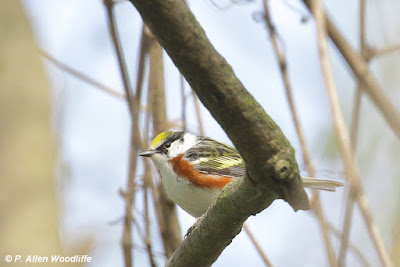 |
| Chestnut-sided |
 |
| Magnolia |
Sometimes you only get a partial view, and hopefully enough to make a positive identification before it disappears.
 |
| Nashville |
 |
| Orange-crowned |
There is a good variety of the usual non-warbler species, including those that may now be here to nest.
 |
| Baltimore Oriole |
 |
| Eastern Kingbird |
|
|
 |
| Eastern Towhee male |
There had been a Spotted Towhee seen in the campground by a few birders. I wasn't in the area at the time, and so missed seeing it. However from photos I have seen, it wasn't very cooperative. It wouldn't be a new Rondeau species for me, as I had one coming to a feeder back in late 1979 when I was the park naturalist. That was before it became an official separate species rather than a western subspecies, so although it was an interesting sighting back then, it wouldn't have created the same stir as today.
 |
| Eastern Towhee female |
I've periodically thought that this next species should be the official bird of the Grand River Conservation Authority, given that its 4-letter bird code name is GRCA.
 |
| Gray Catbird |
Vireos have not been very abundant as of yesterday, although that could change any day now. Red-eyed Vireos, one of the most common of all songbirds in the eastern deciduous forests, have been noticeable by their absence. I think I have seen less than five so far this spring.
Warbling Vireos are a little more common.
Scarlet Tanagers have been around, although not abundant at all.
Of course the 'resident' White-winged Dove has been back for a few weeks now, and as before, likes to build a nest on Mel's car.
An Eastern Screech Owl is back in a frequently occupied hole. There is no guarantee that it will be visible, and if anyone goes off the trail to get a closer look, it will very quickly back up and disappear from view.
Yesterday when I was out, I got word of a Clay-colored Sparrow in the campground (thanks, Mike!). Since I was at the north end of the park at the time, I headed over and met Mike. Even though only a few minutes had passed by, the bird was nowhere to be seen. Which is often what birds do. Mike had indicated he had seen it loosely associating with Chipping Sparrows, so we used that clue to continue and broaden our search. However after another 30-45 minutes went by without seeing it, we decided it was gone. We did see several Chipping Sparrows, including this one which was putting the finishing touches on its nest.
About 3 minutes after Mike and I had gone our separate ways, I heard him call out that it had re-appeared a little way down the campground road, so I hurried over. It was active, and not willing to allow us to get too close, so the long lenses were put to good use.
Who knows, with the closed campground and open grassy/shrubby nature of the campground vegetation, might it be appealing for this species to nest if it can find a mate?
There is always something else to see along the way, including things like this Eastern Chipmunk. It has been a good year for chipmunks, and with the less traffic during the time the park was closed, fewer road kills. On some trails I have seen more chipmunks than warblers!
This Eastern Cottontail was out in a grassy part of the campground.
Leopard Frogs are widespread. I took a break from photographing the Canada Warbler to shoot this guy who was on the other side of the boardwalk.
Tiger beetles, such as this Six-spotted Tiger Beetle (which can have either more, or fewer, than six spots) can be seen on sunny days along the trails and roadways.
While walking along a grassy trail a few days ago, I flushed up a Song Sparrow. Its nest was not too hard to find.
Spring wildflowers are continuing, such as this rarity known as Goldenseal. It occurs in a couple of places at Rondeau, and as of a few days ago, had just about completed its flowering for this season. Due to its rarity and Species At Risk status, its location will not be divulged.
A spring-time orchid is this Showy Orchis. It isn't large and showy in spite of its name, as it seldom gets more than 15 cm (6") high.
 |
| Last year's flowering stalk |
|
|
|
Butterflies have not been too plentiful, not surprising given the cool, windy conditions. With the promise of summer-like temperatures in the next few days, I anticipate a lot greater variety very soon!
 |
| Red Admiral |


