Showing posts with label Wild Ginger. Show all posts

Wednesday, 3 May 2023

A Spring Wildflower 'Walk'

 The warmer than usual weather of a couple of weeks ago spurred a lot of spring wildflowers on their way. But the cool damp weather of the last few days have slowed their growth, and certainly caused the bird migration to stall, with a few birds dribbling through, but not like most birders hope for in late April and early May.

I know there are some readers who look forward to seeing the variety of spring wildflowers, but for various reasons cannot do it like they used to. As one ages, it is hard to get down to ground level to see them up close, and even harder to get back up again! And then there are some folks who have had a misfortune in their lives that limit their mobility in a serious way. I think of one reader in particular, Furry Gnome, who I have known casually for several decades. He has devoted a significant part of his life and career to protecting and promoting natural areas in various ways. Unfortunately a few years ago as a result of some needed surgery, is now limited to a wheelchair. Yet he continues to try and do the best he can. You can read about his adventures in his blog, which I have listed on the side of my blog site entitled 'Seasons in the Valley.'

This blog post is therefore devoted to those like Furry Gnome, who are unable to see spring wildflowers like they would like to, or used to. I am fortunate that I can still get out and about, and even have a camera body with a tilt screen enabling me to see those flowers up super close, without having to get down on my belly to do so.

What follows does not necessarily represent any particular order of flowering, but to a certain extent, just the way they are labelled. Their order of flowering can vary from site to site, depending on how well they are shaded, what the slope of the ground might be which could favour those getting a stronger sunlight to flower earlier.

Unless otherwise noted, all of the following flowers were photographed in the last couple of weeks.

One of the earliest to flower is this one:

Bloodroot

Cut-leaved Toothwort

Downy Yellow Violet
A closer view, which shows some kind of spider approaching the throat of the flower.
Downy Yellow Violet
Early Blue Cohosh
There is another, quite similar species of Cohosh that has greener flowers, and is in flower a couple of weeks later.
Early Buttercup

Dutchman's Breeches

This next one is Squirrel Corn, not nearly as common as Dutchman's Breeches in my experience. The leaves are very similar, so it is necessary to see the actual flowers to determine which species it is.

Yellow Trout Lily, shown next, usually has to have a bright sunny day before the petals open enough to curl back. Sunny days have been few and far between lately so the third one is from a brighter day a year ago.


Very similar to Yellow Trout Lily is White Trout Lily. It isn't as common. Again, it needs a good dose of bright sun to open and the only ones I have seen so far this year are hardly open at all. This one is from a couple of years ago.

Hepatica, shown above, can be one of two different kinds, primarily based on their leaf shape. However early in the season, the flowers typically emerge before the leaves are fully formed, and so are difficult to identify to species. The colours can vary from very white to bluish purple.

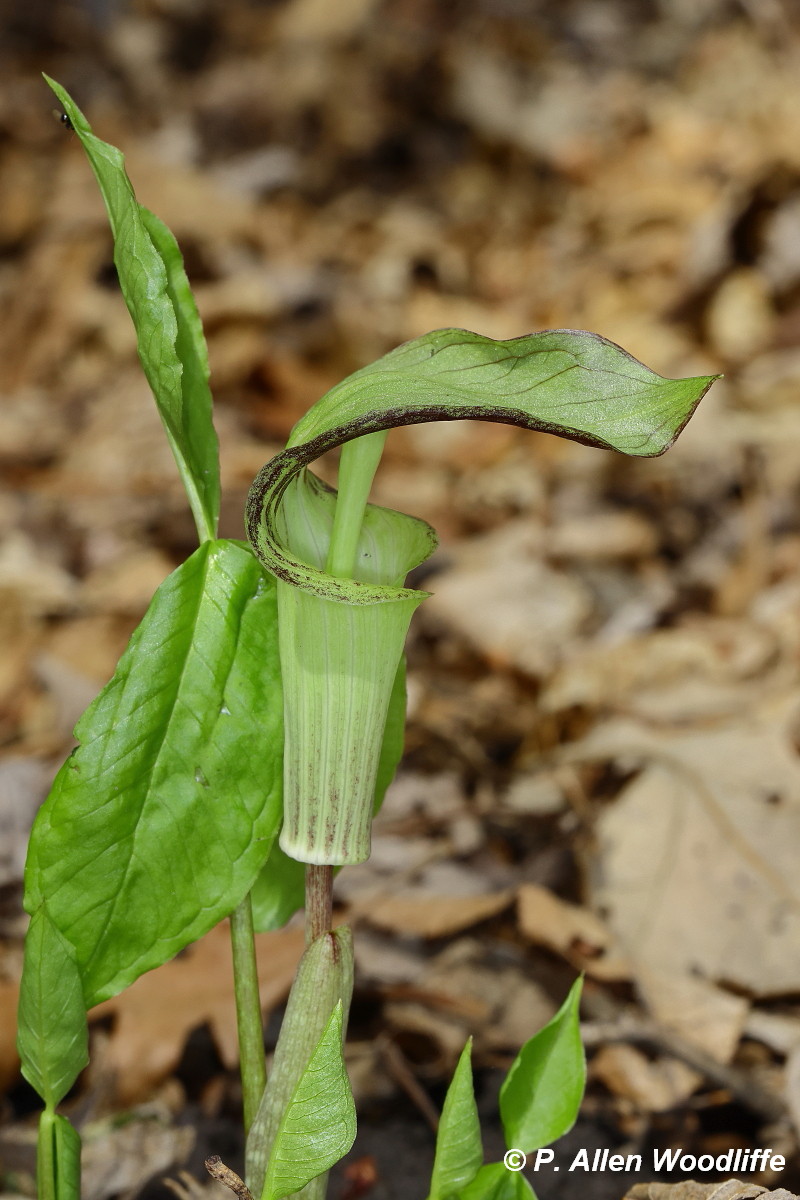
Next is Jack-in-the-Pulpit.
In some of the wetter parts of a woodland, one may come across a beautiful cluster, or many clusters of Marsh Marigold.

Also in the slightly damper parts of a woodland you may come across Purple Cress.

Red Trilliums are always a highlight to see. I am not sure why some have the single petal pointing up, as above, while others have the single petal pointing down.
Red Trilliums always seem to open up a bit earlier than their white counterpart. Most of the White Trilliums I have seen so far are still fairly tightly closed....
...but over the last few days, a few of the whites are showing better.

Spring Beauty, next, is just as its name implies.


One that flowers prolifically, but is seldom noticed, is Wild Ginger. Their distinctive leaves are apparent in various woodlands, but it isn't until you get down and look at the part of the stem right at ground level after brushing away the leaf litter that you can see the chocolatey brown flower resting on the ground. It isn't pollinated by flying insects as most wildflowers are. Instead they are pollinated by invertebrates that crawl on the ground.

A counterpart to the Downy Yellow Violet shown near the beginning is the Downy Blue Violet.
In very wet areas, such as the sloughs of Rondeau, is this Yellow Water Crowfoot, a member of the Buttercup family.
And spring wildflowers are not limited to those fleshy plants growing on the ground. Where there are damp woods, Spicebush, a woody shrub, can be dominant, as it is at Rondeau.
Not a flower in the usual sense, although it is the flowering/spore producing part of a common plant, is this Scarlet Cup, a fungus that is present primarily in spring.


If you would like to subscribe, or unsubscribe, to Nature Nuggets, send an email to: prairietramper@gmail.com


Friday, 16 April 2021

Spring slows, but there are still things to see

 There is no question that the current cooling of the weather has slowed the unfolding of spring, and that is the way it should be. Things, especially plants, were way ahead of themselves, and would risk a severe set back if they continued to develop and got hit with a significant frost in the next few weeks. It happens, as we have had snow even in the second week of May in recent years.

Nonetheless, there are still things to see and enjoy with a little bit of effort. I was at Rondeau earlier in the week, hoping to see the Black Vulture that treated birders on the last weekend. I spent a lot of time checking every vulture I could find, from the north end of the park to the south end. I saw black vultures, but not 'the' Black Vulture.

I also stopped at Mel's place, where the White-winged Dove that has graced the park with its presence over the last several years, is most apt to show up any day now. I didn't see any sign of the target species, but noted this next one on an adjacent lot. Rock Pigeons are not often seen in the park, as they are more often hanging around rural areas, especially farm yards.
Given the bright sunny day, there were a couple of Carolina Wrens advertising their territory.
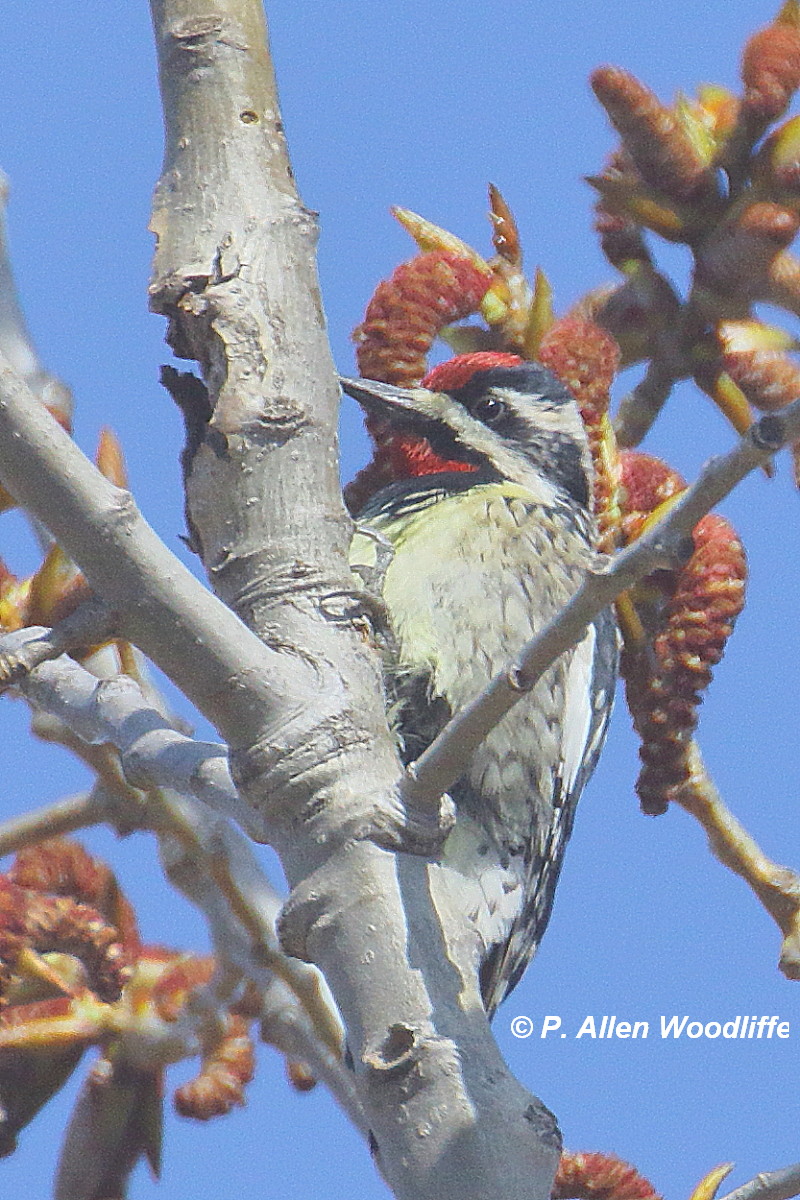
Yellow-bellied Sapsuckers are scattered far and wide in the park, but not always conducive for a good photograph.
Along one of the trails, this Northern Ribbon Snake was slithering by. It is a Species At Risk, and prefers swampy forest habitat, of which there is plenty at Rondeau. I am more likely to see them swimming on the water of a slough rather than through the leaves.
It looks a lot like an Eastern Garter Snake, but has more vivid black and yellow stripes, as well as a rusty brown stripe along the edge of the belly scales. Also it has a white dot right in front of the eye.
Wildflowers continue, such as Bloodroot.....
....and Spicebush, a shrub that is dominant especially in the damper areas of the park. In other words, it is almost everywhere!

This is a great time of year to explore Sinclair's Bush, about half way between Rondeau and Blenheim. Spring wildflowers are fairly diverse and abundant, but certainly are not at their peak quite yet. 

Early Blue Cohosh is one of the earliest, and is out nicely right now.

Yellow Trout Lily is abundant. Their mottled leaves are everywhere, although only a small percentage of plants actually put up a flower.
The petals open up, and curl back, on bright sunny days, but on cloudy days, will almost close right up.
A much less conspicuous wild flower is Wild Ginger. Usually you just see the green leaves poking up through the dead leaves of last year......
....but if you pull away some of those dead leaves, you will see this flower that rests on the ground. It doesn't need to be seen by the flying pollinators that most plants attract, as this species is pollinated by beetles and ants, that spend most of their time at ground level.
Always a pleasant sight to see is Dutchman's Breeches.

Closer to home is the Thamesgrove Conservation area, along the Thames River at the east side of Chatham. The birds were not unusual, but I kept an eye open for flowering plants. I found Common Hackberry, a Carolinian tree species that is abundant along the river.

Several patches of Lesser Celandine, a type of buttercup that is a garden escape but still quite attractive, were here and there.

One of the highlights is to see the White Trout Lily in flower, a close relative to the Yellow one featured above. The white version is relatively uncommon in Chatham-Kent.

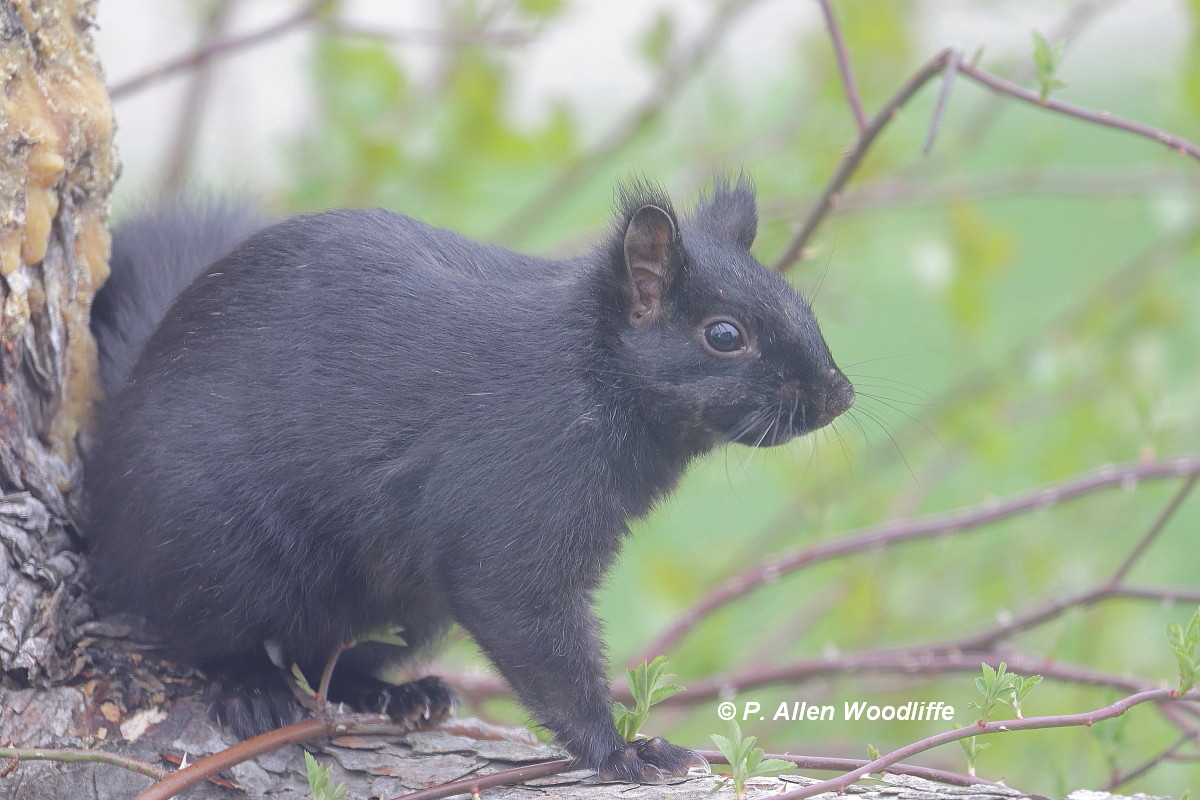
In other news, I got a new camera body to add to my equipment. It is the Canon EOS R6, a mirrorless full frame camera, which will also crop to 1.6X. With an adapter, I can use all of my existing lenses. It is a bit different than the two cameras I have had for several years, a Canon 5D3 and 7D2, and will require a bit of experimenting and adjustment to get comfortable with the new layout, features, etc. But so far it has been a relatively smooth adjustment. I haven't ventured into the more challenging photo situations that I do regularly with my other bodies, but have played around with it at home. Here are a few shots I've taken right from the kitchen window.


I'm looking forward to putting it through some more rigorous photography to see what it is really capable of. One of the things I am looking forward to trying out is low level photography. This camera has a tilt screen, so instead of lying on the ground, I can remain somewhat upright and tilt the screen to see the subject and get the right composition. As I become less and less able to kneel at a low level and get back up quickly and easily (a condition that many seniors eventually have to deal with :-), it will make low level photography less problematic, I hope.