Showing posts with label Willow Flycatcher. Show all posts

Saturday, 12 June 2021

Atlassing explorations

 Now that the peak of bird migration is well behind us, there is time to look for other things. That doesn't mean unusual birds won't appear. This White-faced Ibis showed up a few days ago at the Keith McLean Conservation Area. It isn't the first time one or more has put in an appearance here. There were two a year or so ago, but I couldn't make it. This individual represents the first one I have seen in Ontario.


They aren't the best shots, but the bird was a long way off and not approachable. These first two photos are at an equivalent of about 100X or more.

I had seen a small number out in southern Manitoba almost three years ago, and although they were much closer, the lighting was a challenge.


While I was at the KMCL, I got some photos of the nesting Osprey. This adult was keeping an eye on things while its mate was incubating.

There were quite a few Marsh Wrens chattering and scolding amongst the cattails.
 Atlassing is now the main birding priority, so I've been out to various places. The Acadian Flycatchers and Prothonotary Warblers at Rondeau have continued to be cooperative for viewing and even photographing. This Acadian Flycatcher individual is nesting in a Sugar Maple, one of the few times I have ever found a nest in anything other than an American Beech tree. Perhaps the ongoing effects of Beech Leaf Disease is the cause.


I can never get enough of a Prothonotary, especially a cooperative one! And along the way, one might come across this breeding adult Common Five-lined Skink, a species at risk....

....or a much more common Eastern Chipmunk....
...or on the much smaller scale of things, a Six-spotted Tiger Beetle, which may have more, or fewer, than six spots. I didn't name it!

I was out to the Dealtown Crown Land Prairie site a few days ago. It is off the beaten path, which makes it quite infrequently visited by anyone, but all the more rewarding when one finally gets to it. Unfortunately it is becoming extremely shrubby in places and is in desperate need of a prescribed burn, but I doubt it will happen any time soon. Grassland birds are less common than they used to be, but shrub land type birds are definitely on the increase.

 Yellow Warblers are abundant.

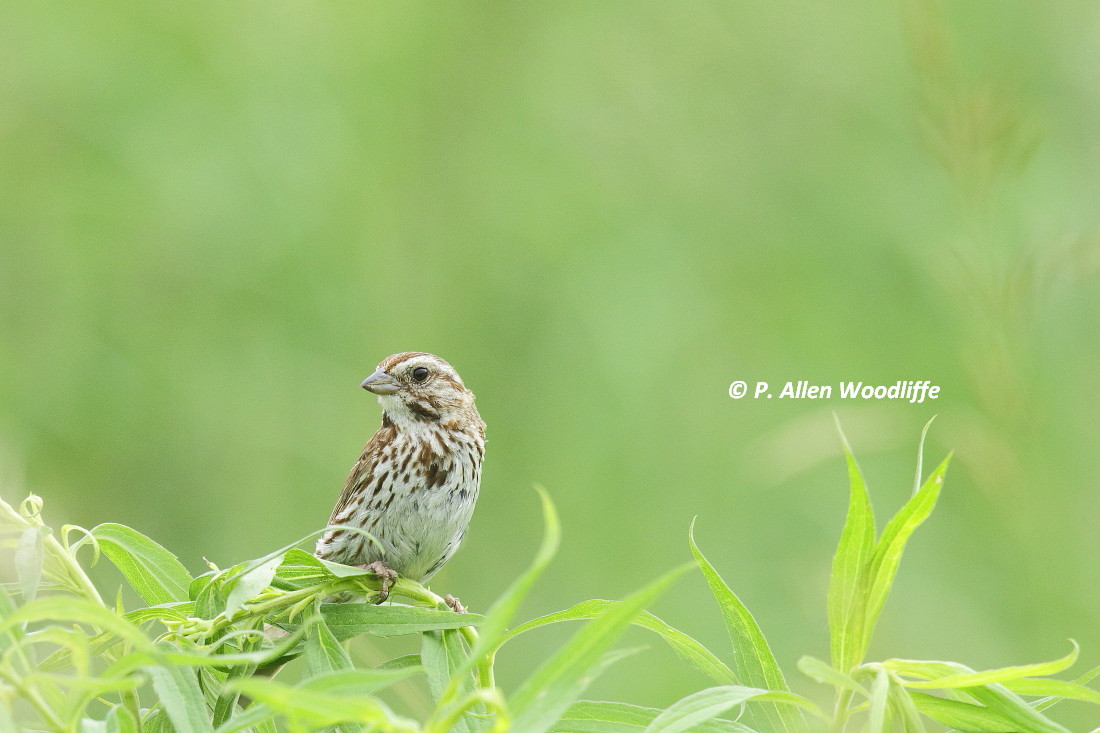
Willow Flycatchers are present in small numbers.
It is slightly early for Cedar Waxwings to be in full nesting mode, but it won't be long. They are likely to be staking out a territory, or at least feeding on the abundant fruit of Red Cedar.
There were several Brown Thrashers. They do a lot of 'chukking' to let you know they don't appreciate your presence, but seldom come into view. They typically skulk in the thicker tangles, but periodically pop up into partial view....
...and on occasion don't seem adverse to being in full view, but at a safe distance. A good telephoto lens is definitely handy.

Yesterday I spent some time in northwestern Chatham-Kent, including some time at a private property I have landowner permission to access.

This sub-adult Bald Eagle flew over, but it is too young to be breeding, so it didn't get counted as a breeding individual. Not to worry, however, as there is an active eagle nest already known for this square.

While I was scanning the patches of cattail vegetation out on the lake, this Black-crowned Night Heron flew almost right overhead.

I also saw three adult Yellow-headed Blackbirds, two males and a female, but they were skittish and I didn't try too hard to get a photo.

I also had permission to access the Mitchell's Bay Sewage Lagoons. During the last atlas, from 2001-2005, they were quite good, but this time around two of the ponds are completely vegetation free even around the edges, except for some grassy/weedy stuff, and the third pond is chock full of Phragmites. Even the area beyond the ponds had been recently mowed. Overall the birding there was poor at best. I did get a couple of Spotted Sandpipers among a handful of species, including the one in this next photo.

Today I went to the municipally owned McKerrall Woods, a few kilometres north east of Chatham. The section of property as one approaches the woodlot is a grassy hayfield, and on a previous visit a few weeks ago, had things like several Bobolink and Savannah Sparrows. I was hoping that maybe a Dickcissel might be there today. Had I been there a week ago, I may have encountered one, but alas, the hay had been cut and more than half of it was now baled. There were no grassland birds other than a couple of Savannah Sparrows that looked out of place given the severe change of habitat quality. 

There was a Turkey Vulture roosting on one of the bales.

The walk in the woods was pleasant, but not overly 'birdy'. Just a handful of the expected species in and around the wooded area. This vulture came by and sat in a tree; I wondered whether it was checking on a nest site, but I couldn't find any evidence of it, and after I moved a bit, it decided to leave the area.
Next up....more atlassing, or a post on spring orchids, or black lighting adventures!


Thursday, 23 June 2016

Bobolinks on the prairie and lifer lep

Earlier this month, I posted that National Prairie Day, at least in the USA, was on June 4. I did get to Ojibway Prairie in Windsor a couple of weeks ago, but today I got to a prairie that I had never been to before. It is a planted prairie, as a few years ago a former colleague of mine, Rob, had planted 20+ acres of the family farm in northeastern Chatham-Kent into a prairie mix. It is maturing nicely. Today it was mostly grasses that were visible, as the wildflowers are not yet that far along, but I'm told that in another month or so it will be quite impressive, and the butterflies love it. I plan to get there again.

Rob had invited me to see the site before, when we were still working out of the same office, but for some reason I just never got around to it. That was my loss. I'm glad I didn't put it off any longer!

One of the target species today was Bobolink. A small group of them has been using this prairie site for several years now. I saw at least 8 birds, including a group of 5 males and 1 female. I saw other males a little farther off, and presumably those males had mates on a nest, so it is quite possible that there are 12-20 birds using this patch of prairie.
None of them came very close, so these images are heavily cropped, and unfortunately the bland sky wasn't what I was hoping for.....guess I will have to go back again!


While I was watching and waiting for the Bobolinks to come around, I was entertained by a few other birds, including many Song Sparrows.

A Willow Flycatcher was seen occasionally in the brushy shrubs nearby.
A Field Sparrow was in residence as well and responded quickly to my pishing. I had the camera set on a high speed frame rate, and these next two were taken less than a second apart.


Common Yellowthroats were nearby, and one male came close enough to get its picture taken.

One of the less expected bird species was this next one....an Orchard Oriole. I had heard, then briefly seen, a second year male, and a possible female off in the distance. But then this mature male came by and started poking around in the grasses. Most of the shots had grasses messing up the auto focus, but this one turned out okay.


After a few hours on this prairie, I decided to call it a day, as the mid-day is not the greatest for bird action, even though it was not a hot day. The breeze was picking up as well, making it difficult to keep the birds in focus with grasses frequently interfering. But I do intend to go back, to capture more Bobolink images while they are still in their prime breeding finery.

While I was in the northern part of the municipality I decided to check on some butterflies. I read on one of Blake's recent posts that a Southern (Northern) Hairstreak had made an appearance at the Reid Conservation Area in southern Lambton, a population that Blake discovered several years ago. In order to minimize confusion on the name of this hairstreak, since there is a southern subspecies and a northern one, apparently some authorities are using the name Oak Hairstreak for this one. I tried looking for it a couple of times last year, without success, so I thought it was worth a try today.

The dogbane there was coming on nicely, and there were lots of butterflies....mostly Northern Crescents and Silver-spotted Skippers. In just a short time I noted a hairstreak and immediately zeroed in on it. It wasn't an Oak Hairstreak but a Banded Hairstreak. It was in great shape, and cooperated nicely for the camera.
But I couldn't find an Oak Hairstreak. I was beginning to think that it was more myth than reality. So I continued down the trail. At one point I noted something bounding towards me fairly directly. It was a Red Fox. I immediately froze, hoping that I wouldn't startle it. It acted like it wasn't used to two-legged critters in its territory, and actually came much closer than I would have expected, perhaps due to its innate curiosity. Since I just had my 100mm macro lens on the camera, these images are not all that large, even with cropping. But certainly a lot better than no camera at all.
After a few seconds, its cautionary nature took over and it retreated, not without stopping from time to time to check on me.

I eventually returned to the big patch of dogbane, and this time I saw a different hairstreak. And there it was, the not-so-mythical Oak Hairstreak!
I got this one photo before it decided to try another flower head. And I only saw it on one more occasion, but was not able to photograph it again that time. By now the clouds were getting heavier, and the wind was picking up more, so presumably this fellow decided to take refuge somewhere else. But not to worry....I will be back again!