Friday, 14 November 2014

It's beginning to look a lot like....

....wait a minute....we shouldn't be singing that jingle for at least another month (although Christmas songs are now being heard on the radio from time to time).

But yesterday morning, it was looking like this for Chathamites: a fresh blanket of snow with autumn leaves still falling.

And to think just two short days before, we were enjoying Indian summer like weather, with temperatures reaching as high as 17C!

Weather changes can affect wildlife, especially migrating birds. Given the as yet not severe late fall/early winter weather, some birds have not taken the next leg of their southern migration journey. I got a message from Jim Burk yesterday morning that he had seen a Semipalmated Plover fly over at Erieau, and also a quick glimpse of a Spotted Sandpiper which had been seen a few days ago and I reported on a previous post. Both of these species should be much farther south by now. So I headed to Erieau in the hopes of finding one or the other of these birds, or something else equally as interesting.

As expected, the closer I got to the lake, the less snow there was, and by the time I got to Erieau there were only tiny bits of snow remaining in some sheltered areas. It is the lake effect, which is the reverse in the spring when inland temperatures can be quite warm, but breezes off the water can make being at the lakeshore very cool.

The water is still completely open, since it hasn't been below freezing long enough to produce ice. And there were birds. The most notable bird species and numbers were: Horned Grebe (125), Ruddy Duck (35), Double-crested Cormorant (22+) and Bald Eagle (2). Actually one of the eagles was so far off it was difficult to call it a Bald for sure.....Goldens are migrating through right now, and it appeared very dark all over, so it might have been the latter species. Of course there were other species, including good numbers of Common Goldeneye, Bufflehead, scaup, Red-breasted Mergansers and the usual mix of gulls, some of which were quite close in the main slip. Most were quite a way off, and not worth attempting a photo of, but for those that swam by close enough, I tried to oblige with the camera.

Double-crested Cormorant


Horned Grebes

Red-breasted Merganser
But no shorebirds that I saw.

Leaving Erieau and returning inland, I noted lots of gulls feeding in the fields, along with huge flocks of starlings. Horned Larks are also around in increasing numbers.

I decided to stop in at the Blenheim Sewage Lagoons, as I hadn't been there for awhile, and one never knows what lingering shorebirds there might be. It turned out to be a worthwhile decision, even though the sun was getting lower. There were lots of ducks, and a good mix of species. Most notable were: Ruddy Duck (260+), Northern Pintail (4), Northern Shoveler (175+), Hooded Merganser (5), Green-winged Teal (6) and Horned Grebe (5) (although the latter species is not technically a duck). Other waterfowl included Mallard, Black, Bufflehead Canada Goose and Greater Scaup. There were lots of gulls as well, mostly Bonaparte's, in a feeding frenzy. I'm not sure what they were finding, as I never saw them with anything in their beaks, but they were sure trying hard!


Bonaparte's Gulls

Bonaparte's with Northern Shoveler and Greater Scaup

Northern Shoveler

Ruddy Duck
The sprinkler cells had quite a bit of water in them, at various levels, providing optimal conditions for a variety of species. The most northerly cells were quite full, and had lots of the Northern Shovelers. Fortunately the closer two cells had a bit of water more suited to shorebirds, and it was there that I found the shorebirds. I counted at least 82 Dunlin as well as a single Pectoral (with one leg) and also had a single Killdeer fly over.

Dunlin

Dunlin
 The sun was very bright but getting fairly low by this time, giving everything a golden glow, so the colour of these Dunlin look more golden than they might under different conditions.
Pectoral Sandpiper
The Pec had a bit of trouble hopping around and feeding, but in flight it had no apparent problem at all.

There were also quite a few American Pipits scattered around.

American Pipit
As the sun began to go behind the clouds near the horizon, it resulted in a brilliant sundog. Having only a lens combination with the equivalent of 640mm at hand, I couldn't back up far enough to get more of the sky.


Tuesday, 11 November 2014

Indian Summer ?

Some of the recognized criteria for being Indian Summer are an unseasonably warm spell, with little or no wind, immediately following a killing frost, and between November 11-20. Well it seems that the last couple of days have met two of the criteria, not having met the specified killing frost in the immediate area or the windless conditions either, but it might be as close as we get. The weather prognosis for the next couple of weeks is quite a bit below normal temperatures, with Monday the 17th having a hi temp of -1C! Normally the daily hi temps are supposed to be about +9C. However with the wonderfully warm temperatures of the last couple of days, with the daily hi between 14 and 16C, I guess we can't complain (although those who are limited to weekends to get out will surely have reason for some grumblings.....sorry Blake :-).

I was able to get to Rondeau twice in the last couple of days, and did lots of hiking. It was warm enough that there were even a few mosquitoes out! The South Point Trail, around the centre block of the park (Rondeau Road, Gardiner Ave, Harrison Trail, Bennett Ave) as well as the north end of Harrison Trail, around the campground, and also Black Oak Trail, were all covered. Probably at least 20 km altogether between the two days. There were very few other folks around at all.

Clearly the leaves are almost all off.


But not all, and that is what led me to one of the most exciting finds of the two days I was roaming the park.

It may not look like much.....just a few green leaves, with lots of brown spots scattered about, to indicate they are well past their best. But this is a tree species which I have never seen inside the park boundaries. It is Common Hackberry (Celtis occidentalis). Now Common Hackberry is quite common at places such as Pelee Island, Point Pelee National Park, and even along some stretches of the Thames River. But it is a Carolinian Life Zone species which just barely makes it into southern Ontario and is greatly restricted.

Even though it has been on the park's checklist of tree species for more than half a century, I have never seen it here. One time back in the late 1970s when R. D. (Dick) Ussher stopped by the Visitor Centre, I asked him about this species, since he was the one who put it on the checklist when he was the park naturalist from about 1954-1968. He said that even though it was quite rare in the park, he had seen it along Black Oak Trail, so he and his wife Molly and I went out searching for it. We couldn't find it, and so I thought that some major wind or ice storm or something had killed the last remaining individuals of this species. And as far as I know, no one else has seen it in the park. So I was quite surprised to see not one, but two individuals on my trek today. One was along Harrison Trail, not far north of Gardiner Ave. The other was just south of Bennett Ave. It is quite possible that there are others.


Admittedly this specimen doesn't look very impressive. It had been damaged quite a few years ago, and the main trunk had died back and even rotted away. This is the individual I found just south of Bennett Ave. There were two new shoots that took over the lead branching, which are shown more closely in the image below.
The characteristic bark is quite obvious in these two stems. And a smaller specimen, which was still in good shape (at least it was upright, with no obvious damage), and showing the characteristic bark, was along Harrison Trail north of Gardiner Ave.

So in spite of roaming Rondeau Provincial Park with my naturalist eyes for more than 45 years, there are still some surprises to be found! As a side note, I am aware of a couple of specimens immediately north of the park boundary.

The warm weather had caused a number of butterflies and dragonflies to be out and about. There were lots of Common Green Darners along the South Point Trail, more than a dozen, but they wouldn't land. I saw a smaller one, which I didn't get a good look at, but it had a grayish white body. I also saw an Autumn Meadowhawk at the south end, as well as along Bennett Ave.

Autumn Meadowhawk

Butterflies were not plentiful, but a few were around. Orange Sulphur (1), Eastern Comma (15+) and a single Red Admiral were all noted in various parts of the park.

Eastern Comma

Red Admiral
The extreme southern part of the South Point Trail is subjected to lots of wave action, resulting in the periodic erosion of the existing trail. Almost exactly a year ago, the bench at the southeast corner was lost to the forces of erosion.


The bench at the very south end is perilously close to a similar fate. Any guesses how much longer it will still be with us?


A lot of birds have left the park area. While I was on the South Point Trail hoping for some flycatcher rarity, I noted at least five, perhaps six, Eastern Bluebirds. I always check a flock, hoping for the park's first Mountain Bluebird to show. But it didn't happen on this trip.


There are still some warblers scattered about, including at least half a dozen Yellow-rumped Warblers hanging around the campground.


As the winter approaches and natural food sources decline, bird feeders are increasingly active. A stop at the Visitor Centre is worthwhile. At the moment, the most abundant bird at those feeders is Pine Siskin, which loves the niger seed.
Pine Siskin

At least 30 siskins were around the VC feeders, along with the usual Black-capped Chickadee (which are actually quite uncommon right now), Blue Jay, Northern Cardinal, American Goldfinch, White-breasted Nuthatch, Downy Woodpecker, Red-bellied Woodpecker, Red-winged Blackbird and House Sparrow. House Sparrows are of course not native to North America. They are not uncommon either, although there are some signs of decline. And apparently in their native European range, it is a declining species.


Friday, 7 November 2014

North Lambton and southern Chatham-Kent combination

I'm playing a bit of catch-up here. I've been up to a private site in north Lambton County a few times lately, doing some inventory and enjoying some terrific forest landscapes. The most recent time was a couple of days ago. Even late in the season, the woods are interesting, and the solitude is worth the effort. The rolling topography of Hemlock-American Beech-Sugar Maple forest, with lots of Tuliptree, is quite impressive. And once on the unofficial trail, there is often no other sound but that of a woodland.


Woodland birds are relatively few at this time of year. But sometimes you can see evidence of them, and be able to identify what was there. The following image is a case in point.

This is the typical workings of a Pileated Woodpecker, which has a massive bill for tearing into tree trunks to go after carpenter ants and such. The deep, oblong holes are very characteristic.

An unexpected highlight during this trip was to find evidence of a fairly rare orchid. It is S2 in Ontario. It may come as a surprise, given the time of year, but this orchid, unless it is flowering, is more obvious from late fall through the winter (if the snow is not covering the leaf litter) and into the early spring. It is known as Puttyroot (Aplectrum hyemale).


The leaves are quite distinctive, with their green colour complete with a hint of gray, especially on the underside. And the leaf veins go the length of the leaf, which is typical of Monocots (includes orchids and lilies). Most other plant families, known as Dicots, have different leaf venation.

There are very few individuals in a population that send up flowering stems....usually less than 10%. So when there is lots of greenery in June, the period when it flowers, and there aren't any flowering stems, it is almost impossible to see this plant. But the leaves at this time of year are quite perky and upright, making them more visible when most everything else has dried and fallen. This plant was historically known from Lambton, but the official database indicates the last record was before the 1920s, so it was quite an important discovery. I plan to look for other populations in Lambton and elsewhere at this time of year. There is lots of forest to look through!


Today, I spent a bit of time checking out the Erieau area. My previous post showed some of the unusual gull and tern observations that I had, and I wanted to see what else there was a few days later.

As it turned out, the gulls were relatively few. There were several hundred gulls feeding off the south beach area, mostly Bonapartes. There were a few in the main channel and next to the marina. Even though they are quite common, I always enjoy watching and photographing them and listening to their calls.

And there were dozens of Horned Grebes. I saw at least 65, but I heard a higher number from another birder (Steve) who was there a bit before me.


I was just ready to leave the marina area, when a Spotted Sandpiper flew into view and landed on the edge of the pier. It was rather skittish, and I had to photograph it through a chain link fence as it darted amongst some of the pipes and other things along the edge of the slip.

This is quite late for Spotted Sandpipers. They are normally gone by late September or early October. A few may linger well into October. This is the first November record for the Rondeau area that I am aware of. It is interesting that there was an individual counted on the local Christmas Bird Count on December 22, 1952, by far the latest record for the Rondeau checklist area. Perhaps it was injured, or there was a really mild spell?

Will this one linger for a December record, or better yet, another record for the CBC? Time will tell.

I also had three Sanderling on the big pier sticking out into the lake. I didn't get any photos of them, as when the gulls were flushed up, the Sanderling left also. We've had them on the CBC on at least 3 occasions.


Monday, 3 November 2014

Sunny and brisk on the Marsh Trail

The strong northerly winds of the last couple of days had died down. They were more out of the west, and a mere 10-15 km/h, so I decided it was time for a trek out the Marsh Trail of Rondeau. It was a non-hunting day, so the trail would not be busy with vehicles full of hunters, dogs, plastic or wooden ducks, etc going back and forth.


It is also prime time for eagle migration, especially Golden Eagles. I hoped that with the wide open skies, my chances of spotting one, and possibly even getting a photo, would be good. So off I went.

Given the beautiful day, there were very few people on the trail.....a total of 6 people and two dogs over the space of about three hours. Two people per hour was okay by me, so as to give me more of a chance to see the wildlife. Perhaps the very cool breezes off Rondeau Bay were not enticing to many folks, and the ones in the park this day stuck to more sheltered trails.

Song birds were quite few. I noted a few sparrows and juncos, including this first year White-crowned Sparrow.

A Sharp-shinned Hawk zipped by.


Golden Eagles were not to be seen, but both resident Bald Eagles were perched in one of their usual spots a few hundred metres from their nest tree.

There were lots of ducks, geese and swans on the bay or flying by, most of which were too far to bother photographing. Ruddy Ducks, Mallards, American Wigeon and Gadwall were the most abundant, with a few Green-winged Teal, Northern Shoveler, scaup and Redhead as well. I also saw my first Common Goldeneye of the fall. I'm sure they have been around for a little while....I'm sure I need to get out more :-).

A mink scampered across the trail 50 metres or so in front of me, but it was not spending any more time than necessary out in the open. I stood still and squeaked and pished, hoping to convince it that a mouse or a rabbit was injured and it would come to investigate, hoping for an easy meal and giving me an opportunity to photograph it. However this large member of the weasel family ignored my attempts, and thus I was left only with a memory of it registered in my brain cells, rather than in a series of pixels in the digital realm.

I came across an 'orange' tree! It wasn't going anywhere.

OK....we may live in the banana belt, but that doesn't mean we have southern fruit trees here. This is actually the ripening fruit of Climbing Bittersweet, a native vine that grows along forest edges. Before long, the outer orange husks will split open and reveal deep red berries, which birds enjoy.

On the return, this Northern Harrier floated by fairly quickly, and I only had time for a quick shot before it headed into even more challenging light.

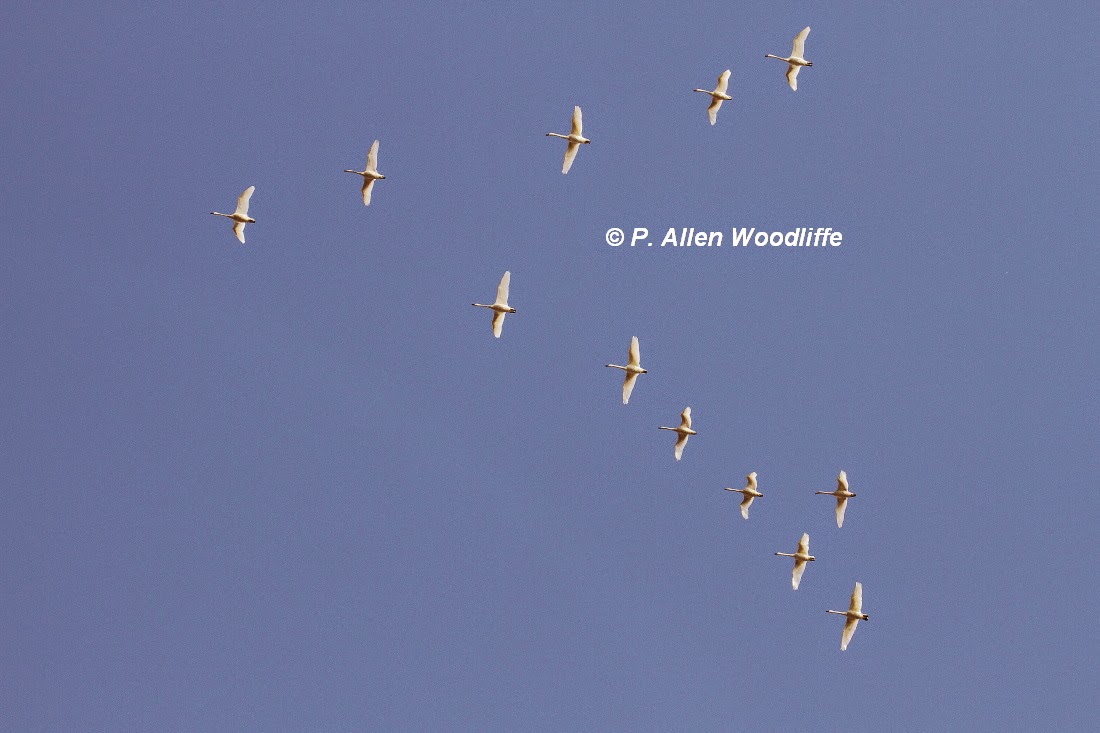
And several small flocks of Tundra Swans were winging high overhead.....and heading north! They have been building in numbers gradually over the last couple of weeks, with most of the population yet to arrive before heading southeast to spend the winter at Chesapeake Bay. Maybe they were really just heading inland to feed in recently harvested soybean or corn fields, and the wind turbulence was less problematic for them at a higher altitude.


I checked part of the campground before leaving, since there is a nice mix of shrubbery amidst the planted conifers and deciduous trees. The fruit of the Red Cedar isn't as plentiful as it was last year, but there were still birds around. Lots of robins, starlings and a few kinglets. I was hoping for Fox Sparrow but didn't find one. There were the usual Song Sparrows and juncos. I spotted at least six Yellow-rumped Warblers, a single Blue-headed Vireo and two Red-breasted Nuthatches. The vireo didn't cooperate for the camera.

American Robin

Yellow-rumped Warbler

Red-breasted Nuthatch
After leaving Rondeau, I drove through Sinclair's Bush, a provincial Area of Natural and Scientific Interest, and one of the few places in Chatham-Kent where there is a bit of forest on both sides of the road. There is still some autumn colour there.

Looking southwest
 Right behind where I took this forest scene from is a stand of Pawpaw. It is a southern large shrub/small tree species, and quite rare in Ontario and thus also rare in Canada. At one point, C-K had the greatest number of locations where Pawpaw was known from. I'm not sure that is still the case, given the recent loss of woodland. It likes rich deciduous woods, but I've seen it along roadsides adjacent to where deciduous woodland used to occur. Pawpaw is easily identified by its large, long leaves and, in the early spring, by its maroon coloured flowers that are out just as the leaves are beginning to emerge. The leaves persist longer than most other tree and shrub species in the fall.
Pawpaw
There has been a fair bit of timber harvest out of Sinclair's Bush in this last year, both large sawlogs and firewood. Firewood extraction is continuing at the moment. Of course there was a lot of ash growing in this woodlot, most of which was killed by the non-native Emerald Ash Borer, so the harvest of dead timber is a preferred option for most landowners. I anticipate that more timber will be extracted sometime in the near future, as trees in other sections of the woodlot have typical markings on them indicating they have been selected for a future harvest.


Saturday, 1 November 2014

Tilbury & Erieau on a very windy day

What a difference a couple of days makes. The gales of November have come early.

I ventured out, noting this Common Green Darner resting on the driveway. It was so cold, clinging on to the concrete that I was able to get right down in its face with the macro lens.

To get a little more natural look, I picked it up and placed it on the sunny, and leeward side of a tree, as below. It was still clinging on the tree a couple of hours later.


Just before I was going to head out, I read about 4 Cattle Egrets at the Tilbury Sewage Lagoon. So I went that way before heading to Erieau. The birds were there, and were reluctant to leave the more sheltered part of the lagoon, and I can't blame them. Lagoons always seem to be out in the open and susceptible to any wind, and today was no exception.


They did move around a bit.


Erieau was next. On the way I noted a dark phase Rough-legged Hawk hovering over the road allowance, but I didn't pull over to attempt a photo.

Lake Erie and Rondeau Bay were quite riled up, not surprisingly, so there was a fair bit of stuff sticking closer to the more sheltered areas. To give an indication how windy it was on the lake, here is a photo of a large lake freighter anchored fairly close to the shore. This one is the Manistee. One hardly ever sees lake freighters at all out in the lake off of Rondeau, let alone this close, but on occasion I have seen them on the east side of the Rondeau peninsula taking shelter from extremely strong west winds. The western basin of the lake, between Pelee Island and the mouth of the Detroit River, gets even rougher, so presumably this freighter decided to take shelter from the very strong north winds here before venturing through the Pelee Passage and up the river. There are several hundred ship wrecks in the vicinity of Pelee Island and the Pelee Passage, although most of them occurred more than a century and a half ago. I wonder if the crew of this freighter had Gordon Lightfoot's haunting Wreck of the Edmund Fitzgerald playing in the back of their minds?


There were lots of gulls off towards the western tip of Rondeau's south beach. Most were Bonaparte's, with a few Herring and Ring-billed gulls mixed in. I noted an adult Little Gull as well. Can you see it in the next photo?

It is in about the centre, just over the beach and against the sand. It has its wings only showing the gray upper side, so the dark underwing is not visible.

However I moved over to the main marina slip, and noted more adult Little Gulls. I think there were at least three adults in the area. The first image shows the all gray upper wing, with the white trailing edge.


This next image shows one banking giving views to both the upper and lower wings.
 This next image shows an adult Little Gull on the right and it is easy to compare it with an adult Bonaparte Gull on the left.

I caught this one just as it was lifting off of the water, and it appears like it is shy and hiding!

There were other birds in the large slip.

Common Loon

Double-crested Cormorant

Double-crested Cormorant lifting off

Horned Grebe
Altogether, there must have been at least 50 Horned Grebes in the vicinity of the Erieau Harbour. But I only saw the one Common Loon.

This group of cormorants were resting on the rocks at the opening to the fishing tug slip.


An unexpected sighting was that of Common Tern. The next two images appear to be different birds. I think there were at least two birds present. It is getting rather late for this species, although I noted that they were reported elsewhere along Lake Erie today. There are other records for the Rondeau checklist area in November, and even one very late bird in December.


I went looking for Snowy Owls while I was in the area, since Blake had seen one a few days ago. I didn't see any, although with the windy conditions, it might have been hunkered down in some protective vegetation. Or it could have been on the south beach of Rondeau, or on a duck blind in the marsh, or some other place. It has clearly come a long way from its normal breeding ground, so it could be anywhere by now.

At the south end of Lagoon Road, I noted a large number of American Coot.
A few of the many American Coot
A conservative estimate of them here, and off of the Shrewsbury area, would easily be 2000+ birds, so they are building up as usual. Probably 100 or more Ruddy Ducks were among the coots at Shrewsbury. Hopefully the coots will be a lot farther south when the icy conditions eventually arrive, but past history indicates quite a few may stick around any little bit of open water in the Erieau area. Some years when this happens, I have even seen them come up to feed at bird feeders at Erieau!