Tuesday, 9 August 2016

Wetland Wanderings

Wetlands are fun places to explore, especially if you can keep dry. Fortunately there are various opportunities in the area with trails traversing these habitats and include Rondeau Provincial Park, St. Clair National Wildlife Area and the two trails up along the Lake St. Clair shoreline both north and south of Mitchell's Bay.

I decided to check out some wetlands in the Mitchell's Bay area recently. Some friends (Bill & Judy) who have waterfront property on the lake near one of the trails, has a very nice wetland right in front, where waterbirds are seen daily. I had been particularly interested in photographing one of the pair of Common Gallinules that occur in the wetland, and Bill has been able to get numerous fabulous full frame shots. Unfortunately the two times I was there recently, they decided to stay well hidden. I did get some decent photos of the resident Pied-billed Grebes. This first one is of an adult.
 There were several full grown young around as well.

I spent a bit more time at the Mitchell's Bay North Nature Trail. It is always fun to check, since it goes through various wetland areas. Some of the drier sections have been planted into tallgrass prairie. One of the plants quite noticeable now is Cup Plant (Silphium perfoliatum).

 You can see by the way the leaves are joined where it gets its name.

There used to be a lot of wet prairie along the shoreline of Lake St. Clair. Some small pockets remain.
Maybe at some point, parts of the wetland at Mitchell's Bay will look like the photo above. If so, maybe the endangered Eastern Prairie Fringed Orchid (Platanthera leucophaea), as shown in the next three photos, will appear.

Note the very long spur tube extending behind the more obvious flower. It is pollinated by night flying sphinx moths, which extend their long proboscis down the tube.

But on this trip, it was mainly the more typical wetland plants that were the prevalent ones.
Fragrant Water Lily (Nymphea odorata)


Pickerelweed (Pontederia cordata)

Arrowhead (Sagittaria sp)


Swamp Rose Mallow (Hibiscus moscheutos)
There were the usual bird species around.....Caspian, Common and Forster's Terns, Great Egret, Great Blue Heron, Green Heron, etc, etc, but very few that were close enough to bother photographing (not to mention that a few that I did try and shoot were heavily backlit and did not turn out). But a family of Eastern Kingbirds were around.

The always present Mute Swans were here and there......
....and a couple of Northern Harriers flew by along the edge.


Thursday, 4 August 2016

Night-time wildlife in the back yard

Late last week I came across an interesting bit of information: it was National Moth Week. It went from July  22-31. The information came from an insect blogger from the USA, so I presume it was recognized in that country only. Nevertheless, I decided to participate on my own.

Years ago, when I was working at Rondeau Provincial Park, I tried sugaring for moths. This entailed mixing up a solution of stale beer, sugar and overly ripe fruit (a banana worked really well) and spreading it on the trunk of a tree. As the darkness set in, moths would be attracted. The highlights for those times were the underwing moths (Catocala species), a large group of medium-sized moths that looked quite drab until they opened their wings to reveal a bright pink or white upper surface of the hind wings. I was moderately successful in attracting some of the Catocalas, but more successful in attracting some of the numerous raccoons! In the classic work "The Moth Book: A guide to the Moths of North America" by W. J. Holland, the author gives a fascinating, descriptive account of sugaring for moths. It was one of the main ways old time collectors found moths to add to their collections or to learn about the moth fauna of a particular area.

For this exercise, however, I dug out my black-light tube, set it up in the back yard to reflect on a suspended white sheet, and see what arrived. The black light was on for slightly more than three hours, beginning at about 9:30 p.m. Some of the insects were photographed on the white sheet, some were on the aluminum ladder on which the black-light was suspended and some were photographed on the blacklight itself (the ones with the blue mesh).

Warm, cloudless nights with little or no wind are ideal, and it was like that the night I chose. Given the relative dryness of the year to date, I wasn't sure what to expect, especially since butterflies were noticeably in lower numbers this year.

(Note: Identification for some species that follow is somewhat tentative, but based on the best references I had to use. References mainly included:
-Insects: their natural history and diversity (Stephen A. Marshall)
-Peterson Field Guide to Moths (Beadle and Leckie)
-Beetles of Eastern North America ( A. V. Evans)
-Field Guide to Grasshoppers, Katydids and Crickets of the United States (Capinera, Scott and Walker)

It wasn't long before the first insects appeared. A medium sized beetle showed up almost immediately and stayed the entire time.

Pole Borer


Other beetles (Coleoptera) were reasonably abundant. Many were so small I didn't even bother trying to photograph them, but others were large enough and cooperative enough to give me a fighting chance.
Multicolored Asian Lady Beetle

Striped Cucumber Beetle

Some bugs (Hemiptera...told by the way the wings folded) were there as well. I haven't figured out this first one yet.
Aster Leafhopper

Leafhopper sp.


Quite unexpected was this damselfly, a male Fragile Forktail. Our yard is a long way from any water, but apparently this species does wander a lot.


Perhaps the strangest creature of the evening was this Mantid Fly (Dicromantsipa sayi).

At least three types of Orthoptera came by, but I only got photos of two.
Northern Ground Cricket

Slender Meadow Katydid
But the intended targets for this venture, being National Moth Week, were the moths. There were quite a few, but many were very tiny and difficult to photograph. Some of the larger ones, those over one cm long, included the following:
Double-banded Grass Veneer

Elegant Grass Veneer

Three-parted Epiblema

Unidentified as yet

Gypsy Moth (male)
 Gypsy Moths can create havoc in forests, especially oak forests. They were extremely damaging back in the 1980s, defoliating large areas of forest. The female looks quite different, being almost pure white with a few black specks, and seldom comes to lights.
Common Tan Wave
The Ailanthus Moth is not a problem species to my knowledge. It is particular to the Tree-of-heaven (Ailanthus altissima), an aggressive and invasive non-native tree species that does really well in places such as abandoned parking lots.
Ailanthus Moth
I will be setting out the black light again one of these evenings.


Sunday, 31 July 2016

A walk in the woods can turn up many things!

A healthy woodland is always interesting to explore. There are breeding birds, of course, but not always as obvious with the heavy foliage. Here, a Great Horned Owl is peering out at me.


There is so much more diversity in the other types of wildlife and vegetation, however. And often the human crowds are not much of a problem, at least on some of the more remote trails.
Some things are brightly coloured and easily noticed, such as this Chicken-of-the-woods fungus. They can be seen at anytime, from June through September.

Other orange things include this Wood Lily (Lilium phildelphicum), found along some of the more open sections of woodland.....

...as well as this Michigan Lily (Lilium michiganense).

A bit earlier in the season, one can see this orangey scene at various places of a woodland.
These oblong cavities are characteristic of where a Pileated Woodpecker has drilled into the trunk of a Hop-hornbeam (Ostrya virginiana) digging out insects. The indirect result is the ensuing run of sap. Sap contains good concentrations of sugars especially in the spring, and these sugars are attractive to yeasts for feeding on. The type of yeast here is Cryptococcus macerans. It can appear on many different types of tree and even on wild grape vines and is often seen where there has been a wound that lets the sap out.

There isn't a lot of sunlight getting to the forest floor these days, and wildflowers are not abundant.
You are more apt to see the spring wildflowers in this condition, with their seeds ripening, such as this Large-flowered Bellwort (Uvularia grandifolia).


Where a tree has died, or fallen over, it lets a bit more sunlight to the forest floor, and it is there where there is a greater profusion of vegetative growth. This American Beech tree (Fagus grandifolia) has fallen over, and the growth on the forest floor is beginning to become more prevalent than in the  adjacent shaded area.
 
There are a few flowering plants, however, even in the somewhat subdued light. Purple-flowering Raspberry (Rubus odoratus) is scattered about. Its fruit is not considered edible like many other  raspberries are.

Fringed Loosestrife (Lysimachia ciliata) may be found in some of the damper sections.
 A close-up of the leaf stem shows the fringe, which gives this plant its name.

Another plant found in rich woodlands these days, and mostly restricted to the Carolinian Life Zone, is Richweed (Collinsonia canadensis).
It wasn't until I got these images on the computer that I noticed the colourful little critter on the stem...a Red-banded Leafhopper!
I usually see these leafhoppers on milkweed plants in more open areas, so I was a bit surprised to see this one here.

A close-up from a previous year

Thimbleweed (Anemone virginiana) is not all that colourful, but is distinctive.

This vine, named Wild Yamroot (Dioscorea villosa), is not common, and the flowers are not particularly impressive. Its seeds are more obvious than the flowers, and in the fall, the heart-shaped leaves turn an attractive golden brown.

Maidenhair Fern (Adiantum pedatum) is quite abundant in these southern hardwood forests. It is one of the more delicate fern species, and will disappear with the first frosts.

Bottlebrush Grass (Elymus hystrix) is an obvious grass species well represented along the trails.

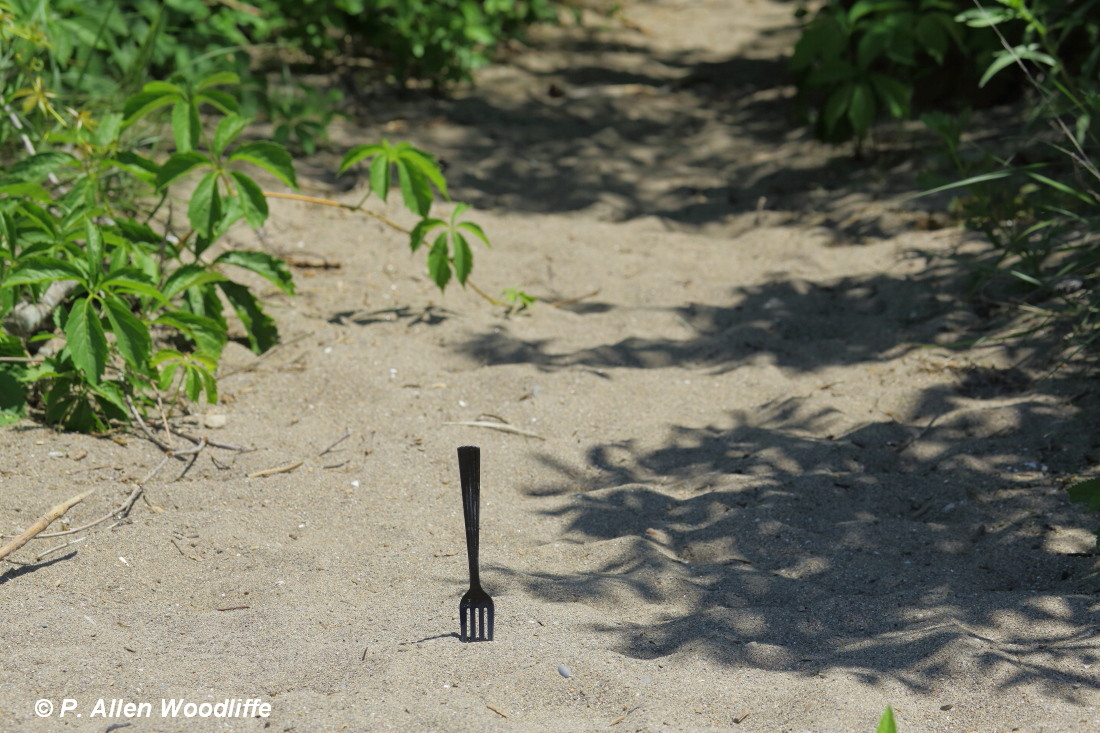
Occasionally one might come across a fork (Forcus plasticus) in the trail :-).

If you look closely to where you are stepping, the distinctly marked caterpillar of a Mourning Cloak butterfly may be crossing the trail.

This next image shows a Brown Stink Bug (Menacles insertus). I didn't handle it to see if it lived up to its name.

Even in the forest, dragonflies occur. Here is presumably a female White-faced Meadowhawk, well away from its normal wetland haunts. The various species of meadowhawk are notoriously difficult to tell apart in the field, especially the females.

Even during these dog days of summer, there is lots to see!