Monday, 5 September 2016

Photographing from a 'wildlife blind'

Photographing wildlife is fun, but can be quite challenging. It helps to use a blind, of course, but you have to know where the wildlife is likely to be, understand the 'target species' behaviour and then set up a blind and let them acclimatize to it so they can carry on their normal activities. It can take a lot of time, with limited success.

Another option, which I have had the pleasure to have available, is to visit the summer trailer of some friends of mine, Bill and Judy, on the waterfront of Mitchell's Bay. They have a lovely covered deck, just a few metres from the water's edge. These first two images were taken with a wide angle lens, from the deck. The water's edge is literally about 3 metres from the deck, which is raised just high enough to look over the marshy vegetation and see into some of the open areas.
The view looks north, so the sun is mostly behind us, making photography better for longer periods of the day. That is Walpole Island First Nation in the background. This next photo is looking the same direction, but shifted slightly to the right. Note the large log in the centre right, and the smaller log beyond it. These logs arrived during higher water levels, and definitely attract wildlife.

Because these trailers are here all the time, and the human activity is minimal, the wildlife have gotten used to the setting. So this is effectively a permanent wildlife blind, and because the semi-open wetland is attractive to wildlife, it provides numerous photo ops. A huge bonus of this location is that there is no Phragmites! It used to be present but several years ago there was an effort to get rid of it, and fortunately it was quite successful.

In the first photo above, there is a Great Egret in the stand of Pickerelweed at the centre left. Being taken with a 17mm wide angle lens, it doesn't appear very large. But a decent telephoto makes all the difference.

Great Egrets fly by regularly....it helps that there is a good egret nesting colony on Walpole, and they venture a bit looking for food.
 The log is a popular place for egrets.....
....as well as Great Blue Herons, Spotted Sandpipers.....
Spotted Sandpiper
 ....and Mallards, among others.
Mallards are wild here...not the semi-domesticated types. Nonetheless, some are quite willing to come in close to feed in the aquatic vegetation right at the edge of the water.

The farther log is smaller, but also is used.
Green Herons fly by with regularity, and occasionally drop in.

Great Blue Herons are frequently seen, flying by or hunting in the emergent marshy vegetation.


Caspian Terns are frequent as well, especially late in the summer.

Osprey show up on occasion.

The semi-open marsh is perfect for nesting birds. At least one family of Pied-billed Grebes is in the area.
Adult Pied-billed Grebe
Full-grown youngster

One of the highlights in the last few weeks has been the ongoing activities of a family of Common Gallinules. This is at least the second year in a row where they have nested close by. This year they were in the patch of cattail in the lower right of the first image above. The nest is no more than 15-18 metres from the deck we photograph from. Unfortunately it is not visible from the deck, but one often heard the coos and clucks of the adults, and the adults would occasionally be out in the open.
This was likely a second nesting of the season, since the young probably hatched somewhere between August 7-11. (Normally the first nesting begins in early June.) The first few days after hatching the young stay in the nest, but after about a week, they venture out with the parents. This next image was taken on Aug 18, where the young had been out briefly with the adults, but this adult was poking around at the edge of the cattails when all of a sudden it let out a startled cackle. Note the slightly churned up water at the extreme centre left of the image. Something swirled around....possibly a Snapping Turtle....causing a lot of cackling and wing-flapping as the gallinule escaped the danger.
The adults and young did come out again, venturing through the sludge mat. There were four chicks....fluffy balls of dark, fluffy down and their trade mark partially bald red head.
Here, one of the adults feeds a tiny tidbit of something to one of its chicks.

But there are risks to such vulnerable members of wildlife. A day or so later there were only three chicks. We don't know what got one of the chicks.....it could have been a turtle, or it could have been a Northern Water Snake, one or more of which was known to hang out in the general area.
This snake is a large one, and it appears to be a female based on its size and relative girth. Water snakes give birth to live young, and for several weeks prior, spend as much time as possible basking. This lets the sun's warmth increase the snake's physiology to ensure the young develop in time to be born so they can adjust to life on their own before the time comes for hibernation. It is interesting to note that shortly before we realized one gallinule chick was missing, we heard some agitated clucks from the vicinity of the nest.

At any rate, the gallinule family was down to three chicks, but they carried on in the area as before, travelling along the edges of the marsh, and sometimes crossing open areas to access the large stand of Pickerelweed.
On occasion they would be in the cattail area almost right below our 'blind'. This next one is less than two metres from the edge. A chick is just out of the photo.
At last visit, the number of gallinule chicks was down to two. As mentioned earlier, this wetland area and in fact much of the Lake St. Clair shoreline is a favourite travel corridor for all sorts of avian wildlife. This includes Northern Harriers, which are seen regularly.


On one occasion, Bill reported seeing a harrier drop down into the stand of Pickerelweed where the gallinule family had been, only to see it emerge with a dark ball of fluff clutched in its talons.

While one feels a sense of loss after watching these gallinule chicks grow in their new world only to disappear one by one, at the same time many folks anxiously look forward to the raptor migration, which is now underway. We would be chagrined if the numbers and diversity of raptors dwindled, but in order for that not to happen, raptors need to feed on a lot of young wildlife! Such is the balance of nature....

This shoreline of Mitchell's Bay is great for sunsets, too. The North Shore Nature trail is just a short distance from the 'wildlife blind', and a great spot to view wildlife and sunsets as well.
Sun dog


Tuesday, 30 August 2016

One of the rarest plants in Canada

Walpole Island First Nation is a fabulous place, full of rare, threatened and endangered species of flora and fauna. Of course to host all of these rarities, there is an abundance of significant habitats as well. Walpole is renowned for its tallgrass prairie, and I have had the privilege of spending a lot of time exploring the wonderful natural areas there over the years, dating back to about the mid 1970s.

One plant I am always excited to see is one of Canada's rarest: the White Prairie Gentian (Gentiana alba). It is a striking yellowish/white flower with fine green markings along the fluted edges. It will partially open, so as to allow pollinators access. This species, at least on Walpole, is in some of the best quality tallgrass prairie/oak savanna habitats.
White Prairie Gentian
It occurs in three known places on Walpole, all of them which are somewhat out-of-the-way. It is interesting to note that even historically it was only known from two other locations in Canada: Northumberland County and Essex County. Those two sites are considered historic, not having been seen for several decades, in spite of searches at known historical locations.

A recent survey of the populations at Walpole totalled 50 plants, with about 40 of them having flowers. That is it...... the entire known Canadian population is just 50 plants, and some years there are even fewer recorded. It is legislated as an Endangered species both provincially and federally, not surprisingly. The localized spots where it occurs are reasonably well protected, although the original population, first found in 1984, is quite shaded and the single surviving plant has not been seen in flower for several years.

At one point during the survey, I only had my point-and-shoot camera, and I got a few shots including this next one. It was the freshest looking of all of the ones we encountered. Most others had at least a bit of brown showing on the petals.

What makes this species toehold in Canada even more precarious is the fact that it sometimes hybridizes with the much more common Bottle or Closed Gentian (Gentiana andrewsii). As its name indicates, it remains closed, and the only way for pollinators to pollinate it is to be a rather robust insect, such as a medium to large bee, having the capability to force its way through the side of the petal.
Bottle Gentian
Clearly the two species are quite different looking, at least in colour, and those hybrids make for some unusual colour combinations.
Gentiana alba X andrewsii

 Some hybrids are mostly closed, with others being at least partly open.
White Prairie Gentian typically flowers in late August, whereas Bottle Gentian typically flowers after mid-September. Of course there are sometimes early or late ones of either species, and if the flowering period overlaps where they both occur, hybrids are more likely.


Friday, 26 August 2016

Endangered orchid, Boogie Woogie Aphid, shorebirds and more

Late August is normally prime time for one of Canada's rarest orchids. The endangered Nodding Pogonia (Triphora trianthophora) only occurs in Canada at Rondeau Provincial Park. The numbers have fluctuated considerably, so annual monitoring is beneficial to understand how the population is doing. I have had a study plot in place since 1985, and have monitored the population there almost every year since.


Nodding Pogonia

It is a small, but very attractive little orchid. I posted a fairly extensive blog about it previously, so will not repeat myself here. If you want to know a bit more about this endangered species, check out this blog post. 

A couple of days ago I met with park staff to visit the study area to see what this year might have in store. I was concerned about the excessive dryness in June and July, as moisture to keep the delicate tuber type root healthy just below the diminishing leaf litter is critical for the species survival.

We parked along the road and headed into the forest, crossing ridges and sloughs to get to the study area. Once there, we checked out the places where this species had been known to flower in previous years. After awhile, it was very evident that it was not a good year for Nodding Pogonia. We saw a grand total of three plants, one of which had grown well but been affected by a blight of some kind. The other two plants had flowered briefly a few days earlier, and had one or two developing buds that, if conditions are favourable, may yet flower.

On the next ridge over, also occasionally good for this orchid, we saw another three plants, none of which had flowered yet but had developing buds. Some years have had over 1000 plants in this general study area. It looks like this year will be less than a dozen. The species is known to fluctuate from year to year, but with the diminishing leaf litter and very dry conditions, perhaps the delicate tubers will not survive dormancy to try another year....time will tell.


While searching for the orchid, my survey colleague called me over as she had noted something quite unusual....it was a branch of an American Beech tree covered with fuzzy white things.
When the branch was bumped, the little fuzzy white things would raise up their hind ends and wave a filament up in the air to make it look like it was dancing!

This is the Beech Blight Aphid, a.k.a. the Boogie Woogie Aphid due to its hilarious behaviour of a branch full of fuzzy white things waving back and forth in unison!

A closer look:


These aphids suck out a lot of sap from a beech tree. After sucking the sap, they excrete copious amounts of a honey dew type of liquid. Since the aphids are concentrated on branches and sometimes even leaves, the honey dew may drip down on a lower branch in considerable concentration. This resulting concentration of honey dew supports the mould Scorious spongiosa, which is especially evident after the leaves have fallen, and may last well into the next summer.
This process seldom does any real or long-term harm to the tree, although sometimes individual branches may die.

Another interesting observation on our orchid search was discovering a small caterpillar that initially looks like a bird dropping. Such mimicry is part of its defense. It also has large eyespots, presumably to appear more fearsome to a would-be predator.
This is the very young larva of a Spicebush Swallowtail butterfly. After it goes through a few growth spurts, it will be a bright green with large eyespots, before going into the pupal stage and eventually emerging as an adult butterfly. I wonder how many times I have passed by such imitation bird droppings without giving them a second glance?

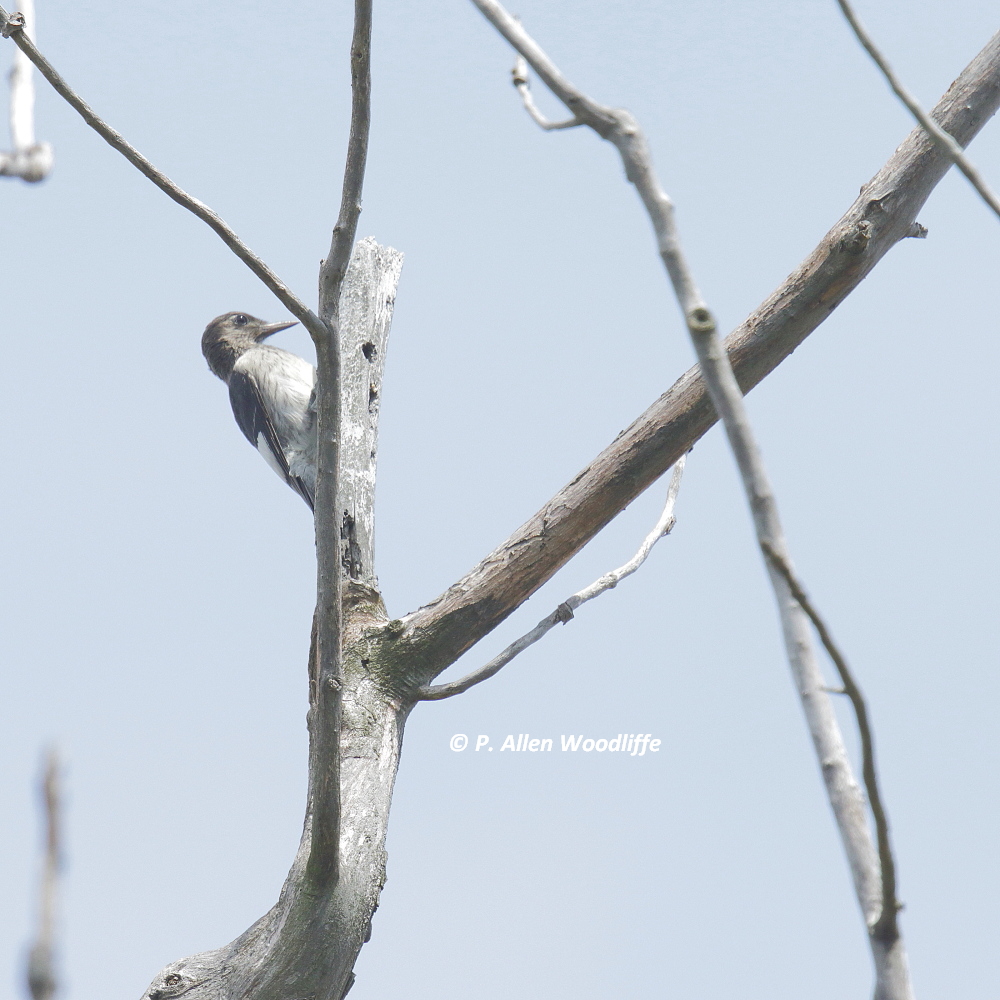
I had heard from the McArthur's that Red-headed Woodpeckers were hanging out in the vicinity of their cottage. We had hoped earlier in the season that a pair of adults would nest in a partially dead cottonwood tree, but that didn't happen. They must have found a location more to their liking. Regardless, both adults and young were now showing up. Although they remained quite high in a dead cottonwood while I was there, I managed to get a few shots, which I had to crop considerably.
Adult Red-headed Woodpecker

Young of the year Red-headed Woodpecker

After leaving the park, I decided to check out the Blenheim Sewage Lagoons. I must admit that I was hoping for a Common Ringed Plover, so I wouldn't be tempted to travel to Toronto to see one (Note: I haven't gone to Toronto, and likely won't). Not surprisingly, I didn't see one here. In fact I didn't even see its look alike relative, the Semipalmated Plover, on this visit. But it was still worthwhile, with half a dozen or so species of shorebirds. Sometimes they are very skittish and getting photos is difficult. I find that if there are a lot of Killdeer, the other shorebirds are more skittish, responding to the startling cries of the Killdeer. When Killdeer are fewer, the other shorebirds are more tolerant of birders.

There were the usual species.

Least Sandpiper

Semipalmated Sandpiper
Lesser Yellowlegs
And there were some less common species including this next one which is my first of the year,
Baird's Sandpiper
Stilt Sandpipers are relatively uncommon in the spring, but more common in the fall as juveniles show up.
Stilt Sandpiper
Although it was windy, I walked along one of the more sheltered paths to see what butterflies were there. I got some very nice shots of the rare Common Checkered Skipper on an earlier visit, and I saw at least 11 individuals on this one. However I only had my camera gear that was the equivalent of a 22X binocular, which could only focus at about 3 metres, so I was pleased to get even one shot that turned out half decent. It blends in quite well on the top of this Wild Carrot.