Tuesday, 6 November 2018

Kontinuing Kiskadee, etc

The Great Kiskadee, which first showed up at Rondeau in early September, continues to be seen daily, at least if there are a few folks out looking for it. The first few days of its known presence resulted in many hundreds of people visiting the park to see this first for Canada occurrence. After about a week, it seemed to have disappeared, but after several more weeks went by, it was seen again in much the same place.
Typical spots for it during the last few weeks include the old canal between the cottages along Water Street and Rondeau Bay.
It has also been seen along Water Street, sometimes at the very south end bend by the last cottage, where sloughs are adjacent to the road. With all the rain of recent weeks, the sloughs have quite a bit of water in them, so there is a lot of habitat for the Kiskadee to search for tadpoles as it was seen doing in September along the Marsh Trail.
When the Kiskadee is in the shrubby and vine covered habitat, it invariably is perched so that a branch or three are partially obscuring it. At these times it becomes almost impossible to get a decent photo.
 As the season progresses, there will be fewer and fewer tadpoles and frogs to feed on, so it may not be as needful of these small bodies of water. Recently the bird has been seen feeding on berries, of which there are many kinds in the profusion of shrubs and vines that Rondeau has to offer. Dogwood, spicebush, Virginia Creeper and poison ivy are all abundant, although the myriad warblers and thrushes that have already passed through have picked off many of the berries. Nonetheless, there are still oodles of berries which may provide sustenance for the Kiskadee for awhile yet.

Just yesterday, Steve Charbonneau who has been at Rondeau almost daily for weeks and weeks, reported seeing the Kiskadee over on Harrison Trail south of the pony barn, feeding on berries! He speculated that the bird may have spent a fair bit of time wandering elsewhere in the park during its several week hiatus from the Marsh Trail from mid September to early October, including by the log pond along Harrison. That area does not get much coverage by birders at this time of year, so could have easily been missed. There are hundreds of hectares of what appears to be suitable habitat of this type available to the bird, so maybe it will survive until the Christmas Bird Count on December 16. If it does, the challenge for birders will be to be able to track it down on that day, so stay tuned.

There are lots of other birds still around, or recently arrived. American Goldfinches seem to be abundant.
A few more northern winter finches have appeared in small, and widely scattered numbers. These include Evening Grosbeak, Common Redpolls and Pine Siskins. I haven't seen any in the last time or two I've been at the park, but others have reported them. Of course most of the birders reporting them have much better hearing than I have, so that can make a difference.

American Tree Sparrows, many of which will remain for the winter, are showing up in increasing numbers.
There are non-bird things to see along the way, such as squirrels busily scrambling around for more seeds and nuts to put away for the winter.
In other news, the shorebirds at the Blenheim Sewage Lagoons are fast disappearing. Only a week or so ago there were hundreds of shorebirds of at least 10 species. The Hudsonian Godwits were a major attraction with as many as 5 present for a few days. It was hard to get more than three in the camera frame at any one time.
HUGO trio
HUGOs with yellowlegs for comparison
 It was getting late for Semipalmated Sandpipers, but at least two or three remained until a few days ago.
The last visit by anyone, as reported on eBird, resulted in only 4 species of shorebird, totalling a mere 16 individuals.

Snowy Owls are reappearing. Of course an occasional one from last winter was still found somewhere in Chatham-Kent at least until the end of July, an unheard of event. But for the last couple of months or more, they have been nowhere to be found. That is until the last few days, when Snowies have appeared in the Pain Court area, where this photo was taken.....
....as well as northern Chatham-Kent and just north of Erieau. Perhaps another invasion of Snowies is in the works.

While driving around, there have been other things along the way, including this immature Bald Eagle feasting on a dead critter well out in a field.
 And now that more and more fields are being harvested, leaving at least a bit of grain scattered on the ground, sometimes there are huge flocks of blackbirds on the move and swirling around. This one flock I encountered while out looking for the above pictured Snowy Owl I estimated to be at least 35,000 birds. The majority were Red-winged Blackbirds and Brown-headed Cowbirds, but I also saw Common Grackles and European Starlings mixed in. I was hoping to get at least a glimpse of a Yellow-headed Blackbird, and there may well have been one or two, but I did not pick any out this time.
A small portion of ~35000 birds


Thursday, 1 November 2018

The Snowy North...a hint of things to come

We recently went on a little trip up to North Bay, something we do once or twice a year to visit 'the kids'. The photo in the header is of Brooks Falls, showing the Magnetawan River in some of its autumn splendor, just a few kilometres east of Hwy 11. This is a photo of a couple of years ago, since at the time we went this year, the colours were well past their best. In fact it was one of the snowiest trips we have made to North Bay, but more of that later.

We did see the Magnetawan River, but from Hwy 124 rather than the location of the header photo. Here Marie gazes at the tumbling water.
The weather was rather dreary, with mostly cloudy conditions that produced either a bit of rain or snow. While we always enjoy visiting our daughter Kristin and her husband Alex--the kids--I also enjoy getting out and exploring some of the landscape that consists of rocks, hills, lakes and trees, which is quite a bit different than that of the extreme southwestern part of Ontario.

Our daughter had noted that a falconry demonstration was going to be held in nearby Callandar, and so we took it in. The demonstrators had 4 species of raptors to show, including a Gyrfalcon/Peregrine Falcon hybrid, a Harris's Hawk, a Red-tailed Hawk and a Peregrine Falcon. This first one is the Gyr/Per hybrid. Raptors don't normally hybridize in the wild, but for captive birds, it does happen.
 Harris's Hawks are normally a bird of the southwestern US, but are favoured by raptor specialists for their demeanour and ease of handling.
Laurier Woods is a conservation area at the edge of the city. It encompasses about 97 hectares (240 acres) and has more than 10 km of trails through the aforementioned rocks, hills, lakes and tree landscape.

Beaver lodge
There had been a bit of wet snow falling during my hike, but it was just warm enough that it didn't stick. However by the next day, with the slightly falling temperatures, it was a different story. We woke up to this:

Here are the same two spots along Laurier Woods Trail, shown above, but 24 hours later.

 And a couple of more photos of the same area.

As one might expect, birds were not terribly abundant at this time of year, and under these conditions. However I did see a few, including
American Robin
Black-capped Chickadee
 Common Redpolls were in fact fairly common. I saw several groups in various places I visited.

 And I saw my first Snow Buntings of the season.
I also saw a lingering Hermit Thrush and Winter Wren among about 30 species overall, but without getting any photos. The Winter Wren was close by this beaver dam.

 As mentioned, Common Redpolls and Black-capped Chickadees were quite regularly found.

When we left North Bay, it was still pretty white, and the landscape along Hwy 11 was a reminder of what the southwest might be experiencing before too many more weeks go by.

Quite often we stop in at Brooks Falls either on the way up or back, but with the snow, I didn't relish climbing up and down over slippery rocks and leaves, so we passed it by this time. This next photo is from several years ago when I did venture close, but refrained from climbing. It wouldn't have had this much snow this time, but gives an idea of what it can look like in late winter.
By the time we got close to Huntsville, the temperatures had warmed to a balmy 4C, and with the brilliant blue skies, the snow had all but disappeared. I stopped briefly at a lake along the highway. If you look closely you can see a bit of snow on the shadier side of the spruce trees. This is one time of the year when the Larch trees really stand out with their golden needles just about to drop. I didn't have to enhance the colours at all!


Wednesday, 24 October 2018

Some birds of late October

As is typical of this time of year, there are a few lingering migrant birds as well as the usual early winter species. It is always fun to see what is around. Rondeau, Erieau and the sewage lagoons at Blenheim are certainly worth checking regularly

Of course one of the really unexpected species to show up in Rondeau is that mega rarity, the Great Kiskadee which is still hanging out.
I suspect it is so totally disoriented that it really doesn't know where to go, so its days are likely numbered. Will it stick around in time for the upcoming Christmas Bird Count on December 16? Wishful thinking, I know I know. There are less than two months to go, but I expect the weather will be too much for it. But given the survival of a Vermilion Flycatcher, another southern Texas and Arizona flycatcher, for the Wallaceburg CBC in late December in 2015, I guess anything is possible!
Vermilion Flycatcher of 2015
Of course the mini invasion of Nelson's Sparrows, one of which is featured on the header for this blog at the moment, has been a nice surprise these last couple of weeks too.

Shorebirds are usually past their peak presence by now. However the extended summer weather of late September and early October probably kept them back, so that now there are some impressive numbers. For example a recent stop at the Blenheim Sewage Lagoon produced a good variety, with some birders counting about a dozen species. I went on a really windy day. How windy was it you ask? It was so windy there were white caps in one of the main ponds! This made it challenging to hold binoculars, 'scope or camera lens steady. When I was concentrating on photographing, I purposely laid my scope on the ground so it wouldn't blow over.

Highlights included 4 Hudsonian Godwits (HUGO). Even one is noteworthy, but 4 is almost unprecedented. It seems that three of the birds stuck together most of the time, with the 4th one often off by itself. Add the single bird still persisting at Keith McLean Conservation Area, 5 HUGOs in the Rondeau checklist area at one time is quite unusual.


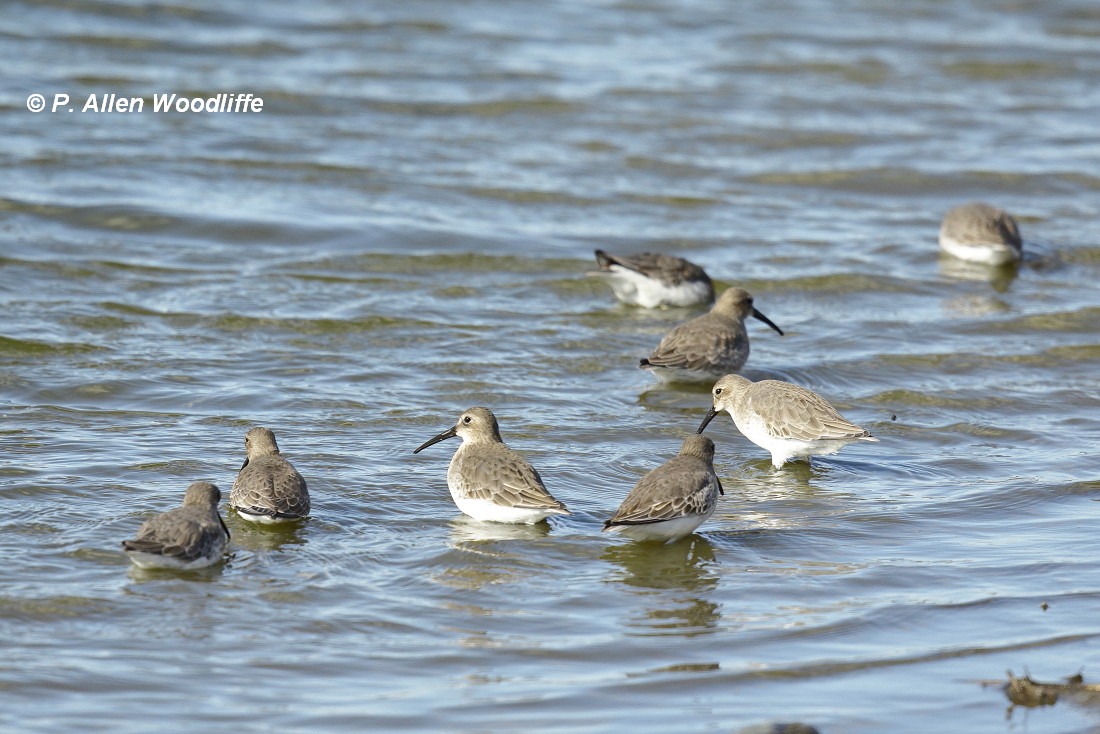
There are very large numbers of Dunlin around right now, with some conservative estimates at these sewage lagoons at least 400 in number. This next photo shows about 65-70 Dunlin partially or wholly in the photo. The large shorebird towards the centre left is a HUGO.

Dunlin
Other shorebirds seen lately, but more difficult to photograph, include White-rumped Sandpiper, Western Sandpiper, Baird's Sandpiper, Semipalmated Sandpiper, both yellowleg species and Wilson's Snipe, among others.
Greater Yellowlegs
I went to Rondeau a bit later that day. There was a stiff NNW wind blowing, which is usually good for raptor movement. I spent a couple of hours in an open spot at the campground which provided a relatively good view to the north and west, as well as being somewhat sheltered for me. A more exposed site might have been more productive, but on a day with strong wind gusts, one has to hang on to the 'scope and tripod or it may be blown over. It can happen, and did on one occasion when I was in the Morpeth Cliffs area, and the base of the scope broke off. Fortunately it was a Vortex scope, with a lifetime warranty, so I eventually got a replacement at no cost.

On this day there was a large number of Turkey Vultures passing through, as is often the case. I spotted both Red-shouldered Hawk and Red-tailed Hawk, along with Sharp-shinned and Cooper's Hawks, as well as American Kestrels. The next two images are of a Red-shouldered Hawk, while the third one is of an immature Red-tailed Hawk. The very cloudy sky made photographs a bit more challenging.


There were other birds passing by, including Tundra Swans.....
....and Eastern Bluebirds. I had a flock of 5 Bluebirds that landed near by, and another flock of 27 that didn't.

An Orange-crowned Warbler stopped by in a nearby patch of goldenrod, searching for a meal. It found a larva of some sort, as shown in this next photo.

There were other birds too, of course. There was a large number of American Robins scattered throughout the park. Puddles on the roadside were great places to see them, along with Hermit Thrushes, as well as Yellow-rumped Warblers.
 Blue Jays are passing through in large numbers, with many exiting Ontario according to the hawkwatching stations close to the Ontario/Michigan border. Some will stay, of course, depending on the acorn abundance or the number of well kept bird feeders in the area.
 Dark-eyed Juncos are always fun to see, and at least some of them will remain over the winter....
 ...as will White-crowned Sparrows, such as this immature one shown next.
All in all, it has been a good few days, and who knows, perhaps the best is yet to come!