Thursday, 13 June 2019

Lake McLean, flooding, orchids and butterflies

There is a new lake in Chatham-Kent. Well not totally new, as part of it has been around due to the high water levels of the last couple of years. But currently it is at likely close to the largest size it has ever been. I'm talking about the flooded fields at Keith McLean Conservation Lands. For those of you who had been there over the last year or so, searching for bird rarities such as Red Knot, Snowy Egret, Glossy Ibis, Black-necked Stilt or Nelson's Sparrow, or even just out enjoying some of the other 208 species of birds now known for the area, or the general landscape, you will know that parts of it have been more than a little wet. But if you haven't been there in the last few weeks, you may be quite surprised.

I was there just last Saturday for the first time in several days. This first photo is taken from Google maps, and shows a good portion of the most accessible part of the KMCL. (Click on the image for a larger version.) The blue line encloses what I have named Lake McLean, where the current water levels have invaded on the agricultural fields. The P is the parking lot, the B is the bridge, the W is the wetland area shown in the second photo which has been under water for well over a year. The M is the wetland along the causeway. I used to live right across from Keith McLean's place, and knew him quite well at the time. He told me that he remembered a time when the water levels were so low that the area I've marked as M was dry enough one year that they actually plowed it and planted a crop! I think the farmer who normally puts a crop in on the McLean property this year will be severely curtailed in his efforts.
 I took this next photo while standing on the bridge that crosses the creek system, marked as B on the map above, and looks onto the area marked as W.
 The creek has always been very close to the field, of course, but as the water in the creek rose, it got perilously close to the top. In the next photo you may be able to see the brownish colour on the vegetation at this very narrow point, as the water spilled over from the creek and flowed into the field. These next photos were taken at a time when the water levels were actually down a slight bit.
 These next two photos were taken from the road.  I am standing with my heels at the edge of the pavement, and the water is only a couple of metres away. These were taken on Saturday, June 8. When I came by on June 12, it was even worse. In fact I couldn't have stood at that same spot, as someone, possibly from the roads dept, had come along and piled mounds of earth all along the side of the road to prevent the water from spilling over across the road. At the beginning of this post, I indicated the current level might be close to having created the largest lake here. However I have 35mm slides of June 1985, when the water was actually spilling over the road at the bridge/causeway.
 The photo above shows the tops of some evergreen trees planted here several years ago, as well as a post. If you take a close look at what it says on the sign in the next photo, it says "No motor vehicles" and specifically shows ATVs, snowmobiles and motor bikes. I think they will have to update their sign to include motorboats!
 Water birds are, naturally, loving it. There have been lots of ducks using it from time to time, including this female Hooded Merganser.
 Great Blue Herons and Great Egrets are regularly seen, especially the former species. With the reports of several Snowy Egrets in various places in southern Ontario lately, I keep checking to see if one will show up here. So far none have, but a couple did show up last year.
 There are sometimes up to a couple of hundred gulls and terns using the lake. Caspian Terns are usually found around large bodies of water. I guess they consider Lake McLean a large enough body of water for now. It probably is a little late for gulls to consider the area as a nesting site, but who knows?
Almost all of the migrating shorebirds have left the area for their more northerly breeding grounds, but from mid May until just a few days ago, flooded fields like this were very attractive to shorebirds. In fact it was not uncommon to see a greater diversity and number of shorebirds in flooded fields than it was at sewage lagoons. In just a few weeks from now some shorebirds will be returning and may find these flooded fields, assuming they are still flooded, to be quite to their liking. Stay tuned.....

As mentioned, I have been back to Rondeau on a couple of occasions in the last few days. I wanted to do some more orchid photography, and was focusing on Puttyroot. I found 15 plants in flower, four of which are shown here. You can see the single faded leaf at the bottom of the stem.


 Another plant that I have been keeping an eye on is American Gromwell, which up until I re-discovered it at Rondeau in 2017, had not been seen in Chatham-Kent in at least 30 years.
 One of the purposes of my latest foray at Rondeau was to try and locate an Acadian Flycatcher nest that had been reported. It was not in the typical habitat, and in spite of my efforts, was not able to locate it yet. But I did come across lots of other birds including this recently fledged Brown Thrasher scurrying about in a shrubby tangle.
 The adults were very close by, keeping watch over their youngster and 'chucking' their alarm call on a regular basis.

 There were also lots of butterflies out along the trails and forest edges. I must have seen at least 50 Azure types, mostly flitting.
 Little Wood-Satyrs were scattered here and there, with their ditsy-doodling flight in the low vegetation.

 I came across at least a dozen skippers, almost all of which were Hobomok, and the only skipper I was able to photograph. The only other skipper I could tell for sure was my first of the season Silver-spotted Skipper.
Only a few more weeks until the butterfly count!

Friday, 7 June 2019

Orchids and herps: including some Species At Risk

Here in southwestern Ontario, there is a high percentage of species that are rare and even legally at risk. With the current provincial conservative government at the helm, which just a couple of days ago made severe cuts to the Endangered Species Act, the outlook for many species looks a lot bleaker than it did just a short while ago. If you want to know the latest regarding these changes, check out this link.

On one of our continuing forays around Chatham-Kent, Marie and I went up to the trails and access points along Lake St. Clair. My goal was to see and photograph Cattle Egret which has appeared from time to time, as well as Yellow-headed Blackbirds, which have been seen much more regularly. Both species, or at least the blackbirds, are believed to be nesting in some off-shore cattail islands, and come to the mainland to feed on lawns and at feeders. Unfortunately for us, we did not see either species. But it was still a nice outing.

Great Egrets, which nest near the southern end of Walpole Island, are fairly regular here.
 On a sunny day, turtles are up basking on almost any surface they can climb on to. The Northern Map Turtle, shown on this next photo, are a legally at-risk species with the status of Special Concern.
In the next photo, a Northern Map Turtle is sharing a log with several Painted Turtles. The Northern Map Turtle is easily identified by its jagged tail end of its shell, and the yellow lines on the greenish skin, appearing like contour lines on a map. Painted Turtles are not yet officially at risk according to the Ontario status, but they are being considered.
While out doing shorebird surveys at local sewage lagoons, I came across this rather large Eastern Fox Snake, which is Endangered. Since I only had my telephoto lens, and the snake was in the grass, I only got a head shot. It was a warm sunny day, and the snake didn't stick around for further modelling, and scurried off into denser vegetation and rocks lining the edge of the pond.

There are at least 19 species of orchids recorded at Rondeau, and some begin flowering at the end of May.

The earliest species is Showy Orchis. It isn't officially at risk yet, but the Ontario populations are being monitored to some extent to see if there has been enough of a decline to warrant some At Risk status in the near future.
It isn't abundant at Rondeau, but occurs in small numbers in several locations. There is lots of what appears to be very good habitat in the park.

Large Yellow Lady's-slipper is fairly abundant at places much farther north, like the Bruce Peninsula, but at Rondeau they are very rare. I know of three locations for them, although one seems to have disappeared in the last decade, and another just had two non-flowering stems appear this year. In 1980 I discovered another and much larger population, made up of at least 50 stems. The last time I saw this population was in 1987, and in all of those years I monitored it, I never saw any more than about a dozen plants in flower. I decided it was time to check on this population to see whether it still existed after this interlude of 30+ years. It is well off any beaten path, and I wasn't certain I could find it, but find it I did. I didn't cover the whole area, but covered enough of it to discover 11 plants in flower and about that many non-flowering plants. I was quite pleased to see that in spite of the high water levels of these last couple of years, the population was doing okay.

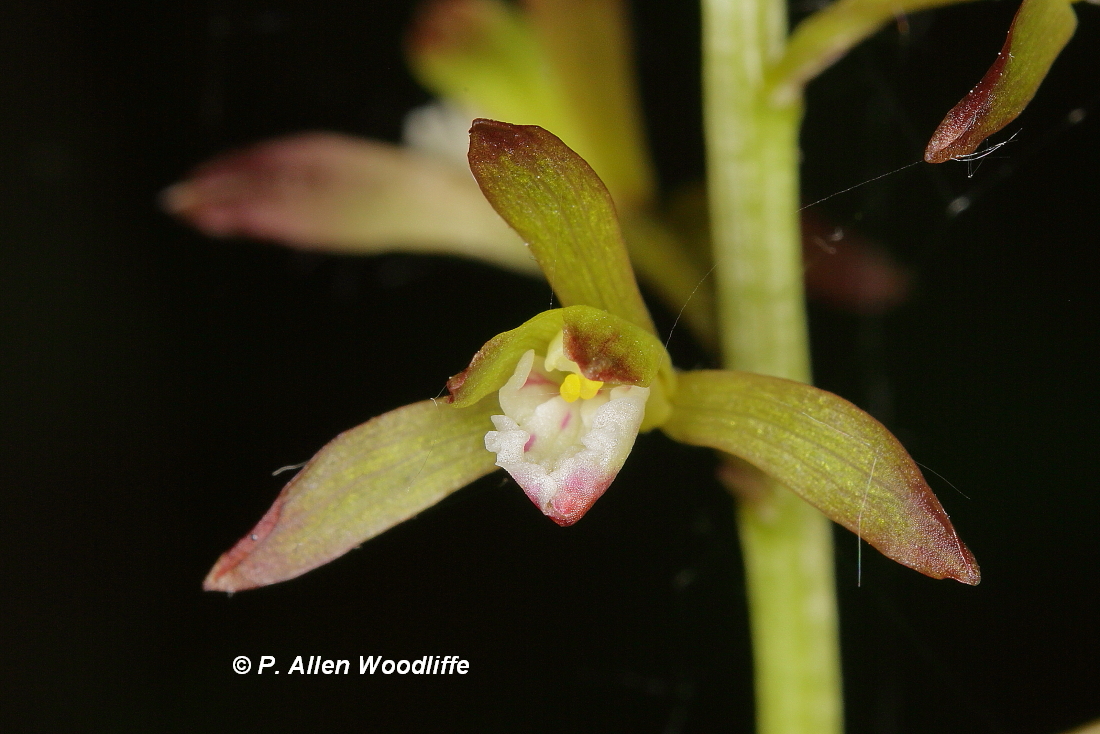
Puttyroot is not yet officially At Risk but like other species, is being evaluated for future consideration. There are at least 5 known locations for it at Rondeau, although only one population is of any size, and at least two of the others have not flowered for several years.
Sandy sites seem to be preferred by orchids. I went north, well at least to northern Lambton County, a few days ago, on the search for two other orchids which I had seen there in the past. The extensive Ipperwash Crown Land Reserve was my destination.

Pink Lady's-slipper is not at risk, and in fact is fairly widespread in parts of central Ontario. It is rare here in the southwest, but does occur in a few places.

My primary target, however was a much smaller and difficult to find orchid: Ram's-head Lady's-slipper. It is well represented in places like the Bruce Peninsula, but is extremely rare here in the southwest. In fact this very small population in the Ipperwash area is the most southern location for it in all of Canada. There were two plants in flower, and another 5-6 non-flowering plants. I photographed the tallest one which was less than 20 cm (8") tall. The other plant was about half that size.


Another orchid which I came across was Hooker's Orchid. I only saw the leaves of several non-flowering stems on this occasion, as I was not in the right part of the Ipperwash area where they are a little more common.
A non-orchid highlight of this venture was to come across Eastern Flowering Dogwood, an Endangered species in Ontario.
While I was prowling around north Lambton I did explore other areas, but that will be featured in a future post.

Thursday, 30 May 2019

Neotropic Cormorant, Whimbrel, Franklin's Gull and other late May highlights

May birding has come to an end, but there are still some northbound migrants trickling through. In fact by the time the northbound migrants have finished passing through this area, it is likely that some of the earliest northbound species that attempted to get to the arctic breeding grounds for an early start, might have had failed nests and are already returning to southern Ontario to feed and rest up, awaiting the urge to return to their wintering ground later this year. So for a very short period, the spring and fall migrants may overlap.

This post will feature some of my favourite bird photos that I took this month that I haven't yet posted, as well as some of the more unusual species that I have caught up with quite recently.

One of the highlights was to have one or more Common Nighthawks using a quite visible branch for their daytime roost along the north part of Rondeau's Harrison Trail. It was seen for several days in a row, and while the mostly cloudy condition at the time did not give a great background for photographic documentation, on one occasion I came across this one with a pleasing blue sky.
 The bird was relatively settled in, but once in awhile do a 180 degree turn on the branch, or open an eye to check out the birders watching it. Maybe it was keeping track of how many people came along, adding us all to its people list.
 An Eastern Screech Owl got a lot of attention. It was nice that it was facing the Bennett Ave road, and a safe distance from folks who stuck to the road.
 Gray Catbirds have been fairly abundant, but do not often pose long enough away from the usually dense shrubbery where they are found.
 Lincoln's Sparrows are not commonly seen, and even when they are, are often furtively poking around some wet shrubby areas. This one was busily foraging on an almost submerged log at the log pond.
 Indigo Buntings, always a delight to see in bright sunlight due to their rich indigo colour, are occasionally seen in shrubby openings, or along shrubby forest edges.
 Red-belllied Woodpeckers are common residents, but are becoming quieter in the forest since they have already established a territory and are busy with nesting activities. This one occurred in a quite open area along Warbler's Way.
 Eastern Kingbirds were very abundant for a few days, and there will often be a few along forest edges such as near the cottage community.
 Scarlet Tanagers are more often heard than seen in the forest, as they are typically fairly high and at least partially obscured by the newly emerged leaves.
 The Wood Thrush is one of my favourite woodland species. Spending time in woodland areas on a quiet evening will usually result in hearing their melodious, flute-like song. Unfortunately due to a decline in the quality of woodland that this species requires, as well as other factors, Wood Thrush is now officially a Species At Risk in Ontario being designated as Special Concern.
Cuckoos are not very common. This next photo is of a Black-billed Cuckoo, easily identified by its dark lower bill and the lack of large white spots on the underside of its tail which are found on the Yellow-billed Cuckoo.
Of course while out looking for birds, one encounters other things along the way. Eastern Chipmunks are quite abundant and briefly visible as they scamper about the forest.
 On the occasional warm, sunny day, one may find a Five-lined Skink basking on a boardwalk or log. The southern Ontario, or Carolinian, population of this reptile is officially Endangered.
Shorebirds are passing through in good numbers these days, and likely will be for the next couple of weeks. Since many of them nest in the high arctic, they wait as long as possible for the conditions at that latitude to be most favourable for their breeding activities. The shores of the lake, at sewage lagoons or, especially this year in flooded fields, are the best places to find them. The Keith McLean Conservation Lands is a good place to check out, since there are several acres of flooded fields with varying water level depths. Rarer shorebird species such as Willet and Black-necked Stilt, mentioned in earlier posts, have been found there not long ago.

Short-billed Dowitchers have been present at the KMCL in small numbers.

 A dozen or more Semipalmated Plovers have been seen there quite recently.

 Solitary Sandpipers are usually solitary, and like shallow water in grassy fields.
 Spotted Snadpipers are found in almost any medium sized to large size wetland edge. The local sewage lagoons often have a few.
 Dunlin are present in fairly large numbers, at any of those shallow wetland habitats or lake edges. Sometimes as many as one hundred can be seen at one of these sites.

One of the shorebird highlights of the spring is the arrival of Whimbrel. This large shorebird species with the distinctive long, down-curved bill,  doesn't stay around for long.

Green Herons, which often look almost black depending on the light they are seen in, are present in or near wooded wetlands.
In the latter part of May and into June, is a good time to see less common gulls. Certainly that has been the case again this year, as several less common species have been found in the Erieau/McGeachy Pond area. Several Franklin's Gulls (FRGU) as well as a Laughing Gull (LAGU) have been seen irregularly. FRGU usually have more white in their wingtips, and LAGU wingtips are typically solid black. Hence a bit of initial confusion on the bird in this next photo. But after checking a bit further, a first summer FRGU will have all dark wingtips. So that, as well as lacking a larger, slightly drooping bill and having fairly wide white eye-crescents, seen better in the second photo, all point to this being a FRGU.

Unfortunately I didn't get any photos of the first summer LAGU, as I just saw it at quite a distance through the scope. But on that occasion, at least, the overcast conditions gave better light and no heat haze to contend with.

An almost full adult Lesser Black-backed Gull was noted in the onion field with other gulls, although it didn't stay very long.
Last, but certainly not least, was this Neotropic Cormorant, one of the very few records for the Rondeau area. It was first found by Jim Burk a couple of weeks ago, and then disappeared for a short while. In the last week or so it had been seen roosting in the willow trees on the far side of the Erieau channel. My first attempts at a photo did not turn out well, due to the lateness of the day but more so due to the very white/gray sky, making a black bird really difficult to photograph. A day or so later, when the sky was blue late in the day I got more satisfactory photos. The bird is on the left, and is distinguished from the larger and super abundant Double-crested Cormorant by being smaller, about 2/3 the size, having a smaller pale throat patch and a white chevron of feathers at the base of the mouth parts. At some angles, the eyes look a little more 'bug-eyed', but that characteristic is not visible in this photo, which was taken and then greatly cropped so that the final result is the equivalent of about 95X.