Tuesday, 16 July 2019

Counting butterflies and other things along the way

The Rondeau butterfly count of this past weekend had excellent weather: sunny, not as hot as some days, tolerable humidity and with a slight breeze. As expected, however, the butterfly season has been a bit less diverse than what we used to get, and the questions arise as to why. There are probably a number of factors, including the cool, wet spring which was hard on overwintering butterflies, as well as the ongoing extensive use of pesticides and genetically modified and/or pesticide ready seeds being used which affect many pollinating insect species. But as usual, some species were relatively plentiful and others were noticeable by their absence or at least extremely low numbers.

My area consists of several small patches, some near Erieau at the McGeachy Pond and Rail Trails, as well as roadsides adjacent to woodlots, old fields, etc., in the greater Blenheim area. All of these sites I do on my own, but for a short time in the middle of the day, I meet up with Steve Charbonneau and Keith Burk to do an old field near the sewage lagoons, which is getting a lot shrubbier than it used to be and is not as productive.

Monarch were pleasantly abundant, unlike some years. I had 69.
 Red Admirals were widely scattered, with about 15.
 Somewhat surprisingly, Cabbage Whites and both sulphurs were not all that common, which is unusual.

 I had a single Mourning Cloak.....
.....and a single Question Mark.
While walking along the McGeachy Pond trail, I noticed this little critter feeding and fluttering exactly like a butterfly. It wasn't anything I had ever recalled seeing before, and managed to get a few photos. It wasn't long until I realized it was a day flying moth, and when I got home I determined it was a Spear-marked Black moth.
There were lots of dragonflies, and I stopped to get this photo of a cooperative Eastern Meadowhawk before a bee came along and the dragonfly left.
When Steve, Keith and I checked out the old field near the sewage lagoon, we added a few species to our list. The most unusual one for our day was this Delaware Skipper, which posed very briefly before vaulting itself into the air in typical skipper fashion, never to be seen again.
I continued on my way, checking out various easily accessible spots. One old field looked promising with a lot of milkweed patches. But it turns out they were almost all Prairie Milkweed (Asclepias sullivantii) and while it looks superficially like Common Milkweed (Asclepias syriaca), I have often found that Prairie Milkweed is not as effective at attracting butterflies. It doesn't seem to be as aromatic or something. Prairie Milkweed flowers are a bit deeper red in colour, have smooth, hairless leaves which are more upright and often have a dark red mid-vein.
I did manage to get a photo of a Common Wood-nymph. Usually these critters are only seen flitting through the vegetation and when they land they are often in an almost impossible spot to photograph.

I checked out the pollinator garden and grassland area near Canadian Tire, where a good population of grassland birds have been the last few years, such as Dickcissel, Bobolink, Eastern Meadowlark and Savannah Sparrow. The one section has been planted with numerous wildflowers. While there was a good diversity, they weren't at their peak, with only scattered individuals throughout the patch, including the following.
Butterfly Milkweed
Large-flowered Coreopsis (not native)
Purple Coneflower (not native)
As was typical everywhere I stopped, there were a few Monarchs, but not a lot of other butterflies. I was pleased to see a lot of Bobolink, however. I stood in one spot and scanned, counting a total of 16, a mix of adult males and females and probably some of them were young of the year, looking much like the females. Some of the males were starting to lose their predominantly black and white feathering as they transition to their non-breeding plumage.

Another stop was at the B-fit park on the south side of Blenheim. It is a walking trail, a loop of about one kilometre. Inside the loop are two cells, one which is mostly wetland and the other is considerably drier, with a lot of Swamp Milkweed and Dogbane.

Swamp Milkweed
I was hoping for something interesting on the Dogbane, but did not see anything. Again, Monarchs were by far the most common butterfly.
One of the adjacent landowners has a sizeable flower garden right next to the trail. Most species were not native, although they were colourful. But there were a few prairie type species, including Butterfly Milkweed, Purple Coneflower, Black-eyed Susan and one which I was quite surprised to see, Queen-of-the-Prairie (Filapendula rubra). This is not a species native to Ontario, but is an indicator of a high quality prairie found in the mid-western states of Missouri, Iowa, Illinois, etc. In spite of my many trips to mid-western prairies, I have either been a bit too early, or a bit too late and never seen one in flower. In fact it is considered a somewhat rare and local species even in the mid-west, so I was quite surprised to see it at the edge of Blenheim!
There were several large plants of dill in this garden, and the Summer Azures were quite interested in it.

I ended up with 19 species of butterflies, not too bad considering the overall lack of habitat diversity of my area, and certainly a little lower than some previous years. Regardless, it was a great day to be out!


Thursday, 11 July 2019

Butterfly Count Scouting

Tis the season for butterfly counts. While there are a number in the area, the only one I participate in is the Rondeau area one, coming up this weekend. So in order to get in the mood, I spent a bit of time last Monday at Rondeau checking out one of the most prolific patches for butterflies in the park. It is actually an old dump site, known as the Dillon Dump. With the high water this year, and a tree that had come down across the entrance to the trail leading to the dump, I don't believe anyone had been in there for weeks, possibly not for months. I talked with some of the park staff ahead of time, and one or more of the maintenance crew cleared a pathway at the entrance through the fallen tree limbs making access possible (thanks, Jon!).

One of the things that this site has going for it is that it is an opening of about one hectare, completely surrounded by deciduous woodland and swamp, and the main plant there right now is Common Milkweed. Fortunately it is in peak flowering condition right now. There must be upwards of 2000 plants, and with each of them having several flower heads and each head having at least several dozen individual flowers, there may be 10,000 or more individual flowers for pollinating insects to feast on. Butterflies were fairly abundant, not surprisingly. I spent about an hour there in the sweltering heat and came up with 14 species of butterfly. I'm sure there were others. There wasn't anything unexpected, but with the butterfly season to date seeming to be a little behind time, it was nice to see this diversity in one location.

I managed to get photos of the following species. There were Monarchs a-plenty, not surprisingly.
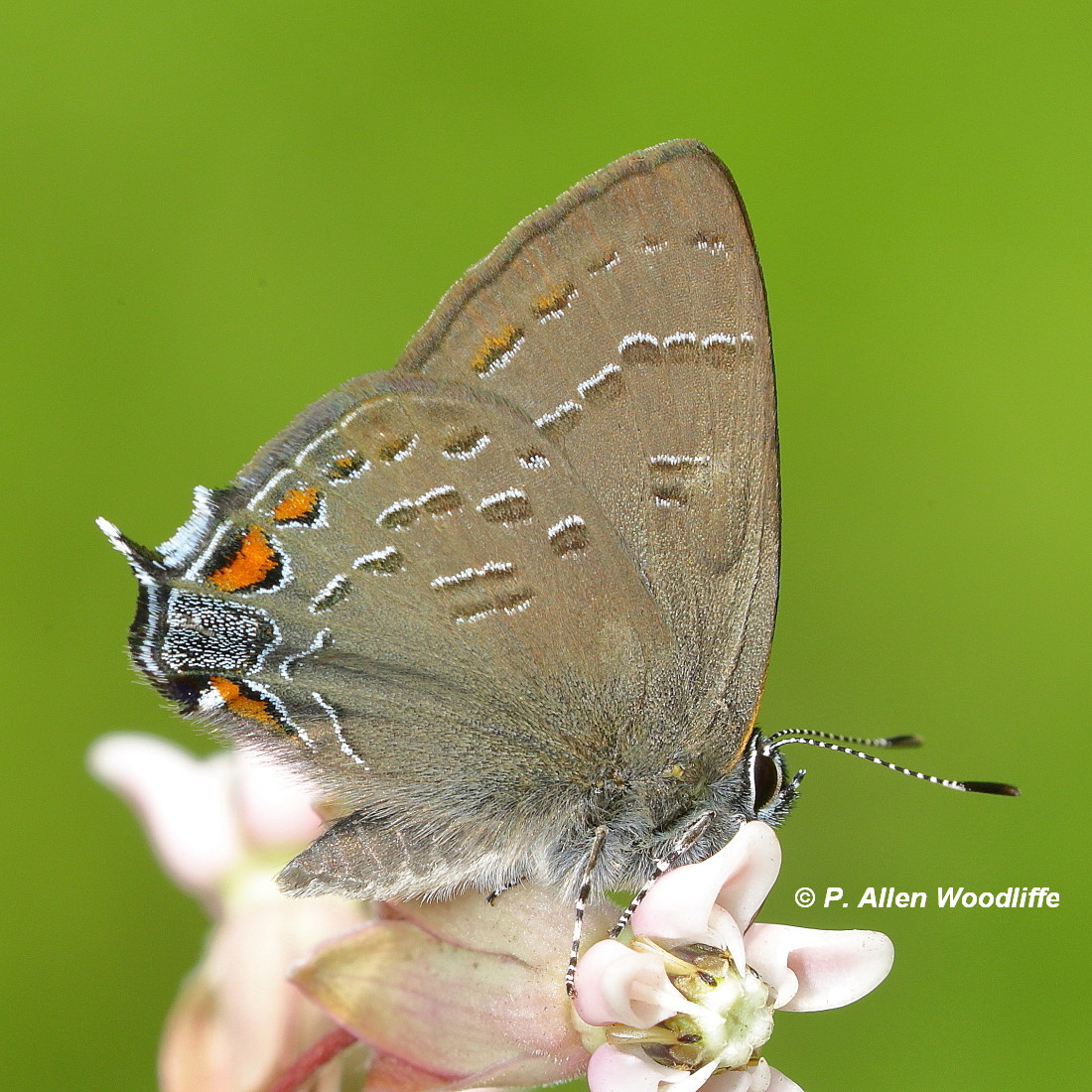
A couple of Banded Hairstreaks were nice.

Eastern Comma
Eastern Tiger Swallowtail
Hobomok Skipper
Pearl Crescent
Question Mark

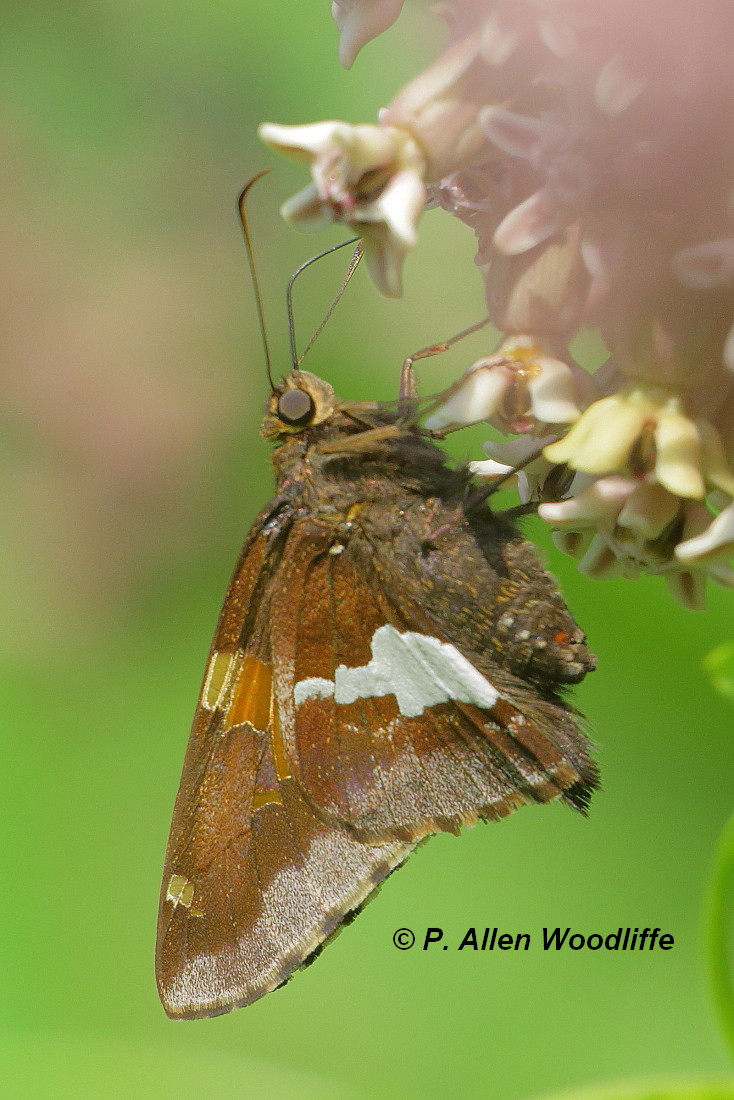
Silver-spotted Skipper
Little Wood-Satyr
There were a few that I didn't get photos of, including Summer Azure, Red Admiral, Tawny-edged Skipper and Northern Broken Dash, as well as a couple of skippers that skipped away too fast to get any kind of decent look at. And there were likely others that I didn't see, but might have if I stuck around long enough. I did get a Viceroy a bit later on.
There were lots of dragonflies as well, although almost all of them were of the Meadowhawk type. I just wasn't sure which one, as the three possible ones are often difficult to distinguish in the field.

 There were lots of damselflies as well, but I only tried to get photos of this one, a type of Spreadwing in the Lestes genus.
Hopefully the upcoming butterfly count will have a decent result, but time will tell. However unless someone wants to venture out the officially closed Marsh Trail, a significant part of the count area will not be covered. This next photo shows the north end of the trail, at a location where hundreds of birders stood patiently last September and October waiting for the famous Great Kiskadee to show itself. Things have changed considerably, due to the record high water levels of the lakes; hence the closure of the trail.

I also had some things to do in the vicinity of Clear Creek Forest Provincial Park, so I took a bit of time to look for butterflies and dragonflies around the open area and ponds at the north side of the park. The butterflies were much the same as what I got at Rondeau earlier, but with less diversity. The dragonflies were plentiful though. Again, nothing really unexpected but it was nice to have so many to choose from in such a small area.
Blue Dasher
Calico Pennant
Common Whitetail
Twelve-spotted Skimmer
Widow Skimmer
 There were quite a few Eastern Pondhawks, including young males with their thorax still transitioning from green to pale blue.

With all of the dragonflies around, it was no surprise to see the exuviae still clinging to the tops of dead stems, where the nymphs had climbed out of the water to subsequently emerge as adults.
Whilst on the watch for dragonflies, I noticed this Bronzed Tiger Beetle scurrying across the sandy edge of one of the ponds.
There were a couple of dragonfly types that just wouldn't land and so I never got a chance to identify them let alone photograph them. Maybe next time.


Friday, 5 July 2019

Birds, butterflies and orchids, mostly in Chatham-Kent

I haven't gone too far these last few days, but enough to find some interesting things.

Dickcissels are around again, but not in nearly the numbers of 2017, nor in 2018. I had found a few at the Dealtown Crown Land prairie both of those years, and have been there twice this year.  I had a good variety of shrubby/grassland birds as well as aerial insectivores, some of which gave me some good photo ops, but no Dickcissel.

Bank Swallows were quite abundant, not surprising though since this site is only about a kilometre from Lake Erie where the steep clay cliffs often have this species nesting in.
Bank Swallow


 No Bobolinks this year either, but a couple of Eastern Meadowlarks are there.
There are some early southern-bound shorebird migrants. Usually the local sewage lagoons are the places to find them, and there is a very small number there, but with all of the flooded fields to choose from, they will be spread out wherever there is shallow water. Lesser Yellowlegs are the more common shorebird so far, although a few others have also shown up.
 I've checked the flooded fields along Lagoon Road where a lingering Franklin's Gull has been seen on occasion, but I did not catch up to it. There were Lesser Yellowlegs and lots of Killdeer. A few of the typical summering gulls were around, as well as a few Caspian Terns.
 The Blenheim lagoons have good conditions for shorebirds, but except for lots of Killdeer and a few Lesser Yellowlegs, the shorebirds have not made a point of hanging out there yet. But there are a few other waterbirds, including a few Ruddy Ducks, this pair of Blue-winged Teal....
....and a Ring-necked Duck. There had been a pair of Ring-necks not that long ago, but the male was not visible on this visit.
I stopped at Erieau on one occasion. As has been the case throughout the spring, the water continues to be very high. The pier gets washed over periodically, even when there is very little wave action.
 On the vegetated part of the beach dunes, the Common Hop-tree is in full flower. It is Special Concern, one notch lower than Threatened under the Endangered Species Act.


Of course I managed to get to Rondeau a couple of times. Birds have been fairly typical, just the usual breeding species or vagrants. American Redstarts are scattered about the forest.
 A couple of pairs of Prothonotary Warblers continue along the Tuliptree Trail. I can never get enough of these critters!


While watching the Prothonotaries for awhile, this Green Frog was plinking like a banjo string in the slough nearby. It is surrounded by a plant called Frog-bit, which is not native to North America but arrived several decades ago. It was first discovered at Rondeau in 1976 when I was out canoeing in the Rondeau marsh with my university Aquatic Vascular Plants professor. It has expanded at Rondeau considerably since then, being found almost anywhere there is some sunny, quiet water.
The White-winged Dove continues along Lakeshore Road, south of the Visitor Centre. The stainless steel chimney at 17168 continues to be a favourite hang-out.
Earlier in the week I was out to show some friends a small population of Puttyroot, an orchid they had never seen before. The Puttyroot had finished flowering and had developing seed capsules. But before these folks left the park, they checked out a couple of trails and came across another orchid: Ragged-fringed Orchid. It is not a common species anywhere, but can be found in wet woods and sometimes in wet grassy meadows. This particular individual was at the base of a tree in a slough. I had access to a pair of hip waders to get close enough for these photos.


On one occasion I ventured beyond the boundaries of Chatham-Kent. Fellow blogger Blake had reported that the Oak Hairstreaks had appeared at the Reid Conservation Area in southern Lambton, so one partly sunny and very hot morning I headed there. There were lots of European Skippers, several Banded Hairstreaks, and at least two Oak Hairstreaks.


Banded Hairstreak

Oak Hairstreak
The butterflies were not as prevalent as they often have been for the time of year, so it will be interesting to see if the upcoming butterfly counts show this trend or not.