Monday, 11 November 2019

'Winter' shorebirding

Yesterday I spent a bit of time checking out parts of the former Dover Twp, looking for waterfowl and hoping to find the first of season Snowy Owl.

As is typical of this time of year, Tundra Swans are fairly abundant. I noted at least 5000 birds scattered about in various locations.

There were a few Great Blue Herons in the fields, and likely a lot more in the wetlands.
 A flock of Wild Turkeys were out in a recently harvest field.

 Towards the north end of my route, I came across 5 Sandhill Cranes, three of which I got in this next photo.
I did not see any Snowy Owls. Perhaps that isn't surprising, as there have only been one or two reported so far in Ontario this fall.

But what a difference a day makes. The snowy forecast for today did indeed occur. And this is what it looked like outside our kitchen window this morning. Maybe this burst of wintry conditions will encourage Snowy Owls to move a little farther south into Ontario!

But some shorebirds either didn't get the memo for this change, or could have cared less. A bird alert in the early afternoon from Steve C indicated that the Blenheim Sewage Lagoons still had a surprising number and diversity of shorebirds, the most unusual being a juvenile Red Phalarope. This species is quite uncommon in Chatham-Kent, and along the lower Great Lakes in general. So in spite of the crummy driving conditions (I'm always reluctant to go very far during the first snowfall, since many drivers aren't driving according to the conditions!), I ventured out to the sewage lagoons. One other birder was just leaving, with a satisfied look on his face, and as I was leaving, two other birders arrived with anticipation on their faces.

The gloomy conditions and steady snowfall was anything but ideal for viewing, let alone photography. Looking through melted snow flakes on the binoculars, in addition to those unmelted ones that provided a steady white curtain across the viewing area, just wasn't what one likes to contend with. But it was either that or likely miss this bird. There were at least nine species of shorebirds, numbering almost 50 individuals that one could see. With the far pond being partly vegetated, it is likely there were even more taking shelter.

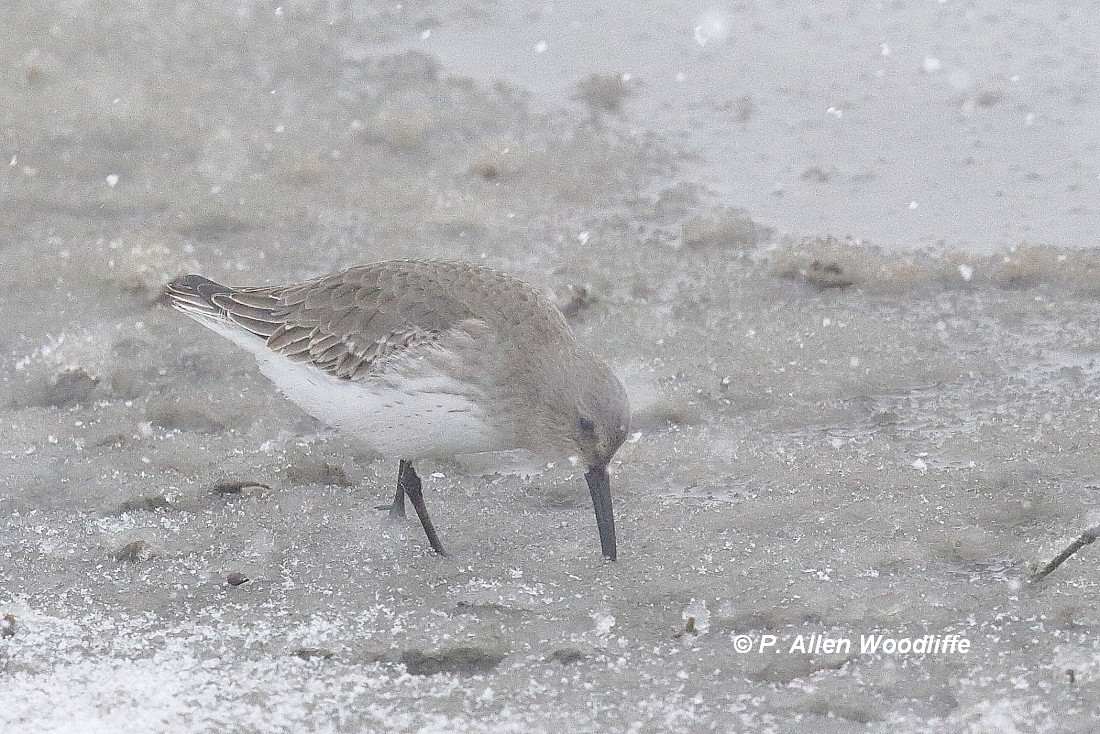
I didn't try photographing all species, but I did manage to get records shots of the following: (and note that the first three species shown are walking through slush, hoping to find some little morsel to keep up their energy.)
Dunlin
Pectoral Sandpiper
Wilson's Snipe
 And the main target species: Red Phalarope. It was actively moving around one or more of the sewage ponds, so it wasn't easy to get many photos. I found the most successful method was to hunker down along the edge, behind some vegetation and wait for the bird to swim closer. It wasn't always easy to get the best focus as it darted this way and that, but some turned out reasonably well considering the circumstances. With snow flakes landing in my camera's eyepiece, it was sometimes hard to look through and get the camera aimed at the right spot let alone locking into the proper focus.
 There were other shorebirds, including Least Sandpiper, White-rumped Sandpiper, Long-billed Dowitcher and Greater Yellowlegs, all of which I photographed here just a few days ago and featured in my previous post. There were a few other things that came along, so I dutifully captured their likeness on my camera as well.
Bonaparte's Gull
 There were at least two or three dozen American Pipits feeding along the edges, and this one flew almost right at me before landing.
American Pipit


Friday, 8 November 2019

Early November birding

There have been some interesting rarities in various parts of Ontario recently....for example a Gannet, Mountain Bluebird, Western Tanager, King Eider, Harlequin Duck and American Avocet..... but they seem to have missed Chatham-Kent so far. But that could change at any time, which keeps birders out looking and hoping. We got spoiled a bit last year with the first Canadian record of Great Kiskadee that showed up several times from early September to early December. But there are birds around to be enjoyed anyway, and just getting out even without seeing rarities is still very much worthwhile.

Carolina Wrens are always a treat to see up close. They are never very common, but more or less permanent residents.
 Red-bellied Woodpecker is also a permanent resident and pretty regular in small numbers.
 Most warbler species have departed, although some linger. The occasional Yellow-rumped Warbler, shown below, may even be around throughout the winter if there are enough berries for them to subsist on.
 Ruby-crowned Kinglets have been quite abundant lately, migrating from their breeding grounds to points that will mostly be far south of here. Some may linger at least for the local bird counts coming up in a few weeks.
 Chipping Sparrow, are also fairly abundant, but will be mostly gone in another few short weeks.
 Mixed flocks of blackbirds, made up of Red-winged Blackbirds, Brown-headed Cowbirds, Rusty Blackbirds and Common Grackles, are fairly plentiful. This next photo shows a small portion of a medium sized flock along Rondeau's Lakeshore Road earlier this week. All of the 4 species listed here were represented in this flock.
 Once in awhile there is a medium to even large-sized flock of mostly one species. That was the case earlier this week, when there were several flocks including a very large one along the south end of Lakeshore Road, made up almost entirely of Rusty Blackbirds. This species is considered At Risk due to their declining numbers. They nest in the wetlands of the boreal forest region of northern Ontario and other provinces. They used to be seen regularly in spring and fall migration in large numbers, but not so much lately. The ones I saw on this day totalled at least 800 birds which is the most I recall having seen on one occasion in quite a few years. It was fairly late in the day when I saw these, so was unable to get any photos of the flock, just the occasional bird that happened to be close by and reasonably visible. A high ISO and lots of photo processing was the only way I could even make use of any of the photos I took.

 In more open areas, groups of American Pipits can be seen, but usually in flight. This one happened to land on a hydro wire long enough for a photo or two.
 In the waterbirds category, there are lots of waterfowl around. The most interesting ones I have seen lately were these two Greater White-fronted Geese, at the Keith McLean Conservation Lands (KMCL). There are lots of waterfowl there as it is off limits to hunting.
 At least two or three dozen Hooded Mergansers have been hanging out there as well.
 Shorebirds are a little more tolerant of photographers, since they aren't hunted. But the season for their migration has mostly passed. A few species are lingering and busily feeding to get the energy for the next leg of their southern migration. Some of them have to go all the way to southern South America.

Dunlin are probably the most abundant shorebird around this late. Flocks of 30-55 or more birds have been seen in various places.
 Greater Yellowlegs are still around in small numbers. I saw at least a dozen at the Keith McLean property yesterday.
 What I found interesting was that in the declining ponds of the KMCL, there were a few small fish that were being fed on by these yellowlegs. Most of the time, this shorebird feeds on much smaller fare, including aquatic invertebrates, but I expect there is a fair bit of energy to be gained by gobbling up a few fish.
 Pectoral Sandpipers are virtually gone with only a couple at KMCL recently.....
 ...and White-rumped Sandpipers, never very common even on fall migration, are quite rare now. This one only had one and a half legs, with the one leg missing the section below the knee. It could fly fine, but did have a bit of difficulty hopping along on the mud with only one useful leg.
 The diminutive Least Sandpiper, with its yellowish-green legs, are really hard to find these days, but there have been a couple at KMCL, and this one at the Blenheim lagoons today.
 Long-billed Dowitchers, here in the last photo, are usually few and far between, but show up in small numbers towards the latter part of the shorebird migration. These two were still present at the Blenheim lagoons today.
With the colder than normal temperatures which have arrived recently, shorebird habitat is quickly disappearing. Even the Blenheim lagoons are partly frozen, so hopefully the lingering shorebirds have put on enough fat to get them to where they should be.

Friday, 25 October 2019

One Skunk, No Mosquitoes, No Misery.....

....and two Coyotes!

I spent a couple of evenings at Skunk's Misery a few weeks ago, on the hunt for night-time critters to come in to my black light. Just before I got to the Misery itself, I noted two nice healthy looking coyotes right along the road side, but they quickly darted into the corn field. Even in the dusky conditions I wouldn't have been able to get a photo. So on I went, to set up at a slightly wider spot along the roadside so as to not impede traffic. Not that there was any traffic to impede. Over the six or seven hours I spent at the two spots, I had only one vehicle go by each night.

Just after I packed up on one of the nights, I spotted a Striped Skunk waddling down the side of the road. I didn't stop to try for a photo.

For anyone who has spent time at Skunk's Misery, it is well-known for its mosquito population. It can be down-right horrendous. The wet areas throughout are a haven for hordes of mossies, and that is part of the reason it was called a Misery many decades ago. But for some reason, during both evenings, I was not bothered by even a single mosquito! It wasn't because it was too cold, as I purposely chose warm evenings to maximize the chances of moth activity. However late in the season much of the wet areas were fairly dry, so it was less conducive for mosquitoes. Regardless, I was just as happy to not have to deal with them.

I was pleasantly surprised by the abundance and diversity of the non-mosquito invertebrates which came to visit. Some were brightly marked, some were much less so, and some were so worn it made identification impossible.

Some of the typical, but well patterned ones were:
American Idia
Aster-head Eucosma
Bold-feathered Grass Moth
 This next one is a Graperoller (Desmia sp). It is next to impossible to identify it to species, since there are two that on the upper side look almost exactly alike, so a photo of the underside is critical.
Desmia sp
Dotted Sallow
Double-striped Scoparia
Large Maple Spanworm
Large Tolype
Packard's Wave
Pink-barred Pseudeustrotia
Sensitive Fern Borer
Three-lined Leafroller
Gold-stripe Grass Veneer
A couple of quite colourful ones put in an appearance.
Bicolored Pyrausta
 This next one was a highlight, as I had never seen one before anywhere. I got just the one photo before the small fly type creature also in the photo was getting too close, and presumably tickled its antenna causing it to move off the sheet completely.
Black-bordered Lemon
By contrast, some were fairly drab.
Common Idia
Copper Underwing
Definte Tussock Moth
 And then there were some that were so worn most of the scales that normally would give any pattern were now worn off. It is hard to say what this next one might be.
As is the case most nights of black lighting, there are non-moth critters that come to visit.
Citrus Flatid Planthopper
Leafhopper, Gyponana sp
 The Gyponana is most likely G. octolineata, although there is some debate as to whether they can be separated from other Gyponana species just by a photo. Regardless, this one can take on various colour patterns, with some almost entirely green and others almost entirely red.

Japanese Maple Leafhopper
 Some don't have common names. This next leafhopper is Colladonus setaceus.
 This next leafhopper is known as a Sharpshooter, Tylozygus bifidus.
 A few of this next critter, a braconid wasp of the genus Aleoides, were there.
 This next one is a type of Scorpionfly of the Panorpa genus.
 Grasshoppers, katydids and other members of the Orthopteran group periodically show up. This next one is a Two-spotted Tree Cricket. It was only a few years ago that it was considered fairly rare anywhere in Ontario, but more recently has been recorded in many places in southwestern Ontario.
 Even the occasional spider will appear, perhaps being attracted to the light and thinking that a few delicacies may be around to feast on.

I got lots more photos of various species, but these represent a variety of the most colourful, and the most drab. There is always a few of each on any night of black lighting!