Monday, 12 September 2022

Late Orchids and other rare to endangered species

 As promised in my previous post, this one will focus primarily on orchids, some of them quite rare, that occur in the August/September time frame.

As is featured in the current header, Nodding Pogonia (Triphora trianthophoros) is one of the rarest in Canada. While I have seen it in flower in very late July and as late as mid-September, typically about the third week in August is when it is at its peak.The following photos of this orchid were taken on August 25. It is legally Endangered, as the only known location for it in Canada is at Rondeau Provincial Park.

 It is very small, as you can probably tell from the first photo. They rarely exceed 12 cm in total height.

The flowers, all of which are developed to a certain point, will open simultaneously for a single day, can be slightly more than 1 cm in height. Singles are the norm, and it is always nice to see them with lots of magenta.
Doubles on the same flower seem to be plentiful at times.....
....while three flowers on the same plant, open all at the same time, is more unusual. In checking on this rare orchid annually since the early 1970s, I don't see a triple flowered one every year.

As tiny as Nodding Pogonia is, here is one that is even less conspicuous. It is Autumn Coralroot (Corallorhiza odontorhiza) and is also quite rare, although not as rare as the first one. It is a bit taller on average, but the flowers are much less showy. There are two varieties of this orchid. The one shown here is var. pringlei, and this is the 'open-flowered' variety. Even though the drooping flowers are open, the seed capsules are already well-developed. The form with flowers that never really open is even less obvious. In both cases, self-pollination occurs. To give you an idea of how small this is, it was taken with a 100mm macro lens plus 68mm of extension tubes, and then cropped some more.


Sticking with orchids a bit longer, there is an interesting group of them in the Ladies'-tresses genus, and some can be challenging to tell apart. A previous post featured the most common one at this time of year, the Sphinx Ladies'-tresses (Spiranthes incurva). I photographed it at Rondeau a few weeks ago. While looking for an endangered gentian in eastern Chatham-Kent, I photographed this same species.
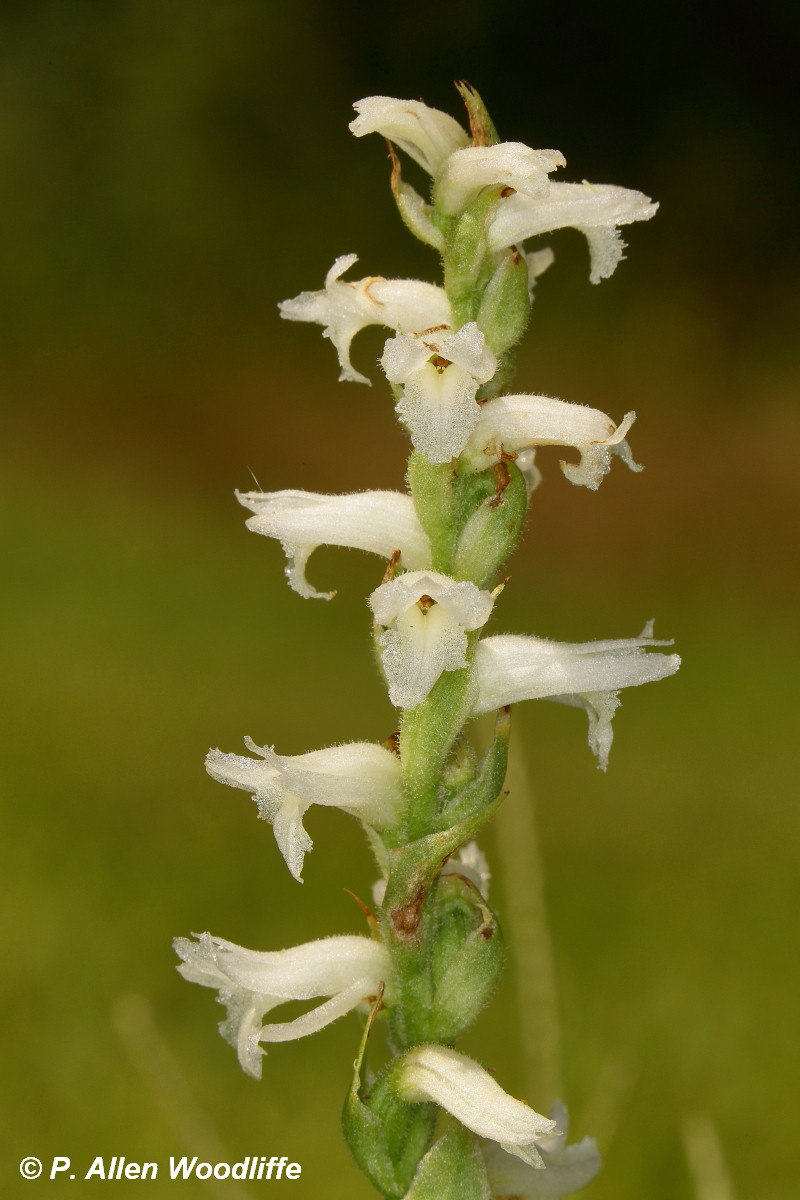
Its flowers are almost entirely white, with little or no fragrance. The brownish spots appearing are an indication that it is past its best. It was photographed on Sept 1, and normally would have been in its peak condition around the third week of August
It has small leaves at the base.

A similar looking one is this next one: Southern Slender Ladies'-tresses (Spiranthes lacera var. gracilis). It is quite dainty, and not easily seen amongst the fairly dense prairie vegetation.

A closer look reveals one of the key characteristics of its spiral flowers: the distinctly green centres of each flower.

Sometimes the spiraling of the flowers takes on a slightly different look with a more drawn out spiral.

It is an extremely rare species, with only this one population showing up in the iNaturalist database. There are older records that I am aware of, but they have not been seen for several decades, primarily due to a change in the overall vegetation.

I have been out to check on another extremely rare orchid of this group: Yellow Ladies'-tresses (Spiranthes ochroleuca), but it was not visible on this date. It occurs on a normally fairly dry sandy site, and it is possible that the extremely dry late June through early August period may be the reason it hasn't appeared. Or maybe I was a few days too early, so I will be out checking for it again soon.

Another one in that genus, while considered rare in Ontario but is relatively common at Rondeau, is Great Plain's Ladies'-tresses (Spiranthes magnicamporum). It is a bit early for it at the moment, but should be showing up in the next week. It is a more robust looking species, with a slightly creamy centre as well as a spicy vanilla scent, and no basal leaves. It grows in grassy areas.


Not an orchid, but an Endangered gentian, is the White Prairie Gentian (Gentiana alba). It grows in the same vicinity as the Southern Slender Ladies'-tresses, and so I combined the time out to photograph them both. There are three sub-populations of this gentian, and at the moment, are the only ones known for Canada. Key characteristics are the creamy white flowers, most of which are fairly closed but not always tightly closed. The flowers also have slight ridges, typically with greenish lines. The plant grows best in high quality tallgrass prairie/savanna vegetation communities.

They can sometimes be confused with another gentian, commonly known as Bottle Gentian (Gentiana andrewsii), which is fairly widespread in a broader vegetation community. Normally they are quite a deep blue, but on occasion they can be white. Such was the case where I was investigating a reported occurrence of the White Prairie Gentian (WPG) in eastern Chatham-Kent. We didn't find any WPG, but did see this white colour form of the Bottle Gentian. The flowers are more tightly closed, and doesn't have the more obvious ridges with greenish edges.

Just to add a little non-botanical information to this post, while I was in eastern Chatham-Kent on the hunt for some of the species above, I stopped by a couple of spots along the Thames River to look for some rare, and very rare, damselflies. The first one is much more common than the second species: American Rubyspot. It has a partially reddish area near the base of the wings, and their abdomen shows definitive brighter rings. They don't always sit in an ideal place to photograph them, but when they do, the patience required is worth it. In Ontario, it is found in many scattered locations west of the Toronto to Barrie area.


Much rarer is the Smoky Rubyspot, next, which shows a bit of red near the base of the wings, and a smoky tip of the wings. Also the abdomen is only faintly ringed, if at all. In Ontario and Canada, it is found primarily along the Sydenham River, the lower reaches of the Thames River and in a couple of places along the Ausable River.

I also managed to check on a couple of rare plants I knew about in the area, both of which are ranked as Endangered. The first one is Eastern Flowering Dogwood (Cornus florida), and while it is not in flower now, it is still quite distinctive. It has a small cluster of red berries.....

...and the large buds of next year's flowers are quite prominent.
In the same general area is a remnant of a population of Eastern Prickly Pear Cactus (Opuntia cespitosa), also Endangered. It was once part of a large population that was widespread across a sandy hillside back in the 1940s, according to a former co-worker of mine who lived across from the site. But eventually the hillside was converted to agriculture, and only a small remnant persists along the roadside.


If you would like to subscribe, or unsubscribe, to Nature Nuggets, send an email to: prairietramper@gmail.com


Wednesday, 7 September 2022

Shorebirds galore!

 Tis the season when shorebirds are probably at their peak numbers, as they make their way southward. They are always looking for places to fatten up so as to continue their journey, and sewage lagoons are high on their preferred sites when the water levels allow for shallow feeding. Such is the case right now at places like the Blenheim Sewage Lagoons.

Birders and bird photographers have been fortunate that these lagoons have been accessible for about 4 decades or so, with a permit.

I've been there a couple of times in the last few days, and there are always other birders there, for good reason. The diversity of shorebirds is quite good. With a bit of patience, one can get 15 species of shorebirds or more in a single visit. 

Here are some of the less common ones I've been able to photograph recently. 

Certainly one of the highlight species is up to three American Avocets, not quite as colourful as when they are in their breeding plumage, but very striking and distinctive nonetheless.


Red Knot is quite a rarity. In fact it is legally Endangered. This one is in its non-breeding plumage, so does not show the red an adult would have shown earlier in the season. It has been present for several days, and is one of the reasons so many birders have been around. It is fairly large and chunky, but can easily be missed, as some have found out. It took me at least a couple of visits in late August before finally seeing it.

Lesser Yellowlegs are fairly abundant now.....
...unlike its larger cousin, the Greater Yellowlegs, where only a handful are present. This one looks a little bedraggled compared to some.
This Red-necked Phalarope has been a crowd-pleaser as well as it is not common. In fact it is considered 'Special Concern' in Ontario due to its rarity.

Related to the Red-necked Phalarope is the larger Wilson's Phalarope, shown next. It is more of a western species, but fairly regular both spring and fall. In fact has even nested at these lagoons in the past.

Stilt Sandpiper, next, with its slightly droopy bill, is also fairly regular both spring and fall......
.....as are Short-billed Dowitchers. The stage of them changing to autumn plumage can vary, as these two birds show.

And finally, for this post, is White-rumped Sandpiper. It is a regular but uncommon migrant. It is a bit larger than the similar looking and much more common Semipalmated Sandpiper. A couple of key characteristics to look for are the slightly longer wings, which at rest as in this one, extend a bit beyond the tail, and in good light and a close look, there is almost always a bit of pale orange at the base of the lower mandible.

The next post may feature late summer orchids, which I have been on a successful hunt for. The photo at the top will give you an idea of some success I have had!


If you would like to subscribe, or unsubscribe, to Nature Nuggets, send an email to: prairietramper@gmail.com


Wednesday, 31 August 2022

Waterbirds, and the fastest animal on the planet

 There are lots of waterbirds on the move these days. While I have been out looking at rare orchids and other plants, that will wait for a later post.

I've been to St. Clair NWA recently, as it is not far from home, and if I choose a time or a route where there is no one else, it is extra pleasant for my tastes.

There is an ongoing presence of the aggressive and invasive Phragmites along the trail, which is somewhat unfortunate in that it obscures the view into the extensive wetland. But with the associated more natural vegetation along the way, there is lots of insect activity to be found.

Monarchs were abundant and most of the ones I saw were looking quite fresh.

This similar looking one, a Viceroy, was looking pretty worn.
There were a few crescents. This one is likely a Pearl Crescent, owing to the tip of the antennae not appearing to have any orange.
I thought this colour of a grasshopper was unusual. It might just be the relatively common Carolina Grasshopper.
Not an insect, obviously, but a critter that feeds on insects is this Leopard Frog. They were quite numerous along the trail.

There were quite a few swallows on the wires along the roadway, such as this Barn Swallow, considered a Species At Risk......

...and also along the trail and road entrance were a few Prairie Thistle, another Species At Risk.

One thing the Phragmites and other vegetation along the trail allows, is a closer approach to somewhat open areas in the dense cattails so as to get a relatively close view of the numerous Great Egrets scattered throughout the wetland. This first one was almost too close to focus on. This NWA, and almost any large wetland along Lake St. Clair, is one of the best places in Ontario to see this species. Of course it helps that there are at least a couple of egret colonies within a short flight distance of the NWA.

Once they get startled away from their feeding area, they may take up a spot in a more distant cluster of trees or shrubs, keeping an eye for when the coast is clear.
When they are startled from their feeding spot, they may circle several times affording some great photo opportunities.

Maybe if the water levels are appropriately lower over the next few weeks, there will be quite the spectacle of over-night roosting egrets, like this that occurred for several weeks in September and October of 2012. There were close to 150 birds using this spot. This photo was taken a few minutes before sunrise, using a long exposure. The birds were almost completely motionless. It is one of my many favourite memories of SCNWA, and I had a nice 24" X 8" canvas print made up of this photo.

Other large wading birds offer similar photo ops, but they aren't usually as numerous to begin with.

Great Blue Heron

Sandhill Cranes used to be quite a novelty to be seen in southwestern Ontario other than on migration. Fortunately it is a species that has increased considerably in the last 2-3 decades, and so are a regularly seen species throughout the breeding season.

Sewage lagoons are popular for shorebirds. I've been to the Blenheim lagoons several times lately, as there has been a good variety of shorebirds, including some rarer ones. For example a young Red Knot has been seen periodically. I didn't get any photos of it, but here are the ones I managed to shoot.

 Baird's Sandpiper were one of the rarer ones. It stood out with its wing tips extending beyond the tail. The long, slim wings really stood out when it was in flight.


Least Sandpiper

Greater Yellowlegs
Lesser Yellowlegs greatly outnumbered their larger relatives.
Lesser Yellowlegs

Pectoral Sandpipers were present in small numbers.


This young Ruddy Turnstone was a bit unusual. They are more often found along sandy shorelines of the local lakes.

Semipalmated Plover

Semipalmated Sandpiper

There were lots of these sandpipers, with probably at least 75 or more around the lagoons in variable sized groups.

One of the highlights was not a water bird type at all, but at least one Peregrine Falcon, formerly an endangered species. It would be high in the sky, and then almost out of nowhere, come swooping in and flushing some shorebirds, hoping one would be vulnerable to be picked off. I didn't see it catch anything. Perhaps it was just practicing.
It was hard to keep the focus locked on to the falcon as it sometimes flew low and fast. This species is the fastest animal on the planet, as they have been known to dive at speeds of over 300 km/hr! But of all the shots I took, I managed to get a small number with satisfactory results.

Non-shorebirds were not fazed at all by the falcon. These two Midland Painted Turtles were soaking up some sun.


If you would like to subscribe, or unsubscribe, to Nature Nuggets, send an email to: prairietramper@gmail.com