Sunday, 9 October 2022

More migrants, some late leps, a cactus conundrum and a house of yesteryear

 Autumn is unfolding as it should, and that means there are lots of things to photograph. A few days ago I was out in the Erieau area. I took time to check the main pier, as the uncommon Purple Sandpiper could appear any day. I walked all the way to the end, flushing a multitude of the usual gulls along the way, but only came up with a single Sanderling right at the end.

Maybe next time there will be a Purple Sandpiper to greet me.

A walk along the Erieau Marsh Trail and McGeachy Pond Trail is often worthwhile, so I included it in my itinerary. There was a nice mix of passerines, including:

Eastern Phoebe

Northern Parula

There were several others, but due to the very contrasty light, were hard to photograph.

Butterflies, on the other hand, were typically out in the open where they could benefit from the sunlight energy while nectaring on the flowers. The deep purple of New England Aster seemed to be the main flower attraction.

Orange Sulphur

Clouded Sulphur
The first two are pretty common, but these next ones are much less common. In fact the Fiery Skippers, of which there were several, were the first ones I had photographed this year.

Bronze Coppers, shown next, are to be expected at some point and usually much more common than the Fiery Skippers.
Female

Male

I also spent a bit of time up along some accessible areas along Lake St. Clair. There were some migrants, not surprisingly, including a good number of Blue Jays on the wing....


 ...and some even landed for another shot.


There were a lot of Yellow-rumped Warblers, by far the most abundant warbler almost everywhere you go these days.

And since it is still relatively early in the season, a few Great Egrets are to be found, and occasionally are in an excellent spot to be photographed.

On another outing, I photographed this Prickly Pear Cactus. Cacti of this type are popular, and always fun to be found. But they present a problem, mainly in the taxonomy. What species is it? For many years, the cacti known in southern Ontario were called Eastern Prickly Pear (Opuntia humifusa). A bit later, taxonomists changed the name to Opuntia cespitosa, and most of the ones are still known as that. However this first one apparently is a different species, known as Grassland Prickly Pear (Opuntia cymochila). It is more of a western species, but due to the arrangement and angle of the spines, is believed by Opuntia experts to be this species. This makes for an interesting element to Ontario's Opuntia, as this particular population in the former Howard Township was quite abundant back in the 1940s. A former co-worker of mine, when I was at Rondeau back in the late 1970s, told me of this population which occurred in a large sandy area almost right across the road from where he and his wife lived. His wife was a teacher at the schoolhouse just down the road, and walked by this population almost every day. That was back in the mid 1940s. However as time went on, the sandy area was converted to agriculture, and it eliminated most of the cactus. Now only a couple of dozen plants persist in the road allowance.

Another population of cactus occurs at Rondeau, in the southeast beach dunes. They do not occur there naturally, as some unknown persons transplanted them there in about 1994. They have done fairly well there since. This population has been determined to be genetically similar to the naturally occurring population on Pelee Island. Therefore the species is legally endangered under the province's Endangered Species Act. The conundrum is: what to do with these plants? They are endangered, sort of, but it is debatable whether transplants are covered under the Act. Or should they be removed, since they may end up being a problem species in an otherwise highly significant natural habitat in one of the most significant provincial parks in Ontario? At the moment, park staff are reluctant to remove them, so they continue where they are.

On quite a different topic than the ones above, here is one of the most photographed abandoned houses in southwestern Ontario, perhaps in all of Canada if you believe some reports. It is known as the Guyitt House, and if you google that name, you can find out lots more information about this house. Regardless, it is along the former Hwy 3, now the Talbot Trail, in eastern Chatham-Kent a short distance east of Palmyra and few kilometers before you get to the Elgin Co border. It was built in the 1840s and was occupied up until about the mid-1980s. I took these photos at various times in about 2010-2011. It has continued to deteriorate, but does so 'gracefully' and it is interesting to see the process.

I took these next two and processed them to reflect an earlier age

This next one was taken during a full moon, with a long exposure of slightly more than 300 seconds using the moon as the sole source of light. You can tell it was a long exposure by seeing the white streak just to the left of the chimney on the right hand side, which is how far a star 'moved' in those 300+seconds.

In recent weeks, an unknown person has complained about its condition, and asked the municipality to enforce a by-law forcing the owner to either repair it or remove it. This has caused a great deal of angst for the landowner, who would like to keep it as is, since it is such a popular photographic subject. The landowner gets nothing for it, just the satisfaction of having a popular photographic subject. There has been a lot of support to leave it as is. At this point nothing has been decided, so stay tuned.

Back on the lep theme, here is what Marie and I call our October Cat. It is a fairly well developed caterpillar of a Black Swallowtail. Interestingly although Black Swallowtail butterflies have been in our garden area periodically all season, it wasn't until the last couple of weeks where we could find any caterpillars.


We have seen about 7 in the last couple of weeks. Today we couldn't find any, so it is possible that the remaining ones have gone off to change over to a pupal form, in which it will overwinter.

And finally, a Magnificent Frigatebird appeared near the mouth of the Thames River yesterday. It was initially seen by some fishermen but word didn't get out until late in the day. It was believed to not be in good health. Several keen birders were there first thing this morning, and one group saw it tumble from its overnight roost and fall into the water, barely able to struggle to a log on the bank of the river. Clearly it was not likely to survive. A few people reported seeing it in the morning, and one or more believed a rehabber was tracking it down and taking it in to see if it could be saved.

Marie and I went for a drive out that way in the early afternoon. I had mixed feelings, as I don't chase as many rarities as I used to, and chasing a bird that was almost dead was not all that appealing. We didn't see it, so perhaps it has been rescued by a rehabber. I haven't heard any more on that. Update: it may have been euthanized due to its poor condition.

I wasn't too concerned about not getting to add it to my Chatham-Kent list, as I had the opportunity to see and photograph a quite healthy one off the south beach of Rondeau, back in early July of 2012.


If you would like to subscribe, or unsubscribe, to Nature Nuggets, send an email to: prairietramper@gmail.com


Sunday, 2 October 2022

Exploring local wetlands results in some interesting birds!

 Wetlands are the place to be these days, it seems. On one occasion I went out to St. Clair National Wildlife area, which is often a good choice. There are thousands of individuals of waterfowl to be seen, partly because of the great wetlands, and partly because the hunting that takes place in adjacent wetlands, causes many of the birds to take refuge in this NWA. Of course at this time of year, Mallards are by far the most numerous.

American Black Ducks are building in numbers. At the time of settlement, they undoubtedly outnumbered the Mallards, simply because Mallards were a species more common to the west, and Am Black Ducks were more common in the wooded wetlands of the east. Now that the habitat is much more open and wooded wetlands have been converted to agriculture and other forms of development, Mallards are more abundant.

Along the trail I noted quite a few White-crowned Sparrows, both adult birds, shown first....
...and first year birds, shown next.

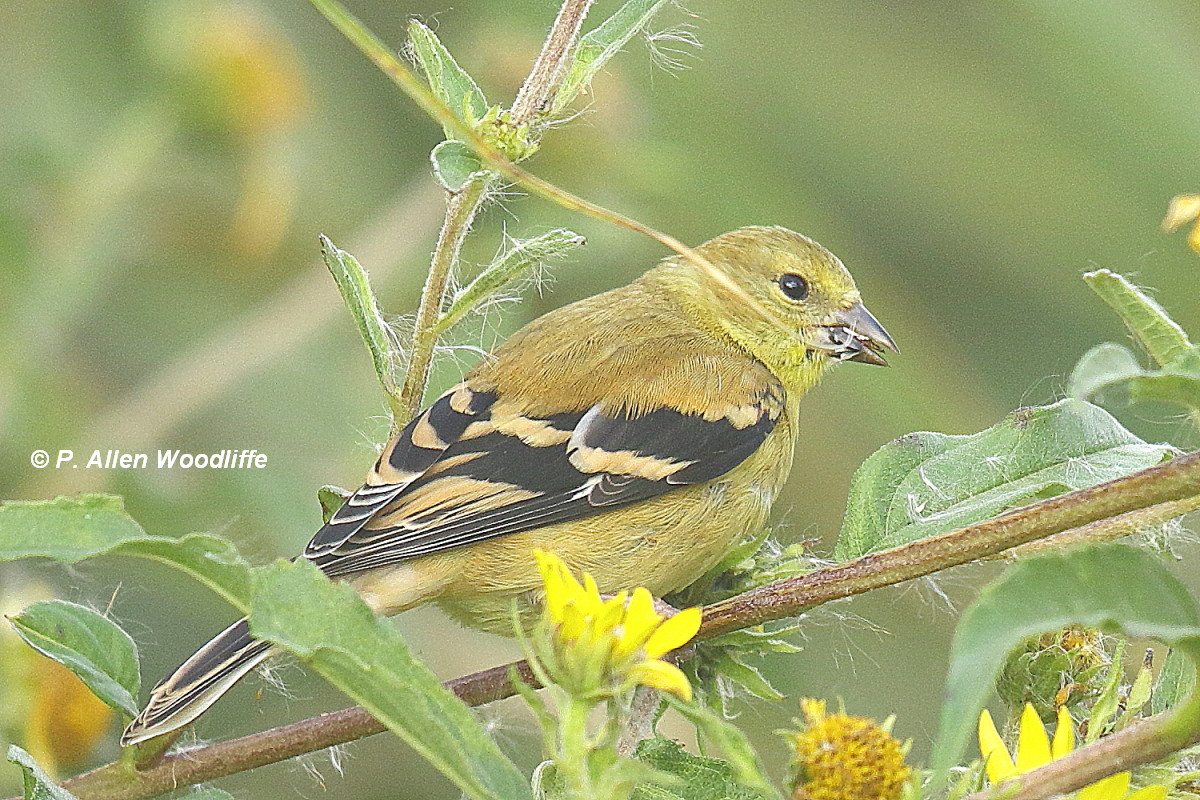
 Lots of American Goldfinches were feeding on the numerous sunflower type plants along the trail.

Wood Ducks are quite common here as well, although at the time these flew by, the bland sky made for extra challenging photography.

At some other wetlands along Lake St. Clair, I had better success at getting more identifiable photos of Wood Ducks.

Not a wetlands species, but along one of the shrubby edges, I encountered this Eastern Phoebe. Again, the bland sky made it a challenge!

In other parts of the wetlands, I came across wading water birds. It was fairly breezy, and these two seemed to be content just to hunker down and face into the wind.


Great Egrets are quite plentiful in the local wetlands, and for good reason. They nest in some of the larger wetlands nearby, and there are lots of things for them to feed on locally. They are especially common in the non-hunted wetlands.
They are regularly seen even in some of the road side ditches.
Will we see them in the numbers and concentration that sometimes have occurred in the past?

If the water levels are low enough, it might happen again, but probably not this year. This setting occurred a few years ago, when the water was drawn down at SCNWA and this photo was taken from the access road at daybreak. There were over 100 birds in the overnight roost.

One morning while I was having my second cup of coffee, this Cooper's Hawk landed in the tree outside the window, with its breakfast (or lunch?) in its talons.

There had been some interesting waterfowl seen from the Erieau Marsh Trail on a couple of occasions: Brant and Greater White-fronted Goose. Neither are common locally, especially the Brant. Unfortunately they did not want to show themselves on a couple of occasions when I was out looking for them. I had to settle for a Trumpeter Swan, not a common species in this area.

I must admit that when I first saw it, I noted the yellow on the black patch of the bill. Many field guides would point out that Trumpeters do not have yellow on those lore areas, only Tundra Swans.

However the size of the swan, more or less the size of the nearby Mute Swan and much bigger than a Tundra Swan, gave reason for a more careful look.


In fact on occasion Trumpeters can have a bit of yellow on the lores, and the size of the bird, in addition to the somewhat pointed white feathering at the top of the bill, and the large and long bill, definitely made it a Trumpeter.
A Great Blue Heron was close by, and usually they are nervous and are quick to get out of camera range. This one must have been quite acclimatized to people on the trail. At any rate, it hardly paid any attention to me, so naturally I had to oblige and take a photo or two (actually, more than two :-)


 I also stopped by the Keith McLean Conservation Lands to see if I could catch up to, and even photograph, one of the Nelson's Sparrows that have appeared there in the last week or so. This site is becoming increasingly popular for this sparrow at least on its autumn migration, and if the food supply and weather conditions work out, one or more may stick around until the Christmas Bird Count in mid-December. 

The amount of weedy vegetation between the agricultural fields and the wetlands is increasing, much to the delight I am sure, to these uncommon sparrows. And with all of the construction going on to create habitat for fish species, etc., there is even more weedy vegetation. I thought it might make finding the Nelson's more challenging to find, if there was only a very small number present. So I was pleased to find at least two in fairly short order and, with a bit of patience, getting some photos.


Savannah Sparrows were more numerous.....
...and even an occasional Marsh Wren popped into view long enough for a photo.

I have been into Rondeau on occasion, partly to look for plants. There are lots of asters around. I was looking specifically for a species that had been recorded for the park many years ago, but not seen in more than half a century. I did not find any sign of it...yet. 

Here are a couple that I captured. Neither are particularly rare, but asters in general can be challenging. In fact Asa Gray, one of the main authoritative plant specialists of early last century, who wrote one of the standard botanical reference manuals of the day, Gray's Manual of Botany, wrote that if he ended up in an insane asylum, to blame it on Asters, as it would be because he had gone half mad trying to sort them out! (My paraphrase) With my limited capacity for sorting out this group, I don't spend a lot of time with them.

This first one is known as Arrow-leaved Aster, and the base of the leaf shown in the second photo shows that characteristic.


A quite common aster is Sky-blue Aster, especially abundant in dry grassy areas such as the Black Oak Savanna.
I've also been out black lighting when the weather seems appropriate, with some success, and sometimes in spite of the weather. The moon can vary, sometimes being almost full....
...and other times just showing a sliver of itself.

A future post will deal with some of the highlights of those night-time adventures.


If you would like to subscribe, or unsubscribe, to Nature Nuggets, send an email to: prairietramper@gmail.com